LED vs Incandescent Cost Savings 2026: Complete Comparison Guide
Switching from incandescent to LED bulbs is the simplest and highest-ROI energy upgrade you can make. A single LED bulb replacing a 60-watt incandescent saves $7-$10 per year in electricity while lasting 15-25 times longer. For a home with 30 light fixtures, the switch saves $225-$300 annually and eliminates the hassle and cost of replacing burned-out bulbs every year. In 2026, LED technology has matured to the point where there is no practical reason to use incandescent bulbs for any application.
The Basic Math: Wattage, Lumens, and Cost Per Hour
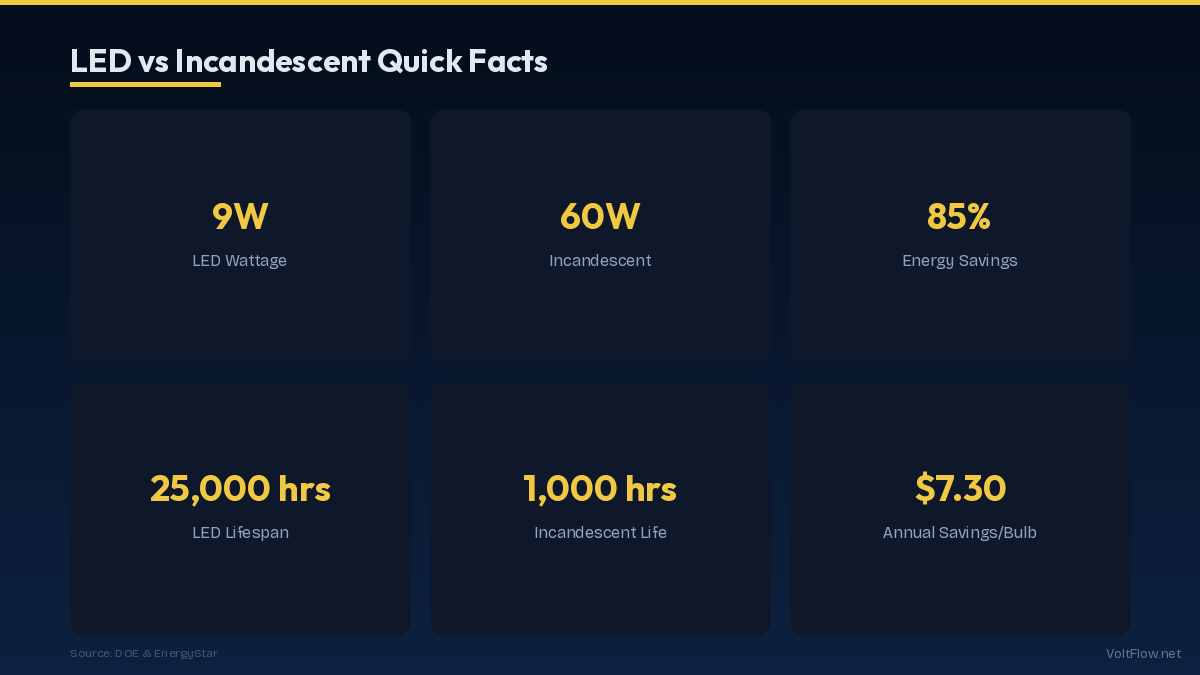
The fundamental advantage of LEDs is simple: they produce the same amount of light using 75-85 percent less electricity than incandescent bulbs. The unit of light output is the lumen, and comparing bulbs by lumens rather than watts reveals the efficiency gap. An old 60-watt incandescent bulb produces approximately 800 lumens. An LED replacement producing the same 800 lumens uses only 8-10 watts. That is an 85 percent reduction in energy consumption for identical light output. Scaling up, a 100-watt incandescent producing 1,600 lumens is replaced by a 15-17 watt LED. A 150-watt incandescent at 2,600 lumens is replaced by a 25-30 watt LED. The cost difference per hour of operation adds up quickly. At the national average electricity rate of $0.16 per kWh, a 60-watt incandescent costs $0.0096 per hour to operate. A 9-watt LED equivalent costs $0.00144 per hour. The difference of $0.0082 per hour seems trivial until you multiply it across multiple bulbs and thousands of hours per year. A single bulb used 5 hours per day saves $14.97 per year ($0.0082 times 5 hours times 365 days). An average home has 30 light sockets. If all 30 used incandescent bulbs averaging 5 hours of daily use, the annual lighting cost would be $526. Replacing all 30 with LEDs drops the annual cost to $79, saving $447 per year. Even at lower daily usage of 3 hours, the savings reach $268 per year. The LED bulbs themselves cost more upfront but have dropped dramatically in price. In 2026, a standard A19 LED bulb producing 800 lumens costs $1.50-$3 each in multi-packs. The equivalent incandescent costs $0.75-$1.50. The LED premium of $1-$2 per bulb is recovered in electricity savings within 2-3 months of average use. For a whole-home upgrade of 30 bulbs, the LED investment of $45-$90 produces $268-$447 in annual savings, a payback period of 2-4 months and an annualized return exceeding 300 percent. No other home energy investment comes close to this ROI.
Lifespan Comparison: 1,000 Hours vs 25,000 Hours
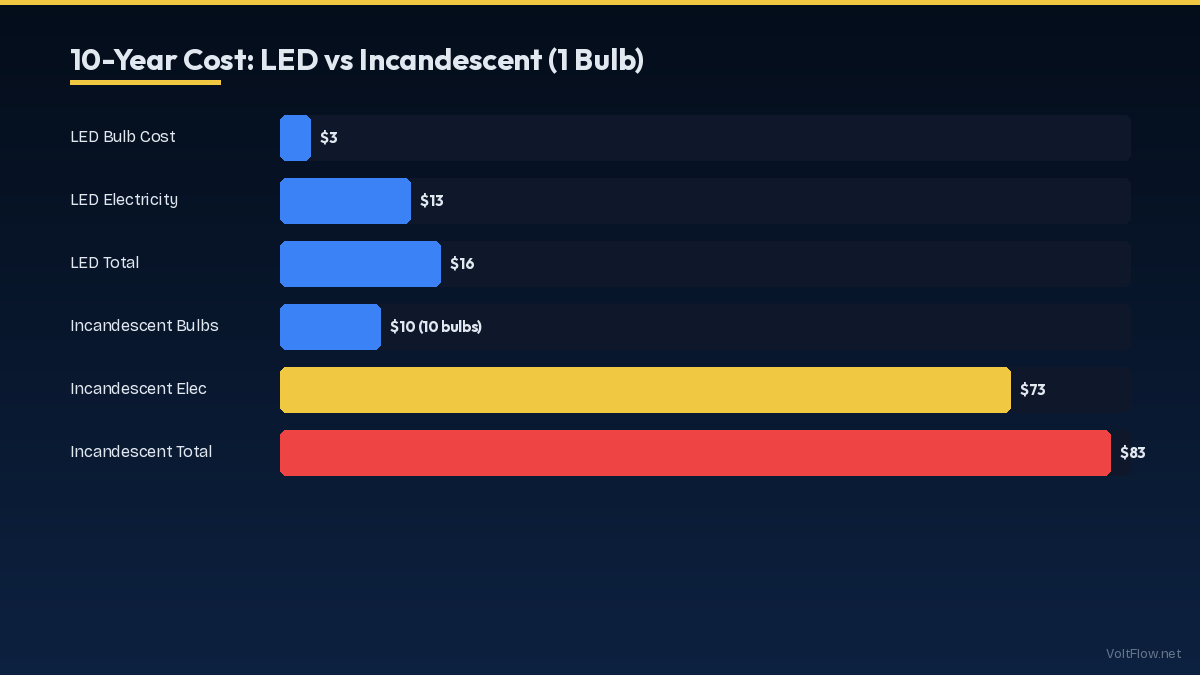
The lifespan advantage of LEDs is even more dramatic than the energy savings. A standard incandescent bulb lasts approximately 1,000-1,200 hours. At 5 hours of daily use, that is just 200-240 days, meaning you replace every incandescent bulb roughly twice per year. Over 10 years, a single socket goes through approximately 18-20 incandescent bulbs at a total bulb cost of $13.50-$30. A standard LED bulb is rated for 15,000-25,000 hours, with premium models reaching 50,000 hours. At 5 hours daily use, a 25,000-hour LED lasts approximately 13.7 years. One $2 LED bulb outlasts 20 or more incandescent bulbs and requires zero maintenance for over a decade. The cost comparison over 25,000 hours of operation tells the complete story. An incandescent bulb costs $0.75 and lasts 1,000 hours, so you need 25 bulbs at a cost of $18.75 in bulbs plus $240 in electricity ($0.0096 per hour times 25,000 hours). Total cost: $258.75 for 25,000 hours of light from one socket. An LED bulb costs $2.50 and lasts 25,000 hours, so you need one bulb plus $36 in electricity ($0.00144 per hour times 25,000 hours). Total cost: $38.50 for the same 25,000 hours of light. The LED saves $220.25 per socket over its lifetime. Multiply by 30 sockets and the lifetime savings exceed $6,600. The maintenance value of long-lasting LEDs is often overlooked. Replacing burned-out incandescent bulbs in hard-to-reach locations like vaulted ceilings, stairwells, and exterior fixtures requires ladders, time, and sometimes professional help. A single recessed light replacement in a 20-foot cathedral ceiling might cost $50-$100 if you hire someone. LED bulbs in these locations last a decade or more, effectively eliminating this recurring maintenance cost and hassle. CFL bulbs, which were the intermediate technology between incandescent and LED, last 8,000-10,000 hours, better than incandescent but far short of LED. CFLs also contain small amounts of mercury requiring special disposal, take time to reach full brightness, perform poorly in cold temperatures, and cannot be dimmed without special compatible dimmers. LEDs have none of these drawbacks, which is why CFLs have largely disappeared from store shelves in 2026.
Light Quality: Color Temperature and CRI
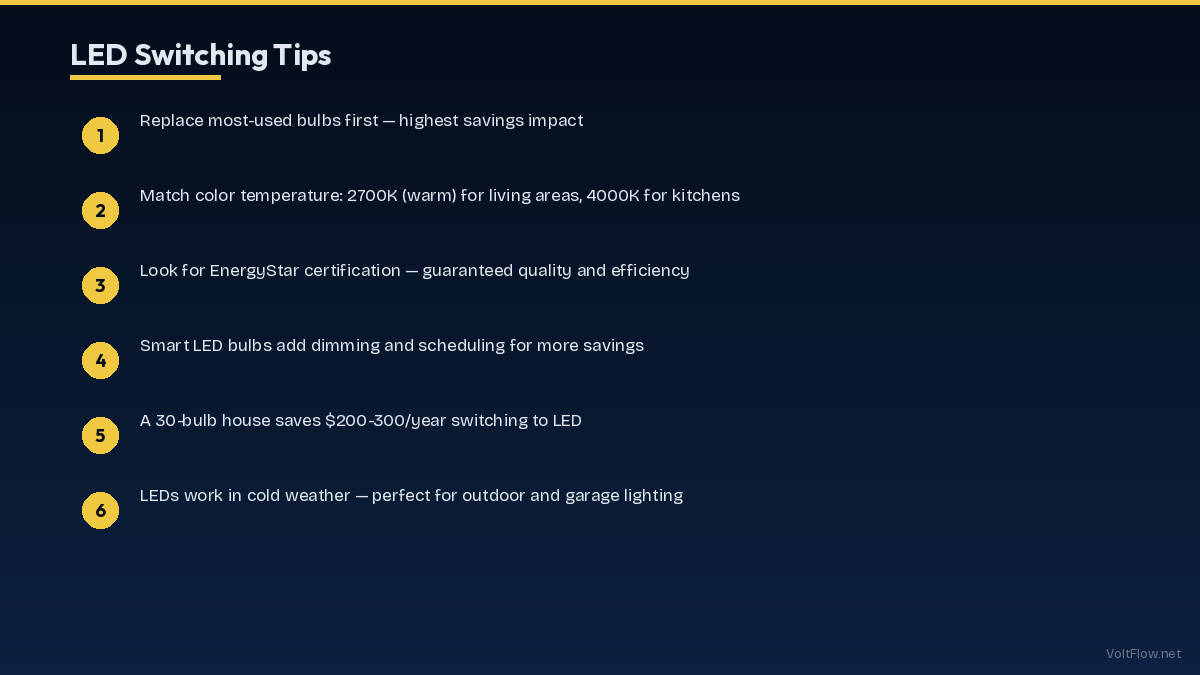
Early LED bulbs earned a reputation for harsh, bluish light that felt cold and unflattering compared to the warm glow of incandescent bulbs. That reputation is thoroughly outdated in 2026. Modern LED bulbs are available in every color temperature from warm candlelight to cool daylight, and premium models match or exceed incandescent light quality. Color temperature is measured in Kelvin and describes the warmth or coolness of the light. Incandescent bulbs produce light at approximately 2,700K, which appears as a warm yellowish glow. LED bulbs labeled as Soft White or Warm White match this at 2,700K. Bright White LEDs at 3,000-3,500K produce a neutral white light suitable for kitchens and bathrooms. Daylight LEDs at 5,000-6,500K produce a cool, energizing light that mimics natural daylight and is preferred for offices, workshops, and task lighting. Tunable white LED bulbs and smart bulbs can adjust their color temperature throughout the day, providing warm light for relaxing in the evening and cool light for productive work during the day. Products like the Philips Hue, Wyze Bulb, and LIFX offer this tunability through smartphone apps and voice assistants. Color Rendering Index or CRI measures how accurately a light source reveals the true colors of objects compared to natural sunlight which has a perfect CRI of 100. Standard LED bulbs have a CRI of 80-85, which is adequate for general use but can make skin tones and food look slightly off. Premium LEDs with CRI of 90 or above render colors beautifully and are recommended for kitchens, bathrooms, closets, and any space where color accuracy matters. Cree, Philips, and GE all offer 90-plus CRI LED bulbs at modest premiums of $1-$3 over standard CRI models. Dimming compatibility has improved enormously. Early LEDs flickered, buzzed, or refused to dim properly with standard dimmers designed for incandescent bulbs. Modern dimmable LED bulbs work with most existing dimmer switches, though performance is best with LED-compatible dimmers from Lutron, Leviton, or Legrand. If you experience flickering when dimming LED bulbs, replacing the dimmer switch with an LED-compatible model ($15-$25) almost always solves the problem. Smart dimmers provide even smoother dimming with fade effects and can be controlled by voice or app.
Room-by-Room LED Upgrade Guide
Different rooms have different lighting needs, and choosing the right LED type for each space maximizes both energy savings and visual comfort. The kitchen benefits most from high-CRI LED bulbs at 3,000-4,000K. Under-cabinet LED strips at 3,000K provide excellent task lighting for food preparation. Recessed ceiling LEDs at 3,500-4,000K deliver bright, even illumination for the entire space. Choose dimmable fixtures so you can lower the light for dining and entertaining. LED under-cabinet lighting uses only 10-15 watts for a full kitchen run, replacing the 60-100 watts that fluorescent or halogen under-cabinet fixtures consumed. Annual savings for kitchen lighting conversion typically run $30-$50. The living room calls for warm, dimmable LED bulbs at 2,700K for lamps and overhead fixtures. LED bulbs in standard A19 shape fit existing table lamps and floor lamps. For recessed lighting, choose LED retrofits that install directly into existing recessed cans, converting outdated R30 or PAR30 incandescent flood lights to efficient LED in minutes. Each recessed light conversion saves $15-$20 annually. A living room with six recessed lights and two table lamps saves $100-$140 per year. Bedrooms prefer warm light at 2,700K or even warmer at 2,200K for bedside reading lamps. Smart LED bulbs that warm to 2,000K at low dimming levels mimic the natural warmth of incandescent bulbs as they dim, creating a cozy ambiance that standard LEDs cannot match. Bathrooms need bright, high-CRI light at 3,000-3,500K for grooming and makeup application. Vanity light strips with 90-plus CRI ensure accurate color rendering. Choose enclosed-rated LED bulbs for fixtures with glass covers, as standard LEDs may overheat in enclosed fixtures and fail prematurely. Garages, workshops, and utility spaces are prime candidates for high-output LED shop lights. A 4-foot LED shop light producing 4,000-5,000 lumens draws only 40 watts compared to 64 watts for a dual-tube fluorescent fixture producing similar output. LED shop lights cost $15-$30 each and last 50,000 hours with instant-on performance in cold temperatures, unlike fluorescent tubes that flicker and dim in cold garages. Outdoor lighting benefits enormously from LED conversion. A traditional 150-watt PAR38 outdoor flood light replaced by a 15-watt LED flood saves $20 per year per fixture. LED flood lights reach full brightness instantly in any temperature, unlike CFL alternatives that struggle in cold weather. Many LED outdoor fixtures include built-in dusk-to-dawn sensors or motion sensors, adding convenience while ensuring the light runs only when needed.
Special LED Applications and Advanced Options
Beyond standard bulb replacements, LED technology enables lighting applications that were impractical or too expensive with incandescent bulbs. LED strip lighting has revolutionized accent and decorative lighting. Flexible LED strips cost $10-$30 for a 16-foot roll and use 1-3 watts per foot. They install under cabinets, behind TVs, inside closets, along stairways, and under vanities with peel-and-stick adhesive backing. A 10-foot strip at 2 watts per foot running 8 hours daily costs approximately $1 per year in electricity. The equivalent effect using small incandescent bulbs would cost $10-$15 per year and generate noticeable heat. Smart LED bulbs add connectivity and automation capabilities for modest additional cost. A standard smart LED bulb costs $8-$15 and connects to your Wi-Fi network for control through smartphone apps and voice assistants like Alexa and Google Home. Smart bulbs can be scheduled to turn on and off automatically, grouped into rooms and scenes, dimmed remotely, and in color-changing models, set to any of 16 million colors. The energy savings compound when smart bulbs automatically turn off in unoccupied rooms. LED Edison-style bulbs replicate the vintage look of exposed-filament decorative bulbs while using 80 percent less energy. These bulbs cost $5-$12 each and are popular in pendant lights, chandeliers, and restaurant-style fixtures. A vintage Edison incandescent at 60 watts replaced by a 7-watt LED Edison saves $8 per year while maintaining the identical aesthetic. LED grow lights have transformed indoor gardening and plant care. A small LED grow light panel using 20-30 watts provides the equivalent photosynthetic radiation of a 100-150 watt metal halide or high-pressure sodium grow light. For hobby gardeners starting seedlings or growing herbs indoors, the energy savings and heat reduction make LED grow lights far more practical than traditional alternatives. Emergency and battery backup LED applications benefit from the low power draw. An LED flashlight or lantern running on batteries lasts 5-10 times longer than an incandescent equivalent because it draws a fraction of the current for the same light output. LED backup lights connected to a small battery provide hours of illumination during power outages compared to minutes from incandescent battery lights.
Common LED Myths and Buying Tips
Despite LED maturity in 2026, several persistent myths cause some consumers to hesitate. Here are the facts. The myth that LEDs produce harsh light is based on early products from 2010-2015 that were indeed too blue and too directional. Modern LEDs at 2,700K are visually indistinguishable from incandescent bulbs in blind comparison tests. If you buy a bulb labeled Soft White or Warm White at 2,700K from any major brand, the light quality matches incandescent. The myth that LEDs do not work with dimmers is partially rooted in truth from early products but is outdated. Most LED bulbs sold in 2026 are labeled as dimmable and work with standard dimmers. For best performance, use a dimmer switch labeled as LED-compatible. Lutron Caseta and Leviton Decora dimmers are specifically designed and tested for LED dimming and cost $15-$25. The myth that LEDs are too expensive ignores the dramatic price drops of the past decade. Standard A19 LED bulbs cost $1.50-$2 each in multi-packs, barely more than incandescent. The first LED bulbs in 2010 cost $20-$40 each. At current prices, the payback period on an LED bulb is measured in weeks, not years. The myth that LEDs contain hazardous materials confuses them with CFL bulbs, which do contain mercury. LED bulbs contain no mercury and are safe for regular trash disposal, though recycling is preferred for the electronic components and rare earth materials they contain. When buying LED bulbs, look for these specifications: lumens (not watts) to compare brightness, color temperature in Kelvin to match your preference, CRI of 90 or above for kitchens and bathrooms, dimmable label if you plan to use a dimmer, enclosed fixture rated label if the bulb goes inside a glass cover, and Energy Star certification which ensures minimum performance standards and qualifies for utility rebates in some areas. Buy in multi-packs for the best per-bulb price. A 12-pack of standard LED bulbs costs $15-$24, bringing per-bulb cost to $1.25-$2. Store brands from Costco (Feit Electric), Home Depot (EcoSmart), and Lowes (Utilitech) offer excellent quality at lower prices than name brands, often using the same LED chips from the same factories. Check your utility company website for LED rebates before purchasing. Many utilities offer instant rebates at participating retailers, reducing the price of LED bulbs by $1-$3 each. These rebates can make LED bulbs cheaper than incandescent bulbs at the point of purchase, eliminating even the modest upfront cost barrier.