Electricity Rates Canada by Province 2026: Complete Price Guide
Canadian electricity rates vary dramatically by province, from 7.3¢/kWh in Quebec to 17-22¢/kWh in Ontario and the Maritimes. The national average sits at approximately 14¢/kWh, though time-of-use pricing, tiered rates, and seasonal adjustments mean your actual cost depends heavily on when and how much you use. This guide covers rates in every province and territory with strategies to reduce your electricity bill.
Provincial Electricity Rates: 2026 Comparison
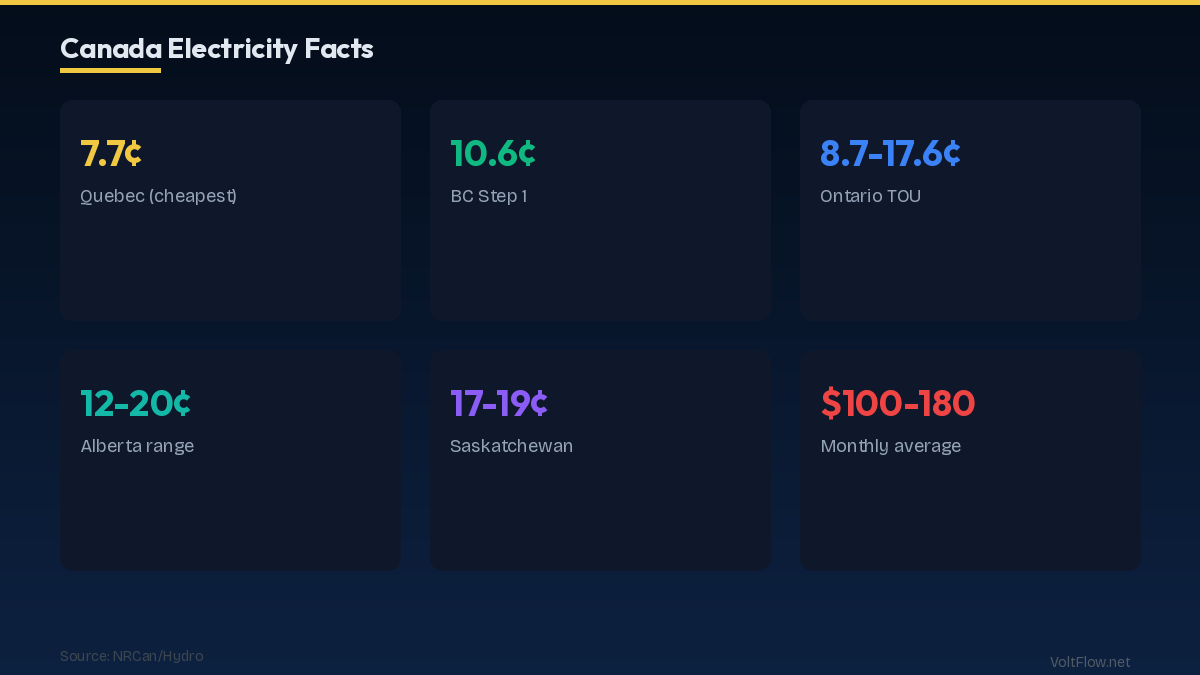
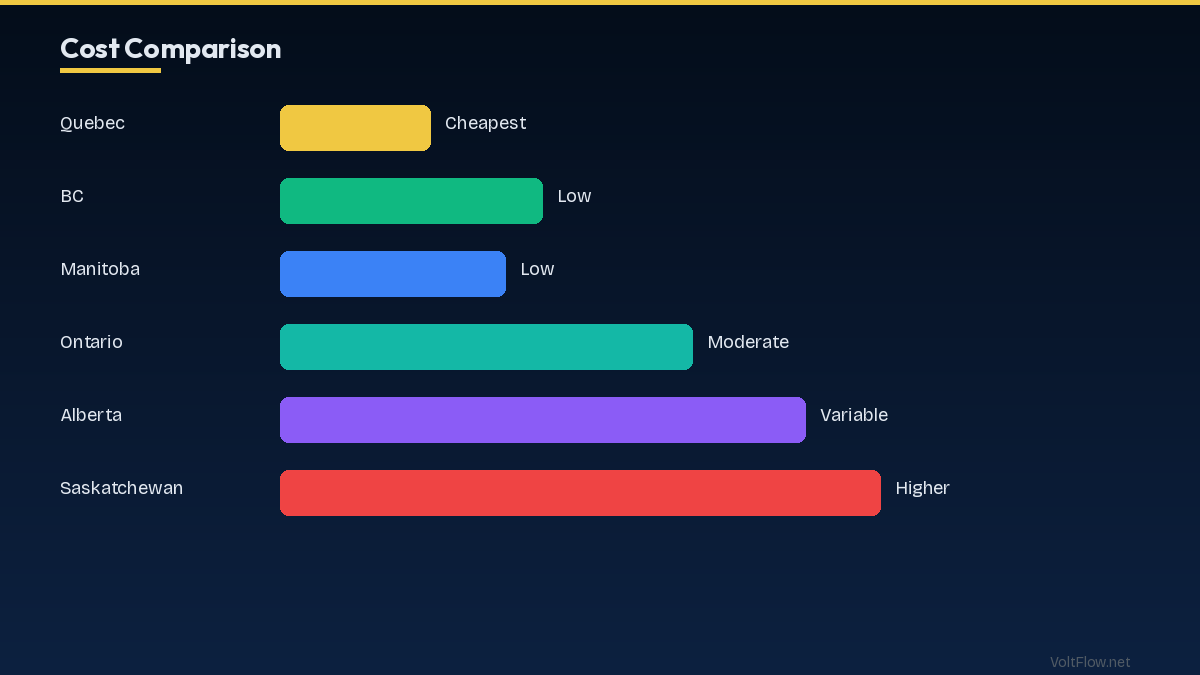
Quebec has the lowest electricity rates in Canada at approximately 7.3¢/kWh for the first 40 kWh per day and 10.3¢/kWh above that threshold under the Hydro-Québec residential tariff D. The province abundant hydroelectric generation from the James Bay and Manicouagan complexes provides some of the cheapest clean electricity in the world. A typical Quebec household using 1,500 kWh per month pays approximately $110-$130 per month. British Columbia offers the second-lowest rates at approximately 10.2¢/kWh for the first 1,350 kWh per two-month billing period (Step 1) and 15.3¢/kWh above that (Step 2) through BC Hydro. The two-step pricing structure encourages conservation by charging more for higher consumption. Average monthly bill for a typical home is $120-$170 depending on heating method. Manitoba through Manitoba Hydro charges approximately 9.9¢/kWh, among the lowest in Canada. Hydroelectric generation provides 97% of Manitoba electricity, keeping costs stable and low. Monthly bills average $100-$140 for typical homes without electric heating. Alberta operates a deregulated market where consumers choose their electricity retailer. Regulated Rate Option prices fluctuate monthly based on wholesale market conditions, averaging 12-18¢/kWh in 2026. Fixed-rate contracts from retailers lock in rates of 10-16¢/kWh for 1-5 year terms. The deregulated market creates price volatility that rewards active shoppers but penalises passive consumers on floating rates. Saskatchewan through SaskPower charges approximately 16.5¢/kWh with a basic monthly charge of $24.05. The relatively high rate reflects the province reliance on natural gas and coal generation with growing wind capacity. Ontario has the most complex pricing structure with Time-of-Use rates of 8.7¢ off-peak, 13.2¢ mid-peak, and 18.0¢ on-peak in winter and adjusted rates in summer, plus a tiered pricing option of 8.7¢ for the first 1,000 kWh and 10.3¢ above. The Ontario Electricity Support Programme provides credits for low-income households. The Maritimes including New Brunswick, Nova Scotia, and PEI have rates of 14-22¢/kWh depending on the province and utility. Nova Scotia Power charges approximately 17-19¢/kWh, among the highest in Canada, driven by reliance on imported coal and natural gas for generation. Newfoundland and Labrador charges approximately 13-15¢/kWh with the Churchill Falls and Muskrat Falls hydro projects providing baseload generation.
Time-of-Use vs Tiered Pricing: Ontario Deep Dive
Ontario unique dual pricing structure gives consumers the choice between Time-of-Use and Tiered pricing, each suited to different consumption patterns. Understanding both options helps Ontario residents minimize their electricity costs. Time-of-Use pricing charges different rates depending on when you use electricity. Winter TOU rates (November to April) are: off-peak at 8.7¢/kWh from 7 PM to 7 AM weekdays and all day weekends and holidays, mid-peak at 13.2¢/kWh from 11 AM to 5 PM weekdays, and on-peak at 18.0¢/kWh from 7-11 AM and 5-7 PM weekdays. Summer TOU rates (May to October) shift the on-peak to 11 AM-5 PM when air conditioning drives demand. TOU pricing rewards households that can shift significant consumption to off-peak hours. Running the dishwasher, laundry, and EV charger after 7 PM or on weekends saves 9.3¢/kWh compared to on-peak rates, a 52% reduction. For a household shifting 500 kWh per month from on-peak to off-peak, annual savings reach $558. EV owners benefit enormously from TOU pricing since overnight charging at 8.7¢ costs roughly one-third of peak-rate charging. Tiered pricing charges a flat rate regardless of time of day: 8.7¢/kWh for the first 1,000 kWh per month (threshold varies by season) and 10.3¢/kWh above that. Tiered pricing suits households with steady consumption throughout the day who cannot easily shift usage to off-peak hours. Working-from-home households, families with children at home during the day, and homes without EV or other shiftable loads often pay less on tiered pricing. Ontario consumers can switch between TOU and Tiered pricing at any time by contacting their Local Distribution Company. The switch takes effect on your next billing cycle with no fees or penalties. The Ontario Energy Board publishes rate schedules and comparison tools at oeb.ca to help consumers choose the optimal pricing structure. Review your choice annually as your consumption patterns change, particularly if you add an EV, heat pump, or solar panels that alter when and how much electricity you use.
Cheapest and Most Expensive Provinces Explained
The enormous rate variation across Canada stems from fundamental differences in electricity generation sources, transmission infrastructure, and provincial energy policy. Understanding why your province charges what it does helps contextualize your bill and identify realistic saving opportunities. Hydroelectric provinces Quebec, BC, Manitoba, and to a lesser extent Newfoundland enjoy the lowest rates because hydro generation has near-zero fuel costs once the dams are built. The capital cost of hydro infrastructure was largely paid off decades ago, and operating costs are minimal. These provinces also export surplus hydro to neighbouring provinces and US states, generating revenue that further subsidizes domestic rates. The result is rates of 7-11¢/kWh that are among the lowest in North America. Fossil-fuel-dependent provinces face higher costs because they must purchase coal, natural gas, or oil to generate electricity. Nova Scotia at 17-19¢/kWh relies heavily on imported coal with growing wind capacity. Saskatchewan at 16.5¢/kWh uses natural gas and coal with increasing wind. Alberta at 12-18¢/kWh is natural-gas-dominant in a deregulated market where wholesale price volatility passes through to consumers. Ontario sits in the middle at 10-18¢/kWh depending on the rate structure chosen. The province generation mix includes nuclear at approximately 60%, hydro at 25%, wind and solar at 10%, and gas at 5%. The Global Adjustment charge, which covers the cost of building new generation capacity and conservation programs, adds significantly to the wholesale electricity cost and is the primary reason Ontario rates exceed those of hydro-rich provinces despite having a largely carbon-free generation fleet. Northern territories face the highest energy costs in Canada. Nunavut, Northwest Territories, and Yukon communities not connected to the southern grid rely on diesel generators with electricity costs of 30-60¢/kWh. Territorial government subsidies reduce the consumer-facing rate to 20-35¢/kWh, but costs remain the highest in the country. Solar and wind projects in northern communities are increasingly displacing diesel, but the extreme climate and logistical challenges keep costs elevated.
How to Reduce Your Canadian Electricity Bill
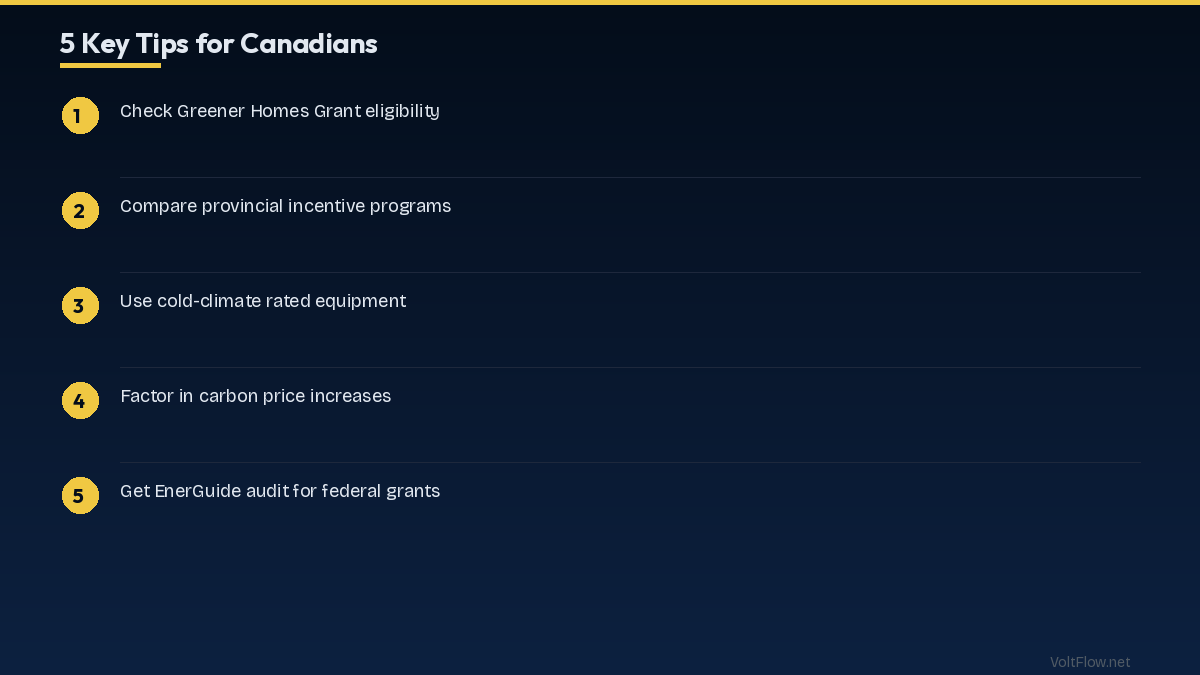
Several strategies can meaningfully reduce your electricity costs regardless of which province you live in. The highest-impact measures combine tariff optimization, efficiency improvements, and generation or storage investments. Switch to the optimal rate structure if your province offers a choice. Ontario residents should compare TOU versus Tiered pricing using their actual consumption data. Alberta residents should compare fixed-rate contracts from multiple retailers against the Regulated Rate Option. BC residents with electric heating should verify they are on the appropriate residential rate that correctly calculates their Step 1 threshold. Time-shift consumption to off-peak in provinces with time-differentiated pricing. Ontario TOU off-peak at 8.7¢ saves 52% compared to on-peak at 18.0¢. BC Step 1 rate at 10.2¢ versus Step 2 at 15.3¢ rewards conservation below the threshold. Even in flat-rate provinces, some utilities offer optional TOU rates for EV charging that provide overnight discounts. LED lighting conversion saves $100-$200 per year for the average Canadian home. Canadian homes use more lighting than warmer-climate homes due to shorter winter days with only 8-9 hours of daylight in December at southern Canadian latitudes and 4-6 hours in northern communities. The electricity saved by switching 30-40 bulbs from incandescent or halogen to LED is proportionally larger than in countries with longer winter days. Smart thermostats save $100-$300 per year on electric heating by reducing temperature during sleeping hours and unoccupied periods. In electrically heated homes common in Quebec and the Maritimes, heating represents 50-70% of the electricity bill. A 2-degree nighttime setback saves approximately 5-10% of heating electricity. Ecobee and Sinope thermostats are popular Canadian-designed options with cold-climate features. Solar panels are increasingly viable in southern Canada. A 6 kW system in Ontario generates approximately 7,000 kWh per year, offsetting $700-$1,200 annually depending on the rate structure. With net metering available in most provinces, surplus generation credits roll forward to offset winter consumption when solar production is lower. System cost of $15,000-$20,000 before incentives produces payback periods of 8-15 years depending on province.
EV Charging Cost by Province
EV charging cost varies significantly across Canadian provinces due to the electricity rate differences, making EV ownership particularly attractive in low-rate provinces. In Quebec at 7.3¢/kWh, charging a Tesla Model 3 consuming 16 kWh per 100 km costs approximately 1.2¢/km. Annual charging cost for 20,000 km is just $234. Compared to a gasoline car at $1.60/litre and 8L/100km costing $2,560 per year, the EV saves $2,326 annually, among the largest EV fuel savings in the world due to Quebec ultra-low electricity rates. In British Columbia at the Step 1 rate of 10.2¢/kWh, charging costs approximately 1.6¢/km or $326 per year for 20,000 km. Gasoline savings of $2,234 per year make BC EVs highly attractive financially, particularly since BC offers additional EV rebates reducing the purchase price premium. In Ontario at the off-peak TOU rate of 8.7¢/kWh available for overnight charging, cost is approximately 1.4¢/km or $278 per year. Even at the blended average rate of 12¢/kWh, annual charging of $384 saves over $2,000 compared to gasoline. Ontario rebate programs for EV charger installation further improve the economics. In Alberta at an average rate of 15¢/kWh, charging costs approximately 2.4¢/km or $480 per year. The higher rate reduces but does not eliminate the fuel cost advantage: gasoline at $2,560 per year still costs over $2,000 more than EV charging annually. In Nova Scotia at 18¢/kWh, the highest significant-population province rate, charging costs approximately 2.9¢/km or $576 per year. The gasoline saving of $1,984 per year remains compelling, though the payback on the EV price premium takes slightly longer than in low-rate provinces. Across all provinces, home EV charging is dramatically cheaper than public DC fast charging at 35-55¢/kWh. The importance of home charging infrastructure for EV economics is magnified in Canada because the home-to-public price ratio is often 4-6x compared to 2-3x in countries with higher base electricity rates.
Future of Canadian Electricity Pricing
Canadian electricity pricing is evolving in response to climate policy, grid modernization, and the electrification of transportation and heating. Understanding these trends helps with long-term planning for solar, EV, and heat pump investments. The Clean Electricity Regulations requiring net-zero electricity grids by 2035 will drive significant investment in renewable generation and grid infrastructure. Provinces that currently rely on fossil fuels for generation including Alberta, Saskatchewan, Nova Scotia, and New Brunswick will need to build or contract substantial new wind, solar, and storage capacity. These investments will flow through to consumer rates, potentially increasing electricity costs by 2-4¢/kWh in affected provinces over the next decade. Hydro-rich provinces Quebec, BC, Manitoba are less affected since their generation is already clean, though grid infrastructure upgrades to support interprovincial clean electricity trade will add modest cost. Electrification of heating in provinces where natural gas and oil heating predominate will increase electricity demand by 20-40% as heat pumps replace fossil fuel furnaces. This demand growth supports grid investment by spreading fixed costs across more kilowatt-hours, potentially moderating per-kWh rate increases. However, the winter peaking characteristics of heating load in Canadian climate create grid capacity challenges that may require peak pricing incentives to manage. EV adoption accelerating toward 30-50% of new car sales by 2030 adds substantial electrical load that must be managed through smart charging and time-of-use pricing. Most provincial utilities are developing EV-specific rate plans with overnight discounts of 30-50% below standard rates to encourage off-peak charging that utilizes overnight generation capacity that would otherwise sit idle. Carbon pricing on fossil fuel generation increases the wholesale cost of electricity from gas and coal plants. At the current federal carbon price trajectory reaching $170/tonne by 2030, the carbon cost adds approximately 3-5¢/kWh to gas-fired generation and 7-10¢/kWh to coal-fired generation. This accelerates the economic case for replacing fossil generation with renewables, which have zero carbon costs. For Canadian homeowners, the long-term trend supports investing in solar panels, heat pumps, and EVs now because electricity rates will likely increase modestly while these investments lock in energy costs at today prices or lower. A solar system installed today generates free electricity regardless of future rate changes, providing an inflation hedge that becomes more valuable as rates rise.