Are Solar Panels Worth It in Canada 2026? ROI by Province
Solar panels are increasingly worth it in Canada, with payback periods of 8-14 years in most southern provinces, well within the 25-year panel warranty. A typical 6-10 kW system costs $15,000-$25,000 and generates 6,000-10,000 kWh per year depending on location. Net metering in most provinces credits surplus solar at retail rates, making your system a virtual battery that offsets winter consumption. Federal and provincial incentives can reduce costs by $5,000-$10,000.
Solar Generation Potential Across Canada
Canada receives more sunshine than many Canadians realize, and solar generation potential varies significantly from coast to coast. The southern prairies receive solar irradiance comparable to parts of Germany, which leads the world in per-capita solar capacity. Calgary and southern Alberta receive approximately 1,300-1,400 kWh/kWp per year, the highest in Canada. The combination of high altitude, low humidity, dry winters with clear skies, and cool temperatures that improve panel efficiency makes Alberta one of Canada best solar locations. A 10 kW system generates approximately 13,000-14,000 kWh per year. Southern Ontario including Toronto, Ottawa, and the Niagara region receives 1,100-1,250 kWh/kWp per year. A 10 kW system generates 11,000-12,500 kWh. Ontario strong net metering policy and relatively high electricity rates make solar financially attractive despite moderate generation. Southern Quebec including Montreal and Quebec City receives 1,050-1,200 kWh/kWp per year. While Quebec has excellent solar resource, the ultra-low electricity rate of 7.3¢/kWh means each kWh generated saves less money than in higher-rate provinces, extending the payback period. Southern BC including the Okanagan Valley receives 1,200-1,400 kWh/kWp, among the best in Canada. The Lower Mainland and Vancouver Island receive less at 1,000-1,150 kWh/kWp due to coastal cloud cover. BC two-step pricing means solar kWh offset the more expensive Step 2 rate first, improving the financial return. The Prairies including Saskatchewan and Manitoba receive 1,200-1,350 kWh/kWp, with excellent solar resource but varying provincial support for net metering. Saskatchewan SaskPower net metering program pays retail rate credits. Manitoba Hydro offers a similar program. The Maritimes receive 1,000-1,150 kWh/kWp, comparable to Northern Europe where solar is widely deployed. Nova Scotia high electricity rates of 17-19¢/kWh make solar financially compelling despite lower generation than western provinces. The seasonal variation in Canadian solar is significant. December and January produce only 15-25% of the peak summer months of June and July. Net metering addresses this by allowing summer surplus credits to offset winter consumption when your panels produce less than you use. Without net metering, Canadian solar economics would be substantially weaker because you would need expensive battery storage to capture summer surplus for winter use.
Solar System Costs and Incentives in Canada
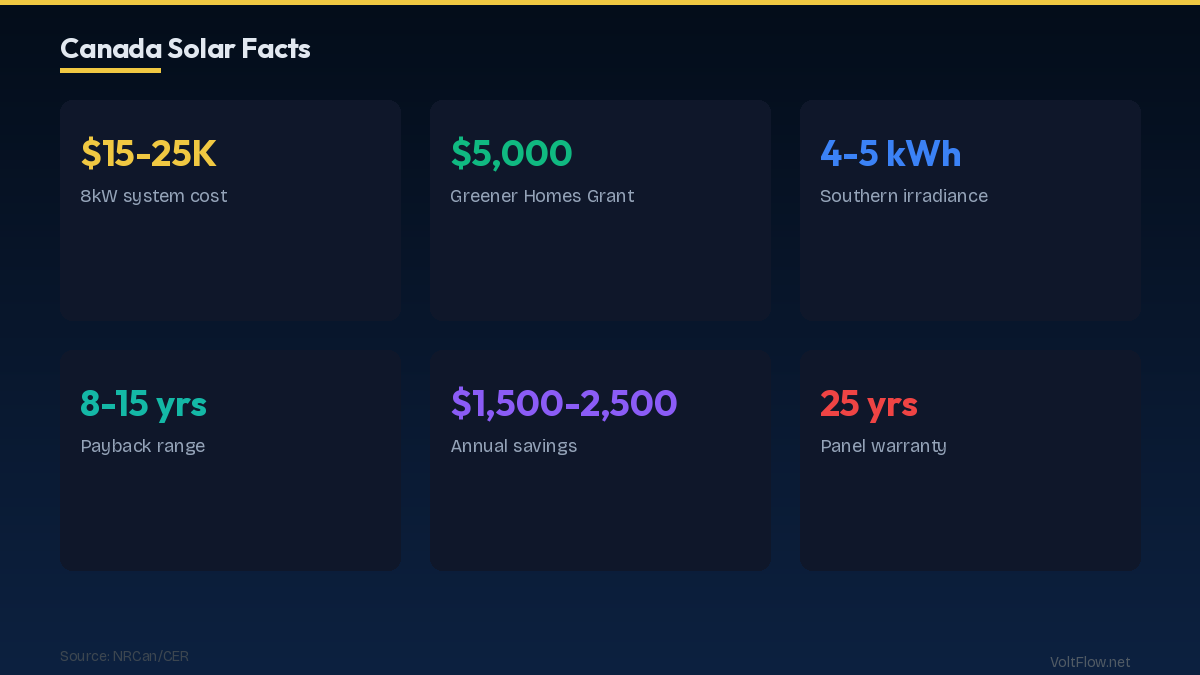
Canadian residential solar costs have decreased significantly but remain higher than in Australia and parts of the US due to smaller market scale, higher labour costs, and fewer installers. In 2026, a standard grid-tied residential system costs $2.50-$3.50 per watt installed before incentives. A 6 kW system costs $15,000-$21,000. An 8 kW system costs $20,000-$28,000. A 10 kW system costs $25,000-$35,000. These prices include panels, inverter, mounting hardware, electrical connections, permitting, and installation labour. The Canada Greener Homes Grant provides up to $5,000 for solar panel installations as part of the broader home energy efficiency incentive program. The grant requires a pre-retrofit EnerGuide evaluation, installation by a certified contractor, and a post-retrofit evaluation confirming the improvement. The evaluation costs $300-$600 which is partially reimbursed. Processing times have improved but budget for 2-4 months from application to grant payment. Provincial incentives supplement the federal program. Ontario does not have a specific solar rebate but the net metering policy provides strong ongoing value. Alberta offers the Residential and Commercial Solar Program with rebates of $0.40-$0.75 per watt reducing system cost by $2,400-$7,500 for a 10 kW system. Nova Scotia Solar Homes program provides rebates reducing costs by $3,000-$6,000 depending on system size. Some municipal programs offer additional incentives. Toronto Green Standard and FCM Green Municipal Fund provide targeted support in participating communities. Saskatchewan SaskPower net metering program requires pre-approval before installation and limits system size to 100 kW. Stacking federal and provincial incentives can reduce the out-of-pocket cost of a 10 kW system from $25,000 to $15,000-$20,000. At annual savings of $1,200-$2,500 depending on province, the incentive-adjusted payback period ranges from 6-14 years. The best returns are in Alberta (high generation plus provincial rebate), Ontario (moderate generation plus high rates), and Nova Scotia (moderate generation plus high rates plus provincial rebate). The weakest returns are in Quebec where the ultra-low electricity rate limits annual savings to $500-$800 despite good solar resource, extending payback to 15-25 years without provincial incentives.
Net Metering: How It Works Across Provinces
Net metering is the policy that makes Canadian solar financially viable by allowing you to use the grid as a virtual battery. When your panels produce more than you consume during sunny daytime hours, the surplus exports to the grid and you receive a credit. When you consume more than you generate during evening hours and winter months, you draw from the grid and use up your credits. Most provinces credit exports at the full retail rate, meaning every kWh exported has the same value as every kWh imported. Ontario net metering under the Ontario Energy Board rules provides retail-rate credits that roll forward month to month. Annual true-up occurs once per year, typically in the anniversary month of your net metering agreement. Any remaining credits at true-up are forfeited, not paid out. This means you should size your system to produce no more than your annual consumption to avoid losing excess credits. Ontario net metering is available to all residential customers through their Local Distribution Company. BC Hydro net metering provides retail-rate credits that carry forward indefinitely. Annual surplus above your consumption is paid out at a rate of approximately 10¢/kWh. BC net metering effectively provides a floor price for surplus generation while crediting self-consumed generation at full retail. Alberta net metering under the Micro-generation Regulation provides retail-rate credits for systems up to 5 MW. Monthly surplus credits carry forward and annual surplus is paid out at the wholesale rate. Alberta deregulated market means the retail rate varies by retailer and contract type, so the credit value depends on your specific plan. Saskatchewan net metering through SaskPower credits at the retail rate of 16.5¢/kWh with monthly carryover and annual payout at a lower rate. Quebec Hydro net metering credits at the applicable rate tier, but the low rates of 7.3-10.3¢/kWh limit the financial value of each credited kWh. Nova Scotia net metering provides retail-rate credits at 17-19¢/kWh, the highest value net metering in Canada, making Nova Scotia solar particularly attractive despite moderate solar resource. Manitoba Hydro and New Brunswick Power offer similar retail-rate net metering programs. The key insight for Canadian solar owners is that net metering eliminates the need for battery storage in most cases. Your summer surplus credits offset your winter deficit, effectively making the grid your seasonal storage. This avoids the $10,000-$15,000 cost of a battery system that would otherwise be needed to store summer electricity for winter use. Battery storage in Canada is primarily justified for backup power during outages rather than for economic optimization.
Payback Period by Province: Real Numbers
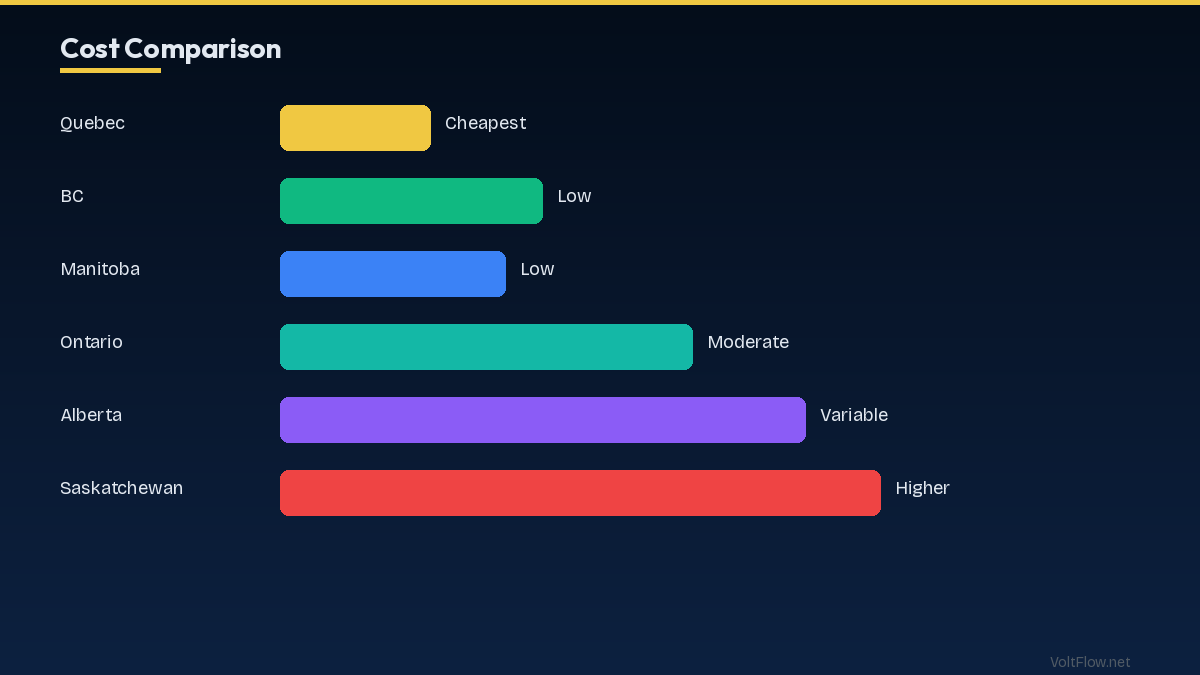
Solar payback period depends on your provincial electricity rate, local solar resource, system cost after incentives, and net metering policy. Here are calculated payback periods for a 10 kW system in each major province using 2026 rates and incentives. Alberta: 10 kW system generating 13,500 kWh/year at blended rate of 14¢/kWh. Annual savings: $1,890. System cost after Alberta rebate and federal grant: $17,000. Payback: 9.0 years. Alberta offers the best combination of high generation and provincial incentives. Ontario: 10 kW generating 12,000 kWh at blended TOU rate of 12¢/kWh. Annual savings: $1,440. System cost after federal grant: $20,000. Payback: 13.9 years. TOU optimization with consumption shifting to off-peak improves effective savings. Nova Scotia: 10 kW generating 11,000 kWh at 18¢/kWh. Annual savings: $1,980. System cost after Nova Scotia rebate and federal grant: $16,000. Payback: 8.1 years. The highest rate province delivers the fastest payback in eastern Canada. British Columbia: 10 kW generating 11,500 kWh at blended rate of 12¢/kWh (mostly offsetting Step 2 at 15.3¢). Annual savings: $1,380. System cost after federal grant: $20,000. Payback: 14.5 years. BC lower rates and modest incentives create longer payback but the system still produces strong lifetime returns. Saskatchewan: 10 kW generating 13,000 kWh at 16.5¢/kWh. Annual savings: $2,145. System cost after federal grant: $20,000. Payback: 9.3 years. Saskatchewan high rates and excellent solar resource produce among the best returns in Canada. Quebec: 10 kW generating 11,500 kWh at blended rate of 8¢/kWh. Annual savings: $920. System cost after federal grant: $20,000. Payback: 21.7 years. Quebec ultra-low rates make solar a poor financial investment without additional provincial incentives, despite excellent solar resource. Manitoba: 10 kW generating 12,500 kWh at 9.9¢/kWh. Annual savings: $1,238. System cost after federal grant: $20,000. Payback: 16.2 years. Low rates limit financial return similar to Quebec. These payback periods improve over time as electricity rates increase. At 2-3% annual rate escalation, a 14-year payback at today rates becomes an 11-12 year payback when future rate increases are included. The 25-year panel warranty means even the longest payback provinces deliver 4-14 years of free electricity after payback.
Winter Performance: Do Solar Panels Work in Canadian Snow?
Canadian winters present unique challenges for solar panels including snow coverage, short daylight hours, extreme cold, and reduced sun angle. Understanding these factors helps set realistic winter expectations and demonstrates that panels work effectively year-round despite seasonal limitations. Snow coverage is the most visible winter challenge. Fresh snowfall on panels blocks sunlight completely, reducing output to zero until the snow melts or slides off. However, the reality is more nuanced than it appears. Solar panels are dark-colored, smooth surfaces mounted at an angle, so snow tends to slide off within 1-3 days as the panel surface warms from ambient solar radiation even through cloud cover. Light dustings of snow melt within hours. Heavy snowfalls take longer but clear naturally in most cases without intervention. Annual energy loss from snow coverage is estimated at 3-8% for a typical southern Canadian installation, meaningful but not catastrophic. The loss is higher for low-pitch roof installations where snow accumulates more readily, and lower for steep-pitch installations where snow slides quickly. Some Canadian solar owners use a soft roof rake (specifically designed for solar panels) to clear heavy snow and accelerate production recovery. Aggressive snow removal with hard tools or excessive force can damage panels and void warranties. Cold temperatures actually improve panel efficiency. Solar panels produce more electricity per unit of sunlight in cold conditions because the photovoltaic cells operate more efficiently at lower temperatures. The temperature coefficient of typical panels is minus 0.35% per degree Celsius above 25°C. On a minus 15°C winter day, panels operate 40 degrees below the standard test condition, gaining approximately 14% efficiency compared to a 25°C summer day. This cold-weather boost partially compensates for the shorter winter days and lower sun angle. Short winter days at Canadian latitudes limit the available generation window. Toronto at 43.7°N receives approximately 8.5 hours of daylight on the winter solstice, with useful solar generation for only 4-5 hours around midday. Calgary at 51°N receives approximately 7.5 hours of daylight with 3-4 hours of useful generation. These short generation windows produce only 15-25% of peak summer daily output, which is why net metering annual credit carryover is essential for Canadian solar economics.
Solar Panels and Canadian Building Codes
Canadian solar installations must comply with the Canadian Electrical Code (CEC), provincial building codes, and local municipal bylaws. Understanding the regulatory requirements helps you navigate the approval process and ensure your installation is compliant. The CEC Section 64 governs photovoltaic systems including requirements for rapid shutdown, grounding, disconnecting means, and interconnection. CEC rapid shutdown requirements mirror the NEC provisions, requiring module-level shutdown capability that reduces rooftop DC voltage to 80V within 30 seconds. This effectively mandates microinverters or module-level power electronics on all new installations. Provincial building codes address structural requirements for rooftop panel mounting. Wind load calculations must account for the specific wind zone, roof height and geometry, and panel mounting configuration. Snow load calculations ensure the roof structure can support the panel weight of approximately 20 kg per panel plus accumulated snow load. In heavy snow regions of Quebec, Ontario, and BC, the combined dead load of panels plus snow can reach 3-5 kPa, requiring structural verification that the roof framing is adequate. Municipal bylaws and zoning regulations vary across Canada. Most municipalities have adopted solar-friendly regulations that exempt typical residential rooftop installations from development permits. However, some municipalities require building permits for rooftop solar, heritage district approval for panels visible from the street, setback requirements from roof edges and ridges for fire code compliance, and height restrictions that solar panels must not exceed. The interconnection process with your local utility requires a net metering application before installation in most provinces. The utility reviews your system size, location, and electrical characteristics to ensure compatibility with the local distribution network. Approval timelines range from 2 weeks to 3 months depending on the utility and system complexity. Most residential systems under 10 kW receive streamlined approval. Your installer handles the utility application, building permit, and electrical permit as part of their service. Verify that all permits and approvals are included in the installation quote to avoid surprise costs or delays. After installation, the utility installs or reconfigures a bidirectional meter that measures both import and export, enabling net metering billing. The meter installation is typically free or included in the interconnection fee of $50-$200.