EV Charging Cost Canada 2026: Home vs Public by Province
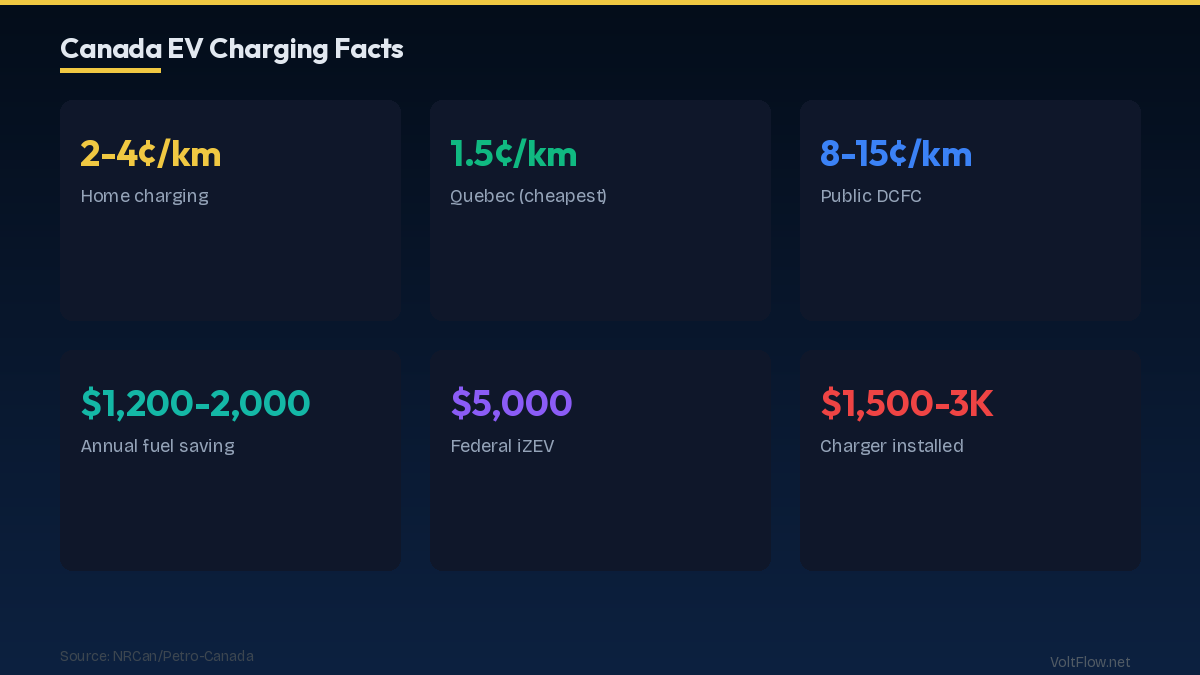
Charging an EV at home in Canada costs 1.2-3.0¢/km depending on your provincial electricity rate, compared to 12-14¢/km for gasoline, a 75-90% fuel cost saving. Quebec EV owners enjoy the cheapest charging in the developed world at just $234/year for 20,000 km. Public DC fast charging at 35-55¢/kWh is 3-5x more expensive than home charging. This guide calculates exact costs by province with annual savings projections.
Home Charging Cost by Province
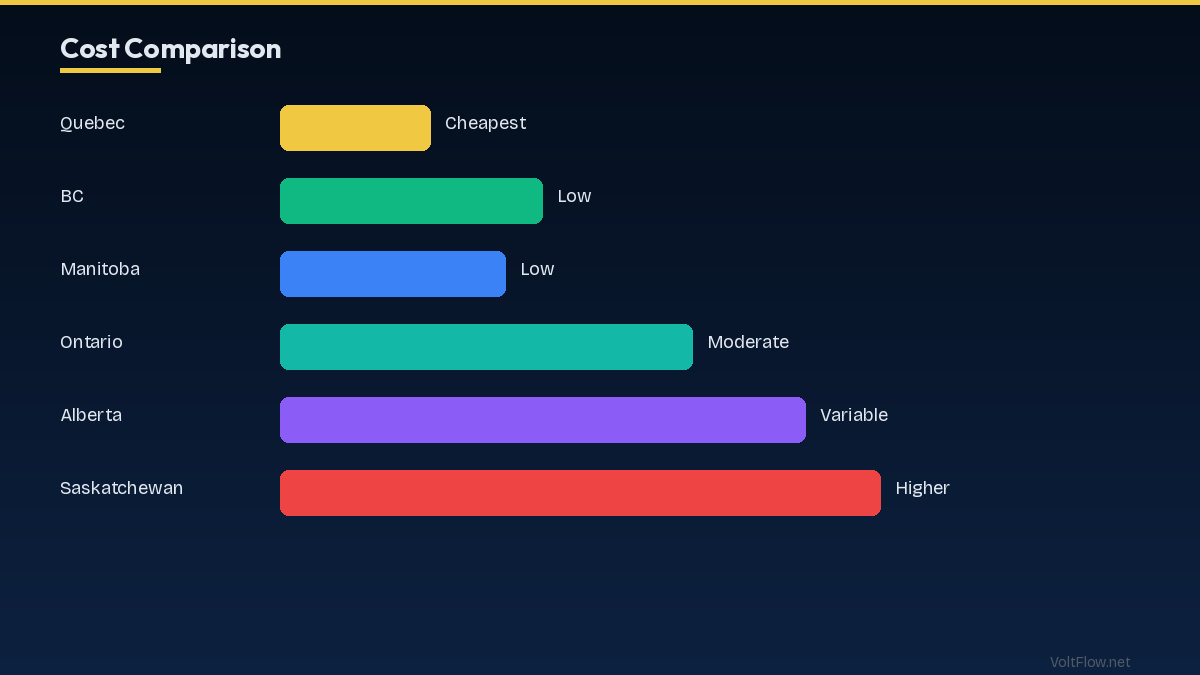
Home EV charging costs vary by province in direct proportion to electricity rates. At average consumption of 16 kWh per 100 km for a mid-size EV, here are the costs per province for 20,000 km annual driving. Quebec at 7.3¢/kWh: 1.17¢/km, $234/year. This is the cheapest EV charging cost in the developed world, making Quebec the most financially attractive province for EV ownership. A Quebec EV owner saves $2,326/year versus gasoline at $2,560. Manitoba at 9.9¢/kWh: 1.58¢/km, $317/year. Savings of $2,243 versus gasoline. British Columbia at 10.2¢ Step 1: 1.63¢/km, $326/year. Most EV charging consumption falls within the Step 1 threshold, keeping costs at the lower tier. Savings of $2,234. Ontario at 8.7¢ off-peak TOU: 1.39¢/km, $278/year when charging overnight. At the blended average of 12¢: 1.92¢/km, $384/year. Ontario TOU pricing makes overnight EV charging exceptionally cheap. Saskatchewan at 16.5¢/kWh: 2.64¢/km, $528/year. Higher rates but still saves $2,032 versus gasoline. Alberta at average 15¢/kWh: 2.40¢/km, $480/year. Savings of $2,080. Nova Scotia at 18¢/kWh: 2.88¢/km, $576/year. The highest home charging cost in significant-population provinces but still saves $1,984 versus gasoline. These costs assume Level 2 home charging at 7.2 kW using a 240V outlet or dedicated EVSE. Level 1 charging from a standard 120V outlet costs the same per kWh but is less efficient, losing approximately 10-15% more energy to heat during the slower charging process. The efficiency loss adds approximately $30-$60 per year to Level 1 charging costs. Canadian cold winter temperatures reduce EV efficiency by 20-40% due to battery heating and cabin heating requirements. A vehicle consuming 16 kWh/100km in summer may consume 22-26 kWh/100km in winter at minus 20°C. Annual cost calculations above use an average that accounts for seasonal variation. Budget an additional 25-35% above summer charging costs during December through February in most Canadian provinces.
Public Charging Network Costs in Canada
Canada public EV charging infrastructure has expanded dramatically with several major networks providing coverage along major highways and in urban centres. Understanding the cost differences helps you minimise expenses during road trips and away-from-home charging. Petro-Canada Electric Highway powered by FLO provides DC fast charging at 50-350 kW along the Trans-Canada Highway from coast to coast. Pricing is $0.35-$0.55/kWh depending on location and charging speed. A Tesla Model 3 charging from 10-80% costs approximately $14-$22, roughly 5-8x the cost of the same charge at home. The network provides essential long-distance travel capability with stations spaced every 150-250 km along major corridors. FLO (formerly AddÉnergie) operates the largest Canadian-owned charging network with over 80,000 chargers across Level 2 and DC fast charging. Level 2 public chargers cost $0-$3 per hour depending on the host site. DC fast charging costs $0.35-$0.50/kWh. FLO membership at $10/month reduces per-session costs for frequent public chargers. Tesla Supercharger network in Canada provides 150-250 kW charging at $0.40-$0.55/kWh for non-Tesla vehicles and $0.35-$0.45 for Tesla owners. Supercharger coverage along Canadian highways has expanded significantly, with most major intercity routes now covered. Electrify Canada provides ultra-fast charging at 150-350 kW at selected locations. Pricing of $0.40-$0.55/kWh with a $4/month membership reducing rates by 10-15%. Coverage is concentrated along major highways in Ontario, Quebec, and BC. ChargePoint operates primarily Level 2 and some DC fast stations. Pricing varies by site host from free to $0.30-$0.50/kWh. The ChargePoint app shows pricing and availability for each station. For Canadian road trips, charging stop planning is more critical than in the US due to longer distances between population centres. A Better Routeplanner is essential for planning charging stops considering Canadian winter range reduction, charger availability, and the limited network coverage in northern and rural areas. Always start long trips with a full charge and plan conservative range estimates during winter months when actual range may be 30-40% below the rated range displayed in your vehicle.
EV vs Gasoline: Total Fuel Cost Comparison
The fuel cost comparison between EVs and gasoline vehicles is the single most compelling financial argument for EV adoption in Canada. The savings are dramatic across all provinces and become even more pronounced as gasoline prices increase. For a driver covering 20,000 km per year, the gasoline baseline is a mid-size car averaging 8L/100km at $1.60/litre: $2,560/year in fuel. A mid-size SUV averaging 10L/100km costs $3,200/year. A pickup truck averaging 13L/100km costs $4,160/year. The EV charging cost for the equivalent vehicle types at the Canadian average electricity rate of 14¢/kWh: mid-size EV at 16 kWh/100km costs $448/year. An EV SUV at 20 kWh/100km costs $560/year. An EV truck at 25 kWh/100km costs $700/year. Annual fuel savings by vehicle type: mid-size car saves $2,112, SUV saves $2,640, and truck saves $3,460. Over a typical 5-year ownership period, cumulative fuel savings range from $10,560 for a car to $17,300 for a truck. These savings substantially offset the EV purchase price premium which ranges from $3,000-$10,000 for most models in 2026. In Quebec, the savings are even more dramatic due to the 7.3¢ rate. A mid-size EV costs just $234/year in fuel, saving $2,326 versus gasoline. Over 5 years, the Quebec fuel saving of $11,630 exceeds the EV price premium for most models, making the EV cheaper in total cost of ownership from day one when fuel savings are included. The federal iZEV rebate of $5,000 for eligible EVs further improves the economics, effectively making EVs cheaper than gasoline equivalents in many provinces when combining the purchase rebate with fuel savings over the first few years of ownership. Provincial rebates in BC ($3,000-$4,000), Quebec ($7,000), and other jurisdictions stack with the federal rebate, potentially eliminating the EV price premium entirely at the point of purchase.
Home EV Charger Installation in Canada
Installing a Level 2 home EV charger in Canada costs $1,500-$3,000 for the charger unit and installation. Federal and provincial incentives can reduce this to $500-$1,500 out of pocket. A Level 2 charger at 240V provides 30-50 km of range per hour, fully charging most EVs overnight. Popular chargers in the Canadian market include the FLO Home X5 at $900-$1,200, designed and manufactured in Quebec with excellent cold-weather performance rated to minus 40°C. The ChargePoint Home Flex at $700-$1,000 offers adjustable amperage from 16-50A for flexibility with different circuit capacities. The Grizzl-E at $500-$700 is a Canadian-designed budget option built for harsh weather with a NEMA 4 rated enclosure and operating range of minus 30°C to plus 50°C. The Tesla Wall Connector at $600-$800 provides maximum charging speed for Tesla vehicles with integrated scheduling. Installation requires a dedicated 240V circuit from your electrical panel. Most Canadian homes with 200A service have adequate capacity for a 40A EV charger circuit. Installation labour costs $500-$1,500 depending on the distance from your panel to the charger location and whether the route requires running cable through finished spaces. Outdoor installations require weatherproof equipment rated for Canadian winter conditions including snow, ice, and temperatures to minus 40°C. The NRCan Zero Emission Vehicle Infrastructure Program provides funding for home and workplace charging installations. Provincial programs supplement federal support: BC offers rebates through CleanBC, Quebec through Roulez vert, and Ontario through specific utility programs. Combined incentives reduce the charger plus installation cost by $500-$1,500 in most provinces. Canadian-specific installation considerations include ensuring the charger is rated for outdoor use in extreme cold if mounted outside. A heated garage installation avoids cold-weather concerns entirely and provides the most reliable charging environment. If the charger must be outdoors, choose a model explicitly rated to minus 40°C and install it in a location protected from direct snow and ice accumulation. Cable management in cold weather requires flexible cable types that remain pliable at low temperatures, standard rubber cables can become stiff and crack at minus 20°C and below.
Cold Weather EV Charging: Canadian Tips
Canadian winters create unique EV charging challenges that require specific strategies to maintain range, optimize charging speed, and minimize costs. Understanding cold-weather EV behaviour helps you plan charging efficiently during the 4-5 months of winter. Cold batteries charge slower because lithium-ion cells have increased internal resistance at low temperatures. A Tesla Model 3 that charges at 150 kW at 20°C may charge at only 50-80 kW at minus 10°C until the battery warms up. Preconditioning the battery by navigating to a Supercharger in the car system or manually activating battery heating before arriving at a fast charger significantly improves charging speed. Most modern EVs automatically precondition when a fast charging stop is set in the navigation system. Home charging at Level 2 is less affected by cold because the slower charging rate generates enough internal heat to warm the battery during the charging session. A cold-soaked battery plugged into a Level 2 charger at minus 20°C may charge at reduced speed for the first 30-60 minutes before warming to normal charging rate. The total overnight charging time increases by 1-2 hours in extreme cold but does not affect the outcome since most EVs complete their charge well before morning departure. Preconditioning the cabin while plugged in is the single most impactful cold-weather strategy. Using wall power to heat the cabin to comfortable temperature before departure preserves 15-25 km of range that would otherwise be consumed by the cabin heater drawing from the battery. Every EV with a companion app supports departure-time scheduling that automatically preconditions both the battery and cabin. Set your departure time and the car handles the rest. Block heater outlets that are ubiquitous in Canadian garages and parking lots for engine block heaters provide a convenient 120V power source for Level 1 EV charging. While Level 1 at 120V adds only 6-8 km per hour, plugging in at work for 8 hours adds 48-64 km, enough to cover the average Canadian daily commute of 25 km with margin for cold-weather efficiency loss. Many Canadian workplaces with outdoor parking already have 120V outlets at every stall, providing free or low-cost daytime Level 1 charging. Winter range reduction of 20-40% is the most significant cold-weather impact. A vehicle rated at 400 km range may achieve only 240-320 km in winter depending on temperature, speed, and heating use. Plan winter road trips with charging stops at 60-70% of rated range intervals rather than the 80-85% intervals comfortable in summer. Carry a portable Level 1 charger as an emergency backup for situations where planned charging stations are occupied or out of service in remote areas.

Federal and Provincial EV Incentives
Canada offers substantial EV purchase and charging incentives that reduce the total cost of EV ownership. Combining federal and provincial programs can save $8,000-$15,000 on purchase plus $500-$1,500 on charging infrastructure. The federal iZEV (Incentives for Zero-Emission Vehicles) program provides a rebate of $5,000 for battery electric vehicles and long-range plug-in hybrids with MSRP below $60,000 (base model) or below $70,000 (higher trims). The rebate is applied at the point of sale by the dealer, reducing the purchase price immediately. Most popular EVs qualify including Tesla Model 3, Hyundai Ioniq 5, Kia EV6, Chevrolet Equinox EV, Ford Mustang Mach-E, and BYD models entering the Canadian market. Quebec offers the most generous provincial rebate at up to $7,000 for battery EVs, stacking with the federal $5,000 for a combined $12,000 reduction. Quebec also offers $600 for Level 2 home charger installation through the Roulez vert program. The combined purchase plus charger incentive of $12,600 makes Quebec the cheapest jurisdiction in North America for EV acquisition. British Columbia offers $3,000-$4,000 through the CleanBC Go Electric Passenger Vehicle Rebate, plus $350 for home charger installation. Total BC incentive stacking with federal: $8,350-$9,350. New Brunswick offers $5,000 for EVs stacking with federal for $10,000 total. Nova Scotia offers $3,000 stacking for $8,000 total. PEI offers $5,000 stacking for $10,000 total. Ontario does not currently offer a provincial EV purchase rebate but provides various utility-level programs for charger installation and EV-specific electricity rates through some Local Distribution Companies. Alberta offers $5,000 through certain municipal programs in Calgary and Edmonton. The combined effect of these incentives is transformative for EV economics. A $45,000 EV purchased in Quebec with $12,000 in combined rebates has an effective price of $33,000, comparable to many mid-range gasoline vehicles. Add annual fuel savings of $2,326 in Quebec, and the EV becomes definitively cheaper than the gasoline equivalent within the first year of ownership.