How to Calculate Electrical Load for Your Home: 2026 NEC Guide
Knowing your home total electrical load determines whether your panel can handle new additions like EV chargers, heat pumps, and solar systems, or if an expensive upgrade is needed first. The NEC Article 220 Standard Calculation provides the official method, using demand factors that account for the reality that not all appliances run simultaneously. This guide walks you through the complete calculation step by step, with real examples for common home configurations in 2026.
Why Electrical Load Calculations Matter in 2026
An electrical load calculation is the foundation of every panel sizing decision, circuit planning exercise, and service upgrade evaluation. Without it, you are guessing about whether your electrical system can handle new loads, and guessing wrong has consequences ranging from nuisance breaker tripping to dangerous overheating and fire hazards. The most common scenario requiring a load calculation in 2026 is adding an EV charger to an existing home. A Level 2 EV charger draws 32-48 amps continuously, a significant addition to any residential panel. Before installing the charger, your electrician must verify that the panel has sufficient capacity by performing a load calculation per NEC Article 220. If the calculated load plus the EV charger exceeds the main breaker rating, you need either a panel upgrade or a load management solution. Panel upgrades from 100 to 200 amps cost $1,800-$3,500, while load management devices cost $200-$500. A proper load calculation can save you thousands by determining which solution is actually necessary. Heat pump installations present a similar challenge. Replacing a gas furnace with a heat pump adds 30-60 amps of electrical demand while removing zero electrical load since the gas furnace used minimal electricity. The load calculation determines whether your existing 200-amp service can absorb this addition or whether it needs upgrading to accommodate the new system. Solar panel installations require load calculations for a different reason entirely. The utility company and your solar installer need to know your home electrical characteristics to properly size the solar system and configure the interconnection agreement. An oversized solar system may require a larger service to handle backfeed current during peak production hours. Insurance companies and home inspectors increasingly request load calculations during property transactions and policy renewals. A documented load calculation showing that the electrical system is properly sized provides evidence that the home meets code requirements and is safe for its current usage pattern. Building permits for any electrical work that modifies the panel or adds significant load require load calculations as part of the permit application. Submitting an accurate calculation speeds permit approval and demonstrates professional competence that building inspectors appreciate and look for.
NEC Article 220 Standard Calculation: Step by Step
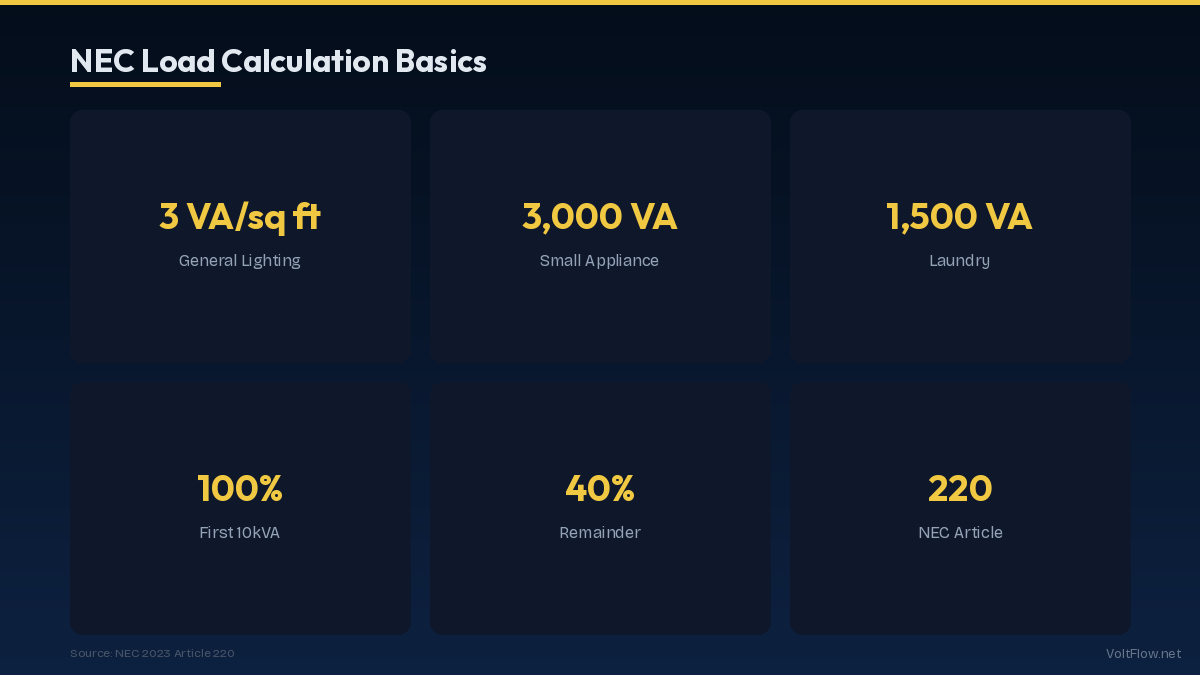
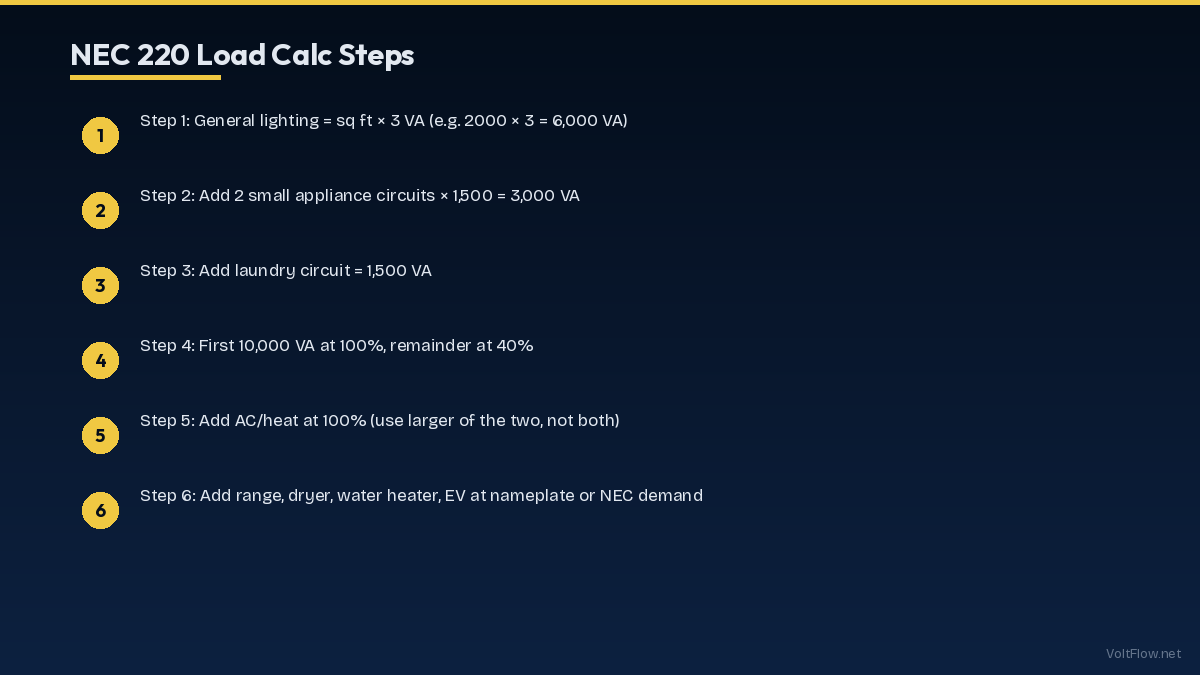
The NEC standard method in Article 220 Part III is the most commonly used calculation for existing residential services. Here is the complete step-by-step process with a worked example. Step one: Calculate the general lighting and receptacle load. Multiply the total floor area of your home in square feet by 3 VA per square foot per NEC Table 220.12. A 2,400-square-foot home gets 7,200 VA for general lighting and receptacles. This covers all standard lighting circuits and general-purpose outlets but not dedicated appliance circuits. Add to this 1,500 VA for each small appliance circuit required by NEC 210.11(C)(1), which is a minimum of two circuits for the kitchen countertop. Also add 1,500 VA for the laundry circuit required by NEC 210.11(C)(2). For our 2,400-square-foot example: 7,200 VA general plus 3,000 VA for two kitchen circuits plus 1,500 VA for laundry equals 11,700 VA total general load before demand factors. Step two: Apply demand factors to the general load. Per NEC Table 220.42, the first 10,000 VA is calculated at 100 percent and the remainder at 35 percent. For our example: 10,000 VA at 100 percent equals 10,000 plus 1,700 VA at 35 percent equals 595. Total demand-adjusted general load: 10,595 VA. Step three: Add fixed appliance loads. List every permanently connected appliance with its nameplate VA rating. Common residential appliances include dishwasher at 1,500 VA, garbage disposal at 1,000 VA, electric water heater at 4,500 VA, microwave if hardwired at 1,500 VA, and bathroom exhaust fans at 200 VA total. If you have four or more fixed appliances, NEC 220.53 allows a 75 percent demand factor on the total. For our example with dishwasher, disposal, electric water heater, and microwave: 8,500 VA times 0.75 equals 6,375 VA. Step four: Add the cooking appliance load. For a single household range rated between 8.75 kW and 12 kW, NEC Table 220.55 Column C allows a demand of 8,000 VA regardless of the actual nameplate rating. Step five: Add the clothes dryer load at 5,000 VA minimum per NEC 220.54. Step six: Add the larger of heating or cooling since they do not operate simultaneously per NEC 220.60.
Completing the Calculation and Determining Service Size
Continuing from the step-by-step calculation with our 2,400-square-foot example home that has a heat pump, electric range, electric water heater, and electric dryer. Adding all the demand-adjusted loads together: general lighting and receptacles at 10,595 VA, fixed appliances at 6,375 VA, cooking range at 8,000 VA, clothes dryer at 5,000 VA, and heating load at 14,800 VA (the larger of the heat pump with backup strips versus the air conditioning load alone). Total calculated demand: 44,770 VA. To convert VA to amps at 240 volts single-phase: 44,770 divided by 240 equals 186.5 amps. This home needs a minimum 200-amp service to handle its current loads safely. A 150-amp service would be inadequate and a code violation. Now add the planned EV charger: a 40-amp continuous load requires 40 times 1.25 equals 50 amps times 240 volts equals 12,000 VA. New total: 44,770 plus 12,000 equals 56,770 VA divided by 240 equals 236.5 amps. This exceeds 200-amp service capacity, suggesting either a service upgrade to 320 or 400 amps, or installation of a load management device to keep actual simultaneous demand under 200 amps at all times. The NEC Optional Calculation Method in Article 220 Part IV provides an alternative for existing dwellings that often yields lower calculated loads. Under the optional method, the first 10 kVA of all loads is taken at 100 percent, and everything above 10 kVA is taken at 40 percent. For our example: total connected load approximately 70 kVA. Using the optional method: 10 kVA at 100 percent equals 10,000 VA plus 60 kVA at 40 percent equals 24,000 VA. Total: 34,000 VA divided by 240 equals 141.7 amps. Under this optional method, the home with EV charger fits comfortably within a 200-amp service. The optional method produces lower values because it applies a more aggressive diversity factor recognizing that a home will never operate all loads simultaneously at their maximum ratings. Many electricians prefer the optional method for existing homes because it more closely reflects real-world demand patterns than the standard calculation.
Real-World Load Calculation Examples
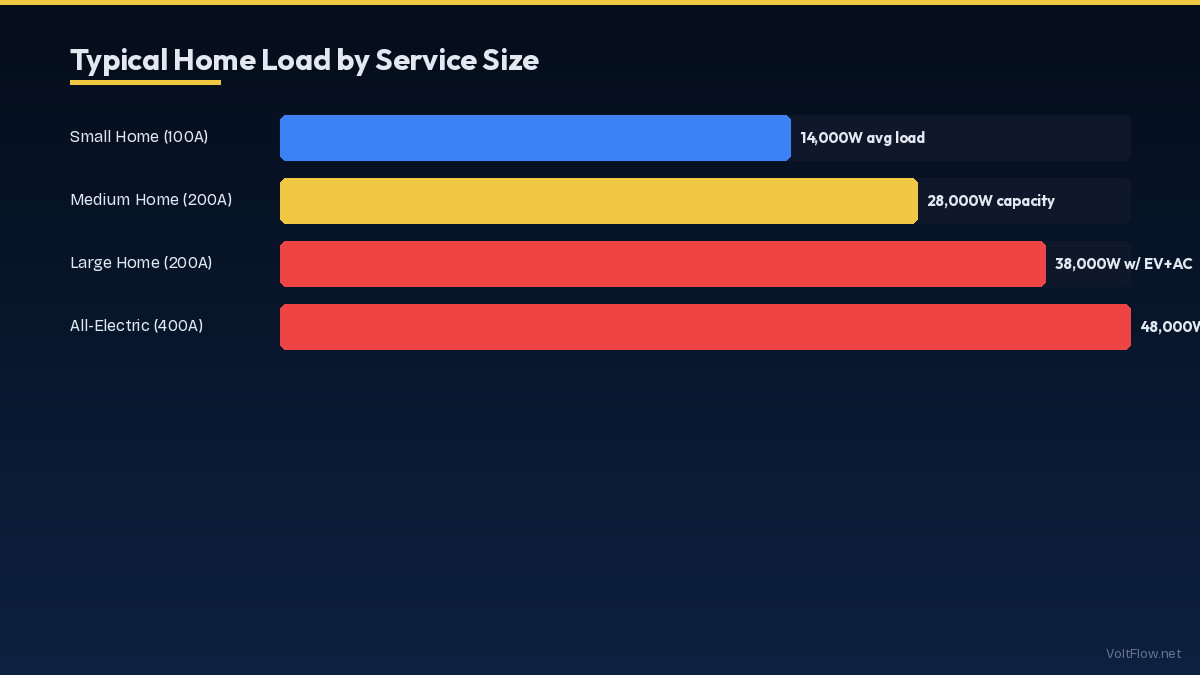
Abstract calculations become clearer with specific real-world examples covering common home configurations that electricians encounter in 2026. A 1,500-square-foot starter home with gas heating, gas water heater, gas range, electric dryer, and no EV charger represents the lightest electrical load scenario. General load: 1,500 times 3 equals 4,500 plus 3,000 kitchen plus 1,500 laundry equals 9,000 VA. Demand adjusted: 9,000 at 100 percent since it is under 10,000 VA. Fixed appliances at 75 percent: dishwasher plus disposal equals 2,500 times 0.75 equals 1,875 VA. Dryer at 5,000 VA. Cooling at 2,800 VA for a 2-ton AC unit. No electric heating or electric range in this scenario. Total: 18,675 VA divided by 240 equals 77.8 amps. This home operates comfortably on a 100-amp service with room to spare for moderate additions. A 2,200-square-foot all-electric home with heat pump, electric range, electric water heater, electric dryer, and one EV charger represents the full electrification scenario increasingly common as homeowners move away from gas. Using the optional method for simplicity: total connected load of approximately 55 kVA. First 10 kVA at 100 percent equals 10,000 VA, remaining 45 kVA at 40 percent equals 18,000 VA. Total: 28,000 VA divided by 240 equals 116.7 amps. This fits within a 200-amp service with reasonable headroom for additional loads in the future. A 3,500-square-foot luxury home with two HVAC zones, electric range, electric dryer, electric water heater, pool pump, hot tub, two EV chargers, and a workshop sub-panel represents the maximum residential load scenario. Total connected load approximately 95 kVA. Using optional method: 10,000 plus 85 times 0.40 equals 34,000 plus 10,000 equals 44,000 VA divided by 240 equals 183.3 amps. This barely fits a 200-amp service and is a strong candidate for either a 400-amp service upgrade or a smart panel with load management that ensures the two EV chargers, hot tub heater, and pool pump never all run at maximum simultaneously. The practical lesson from these examples is that most homes below 3,000 square feet with typical equipment fit within a 200-amp service even with full electrification including one EV charger.
Tools and Resources for DIY Load Calculations
Several tools and resources make load calculations accessible to homeowners who want to evaluate their own electrical capacity before calling an electrician for a formal assessment. The VoltFlow Electrical Load Calculator at voltflow.net provides a guided online calculation that walks you through each step of the NEC standard and optional methods. Enter your home square footage, select your appliances from a dropdown list, and the calculator produces both the standard and optional method results with the required service size. This free tool saves time and provides a professional-quality calculation you can share with your electrician to get more accurate quotes. NEC Article 220 worksheets are available from multiple sources. Mike Holt Enterprises publishes a detailed dwelling load calculation worksheet that follows the standard method step by step with spaces for each individual entry. This paper worksheet is the same format many electricians use for permit applications. The worksheet is available for download from electrical education websites. Your electrical panel itself provides critical starting data for any load calculation. Open the panel cover after turning off the main breaker for safety and photograph the breaker layout, panel label showing the main breaker amperage and bus bar rating, and the wiring entering each breaker. Note which breakers are double-pole for 240-volt circuits and which are single-pole for 120-volt circuits. This inventory tells your electrician exactly what is currently installed and draws power. A clamp-on ammeter is the best tool for measuring actual real-time demand rather than theoretical maximums. A $30-$50 clamp meter from Klein Tools or Fluke placed around the main service entrance conductors reads your total household amperage at any given moment. Take readings during your peak usage period, typically 5-8 PM on a weekday when the AC or heat runs while you cook dinner and run the dryer simultaneously. Peak readings of 60-80 amps on a 200-amp service indicate ample headroom for additions. Readings approaching 150-160 amps suggest limited capacity. Whole-home energy monitors like the Sense, Emporia Vue, and Span Panel provide continuous demand monitoring with historical data and per-circuit breakdown. These devices install inside your panel and connect to a smartphone app. The data from a week of monitoring is more valuable than any paper calculation because it shows your actual demand patterns rather than theoretical maximums based on nameplate ratings.
Load Management: The Alternative to Panel Upgrades
When your load calculation shows you are at or near the limit of your current service, load management technology offers a cost-effective alternative to upgrading your panel or service size. These devices coordinate high-draw loads to prevent simultaneous peak demand from exceeding your service capacity at any point. Dedicated EV load management devices like the DCC-9 and DCC-10 from Emporia specifically manage EV charger demand based on real-time household consumption. These devices monitor your main panel current and automatically reduce EV charging speed when other loads are active. When the AC compressor starts and draws 30 amps, the load manager reduces EV charging from 40 amps to 20 amps to keep total demand under the service limit. When the AC cycles off, EV charging ramps back up automatically. These devices cost $200-$400 installed and can eliminate the need for a $3,000-$5,000 panel upgrade in many situations. Smart electrical panels like the Span Panel and Lumin Panel provide whole-home load management across all circuits, not just the EV charger. The Span Panel costs $4,000-$6,500 installed and replaces your existing panel with an intelligent system that monitors every circuit in real time and can remotely control any circuit. During peak demand, the Span Panel can temporarily reduce or shed non-critical loads like the water heater, pool pump, or second EV charger to keep total demand within your service capacity. The Span Panel also provides per-circuit energy monitoring, remote circuit control through a smartphone app, and integration with solar and battery systems. For homes that need to add both an EV charger and a heat pump without exceeding 200-amp service, a smart panel can manage both additions by ensuring they never run at full capacity simultaneously. The cost of a smart panel is comparable to a conventional panel upgrade to 400 amps and provides ongoing load optimization that a conventional panel cannot offer. Circuit-level load controllers like the Sense Flex and Leviton Smart Breakers offer a middle ground between dedicated EV load managers and full smart panels. These devices attach to individual breakers and can be programmed to shed specific loads when total demand approaches the service limit. At $50-$150 per circuit, you can manage 3-4 critical high-draw circuits for $200-$600, far less than either a panel upgrade or a full smart panel replacement. The choice between load management and a service upgrade depends on your specific situation. If you need to add one EV charger to a 200-amp panel that is currently at 70 percent capacity, a $300 load management device is the clear winner. If you are adding an EV charger, heat pump, and induction cooktop while your 100-amp panel is already maxed out, a service upgrade to 200 or 400 amps is necessary regardless of load management because the total connected load simply exceeds what load management alone can accommodate.