NEC Wire Size Chart 2026: Complete Ampacity Table & Guide
Selecting the correct wire size is one of the most critical decisions in any electrical installation. Undersized wire overheats and creates fire hazards, while oversized wire wastes money. The NEC Table 310.16 is the primary reference for wire ampacity in residential and commercial work, covering copper and aluminum conductors from 14 AWG to 2000 kcmil. This guide explains the chart, shows you how to use it, and covers the derating factors that modify the base ampacity values.
NEC Table 310.16: The Master Wire Ampacity Chart
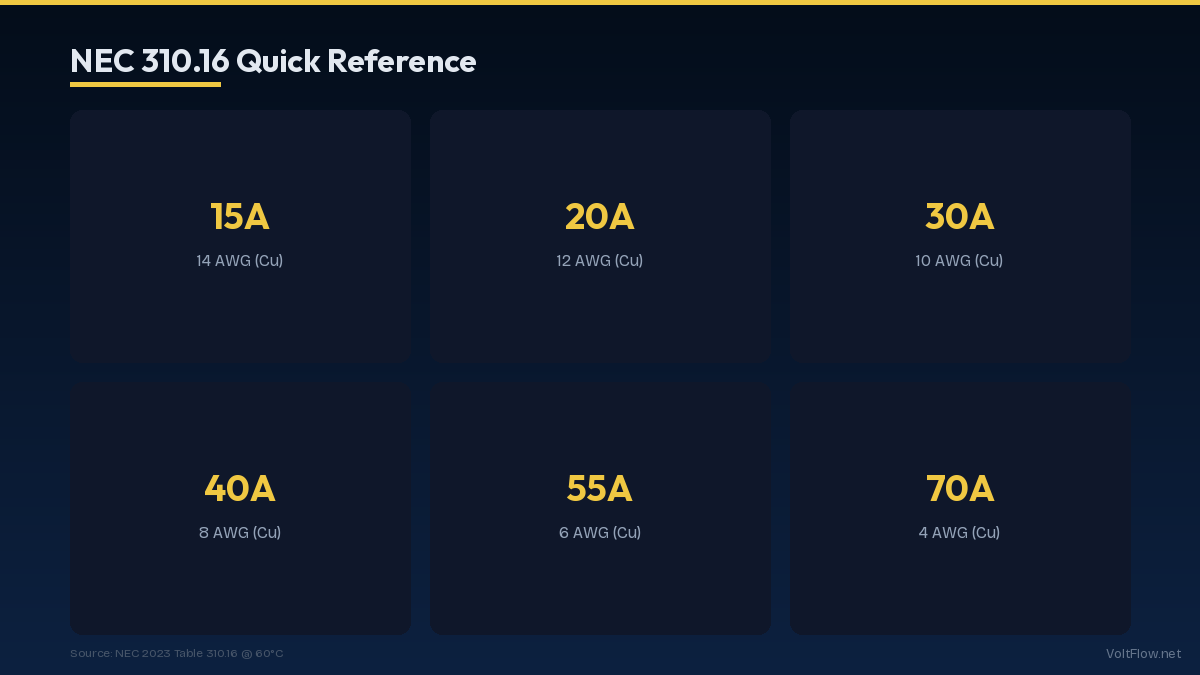
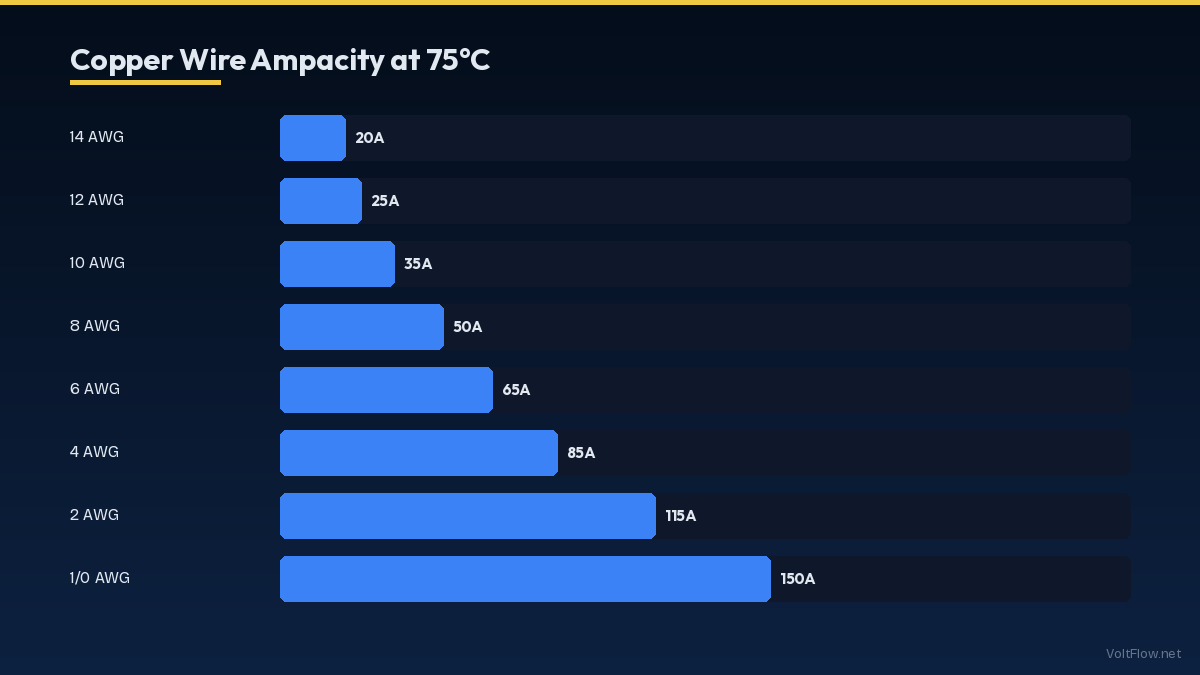
NEC Table 310.16 lists the allowable ampacity of insulated conductors rated up to 2000 volts in raceway, cable, or direct burial. The table has three main columns based on conductor insulation temperature rating: 60 degrees Celsius, 75 degrees Celsius, and 90 degrees Celsius. The 60-degree column applies to older insulation types like TW and UF. The 75-degree column covers the most common residential insulation types including THWN, XHHW, and NM-B when terminated at 75-degree equipment. The 90-degree column covers THWN-2 and XHHW-2, primarily used as a starting point for derating calculations. For residential wiring using copper NM-B cable at 60-degree terminations, the key ampacity values are: 14 AWG carries 15 amps, 12 AWG carries 20 amps, 10 AWG carries 30 amps, 8 AWG carries 40 amps, 6 AWG carries 55 amps, 4 AWG carries 70 amps, 3 AWG carries 85 amps, 2 AWG carries 95 amps, 1 AWG carries 110 amps, 1/0 AWG carries 125 amps, 2/0 carries 145 amps, 3/0 carries 165 amps, and 4/0 carries 195 amps. For aluminum conductors at 75-degree terminations, the values are: 12 AWG at 15 amps, 10 AWG at 25 amps, 8 AWG at 30 amps, 6 AWG at 40 amps, 4 AWG at 55 amps, 3 AWG at 65 amps, 2 AWG at 75 amps, 1 AWG at 85 amps, 1/0 at 100 amps, 2/0 at 115 amps, 3/0 at 130 amps, and 4/0 at 150 amps. Notice that aluminum requires wire approximately two sizes larger than copper for the same ampacity. This size penalty is offset by aluminum lower cost per foot, which is roughly one-third the price of copper. For feeders and service entrance cables above 6 AWG, aluminum is commonly used in residential construction and is the standard for utility service drops. The AWG numbering system works in reverse of intuition: smaller numbers mean larger wire. This originated from the wire drawing process where each successive draw through a smaller die produced a thinner wire with a higher gauge number. A 4 AWG wire has a cross-sectional area of 41,740 circular mils compared to 6,530 circular mils for 12 AWG, making it physically much larger and capable of carrying much more current safely.
Temperature Rating and Termination Rules
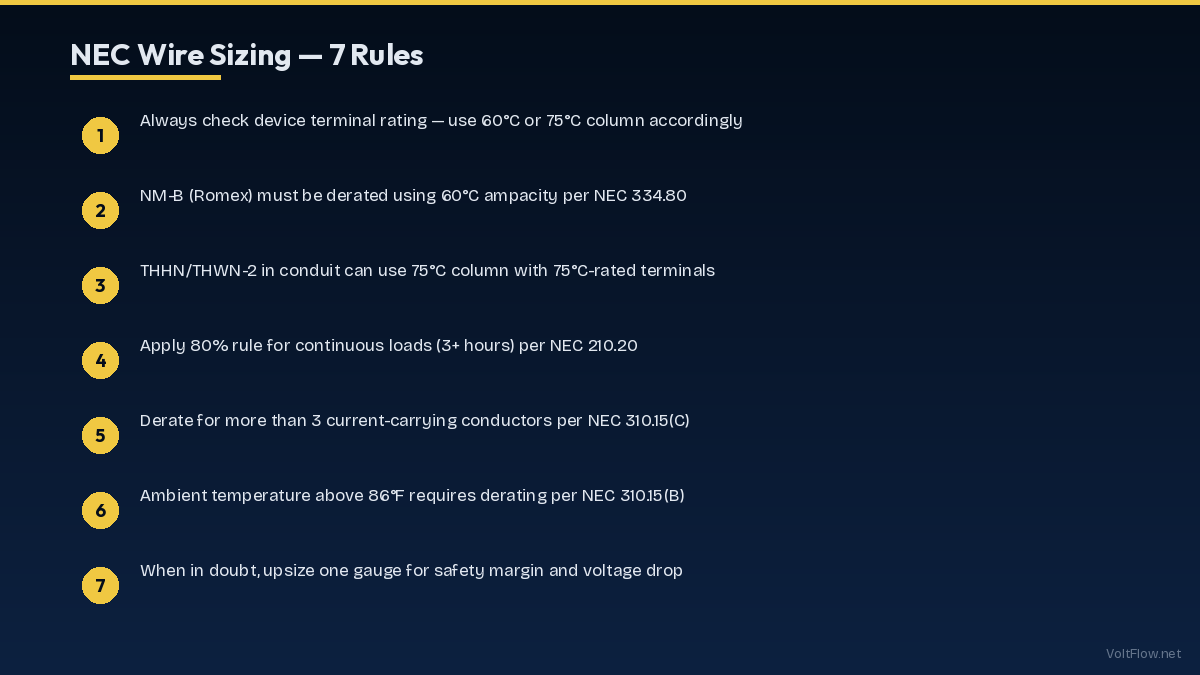
One of the most misunderstood aspects of NEC wire sizing is the relationship between the wire insulation temperature rating and the equipment termination temperature rating. The ampacity you can actually use is limited by the lower of these two ratings, not the higher. Most residential electrical equipment including breakers, outlets, and switches is rated for 60-degree or 75-degree terminations. Even if you install THWN-2 wire rated for 90 degrees, you must use the 75-degree column ampacity (or 60-degree for equipment rated only to 60 degrees) because the equipment terminals cannot safely handle the heat generated by the higher 90-degree ampacity. NEC 110.14(C) governs this requirement. For circuits rated 100 amps or less, the conductor ampacity is determined using the 60-degree column unless the equipment is listed and identified for use at 75 degrees. Most modern breakers from Square D, Eaton, and Siemens are rated for 75-degree terminations when used with 75-degree-rated wire. This means you can use the 75-degree column values for most new panel installations but should verify by checking the panel label or breaker documentation. For circuits rated over 100 amps, the 75-degree column applies by default per NEC 110.14(C)(1)(b). This is why service entrance conductors and large feeder cables use the 75-degree column values. So when does the 90-degree column matter? It serves as the starting point for ampacity adjustment calculations. When conductors must be derated for ambient temperature or conduit fill, you start with the higher 90-degree ampacity and apply the correction factors. After derating, the adjusted ampacity must still meet or exceed the circuit requirement, and you must also verify that the adjusted value does not exceed the 75-degree or 60-degree termination limit. For example, 6-gauge THWN-2 copper has a 90-degree ampacity of 75 amps. After applying a conduit fill derating factor of 0.80 for seven to nine current-carrying conductors, the adjusted ampacity is 60 amps. This exceeds the 55-amp value in the 60-degree column, so the wire can carry 55 amps on a 60-degree-rated device or 65 amps on a 75-degree-rated device after derating. Without the 90-degree starting point, the derated ampacity might fall below the circuit requirement, necessitating a larger wire.
Conduit Fill Derating: When Multiple Wires Share a Raceway
When multiple current-carrying conductors share a conduit or raceway, they generate mutual heat that reduces each conductor safe ampacity. NEC Table 310.15(C)(1) provides adjustment factors based on the number of current-carrying conductors in the raceway. For one to three current-carrying conductors, no adjustment is required. This covers the vast majority of residential circuits where a single cable containing a hot, neutral, and ground runs in a raceway. The ground wire does not count as a current-carrying conductor for this calculation. For four to six current-carrying conductors, apply an 80 percent adjustment factor. This means a 12 AWG wire normally rated at 20 amps (60-degree column) is reduced to 16 amps. This situation occurs when multiple circuits share a single conduit run, such as two 12/2 circuits pulled through the same raceway. For seven to nine conductors, the factor drops to 70 percent. For ten to twenty conductors, use 50 percent. For twenty-one to thirty conductors, use 45 percent. These higher conductor counts are more common in commercial and industrial installations than residential, but they can occur in residential work when multiple circuits share a conduit run from a sub-panel to a junction box. The practical implication is significant. If you plan to pull four 12/2 NM cables through a short section of conduit in a basement ceiling to consolidate wire routing, those eight current-carrying conductors (four hots and four neutrals) require a 70 percent derating. Each 12 AWG conductor drops from 20 amps to 14 amps at 60 degrees, which is insufficient for a 20-amp circuit. You would need to either use 10 AWG wire (30 amps times 0.70 equals 21 amps, which covers the 20-amp circuit) or separate the cables into two conduits with four conductors each (80 percent derating, 20 times 0.80 equals 16 amps per conductor, still insufficient for 20-amp circuits). This example illustrates why starting with the 90-degree column is valuable. A 12 AWG THWN-2 wire has a 90-degree ampacity of 30 amps. With a 70 percent derating for eight conductors, the adjusted ampacity is 21 amps. Since this does not exceed the 75-degree column value of 20 amps, you can use 12 AWG on a 20-amp circuit even with eight conductors in the conduit, provided the equipment terminations are rated for 75 degrees. Always count current-carrying conductors carefully. Neutral conductors that carry only unbalanced current from two hot legs on a multi-wire branch circuit do not count as current-carrying. However, the neutral on a circuit supplying non-linear loads like electronic equipment with harmonic currents does count.
Ambient Temperature Correction Factors
The ampacity values in NEC Table 310.16 assume an ambient temperature of 30 degrees Celsius or 86 degrees Fahrenheit. When conductors operate in environments hotter than 30 degrees, their ampacity must be reduced using correction factors from NEC Table 310.15(B)(1). This affects installations in attics, rooftop conduit, boiler rooms, and exterior runs in hot climates. For ambient temperatures of 31-35 degrees Celsius, the correction factor for 75-degree insulation is 0.94, reducing ampacity by 6 percent. For 36-40 degrees, the factor is 0.88. For 41-45 degrees, the factor is 0.82. For 46-50 degrees, the factor is 0.75. For 51-55 degrees, the factor is 0.67. These corrections stack with conduit fill derating, meaning a conductor in a hot attic with multiple wires in a conduit gets hit with both factors multiplied together. Attic installations are the most common residential scenario requiring temperature correction. Attic temperatures in the southern United States regularly reach 50-65 degrees Celsius during summer months. NEC 310.15(B)(2) adds an additional consideration for cables installed in attics within 4 inches of the roof sheathing. If the conductor cannot be maintained at least 4 inches below the roof deck, the ambient temperature is assumed to be the roof deck temperature, which can exceed 70 degrees Celsius. At these temperatures, the correction factor for 75-degree insulation drops below 0.58, reducing a 12 AWG conductor from 20 amps to under 12 amps. This makes standard 12 AWG NM-B cable insufficient for 20-amp circuits when run tight against attic roof sheathing in hot climates. The solution is to either maintain the 4-inch clearance from the roof deck, upsize the conductor, or run the cable in conduit separated from the roof structure. Rooftop solar installations face similar challenges. Conductors in conduit exposed to direct sunlight on a roof surface operate at ambient temperatures well above 30 degrees Celsius. Solar installation designers must apply temperature correction factors to the wire running from rooftop panels to the inverter or combiner box, often requiring one or two sizes larger than the minimum for the circuit amperage. Underground direct-burial cables generally experience moderate ambient temperatures of 20-30 degrees Celsius at the standard burial depth of 24 inches, so temperature correction is rarely needed for underground residential feeder cables.
Wire Size for Common Residential Circuits
While the NEC tables provide the technical basis for wire sizing, most residential electricians work from a practical reference of standard circuit configurations. Here are the most common residential circuits and their wire requirements. General lighting and receptacle circuits use 14 AWG copper on 15-amp circuits or 12 AWG copper on 20-amp circuits. The NEC requires 20-amp circuits in kitchens, bathrooms, laundry rooms, and garages, making 12 AWG the most commonly purchased residential wire size. Many electricians standardize on 12 AWG throughout the home even for general lighting circuits to simplify ordering and avoid accidentally using 14 AWG where 12 is required. Kitchen countertop circuits require two dedicated 20-amp circuits per NEC 210.52(B), using 12 AWG copper. These circuits serve the countertop outlets where high-draw appliances like toasters, blenders, and coffee makers connect. The two-circuit requirement ensures that no single appliance trips a breaker during normal use. Bathroom circuits require at least one dedicated 20-amp circuit per NEC 210.11(C)(3), using 12 AWG copper. This circuit can serve multiple bathrooms but cannot serve any other room. The high-draw combination of hair dryers, curling irons, and electric shavers makes the dedicated circuit essential. A 240-volt electric dryer circuit uses 10 AWG copper on a 30-amp breaker with a NEMA 14-30 outlet. This is one of the most standardized residential circuits, unchanged for decades. An electric range or cooktop circuit uses 6 AWG copper on a 50-amp breaker with a NEMA 14-50 outlet. Some smaller ranges and apartment-sized cooktops work on 8 AWG with a 40-amp breaker. An EV charger circuit uses 6 AWG copper on a 50-amp breaker for a 40-amp charger, or 4 AWG copper on a 60-amp breaker for a 48-amp charger. The continuous load rule requiring 125 percent breaker sizing determines the breaker and wire pairing. A central air conditioning circuit uses 10 AWG or 8 AWG copper on a 30-amp or 40-amp breaker depending on the unit tonnage. Always check the AC unit nameplate for the Minimum Circuit Ampacity and Maximum Overcurrent Protection ratings, which specify the exact wire and breaker requirements for your specific unit. A sub-panel feeder uses wire sized for the sub-panel amperage. A 60-amp sub-panel needs 6 AWG copper or 4 AWG aluminum. A 100-amp sub-panel needs 3 AWG copper or 1 AWG aluminum. Always include voltage drop calculations for sub-panel feeders running more than 50 feet.
Common Wire Sizing Mistakes and How to Avoid Them
Wire sizing errors are among the most common code violations found during electrical inspections. Understanding the most frequent mistakes helps you avoid them. Using the wrong NEC table column is the most subtle error. An electrician who looks at 6 AWG copper in the 90-degree column sees 75 amps and might install it on a 70-amp circuit. But if the breaker is rated for only 75-degree terminations, the actual allowable ampacity is 65 amps, and the installation fails inspection. Always verify the termination temperature rating of both the breaker and the device at the load end before selecting the ampacity column. Ignoring continuous load calculations causes undersized wiring on circuits that run for three hours or more at a time. The NEC defines a continuous load in Article 100 and requires that the circuit ampacity be 125 percent of the continuous load per NEC 210.20(A). An EV charger drawing 40 amps continuously requires a conductor rated for at least 50 amps, which means 6 AWG copper minimum. A common mistake is using 8 AWG copper rated for 40 amps because the charger draws 40 amps, failing to account for the continuous load multiplier. Confusing wire gauge between copper and aluminum leads to dangerous undersizing. A homeowner or inexperienced installer who reads that 6 AWG carries 55 amps might use 6 AWG aluminum, which carries only 40 amps at the same termination rating. When substituting aluminum for copper, always go two sizes larger to maintain equivalent ampacity. Failing to account for voltage drop on long runs results in wire that meets the ampacity requirement but delivers inadequate voltage to the load. A 20-amp circuit on 12 AWG copper is properly sized for ampacity for any distance, but at 100 feet the voltage drop is 6.6 percent on 120 volts, far exceeding the 3 percent NEC recommendation. The wire meets code for ampacity but fails the voltage drop guideline, causing equipment performance problems. Always calculate voltage drop separately from ampacity for runs exceeding 50 feet. Mixing wire types in the same circuit creates potential failure points. Splicing solid NM-B cable to stranded THWN wire requires appropriate connectors rated for the combination. Using standard wire nuts designed for solid wire on stranded conductors can result in loose connections that overheat. Use push-in connectors rated for both solid and stranded wire, or use crimped butt splices for stranded-to-stranded connections. Double-tapping breakers, connecting two wires to a breaker terminal designed for one, is both a code violation and a safety hazard. If your panel is full and you need additional circuits, use listed tandem breakers in slots that accept them, install a sub-panel, or upgrade to a larger panel. Never force two wires under one breaker terminal unless the breaker is explicitly listed for double-tapping by the manufacturer.