How to Size a Breaker: 2026 NEC Guidelines & Calculator
Choosing the correct breaker size protects your wiring from overheating and prevents electrical fires. The NEC provides clear rules: the breaker must match the wire gauge ampacity, and for continuous loads it must be rated at 125% of the load current. A 32-amp continuous load like an EV charger needs a 40-amp breaker minimum, not a 32-amp. This guide covers breaker sizing for every common residential circuit with NEC code references.
The Basic Breaker Sizing Rule: Match Wire to Breaker
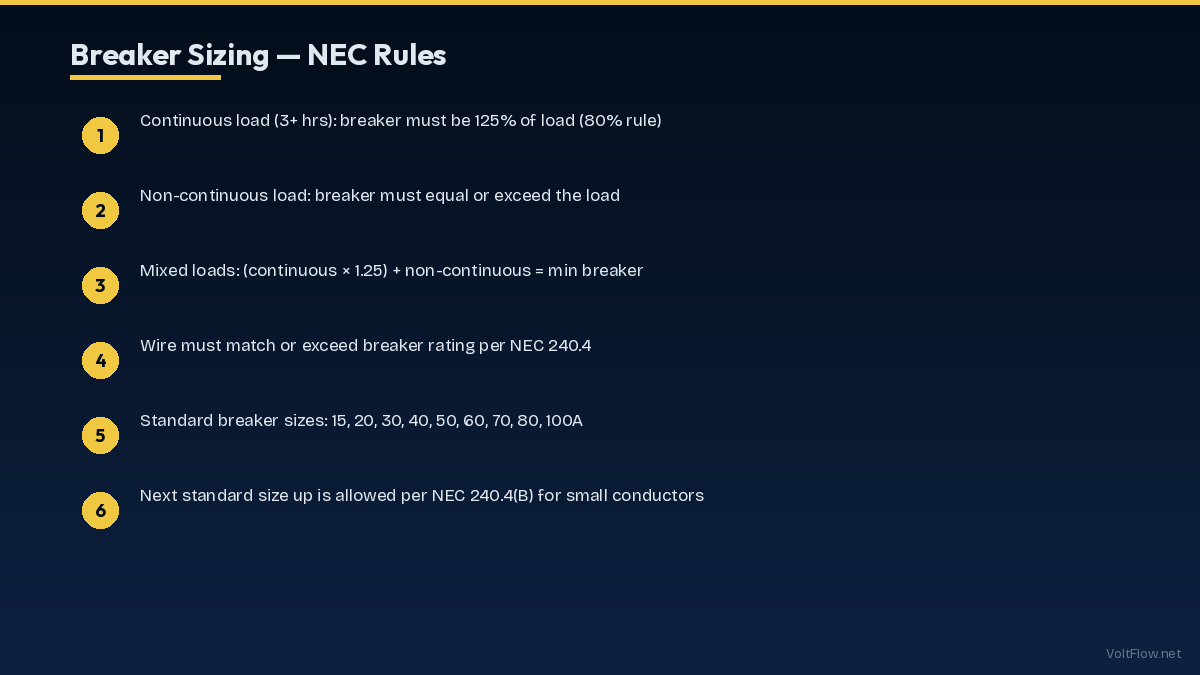
The fundamental rule of breaker sizing is that the breaker protects the wire, not the appliance. The breaker rating must not exceed the ampacity of the wire it protects per NEC 240.4. If the wire is rated for 20 amps, the breaker must be 20 amps or less. A larger breaker allows more current than the wire can safely carry, causing the wire to overheat inside the wall before the breaker trips. This is how electrical fires start. The standard residential wire-to-breaker pairings per NEC Table 310.16 at 60-degree terminations are: 14 AWG copper wire gets a 15-amp breaker, 12 AWG copper gets a 20-amp breaker, 10 AWG copper gets a 30-amp breaker, 8 AWG copper gets a 40-amp breaker, 6 AWG copper gets a 55-amp breaker (typically a 50-amp breaker since 55-amp breakers are not standard), 4 AWG copper gets a 70-amp breaker (typically a 60-amp or 70-amp breaker), and 3 AWG copper gets an 85-amp breaker. For aluminum conductors, each wire size has a lower ampacity, so the breaker must be correspondingly smaller: 12 AWG aluminum gets 15 amps, 10 AWG gets 25 amps, 8 AWG gets 30 amps, 6 AWG gets 40 amps, 4 AWG gets 55 amps, and 2 AWG gets 75 amps. NEC 240.4(D) provides specific limitations for small conductors. It explicitly states that 14 AWG copper must be protected at no more than 15 amps, 12 AWG at no more than 20 amps, and 10 AWG at no more than 30 amps, regardless of the allowable ampacity from the table. This eliminates any ambiguity about using temperature correction or other adjustments to put a larger breaker on small wire. The wire gauge in NM-B cable determines the maximum breaker size automatically. When you buy 12/2 NM-B cable, you are buying a cable that is only appropriate for 20-amp circuits. Putting it on a 30-amp breaker violates NEC 240.4(D) and creates a fire hazard. This is one of the most commonly violated and most dangerous electrical code provisions in residential construction. Always verify that the wire in the circuit matches the breaker before energizing any circuit, whether new work or modifications to existing circuits.
The 125% Rule for Continuous Loads
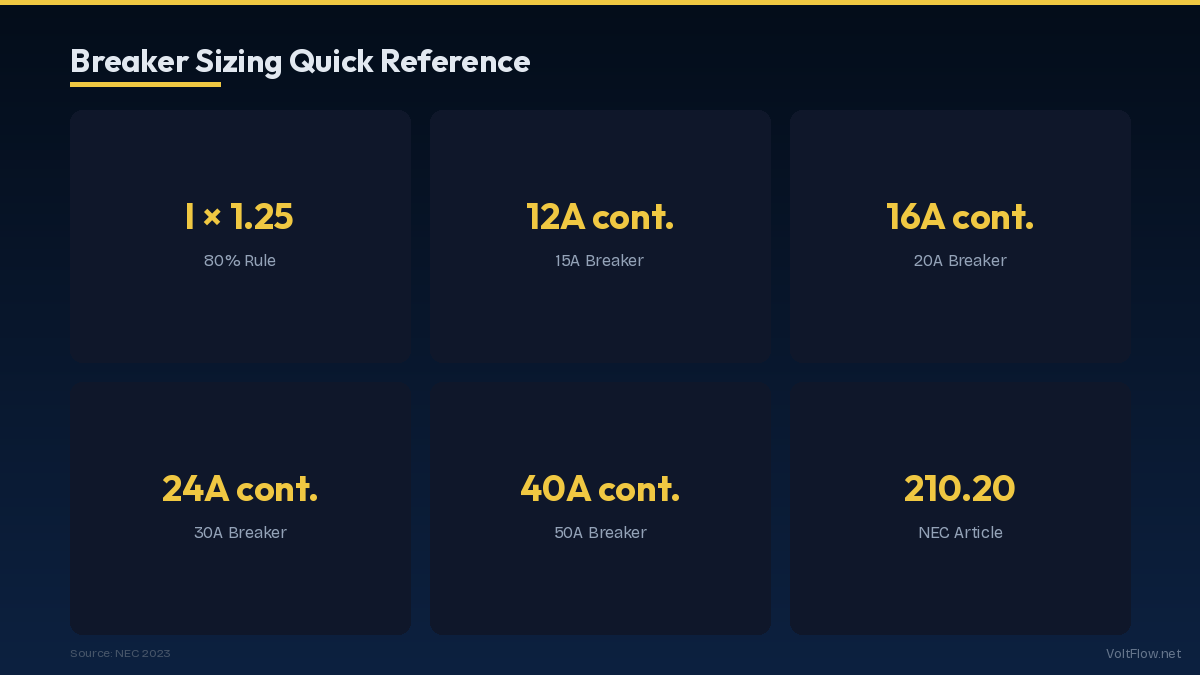
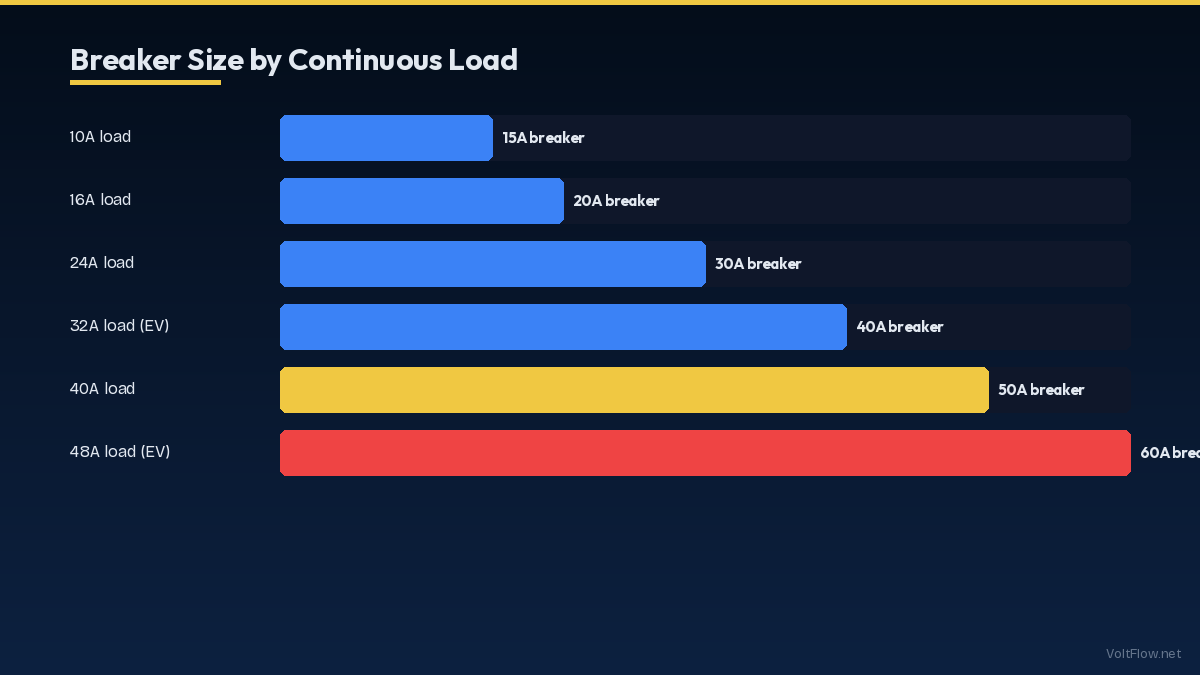
NEC 210.20(A) requires that the branch circuit breaker rating be not less than 125 percent of the continuous load plus 100 percent of the non-continuous load. A continuous load is defined by NEC Article 100 as a load where the maximum current is expected to continue for three hours or more. This 125 percent rule is one of the most important and most frequently misunderstood breaker sizing requirements. Common residential continuous loads include EV chargers that run for 4-10 hours per charge session, electric water heaters that heat for 3 or more hours during heavy use, electric baseboard heaters that run continuously during cold weather, outdoor lighting that operates from dusk to dawn, and pool pumps that run 6-10 hours per day. For an EV charger rated at 40 amps continuous, the breaker must be at least 40 times 1.25 equals 50 amps. The wire must also be sized for the breaker, so 6 AWG copper rated for 55 amps at 60-degree terminations supports the 50-amp breaker. A common mistake is installing a 40-amp breaker on a 40-amp EV charger because the numbers match. While the breaker will not trip immediately, it operates at 100 percent of rating for hours at a time, generating excessive heat in the breaker mechanism that accelerates wear and can eventually cause failure. The 125 percent rule provides the thermal headroom necessary for reliable long-term operation. For a 48-amp EV charger, the calculation is 48 times 1.25 equals 60 amps, requiring a 60-amp breaker and 4 AWG copper wire. This is the maximum practical residential EV charging setup and requires a panel with available capacity for a 60-amp double-pole breaker. For electric water heaters rated at 4,500 watts on 240 volts, the load is 18.75 amps. Applying the 125 percent rule: 18.75 times 1.25 equals 23.4 amps, requiring a 25-amp or 30-amp breaker (30 amps is the standard size available). The wire must be 10 AWG copper to support the 30-amp breaker. Non-continuous loads like kitchen countertop circuits, bedroom circuits, and most general-purpose circuits do not require the 125 percent calculation. A 20-amp kitchen circuit can serve loads up to 20 amps because normal kitchen appliance use is intermittent, not sustained for three hours. However, if you know a specific outlet will serve a continuous load like a space heater running all night, the 125 percent rule applies to that specific load on that circuit.
Breaker Sizing for 240-Volt Circuits
Residential 240-volt circuits use double-pole breakers that occupy two adjacent slots in the panel. Each pole connects to one of the two 120-volt legs, providing 240 volts between them. The breaker rating applies to each leg, meaning a 50-amp double-pole breaker allows 50 amps on each leg. Common 240-volt residential circuits and their breaker sizes include central air conditioning units which typically need a 30-amp or 40-amp breaker depending on the unit tonnage. The outdoor unit nameplate specifies both the Minimum Circuit Ampacity or MCA and the Maximum Overcurrent Protection Device or MOCP. The breaker must be at least as large as the MCA but no larger than the MOCP. For a unit with MCA 19.7 and MOCP 35, you install a 30-amp or 35-amp breaker and wire sized for the breaker rating. Electric ranges require a 50-amp breaker with 6 AWG copper wire and a NEMA 14-50 outlet. Some smaller ranges and cooktops work on 40-amp breakers with 8 AWG wire. Always check the appliance nameplate or installation manual for the specific breaker requirement. Electric dryers use a 30-amp breaker with 10 AWG copper wire and a NEMA 14-30 outlet. This is one of the most standardized residential circuits and has not changed in decades. Hot tubs and spas typically require a 50-amp or 60-amp GFCI breaker depending on the heater wattage. A 240-volt hot tub with a 5,500-watt heater and two pump motors may draw 40-50 amps, requiring a 50-amp or 60-amp breaker with appropriate wire. NEC 680 requires GFCI protection for all spa and hot tub circuits, and the GFCI breaker must be readily accessible. Well pumps use breaker sizes matching the pump motor nameplate, typically 15-amp to 30-amp depending on the pump horsepower. A 1 HP submersible pump typically draws 10-12 amps at 240 volts, requiring a 15-amp or 20-amp breaker with 12 AWG or 10 AWG wire. Electric tankless water heaters are among the largest residential electrical loads, requiring 100-150 amps across multiple circuits. A whole-house tankless unit may need three 40-amp double-pole breakers, each serving one heating element. The combined 120-amp load requires careful panel capacity planning and may necessitate a 200-amp panel upgrade if the existing panel lacks capacity.
AFCI, GFCI, and Dual-Function Breaker Selection
Beyond sizing, you must select the correct breaker type for each circuit location per NEC requirements. Standard breakers provide overcurrent protection only. AFCI, GFCI, and dual-function breakers add specialized fault detection that the NEC requires in specific locations throughout the home. AFCI breakers are required on virtually all 15-amp and 20-amp 120-volt circuits in living spaces including bedrooms, living rooms, kitchens, laundry rooms, hallways, closets, and basements per NEC 210.12. AFCI breakers cost $30-$45 each compared to $5-$12 for standard breakers. They detect arc faults caused by damaged or deteriorating wiring and trip before an arc can ignite surrounding materials. When sizing an AFCI circuit, the same ampacity and continuous load rules apply, the AFCI function is an additional protection layer that does not change the sizing calculation. GFCI breakers are required for circuits serving bathrooms, garages, outdoor outlets, crawl spaces, unfinished basements, kitchen countertop receptacles within 6 feet of a sink, and laundry sinks per NEC 210.8. GFCI breakers cost $25-$40 each and detect ground faults as small as 4-6 milliamps, tripping before the leakage current can cause electrocution. GFCI protection can be provided at the breaker or at the first outlet in the circuit using a GFCI outlet that protects all downstream devices. Breaker-based GFCI is preferred for simplicity but outlet-based GFCI is acceptable and often more convenient for troubleshooting when trips occur. Dual-function AFCI/GFCI breakers provide both types of protection in a single device at $40-$55 each. These are required wherever both AFCI and GFCI protection apply to the same circuit, such as kitchen circuits, laundry circuits, and garage circuits. Using a single dual-function breaker is more cost-effective and space-efficient than combining separate AFCI breakers with GFCI outlets. Breaker compatibility is critical. AFCI, GFCI, and dual-function breakers are panel-brand-specific. A Square D AFCI breaker fits only Square D panels. An Eaton GFCI breaker fits only Eaton panels. Never install a breaker from a different manufacturer than the panel, even if it physically fits. Mismatched breakers may not trip properly during fault conditions, defeating the purpose of the protection. When purchasing specialty breakers, note your panel brand and model number to ensure compatibility.
Breaker Sizing for Sub-Panels and Feeders
Sub-panel breaker sizing follows different rules than branch circuit sizing because the breaker protects the feeder cable between the main panel and the sub-panel rather than protecting individual circuits. The sub-panel breaker in the main panel must be sized to match the feeder wire ampacity and the sub-panel bus bar rating, whichever is smaller. For a 60-amp sub-panel in a detached garage, you install a 60-amp double-pole breaker in the main panel and run 6 AWG copper wire or 4 AWG aluminum wire as the feeder. The sub-panel bus bar must be rated for at least 60 amps. Inside the sub-panel, individual branch circuit breakers are sized according to standard rules for each circuit they protect. The sub-panel breaker in the main panel does not need the 125 percent continuous load sizing because the feeder serves diverse loads that do not all run continuously. However, if the sub-panel feeds only continuous loads like a workshop with multiple machine tools running for hours, the 125 percent rule could apply to the feeder calculation. For a 100-amp sub-panel, you need 3 AWG copper or 1 AWG aluminum wire with a 100-amp breaker. For a 125-amp sub-panel, you need 1 AWG copper or 2/0 aluminum with a 125-amp breaker. Always include voltage drop in feeder calculations. Long runs to detached buildings frequently require one or two wire sizes larger than the minimum ampacity requirement to maintain acceptable voltage at the sub-panel. A 60-amp feeder using 6 AWG copper over 100 feet has approximately 3.2 percent voltage drop, slightly over the 3 percent recommendation. Upgrading to 4 AWG copper reduces the drop to 2 percent and costs about $150 more in wire for a typical run. The sub-panel must have separate neutral and ground buses. Unlike the main panel where neutral and ground are bonded together, the sub-panel keeps them separate with the ground bus bonded to the panel enclosure and the neutral bus floating. This ensures fault current returns to the main panel through the equipment grounding conductor rather than through the neutral, which is essential for proper ground fault detection by GFCI devices. The feeder cable must include four conductors: two hots, one neutral, and one equipment grounding conductor. Three-wire feeders without a separate ground are a code violation for new sub-panel installations and should be upgraded when encountered during renovations.
Common Breaker Sizing Mistakes to Avoid
Breaker sizing errors are among the most common electrical code violations and safety hazards in residential wiring. These mistakes range from simple oversights to fundamental misunderstandings of how breakers protect circuits. Oversizing the breaker to prevent nuisance tripping is the most dangerous common mistake. When a 20-amp breaker trips repeatedly, replacing it with a 30-amp breaker seems like a simple fix. But if the circuit uses 12 AWG wire rated for only 20 amps, the 30-amp breaker allows 50 percent more current than the wire can safely carry. The wire overheats inside the wall, potentially starting a fire long before the breaker trips. The correct response to a tripping breaker is to identify and fix the cause, either reduce the load on the circuit or run a new circuit with appropriately sized wire and breaker. Ignoring the continuous load rule is extremely common with EV charger installations. Homeowners or inexperienced installers connect a 40-amp EV charger to a 40-amp breaker because the numbers match. While this does not cause immediate failure, the breaker operates at its maximum rating for hours every night, generating excessive heat that degrades the breaker mechanism over months and years. The correct sizing is a 50-amp breaker for a 40-amp continuous load. Using the wrong breaker type for the panel is a compatibility issue that can have serious safety consequences. Each panel brand uses a specific bus bar design that matches only their breakers. A breaker that physically fits into a panel from a different manufacturer may not make proper contact with the bus bars, creating a high-resistance connection that overheats. Square D QO breakers fit only QO panels. Eaton CH breakers fit only CH panels. Siemens breakers fit only Siemens panels. Do not mix brands regardless of physical compatibility claims from third-party breaker manufacturers. Failing to account for ambient temperature in hot environments can lead to breaker nuisance tripping. Breakers installed in panels exposed to direct sunlight or located in unconditioned attics may operate at elevated temperatures that reduce their trip threshold. A 20-amp breaker at 40 degrees Celsius ambient trips at approximately 16-17 amps instead of 20 amps. If your panel is in a hot location and breakers trip at loads below their rating, the ambient temperature is the likely cause. Relocating the panel, improving ventilation, or upsizing breakers by one standard size with correspondingly larger wire can resolve this issue. Double-tapping, which is connecting two wires to a single breaker terminal designed for one wire, is a code violation and fire hazard. If your panel is full and you need additional circuits, use approved tandem breakers in slots that accept them, add a sub-panel, or upgrade to a larger panel. Never force two wires under one screw terminal.