Solar Battery Storage Cost 2026: Complete Home Battery Pricing Guide
Home battery storage costs have dropped significantly but remain a major investment. In 2026, a typical 10-15 kWh home battery system costs $10,000-$18,000 installed, with the 30% federal tax credit reducing that to $7,000-$12,600. Whether a battery makes financial sense depends on your electricity rate structure, net metering policy, and how much you value backup power. This guide covers pricing for every major battery, installation costs, and payback calculations.
Battery Prices by Brand and Capacity in 2026
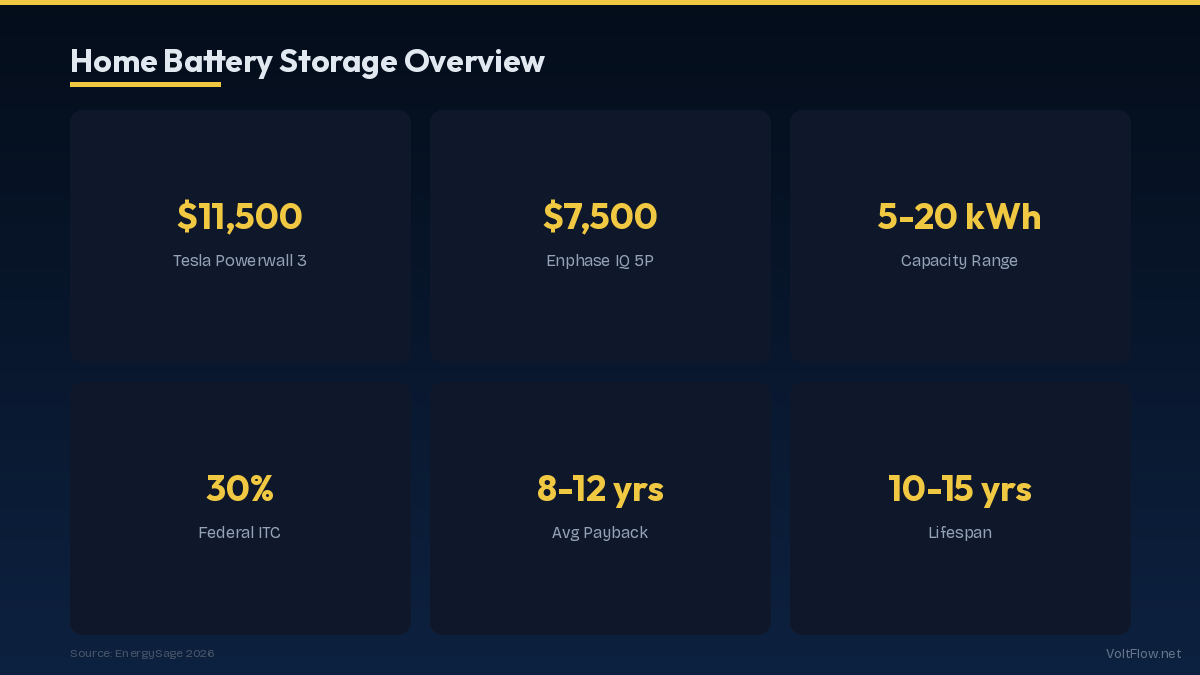
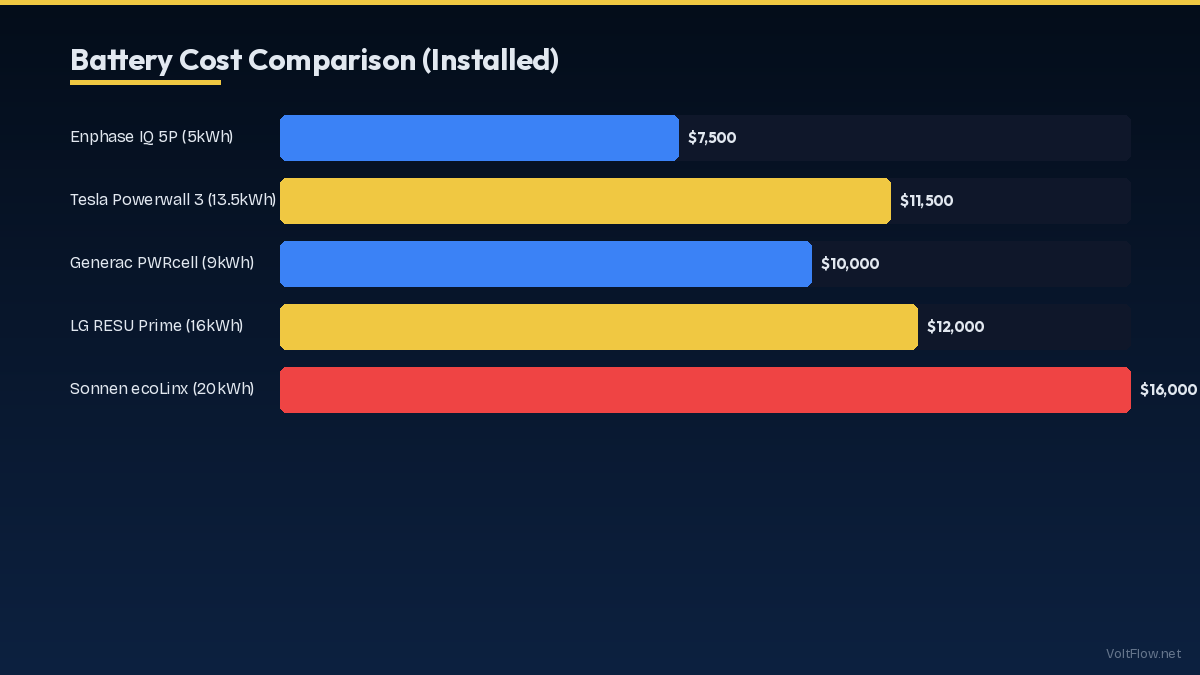
The home battery market in 2026 is dominated by a handful of established brands, each offering different capacities, chemistries, and feature sets at varying price points. The Tesla Powerwall 3 remains the most popular residential battery at $8,500-$9,500 for the unit before installation. It provides 13.5 kWh of usable capacity with a continuous power output of 11.5 kW and peak output of 22 kW. The integrated inverter eliminates the need for a separate solar inverter, reducing total system cost for new solar-plus-battery installations. Tesla installation through their certified installer network adds $3,000-$5,000, bringing total installed cost to $11,500-$14,500 before the federal tax credit. The Enphase IQ Battery 5P offers a modular approach with 5 kWh units that can be stacked to 40 kWh or more. Each 5 kWh unit costs approximately $5,500-$6,500 installed. For a 15 kWh system comparable to the Powerwall, total installed cost runs $16,500-$19,500 before credits. The modular design allows you to start small and add capacity later, which appeals to homeowners who want to test battery economics before committing to a large system. The Enphase system works exclusively with Enphase microinverters, so it is the natural choice for homes already using the Enphase solar ecosystem. The Generac PWRcell targets the backup power market at $12,000-$18,000 installed for a 9-18 kWh configuration. The PWRcell integrates with Generac home standby generator ecosystem, offering a hybrid battery-plus-generator solution that provides both daily energy management and extended backup capability during multi-day outages. The Franklin Whole Home Battery (formerly known as FranklinWH) costs $13,000-$16,000 installed for a 13.6 kWh system. It includes an integrated transfer switch and gateway that manages the interaction between solar, battery, grid, and generator inputs. The SolarEdge Home Battery at $10,000-$13,000 installed for a 9.7 kWh unit integrates with SolarEdge optimized solar inverter systems. It uses the same DC bus as the solar inverter, improving round-trip efficiency to 90-94 percent compared to 85-90 percent for AC-coupled systems. For homes already using SolarEdge inverters, this battery adds the least complexity and achieves the best energy efficiency. BYD, Sonnen, and LG Energy Solution round out the market with competitive products ranging from $8,000-$16,000 installed depending on capacity and configuration. Competition among these brands has driven prices down 30-40 percent over the past five years and continues to put downward pressure on installed costs.
Installation Costs and What They Include
The battery unit itself represents 50-65 percent of the total installed cost. Installation labor and supporting hardware make up the remaining 35-50 percent, and understanding these costs helps you evaluate quotes and identify potential savings. Electrical work is the largest installation cost component at $1,500-$3,500. This covers installing the battery disconnect switch, running wire from the battery to the electrical panel, installing the critical loads panel or transfer switch that manages which circuits receive backup power during outages, and configuring the system with your existing solar inverter and utility meter. If your home needs a main panel upgrade to accommodate the battery connection, add $1,800-$3,500 for the panel work. Permitting and inspection fees run $200-$500 depending on your jurisdiction. Most cities and counties require an electrical permit for battery installation, and some require a separate building permit if the battery is mounted on an exterior wall or in a structure that needs seismic anchoring. The permit process adds one to four weeks to the timeline and requires the installer to schedule an inspection after completion. Mounting hardware and enclosure costs range from $200-$600. Indoor installations require a battery-rated wall mount and adequate ventilation space. Outdoor installations need a weatherproof enclosure if the battery is not rated for outdoor use. The Tesla Powerwall is rated for outdoor installation without an additional enclosure, while some other brands require indoor installation or an optional outdoor-rated cabinet. The critical loads panel, also called a backup loads panel, costs $300-$800 for the panel itself plus $500-$1,500 for the electrician to transfer circuits from your main panel to the critical loads panel. This sub-panel contains only the circuits you want powered during an outage, typically the refrigerator, lighting, internet router, garage door, and a few outlets. Whole-home backup without a critical loads panel is possible with larger battery systems like two Powerwalls but requires adequate battery capacity to handle all circuits including high-draw items like the AC compressor and electric range. System commissioning includes programming the battery management system, configuring the solar-battery-grid interaction settings, registering the system with your utility for interconnection approval, and enrolling in any virtual power plant or demand response programs. This takes 1-2 hours of electrician time and is typically included in the installation quote. When comparing quotes from multiple installers, ensure each quote includes all these components. Low-ball quotes sometimes exclude the critical loads panel, permitting fees, or utility interconnection paperwork, leaving you with unexpected additional costs after signing the contract.
Federal Tax Credit and State Incentives
The 30 percent federal Investment Tax Credit under Section 48 of the Internal Revenue Code applies to battery storage systems installed through 2032, regardless of whether the battery is paired with solar panels. This is a significant change from earlier tax credit rules that required the battery to be charged primarily from solar to qualify. In 2026, a standalone battery added to an existing home qualifies for the full 30 percent credit even if no solar panels are installed. For a $14,000 installed battery system, the federal credit reduces your net cost to $9,800. The credit is claimed on IRS Form 5695 with your annual tax return. It is a tax credit, not a deduction, meaning it directly reduces your tax owed dollar for dollar. If your tax liability in the installation year is less than the credit amount, the excess carries forward to future tax years. State-level incentives stack on top of the federal credit in many markets. California Self-Generation Incentive Program or SGIP provides rebates of $200-$1,000 per kWh of battery capacity, potentially adding $2,000-$15,000 in rebates for residential batteries. The exact amount depends on your income level, location, and the current incentive step. Low-income households in high-fire-threat districts receive the highest rebates. Massachusetts offers the ConnectedSolutions program that pays battery owners $225-$275 per kW per summer season for allowing the utility to dispatch stored energy during peak demand events. For a 10 kW battery, this generates $2,250-$2,750 per year in program payments, dramatically improving the battery payback calculation. Oregon provides a state tax credit of up to $5,000 for residential battery storage through the Energy Trust of Oregon. Vermont offers a $10,500 incentive through Green Mountain Power for customers who allow the utility to use their battery for grid support during peak events. Maryland provides a $5,000 state tax credit for battery installations. Many utility companies offer their own battery incentive programs independent of state programs. These typically take the form of monthly bill credits for enrolling in demand response or virtual power plant programs. Check with your specific utility for available programs. When stacking federal and state incentives, it is possible to reduce the out-of-pocket cost of a $14,000 battery system to $4,000-$7,000 in the most generous incentive markets. The combination of federal credit, state rebate, and utility program payments can produce a battery payback period of 3-5 years in the best scenarios, compared to 8-12 years without incentives.
When Does a Battery Make Financial Sense?
The financial case for home battery storage depends on your specific utility rate structure and net metering policy. In some markets, a battery pays for itself in 5-7 years. In others, the payback exceeds the battery warranty period, making it a poor financial investment regardless of the backup power value. Batteries make the strongest financial case in markets with time-of-use rates that have large peak-to-off-peak differentials. If your utility charges $0.40 per kWh from 4-9 PM and $0.15 per kWh overnight, a battery that charges from solar or off-peak grid power and discharges during peak hours saves $0.25 per kWh shifted. A 13.5 kWh battery cycling daily saves approximately $3.38 per day or $1,233 per year from TOU arbitrage alone. At an after-credit cost of $8,000-$10,000, the payback is 6-8 years. Batteries also make strong financial sense in markets that have moved from full retail net metering to net billing or reduced export credits. California NEM 3.0 credits solar exports at only $0.05-$0.08 per kWh while retail import rates are $0.30-$0.45 per kWh. A battery that stores midday solar surplus and uses it during evening peak hours converts $0.06 per kWh export credits into $0.35 per kWh avoided imports, a $0.29 per kWh value gain. This makes batteries nearly essential for financial optimization of solar systems under NEM 3.0. Demand charge management makes batteries valuable for the small but growing number of residential customers on demand rate plans. These plans charge based on your highest instantaneous power draw during peak hours, not just total consumption. A battery that limits grid draws to 5 kW during peak hours by supplementing with stored energy can reduce monthly demand charges by $20-$50, adding $240-$600 per year in savings. Batteries make a weaker financial case in markets with flat electricity rates below $0.15 per kWh and full retail net metering. In these markets, the battery has little opportunity for arbitrage because the rate does not vary by time, and net metering already provides full value for solar exports. The primary financial benefit is avoided power outage costs, which are difficult to quantify but meaningful for homeowners who work from home, have medical equipment, or live in areas with unreliable grid service. The non-financial value of backup power is significant and personal. If you experience multiple power outages per year lasting hours or days, the value of keeping your refrigerator, lights, internet, and medical equipment running is substantial. Many battery buyers report that the peace of mind from backup power alone justified their purchase even if the financial payback is longer than ideal.
Battery Sizing: How Much Storage Do You Need?
Choosing the right battery capacity involves balancing your energy goals against your budget. Undersizing means the battery drains before you need it most, while oversizing wastes money on capacity you never use. The right size depends on whether your primary goal is energy arbitrage, self-consumption maximization, or backup power resilience. For TOU rate arbitrage, you need enough capacity to cover your evening peak consumption from approximately 4 PM to 9 PM when rates are highest. The average American home consumes 3-5 kWh during these evening hours for lighting, cooking, entertainment, and background loads. A 10 kWh battery covers this peak window for most homes with capacity to spare. Larger homes with higher evening consumption may benefit from 13-15 kWh to avoid grid purchases during the entire peak window. For solar self-consumption maximization, the ideal battery size captures your midday solar surplus and releases it during evening and nighttime hours. Analyze your solar production data and evening consumption patterns to determine the daily surplus. If your solar system produces 8 kWh more than you consume during midday hours, a 10 kWh battery captures virtually all of this surplus with a small buffer for system losses. A 5 kWh battery would capture only about 60 percent of the surplus, leaving the remainder to be exported at lower net billing rates. For whole-home backup power during outages, you need to calculate your critical loads and desired backup duration. Minimal backup covering the refrigerator, lights, internet, and a few outlets draws approximately 1-2 kW average, meaning a 13.5 kWh battery provides 7-13 hours of minimal backup. If you add the HVAC system, the draw jumps to 3-5 kW and a single battery provides only 3-4 hours. For full-day backup with HVAC, you need 25-40 kWh of battery capacity, requiring two or three battery units. For extended multi-day backup during storms or grid emergencies, a battery-plus-solar combination is essential. The solar system recharges the battery each day, providing indefinite backup as long as the sun shines. A 10 kWh battery paired with a 5 kW solar system can sustain critical loads indefinitely through a multi-day outage in most weather conditions. Without solar recharging, even large battery systems drain within 12-24 hours under typical household loads. Most residential battery buyers in 2026 choose 10-15 kWh of capacity, which provides effective TOU arbitrage, captures most solar surplus, and delivers 6-12 hours of backup for critical loads. This sweet spot balances cost at $10,000-$15,000 after credits with meaningful daily savings and adequate backup protection for the majority of outage scenarios.
Battery Lifespan, Warranty, and Long-Term Value
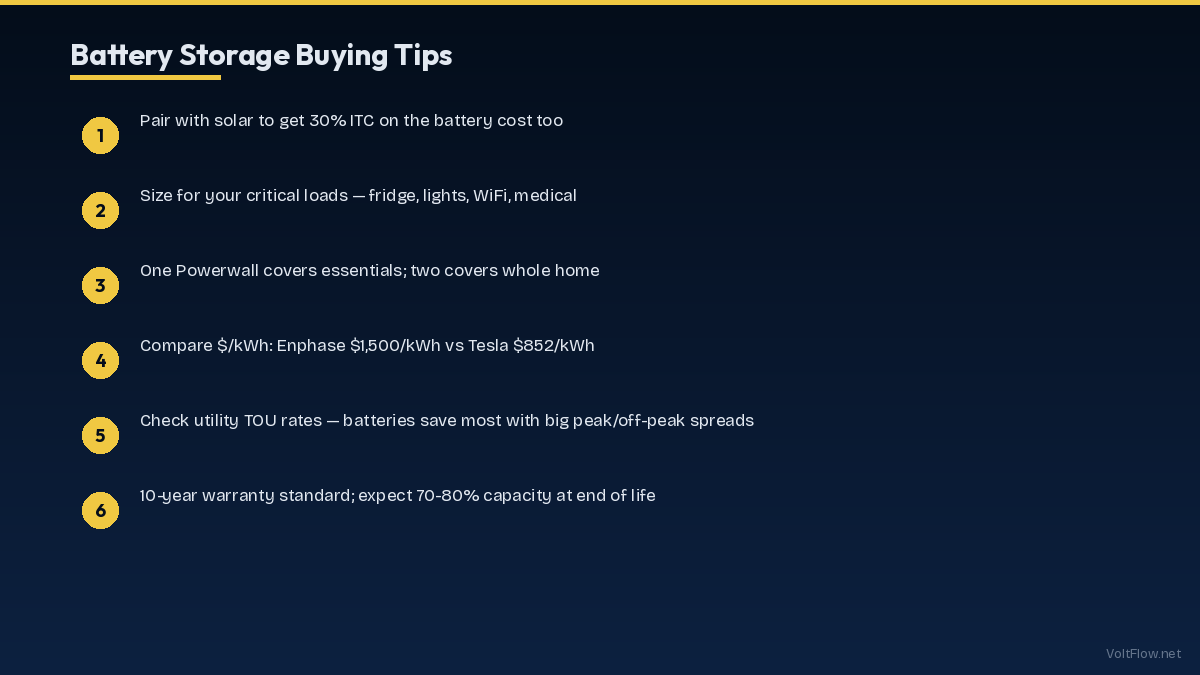
Home battery warranties typically guarantee 10 years of operation with at least 70-80 percent of original capacity retained, but actual useful lifespan extends to 12-15 years for quality lithium-ion systems. Understanding warranty terms and degradation rates helps you project long-term value accurately. The Tesla Powerwall warranty guarantees unlimited cycles for 10 years with at least 70 percent capacity retention. At 70 percent of 13.5 kWh, you retain 9.45 kWh of usable capacity at warranty end, still meaningful for both arbitrage and backup applications. Tesla provides a simple warranty without complex cycle count or throughput limitations, making it the most straightforward warranty in the market. The Enphase IQ Battery warranty covers 10 years or 4,000 cycles, whichever comes first. At one cycle per day, the 4,000-cycle limit is reached in approximately 11 years, so the time limit is typically the binding constraint. Capacity retention is guaranteed at 80 percent after 4,000 cycles, slightly better than the Tesla 70 percent guarantee. The Generac PWRcell warranty covers 10 years with capacity retention based on the energy throughput model specific to the battery configuration. SolarEdge and Franklin offer similar 10-year warranties with 70 percent capacity retention guarantees. Real-world degradation data from early residential battery installations suggests that quality lithium iron phosphate or LFP batteries retain 85-90 percent capacity after 10 years of daily cycling, outperforming the conservative warranty guarantees. NMC chemistry batteries used in some systems may degrade slightly faster at 80-85 percent after 10 years but offer higher energy density per unit weight and volume. After the warranty period, batteries do not suddenly stop working. They continue to function with gradually declining capacity. A battery that retains 75 percent of original capacity at year 12 still provides substantial value for both arbitrage and backup, just with reduced duration. Many homeowners will choose to continue using their battery well past the warranty period rather than replacing it, especially if the daily savings still exceed any maintenance costs. Replacement cost at year 10-15 will be substantially lower than today installation cost due to continued technology improvement and manufacturing scale. Just as solar panel costs dropped 90 percent over a decade, battery costs are on a similar trajectory. A replacement battery in 2036 may cost 40-60 percent of what you pay today for equivalent capacity, making the long-term cost of battery ownership more attractive than initial purchase prices suggest. For financial modeling purposes, assume a 12-year useful life with 80 percent average capacity over that period. This conservative estimate captures both the warranty period and the extended functional period beyond warranty. At an after-credit cost of $9,000 and annual savings of $1,200, the 12-year lifetime produces total savings of $14,400, a net positive return of $5,400 or approximately 60 percent total return on investment over the battery lifetime.