How Many Solar Panels to Power a House in 2026? Complete Sizing Guide
The average American home needs 15-25 solar panels to cover its full electricity consumption, depending on location, energy usage, and panel wattage. In 2026, with standard 400-watt panels, a typical home using 10,500 kWh per year needs about 20 panels covering roughly 350 square feet of roof space. This guide walks you through the exact calculation for your home, factors that affect panel count, and how to optimize your system size for maximum savings.
The Solar Panel Sizing Formula Explained
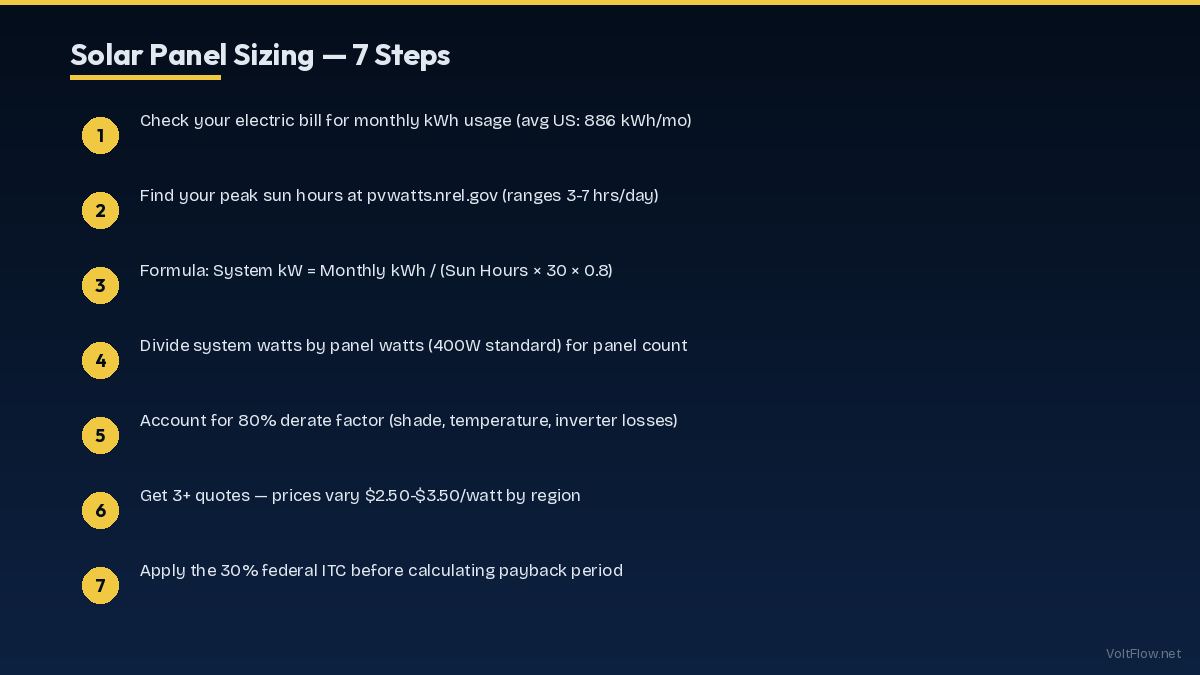
Calculating how many solar panels you need is straightforward once you understand the three inputs: your annual electricity consumption, your location peak sun hours, and the wattage of the panels you plan to install. The formula is annual kWh consumption divided by 365 days divided by peak sun hours divided by panel wattage times 1,000 equals number of panels. Start with your annual electricity consumption. Pull your last 12 monthly electric bills and add up the total kWh used. The average American household consumes approximately 10,500 kWh per year, but this varies dramatically by region. Homes in the South and Southwest average 12,000-14,000 kWh due to air conditioning, while homes in the Pacific Northwest average 8,000-9,500 kWh. Your utility bill shows monthly kWh consumption, and many utilities provide annual summaries in December or January. Next, determine your peak sun hours. This measures the average daily solar energy available at your location, expressed in equivalent hours of full sunshine. Phoenix averages 6.5 peak sun hours, Miami gets 5.5, New York gets 4.5, Seattle gets 3.5, and Anchorage gets 3.0. The National Renewable Energy Laboratory provides detailed solar resource maps at their PVWatts calculator website. Finally, choose your panel wattage. In 2026, residential panels commonly range from 370 to 430 watts. The most popular residential panels are 400-watt models from manufacturers like REC, QCells, Canadian Solar, and LONGi. Higher-wattage panels of 430 watts or more cost slightly more per panel but reduce the total number needed, saving on mounting hardware and installation labor. Working through the formula for an average home: 10,500 kWh per year divided by 365 equals 28.8 kWh per day. In a location with 5 peak sun hours, you need 28.8 divided by 5 equals 5.76 kW of solar capacity. With 400-watt panels, that is 5,760 divided by 400 equals 14.4 panels, rounded up to 15 panels. This formula gives you a starting point. Real-world factors like panel orientation, shading, system losses, and your net metering policy affect the actual number. Most solar installers add a 15-25 percent buffer to account for these losses, bringing our example to 17-19 panels. This buffer ensures your system produces enough electricity to cover your full consumption even during cloudy months and after accounting for inverter efficiency losses of 3-5 percent and wiring losses of 1-2 percent.
Panel Count by Home Size and Energy Usage
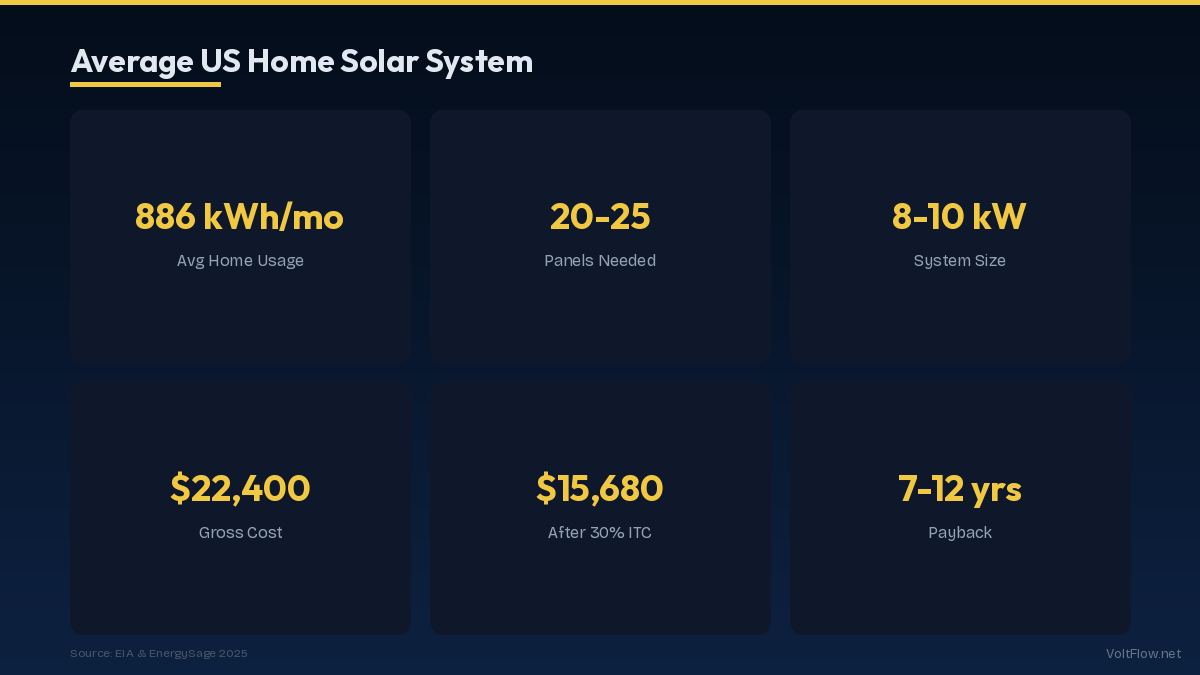
While the formula above gives exact numbers for your situation, general guidelines based on home size provide a useful starting point for planning. A small home or apartment of 1,000-1,500 square feet typically uses 6,000-8,000 kWh per year and needs 10-15 solar panels, covering about 175-260 square feet of roof. Total system cost before incentives runs $8,000-$12,000 with the federal tax credit bringing it to $5,600-$8,400. Monthly savings of $80-$120 depending on local electricity rates produce a payback period of five to eight years. A medium home of 1,500-2,500 square feet typically uses 9,000-12,000 kWh annually and needs 16-22 panels covering 280-385 square feet of roof. System cost runs $12,000-$18,000 gross or $8,400-$12,600 after the federal credit. Monthly savings of $120-$180 produce a payback period of five to eight years in most markets. A large home of 2,500-4,000 square feet consuming 13,000-20,000 kWh annually needs 23-35 panels covering 400-615 square feet. System cost runs $18,000-$28,000 gross or $12,600-$19,600 after credit. Larger systems have a slightly lower cost per watt due to economies of scale, and the higher monthly savings of $180-$300 can produce payback periods as short as four to six years in high-electricity-rate states. These estimates assume average energy usage patterns for each home size. However, specific factors can dramatically change your panel count. A 2,000-square-foot home with an EV that adds 4,000 kWh of annual charging needs the same system as a 3,500-square-foot home without an EV. A home with a pool pump adds 2,000-3,000 kWh per year. All-electric homes with heat pumps and no natural gas use 15,000-25,000 kWh regardless of size. Cryptocurrency mining rigs, home servers, and grow operations can easily double a home electricity consumption. The most accurate approach is always to use your actual consumption from utility bills rather than estimating based on home size. If you are planning to add an EV charger, heat pump, or other major electrical load, include that projected consumption in your calculation so your solar system is sized for your future needs rather than your current ones. Adding panels later costs more per watt than including them in the original installation due to mobilization costs and permitting fees.
How Location Affects the Number of Panels Needed
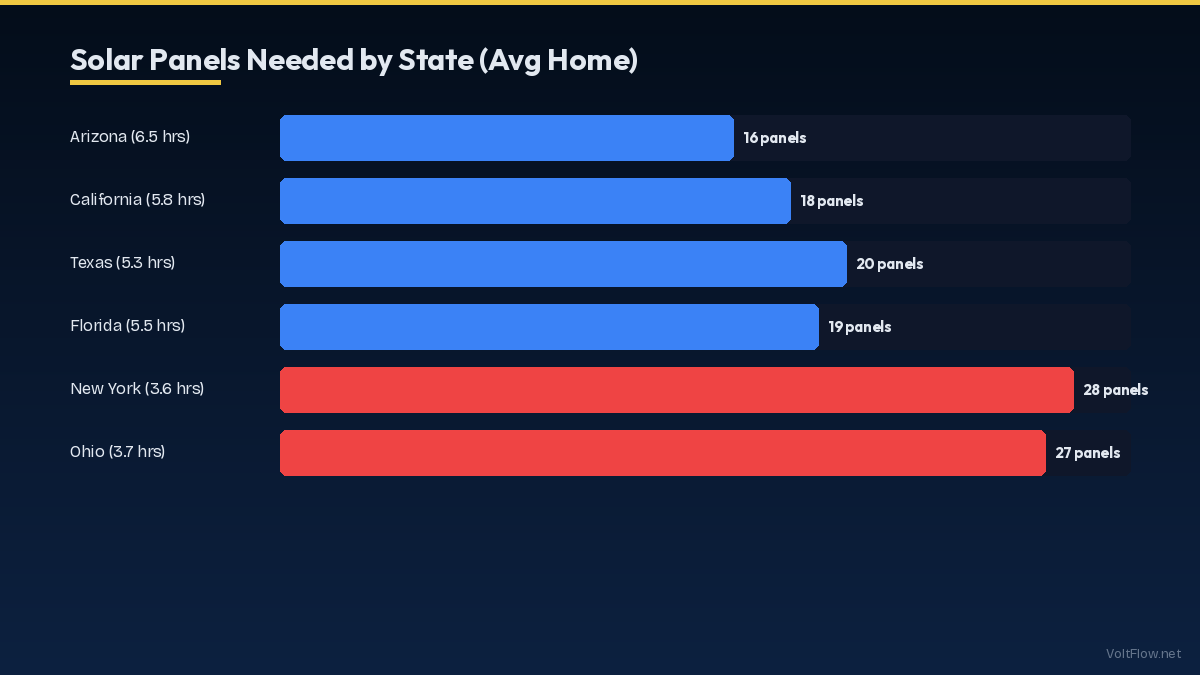
Your geographic location is the second most important factor after energy consumption in determining panel count. The difference between the sunniest and cloudiest major cities in the US requires nearly double the panels for the same energy offset. Phoenix, Arizona leads the nation with approximately 6.5 peak sun hours daily. A home consuming 10,500 kWh per year needs only 12 panels at 400 watts each. The abundant sunshine also means panels produce close to their rated output for more months of the year, reducing the seasonal variation that affects less sunny locations. Las Vegas, Denver, Albuquerque, and Sacramento sit in the next tier with 5.5-6.0 peak sun hours. These locations need 14-15 panels for the same 10,500 kWh offset. The combination of abundant sunshine and rapidly growing solar markets makes these cities among the most cost-effective for solar installation, with competitive installer pricing and streamlined permitting. Miami, Houston, Dallas, Atlanta, and Charlotte represent the middle tier at 4.5-5.5 peak sun hours. These Sun Belt cities need 15-18 panels for 10,500 kWh. While they receive less intense sunshine than the desert Southwest, they compensate with long summer days and mild winters that maintain reasonable year-round production. Humidity and afternoon thunderstorms reduce production compared to arid climates with the same latitude. New York, Chicago, Philadelphia, Boston, and Washington DC sit at 4.0-4.5 peak sun hours. These cities need 18-21 panels for 10,500 kWh. Despite less sunshine, these markets often have the fastest solar payback periods because their electricity rates are among the highest in the nation at $0.20-$0.35 per kWh. Higher rates mean each kilowatt-hour your panels produce saves more money. Seattle, Portland, Cleveland, Buffalo, and Minneapolis represent the lower tier at 3.5-4.0 peak sun hours, needing 21-25 panels for 10,500 kWh. Seasonal variation is most extreme in these locations, with winter months producing only 20-30 percent of summer output. System sizing must account for this variation, and battery storage becomes more valuable for maintaining year-round energy independence. Anchorage and other high-latitude locations see 3.0 peak sun hours on average, requiring 25-30 panels. However, Alaska electricity rates of $0.22-$0.40 per kWh and extremely long summer days with 18-20 hours of daylight partially compensate for the shorter solar season. Roof orientation matters more in lower-sun locations. In Phoenix, a west-facing roof produces 85-90 percent as much as a south-facing roof. In Seattle, a west-facing roof produces only 70-75 percent as much, significantly affecting the number of panels needed to offset your consumption.
Roof Space, Orientation, and Shading Considerations
Having enough roof space with the right characteristics is a practical constraint that sometimes matters more than the theoretical panel count. Each 400-watt residential solar panel measures approximately 17.5 square feet including the required spacing between panels and from roof edges. For a 20-panel system, you need roughly 350 square feet of usable south-facing roof. Not all roof area is usable for solar. Setback requirements mandated by the NEC rapid shutdown rules and local fire codes require keeping panels at least 18 inches from the roof ridge and 36 inches from all roof edges. Plumbing vents, exhaust fans, skylights, and HVAC equipment further reduce usable area. A 1,500-square-foot roof footprint might have only 600-800 square feet of usable solar area after accounting for these obstructions and setbacks. South-facing roof sections produce the most energy in the Northern Hemisphere. A true south orientation at the optimal tilt angle, which roughly equals your latitude, produces 100 percent of potential output. Southwest and southeast orientations produce 90-95 percent. Due west or due east orientations produce 75-85 percent. North-facing roofs produce only 50-65 percent and are generally not recommended for solar unless you have no other option. Roof pitch affects both production and installation complexity. The optimal pitch for solar production ranges from 20 to 40 degrees depending on latitude. Flat roofs work fine for solar with tilted mounting systems, though these take up more space per panel due to the tilt angle and row spacing needed to prevent panels from shading each other. Very steep roofs above 45 degrees produce less annual energy and are more expensive to install on due to safety equipment and labor requirements. Shading is the most critical site-specific factor. Even partial shading on one panel can significantly reduce output for an entire string of panels wired in series. Trees, neighboring buildings, chimneys, and power lines can all cause shading. Modern solar installations mitigate shading impacts by using microinverters or power optimizers that allow each panel to produce independently. However, a panel in full shade produces close to zero regardless of the technology. Before installing solar, have your installer perform a shade analysis using a Solar Pathfinder tool or satellite-based shade modeling like Aurora Solar. This identifies which roof sections receive adequate sunshine and which should be avoided. Trimming or removing shade-producing trees may be necessary and should be factored into your project cost and timeline.
Panel Efficiency and Technology Comparison
Solar panel technology has advanced significantly, and the panel type you choose directly affects how many you need and how much roof space they require. Understanding the differences helps you make an informed choice. Monocrystalline PERC panels are the current industry standard for residential installations. They use single-crystal silicon cells treated with a Passivated Emitter and Rear Contact process that boosts efficiency to 20-22 percent. A standard 400-watt monocrystalline PERC panel measures about 69 by 41 inches. These panels offer the best balance of efficiency, durability, and cost, typically priced at $0.30-$0.45 per watt for the panel alone. The 25-year warranty is standard and most manufacturers guarantee at least 85 percent output at year 25. N-type TOPCon panels represent the next generation of mainstream solar technology in 2026. They use an n-type silicon base with Tunnel Oxide Passivated Contact technology that pushes efficiency to 22-24 percent. The same physical footprint produces 410-440 watts, meaning you need fewer panels. TOPCon panels cost $0.35-$0.50 per watt, a 15-20 percent premium over PERC, but the higher output means fewer panels, less mounting hardware, and slightly lower installation labor, partially offsetting the panel cost premium. TOPCon panels also degrade more slowly, maintaining 87-90 percent output at year 25. Heterojunction or HJT panels combine crystalline and amorphous silicon layers for efficiencies of 23-25 percent. Premium manufacturers like REC, Panasonic, and Meyer Burger produce HJT panels rated at 420-450 watts. These panels perform better in high temperatures, losing only 0.26 percent per degree Celsius above 25 degrees compared to 0.35 percent for standard PERC panels. This temperature advantage is significant in hot climates where rooftop temperatures reach 65-75 degrees Celsius on summer afternoons. HJT panels cost $0.45-$0.60 per watt, making them the premium choice for homeowners who want maximum production from limited roof space. IBC or Interdigitated Back Contact panels from manufacturers like SunPower and Maxeon place all electrical contacts on the rear of the cell, eliminating front-side shading from gridlines and achieving efficiencies of 24-26 percent. SunPower Maxeon panels are rated at 440-460 watts and come with a 40-year warranty. At $0.55-$0.75 per watt, they are the most expensive residential option but produce the most power per square foot. For homes with limited roof space that need maximum output, IBC panels can reduce the panel count by 15-25 percent compared to standard PERC panels. The choice between panel technologies comes down to roof space constraints and budget. If you have ample south-facing roof area, standard PERC panels at $0.30-$0.45 per watt offer the best value. If roof space is limited, upgrading to TOPCon or HJT panels lets you reach your target system size with fewer panels.
Optimizing Your System Size for Maximum Savings
Sizing your solar system correctly maximizes your financial return. Both undersizing and oversizing have drawbacks that affect your long-term savings. The optimal system size depends on your net metering policy, electricity rate structure, and future energy plans. In states with full retail net metering, where the utility credits you at the same rate you pay for electricity consumed, sizing to 100 percent of your annual consumption is optimal. Every kWh your panels produce offsets a kWh you would otherwise buy at full retail price. However, do not significantly oversize beyond 100 percent because most utilities do not pay for annual excess generation or pay only a fraction of the retail rate. In states with reduced net metering or net billing, where exported solar electricity is credited at wholesale or avoided-cost rates that are 30-60 percent below retail, the optimal strategy shifts. You want to size your system to cover your daytime consumption plus a modest buffer, typically 70-85 percent of total consumption. The electricity you generate and consume directly offsets retail-rate purchases, while excess exported to the grid earns less valuable credits. In these markets, pairing solar with a battery makes economic sense because it lets you store daytime surplus and use it during evening peak hours at full retail value instead of exporting it at reduced credit rates. Time-of-use rate plans change the optimization calculation further. If your peak rate is $0.40 per kWh from 4-9 PM and off-peak is $0.15 per kWh overnight, a solar plus battery system that stores afternoon production and discharges during peak evening hours provides more value per kWh than simply offsetting average-rate consumption. In this scenario, slightly oversizing the solar array to charge both the battery and export surplus during the afternoon peak rate period can increase returns. If you plan to add an EV within the next few years, size your solar system for your current consumption plus the expected EV charging load of 3,000-5,000 kWh per year. The incremental cost of 5-8 additional panels during initial installation is far less than adding them separately later due to mobilization costs, permitting, and potential need for a second inverter. Similarly, if you are considering switching from a gas furnace to a heat pump, add the expected heating load of 3,000-8,000 kWh per year to your sizing calculation. The investment tax credit applies to the full system cost at installation time, so maximizing your initial system size maximizes the credit value. Panels installed later may not qualify for the same credit rate if the program changes. Talk to your installer about future load planning during the design phase to ensure your system and inverter are sized to accommodate additions without major rework.