Canadian Electrical Code Basics 2026: CEC vs NEC Key Differences
The Canadian Electrical Code (CEC) governs all electrical work across Canada and while similar to the US National Electrical Code, it has important differences in wire sizing, outlet requirements, and safety standards. Whether you are a Canadian homeowner planning electrical work, a US electrician taking on Canadian projects, or an electrical student, understanding CEC basics is essential. The 2024 CEC edition (latest in effect during 2026) covers everything from residential wiring to renewable energy systems.
CEC vs NEC: Structure and Adoption Differences
The Canadian Electrical Code, published by the Canadian Standards Association (CSA) as CSA C22.1, serves the same purpose as the US National Electrical Code (NEC/NFPA 70), establishing minimum safety standards for electrical installations. While both codes share a common heritage and similar organizational structures, they are independently developed and maintained by different standards organizations. The CEC is updated every three years, with the 2024 edition being the most current during 2026. Provinces and territories adopt the CEC with varying timelines and local amendments, similar to how US states adopt the NEC. Some provinces adopt the CEC with minimal changes, while others like Ontario and Quebec add significant provincial amendments through their Electrical Safety Authority (ESA) or Régie du bâtiment du Québec (RBQ) respectively. A key structural difference is that the CEC is a purchase-required document, typically costing $200-$300 for the printed code book, whereas the NEC is available through various access points including free online viewing through NFPA. This cost barrier makes the CEC less accessible to homeowners and DIY enthusiasts, though provincial safety authorities often publish free guides covering the most commonly referenced residential requirements. The CEC uses metric measurements as primary units with imperial as secondary, while the NEC uses imperial as primary. Wire sizes in the CEC are referenced in AWG (American Wire Gauge) just like the NEC, since both countries use AWG as the standard wire sizing system. However, conduit sizes, box fill calculations, and spacing requirements in the CEC are expressed primarily in millimeters with inches provided as equivalents. Permits and inspections work similarly in both countries. Canadian provinces require permits for all electrical work beyond basic maintenance like replacing a switch or outlet. Licensed electricians hold provincial or territorial certification rather than national certification. Ontario requires licensed Electrical Contractors with a Master Electrician designation. British Columbia requires Field Safety Representatives (FSRs) certified by Technical Safety BC. Alberta uses certified Master Electricians licensed through the Safety Codes Council. Homeowners in some provinces, notably Alberta and parts of British Columbia, can obtain homeowner permits to perform their own electrical work on their primary residence, subject to inspection.
Wire Sizing Differences Between CEC and NEC
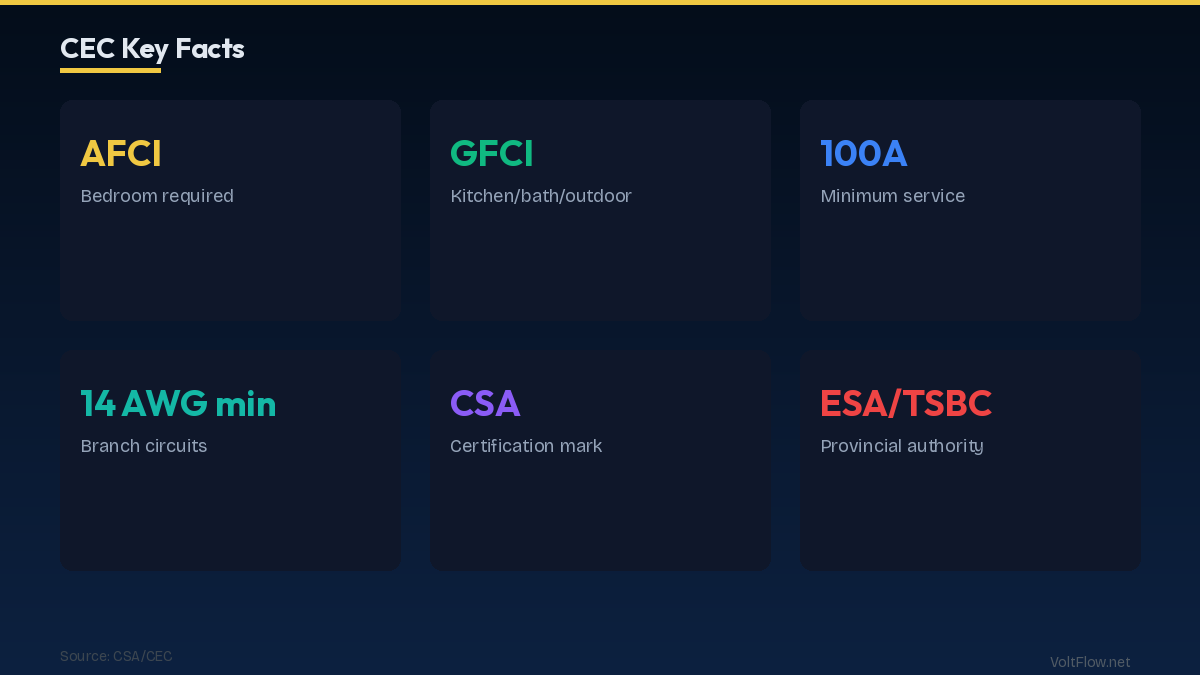
Wire sizing is one area where the CEC and NEC diverge in important ways, even though both use the AWG system. The differences stem from different temperature ratings, derating factors, and safety margins applied to the same physical wire. CEC Table 2 lists conductor ampacities at 60-degree, 75-degree, and 90-degree Celsius ratings, similar to NEC Table 310.16. However, the CEC applies different correction factors for ambient temperature and conduit fill that can result in different effective ampacities for the same wire gauge. For the most common residential wire sizes at 60-degree terminations, the CEC and NEC ampacity values are identical: 14 AWG at 15 amps, 12 AWG at 20 amps, and 10 AWG at 30 amps. Differences emerge at larger wire sizes where derating factors diverge. CEC Rule 4-004 governs conductor sizing and includes provisions for temperature correction that differ slightly from NEC 310.15(B). The CEC ambient temperature correction factors use different temperature bands and multiplication factors than the NEC, which can result in different wire size requirements for installations in hot environments like attics and mechanical rooms. In practice, the differences are most significant for commercial and industrial installations where multiple conductors in conduit and elevated ambient temperatures combine to create significant derating. For typical residential installations with NM cable in walls at normal temperatures, CEC and NEC wire sizing is effectively identical. One notable CEC difference is the requirement for 12 AWG minimum on all kitchen and bathroom circuits. While the NEC requires 12 AWG by virtue of mandating 20-amp circuits in these locations, the CEC makes the 12 AWG minimum explicit in Rule 26-720 for kitchen circuits and Rule 26-710 for bathroom circuits. Some Canadian electricians interpret this as prohibiting 14 AWG wire anywhere in kitchen or bathroom wiring, including switch legs and lighting circuits that the NEC would permit on 15-amp circuits. Another CEC distinction is the treatment of aluminum wiring. CEC Rule 12-118 specifically addresses aluminum conductor connections and requires anti-oxidant compound on all aluminum terminations. While this is widely practiced in the US as well, the CEC makes it an explicit code requirement rather than a recommended practice. The CEC also requires specific connector types listed for aluminum use, with more stringent marking requirements than the NEC.
Canadian Outlet and Circuit Requirements
The CEC specifies outlet placement, circuit requirements, and protective device rules that parallel but differ from the NEC in several important ways. Understanding these differences is essential for anyone performing electrical work in Canada. CEC Rule 26-712 governs receptacle spacing in habitable rooms. The CEC requires receptacles so that no point along the floor line of any usable wall space is more than 1.8 meters (approximately 5.9 feet) from a receptacle. This is slightly tighter than the NEC 6-foot rule and results in slightly more outlets in Canadian homes compared to equivalent US homes. The practical difference is minimal but means Canadian homes may need one or two additional outlets per room. Kitchen requirements under CEC Rule 26-720 are similar to NEC requirements but with some differences. The CEC requires a minimum of two dedicated 20-amp split receptacle circuits for kitchen countertop outlets. In a split receptacle circuit, the top and bottom outlets of a duplex receptacle are on different circuits, providing two circuits at every outlet location. This approach is more common in Canadian kitchens than in US kitchens, where separate outlet positions on alternating circuits is the typical approach. The CEC requires GFCI protection on kitchen countertop outlets within 1.5 meters of a sink, bathroom outlets, garage outlets, outdoor outlets, and outlets near swimming pools and hot tubs. CEC Rule 26-700 governs GFCI requirements with protection thresholds of 5 milliamps trip level, similar to the NEC 4-6 milliamp range. Arc fault protection requirements in the CEC have expanded significantly in recent editions. CEC Rule 26-656 requires AFCI protection in bedrooms, similar to early NEC requirements, and the 2024 CEC edition expanded AFCI requirements to additional living spaces. However, the CEC AFCI expansion has lagged behind the NEC, which now requires AFCI in virtually all living spaces. Canadian jurisdictions are gradually adopting the expanded AFCI requirements, with Ontario ESA leading adoption and some western provinces following more slowly. The CEC requires tamper-resistant receptacles in all new residential installations per Rule 26-700, similar to the NEC requirement. Additionally, the CEC requires weather-resistant receptacles for outdoor installations and requires all outdoor receptacles to have in-use covers that protect the outlet while a cord is plugged in. These requirements mirror recent NEC provisions and ensure consistent safety standards between the two countries for these specific applications.
Grounding and Bonding Under the CEC
Grounding and bonding requirements in the CEC follow the same principles as the NEC but use different rule numbering, slightly different conductor sizing tables, and some unique requirements for Canadian conditions. CEC Section 10 covers grounding and bonding, equivalent to NEC Article 250. The fundamental requirement is the same: all electrical systems must be grounded, all equipment must be bonded to the grounding system, and the grounding electrode system must provide a reliable connection to earth. The CEC grounding electrode system requirements in Rule 10-700 specify acceptable grounding electrodes including metal water pipes, ground plates, ground rods, and concrete-encased electrodes. Ground rods must be at least 3 meters (approximately 10 feet) long and driven to their full length, compared to the NEC 8-foot minimum. This longer rod requirement reflects Canadian frost depth concerns, ground rods must extend below the frost line to maintain contact with moist soil year-round. In northern provinces, frost depth can reach 2-3 meters, making the longer rod essential for reliable grounding. The CEC requires a ground resistance of 25 ohms or less for a single ground rod, similar to the NEC. If the single rod exceeds 25 ohms, supplemental electrodes must be added. In rocky or sandy soil common in parts of the Canadian Shield, Prairie provinces, and coastal British Columbia, achieving 25 ohms can require multiple rods, a ground ring, or chemical ground enhancement. Equipment grounding conductor sizes in CEC Table 16 correspond closely to NEC Table 250.122, with minor differences at some breaker sizes. For the most common residential circuits, the ground wire sizes are identical: 15-amp circuit uses 14 AWG ground, 20-amp uses 12 AWG, 30-amp uses 10 AWG, and so forth. A unique CEC requirement involves the bonding of gas piping systems. CEC Rule 10-406 requires bonding of interior gas piping to the electrical grounding system. While the NEC also addresses this in Article 250.104(B), the CEC requirement is more explicit and more commonly enforced during inspections. The bonding connection must be made at the gas meter or where the gas piping enters the building, using an approved bonding clamp and a conductor sized per Table 16. This bonding prevents static charge buildup on gas piping and ensures that a fault from an electrical appliance to a gas line trips the circuit breaker rather than energizing the entire gas piping system.
Permits, Inspections, and Provincial Differences
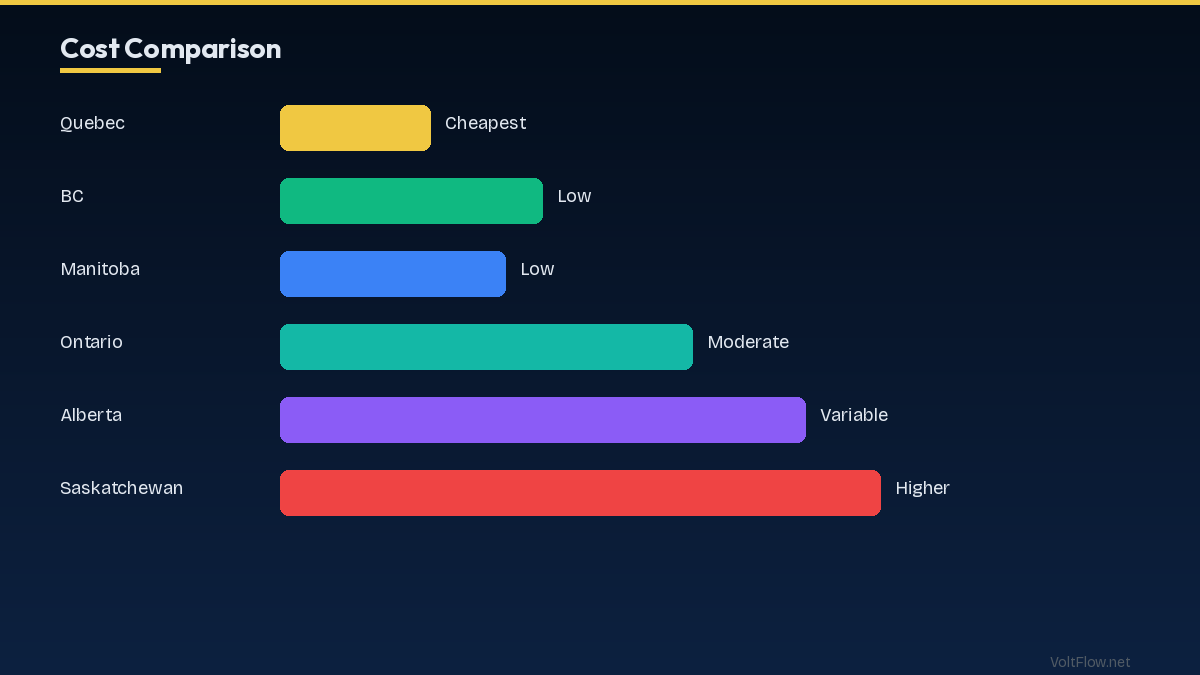
Electrical permitting and inspection in Canada is administered at the provincial and territorial level, creating significant variations in requirements, costs, and processes across the country. Understanding your province specific system is essential before starting any electrical work. Ontario regulates electrical safety through the Electrical Safety Authority (ESA). All electrical work beyond basic maintenance requires a notification (permit) through the ESA online portal. Homeowners can perform their own electrical work on their primary residence by filing a homeowner notification, but the work must be inspected by an ESA inspector before energizing. Notification fees range from $75-$250 depending on the scope of work. Inspections are typically scheduled within 5-10 business days. ESA enforces the Ontario Electrical Safety Code, which adopts the CEC with Ontario-specific amendments. British Columbia regulates through Technical Safety BC. Licensed contractors file declarations of work through the TSBC online system. Homeowners cannot perform their own electrical work in BC, all work must be done by a licensed contractor with a Field Safety Representative (FSR) designation. Permit fees are based on the value of the electrical work, typically $50-$200 for residential projects. TSBC adopts the CEC with BC-specific amendments in the BC Electrical Code. Alberta allows homeowner electrical permits through the local Safety Codes Officers. Homeowners must pass a basic competency assessment and obtain a homeowner permit before starting work. All work is inspected before energizing. Alberta adopts the CEC with Alberta amendments published in the Alberta Electrical Code. Permit costs vary by municipality but typically range from $50-$150 for residential work. Quebec regulates through the Régie du bâtiment du Québec (RBQ) and the Corporation des maîtres électriciens du Québec (CMEQ). All electrical work must be performed by licensed electricians, Quebec does not allow homeowner electrical work. Quebec adopts the CEC with Quebec-specific amendments and uses the Construction Code of Quebec as the governing legislation. Permit and inspection costs vary by municipality and scope. The Maritime provinces (Nova Scotia, New Brunswick, Prince Edward Island, and Newfoundland and Labrador) generally adopt the CEC with minimal amendments and allow homeowner permits with inspection requirements. Northern territories (Yukon, Northwest Territories, and Nunavut) follow the CEC but may have delayed adoption of the latest edition due to the logistics of code development in remote areas. Regardless of province, all electrical work in Canada must meet the minimum standards of the CEC edition adopted by the jurisdiction, be performed by a licensed electrician or permitted homeowner, be inspected by a qualified inspector before energizing, and use materials and equipment that bear the CSA or equivalent certification mark. The CSA certification mark in Canada serves the same purpose as the UL listing in the United States, it indicates that the equipment has been tested and found to meet applicable safety standards. While UL-listed equipment is generally accepted in Canada through mutual recognition agreements, some inspectors may require CSA-marked equipment specifically. When purchasing electrical materials for Canadian installations, look for the CSA mark to avoid potential inspection issues.

Renewable Energy and EV Charging Under the CEC
The CEC addresses solar panels, battery storage, and EV charging in Section 64 (Renewable Energy Systems) and Section 86 (Electric Vehicle Charging), with requirements that parallel but differ from the NEC provisions in Articles 690 and 625. CEC Section 64 governs photovoltaic systems with requirements for rapid shutdown, grounding, disconnecting means, and interconnection that closely mirror the NEC Article 690 requirements. The CEC rapid shutdown requirements in Rule 64-218 specify voltage reduction within the array boundary, similar to the NEC requirement. Equipment must be certified to CSA standards for use in Canada. Enphase microinverters and SolarEdge optimizers sold in Canada carry CSA certification and meet CEC rapid shutdown requirements. Canadian solar installations face unique challenges from snow loading, extreme cold, and shorter winter days at high latitudes. The CEC addresses these through requirements for equipment rated for outdoor use in Canadian climate conditions (typically -40 degrees Celsius to +50 degrees Celsius ambient range) and structural mounting requirements that account for snow loads of 1-3 kPa depending on location. Solar production in Canada varies dramatically by location. Southern Ontario and British Columbia achieve 4-5 peak sun hours, comparable to the northern US. Alberta and Saskatchewan achieve 4.5-5 peak sun hours due to clear prairie skies. Northern locations like Yellowknife and Whitehorse achieve only 2-3 peak sun hours on an annual average basis. System sizing must account for this variation and the extremely short winter days at high latitudes. CEC Section 86 for EV charging mirrors NEC Article 625 in most respects. The CEC requires that EV charger circuits be treated as continuous loads with the circuit rated at 125 percent of the charger maximum current, matching the NEC approach. The CEC uses the same NEMA outlet designations (14-50, 6-50, etc.) since these are North American standards used in both countries. Provincial incentives for EV chargers and solar vary significantly. British Columbia offers a $350 rebate for home EV charger installation through BC Hydro. Quebec offers up to $600 through the Roulez vert program. Ontario offers periodic incentive programs through local distribution companies. Federal incentives include the Canada Greener Homes Grant which has provided up to $5,000 for eligible home energy improvements including solar panels. The CEC treatment of battery energy storage systems in Rule 64-900 series covers residential batteries from Tesla Powerwall, Enphase, and other manufacturers. Requirements address installation location (ventilation, fire separation, seismic), disconnecting means, grounding, and interconnection with the grid and solar systems. Canadian installations must use equipment certified to CSA C22.2 No. 340 for energy storage systems. Most major battery manufacturers including Tesla and Enphase carry CSA certification for their Canadian-market products.