Whole House Generator Sizing 2026: Complete Guide by Home Size
A whole-house standby generator provides automatic backup power during outages, keeping your lights, HVAC, refrigerator, and essential circuits running without manual intervention. Sizing correctly is critical: too small and the generator overloads, too large and you waste thousands on unnecessary capacity. Most homes need a 16-24 kW generator, costing $5,000-$15,000 installed. This guide helps you calculate the exact size for your home.
How Generator Sizing Works: kW vs kVA Explained
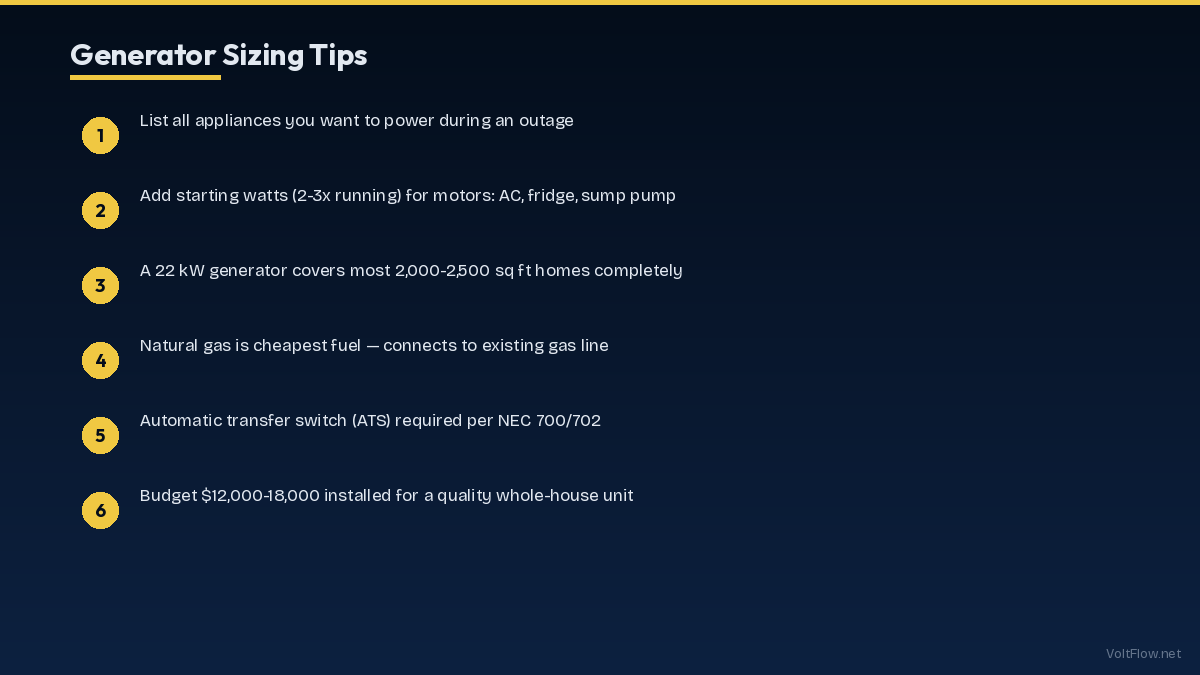
Generator sizing determines whether the unit can handle all the electrical loads you want to power simultaneously during an outage. The key measurement is kilowatts or kW, which represents the actual power output available to run your appliances. Some manufacturers list capacity in kVA (kilovolt-amperes), which is the apparent power before accounting for power factor. For residential generators, kW is typically 80 percent of kVA, so a 22 kVA generator delivers approximately 17.6 kW of usable power. Always compare generators using kW ratings for accurate sizing. Generator capacity is listed as both a running watts rating and a surge watts or starting watts rating. The running watts rating represents continuous power output that the generator can sustain indefinitely. The surge rating represents the brief power spike the generator can handle for a few seconds when motor-driven appliances like air conditioners, well pumps, and sump pumps start up. Startup surge can be 2-3 times the running watts for motor loads. Your generator must have sufficient running watts to power everything you want to operate simultaneously, and sufficient surge watts to handle the starting current of the largest motor in your system. The sizing process involves three steps. First, list every appliance and circuit you want the generator to power during an outage. Second, determine the running watts and starting watts for each item. Third, add up the running watts for simultaneous loads and verify the surge requirement for the largest motor starting while other loads run. This calculation produces the minimum generator size for your specific needs. Most generator manufacturers provide sizing calculators on their websites that walk you through this process. Generac, Kohler, Briggs and Stratton, and Cummins all offer online tools that produce a recommended size based on your inputs. These calculators tend to recommend slightly larger generators than strictly necessary, which provides a safety margin but also pushes you toward higher-priced models. Use the manufacturer calculator as a starting point and verify with your own load list.
Load Calculation for Generator Sizing
A detailed load calculation identifies exactly how much power your home needs during an outage. Unlike the NEC service calculation that determines your panel size, the generator calculation focuses on the specific loads you want to run simultaneously. Essential loads that most homeowners include are the refrigerator and freezer at 700-1,200 running watts with startup surge of 1,400-2,400 watts, lighting throughout the home at 500-1,500 watts depending on how many fixtures you include, the internet router and modem at 30-60 watts for maintaining connectivity, the garage door opener at 600-1,400 watts, sump pump at 800-1,500 running watts with startup surge of 2,000-3,000 watts, and a few outlets for charging phones and running small appliances at 500-1,000 watts. These essential loads total approximately 3,000-6,000 running watts. A small portable generator or a 7-10 kW standby can handle this minimal load set. Comfort loads add significantly to the requirement. Central air conditioning is the single largest residential load at 3,000-6,000 running watts for a 2-3 ton system, with startup surge of 6,000-12,000 watts. A heat pump adds similar loads during winter heating mode with the added complication of resistance backup heat strips that can draw 5,000-15,000 watts when they activate in very cold weather. An electric water heater adds 4,500 watts. An electric range adds 5,000-12,000 watts depending on how many burners and the oven operate simultaneously. Including all comfort loads pushes requirements to 12,000-20,000 watts, necessitating a 14-22 kW generator. Full-house coverage that powers every circuit in the home requires calculating the total demand similar to a NEC Article 220 load calculation. A typical 2,000-2,500 square foot all-electric home has a calculated demand of 15,000-22,000 watts, requiring a 20-24 kW generator. Larger homes exceeding 3,500 square feet may need 30-48 kW generators to cover all loads. These whole-house units cost $12,000-$25,000 installed but provide smooth operation where the homeowner never has to think about which loads to manage during an outage.
Generator Size Recommendations by Home Size
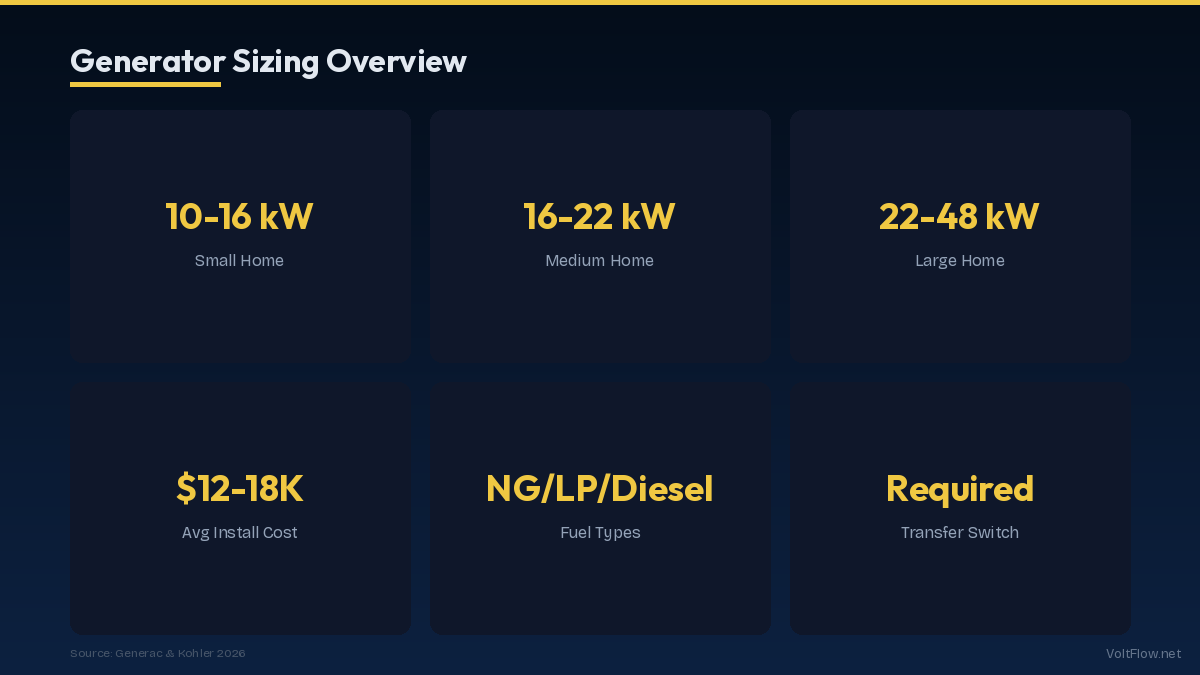
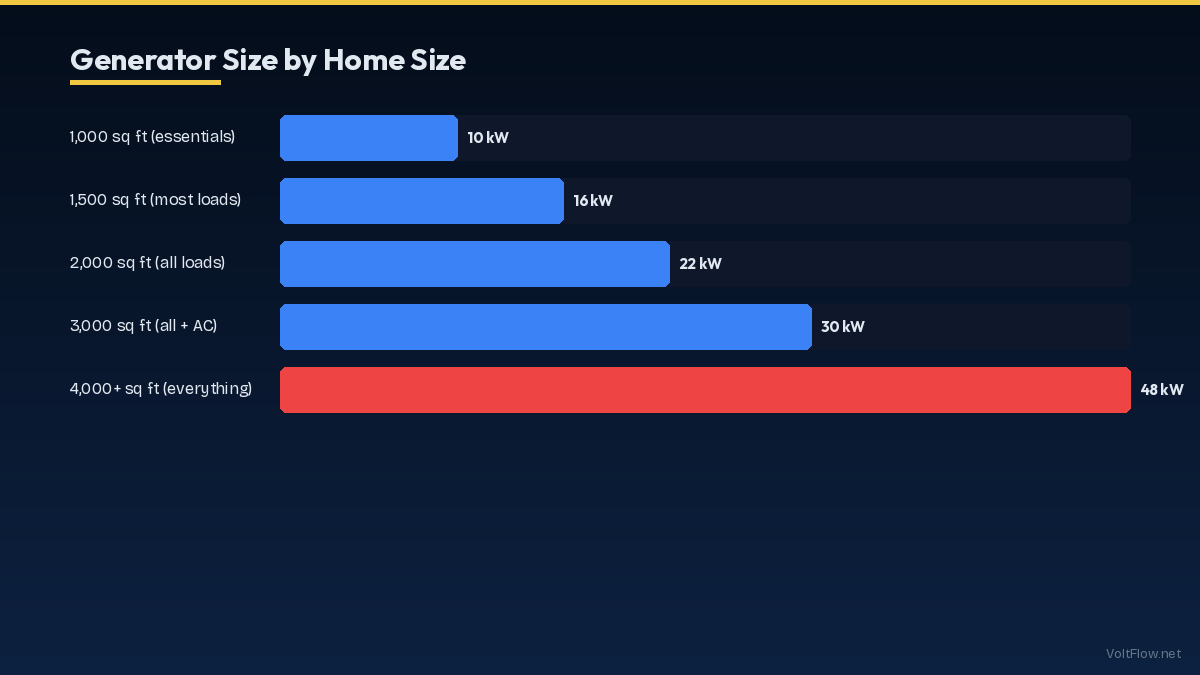
While a detailed load calculation is always the most accurate sizing method, these general guidelines provide a starting point based on typical electrical loads for homes of different sizes and configurations. A small home of 1,000-1,500 square feet with gas heating and gas water heater needs a 10-14 kW generator to power all circuits. If the home has central air conditioning, a 14 kW minimum is recommended to handle the AC startup surge. Without AC, an 8-10 kW generator covers all other loads comfortably. Installed cost for this size range is $4,000-$8,000 including the concrete pad, automatic transfer switch, gas connection, and electrical work. A medium home of 1,500-2,500 square feet with central AC needs a 16-20 kW generator. This is the most common size range for American homes and covers the AC system, refrigerator, lighting, kitchen appliances, and most other household loads running simultaneously. If the home has a heat pump with electric backup strips, size up to 20-22 kW to handle the backup heat load during winter outages. Installed cost is $6,000-$12,000. A large home of 2,500-4,000 square feet with multiple AC zones needs a 22-30 kW generator. Two separate AC systems can draw 8,000-12,000 watts combined, and adding kitchen, laundry, and other loads pushes total demand into the 18-25 kW range. Installed cost for this size is $10,000-$18,000. An estate home exceeding 4,000 square feet may need a 30-48 kW commercial-grade generator at $15,000-$30,000 installed. These units run on natural gas or propane and provide enough power for multiple HVAC zones, elevators, pool equipment, and extensive lighting systems. For any home planning to charge an EV during a power outage, add 7,200-11,500 watts to the generator sizing for the EV charger. Most homeowners choose not to charge their EV from the generator since it would consume a large portion of the generator capacity. However, if your EV is your only vehicle and you need it charged during an extended outage, factor this into the sizing. A managed charging approach at reduced amperage, such as 16 amps instead of 40 amps, adds only 3,840 watts and may be a reasonable compromise.
Fuel Types: Natural Gas vs Propane vs Diesel
Whole-house standby generators run on natural gas, propane (LP), or diesel. Each fuel type has advantages that make it better suited to specific situations. Your fuel choice affects generator cost, running cost, maintenance requirements, and availability during extended outages. Natural gas generators connect to your home existing gas utility line, providing virtually unlimited fuel supply that does not require storage tanks or refilling. As long as the gas utility has pressure in the line, which they typically maintain even during widespread electrical outages, your generator runs indefinitely. Natural gas generators cost $5,000-$15,000 for the unit plus $500-$1,500 for the gas line connection. Running cost is approximately $1-$3 per hour depending on generator size and local gas rates. Natural gas has lower energy density than propane, so generators produce about 10 percent less power on natural gas than on propane. A generator rated at 22 kW on propane typically produces 19-20 kW on natural gas. This derate is already factored into manufacturer specifications that list both ratings. Propane generators use a dedicated propane tank, typically 250-1,000 gallons, installed on your property. The tank requires refilling by a propane delivery service. A 500-gallon propane tank running a 20 kW generator at 50 percent load provides approximately 5-7 days of continuous operation. Propane costs $2-$4 per gallon, making running cost approximately $2-$5 per hour. Propane generators are the best choice for rural homes without natural gas service. Tank rental or purchase costs $500-$2,500 depending on size. Propane has a very long shelf life, essentially indefinite, so the fuel in your tank remains ready for years between outages. Diesel generators offer the highest fuel efficiency and longest engine life, making them the preferred choice for commercial and institutional applications. Residential diesel generators are less common but available from Kohler and Cummins in the 20-60 kW range at premium prices of $10,000-$25,000. Diesel fuel costs approximately $3-$5 per gallon with running costs of $2-$4 per hour. Diesel generators require on-site fuel storage in a code-compliant tank, typically 100-500 gallons. Diesel fuel has a shelf life of 12-18 months and requires stabilizer treatment for longer storage. The primary advantage of diesel is fuel efficiency and durability, but the higher purchase cost and fuel storage requirements make it less popular for residential use than natural gas or propane.
Installation Requirements and Costs
A whole-house standby generator installation involves several components beyond the generator unit itself. Understanding each component helps you evaluate quotes and avoid surprises. The automatic transfer switch or ATS is the brain of the system. It monitors utility power continuously and automatically starts the generator within 10-30 seconds of detecting an outage. When utility power returns and stabilizes for a set period (typically 5 minutes), the ATS transfers the load back to utility power and shuts down the generator. ATS units cost $500-$2,000 depending on amperage and features. Most generator packages include a matched ATS. The transfer switch must be rated for your main panel amperage. A 200-amp home needs a 200-amp ATS. Some installations use a load-shedding ATS that manages which circuits receive power based on priority, allowing a smaller generator to serve a larger home by temporarily shedding non-essential loads. The concrete or composite pad provides a level, stable mounting surface for the generator. Concrete pads cost $200-$500 for materials and installation. Pre-fabricated composite pads cost $100-$200 and install faster. The generator must be positioned per manufacturer clearance requirements, typically 18 inches from the building wall on the exhaust side and 36 inches from windows, doors, and fresh air intakes to prevent exhaust infiltration. Electrical work includes running conduit from the generator to the ATS, connecting the ATS to the main panel, and wiring the generator control circuits. This typically costs $1,000-$3,000 depending on the distance between the generator and panel and the complexity of the transfer switch installation. Gas line installation for natural gas or propane involves running a properly sized gas line from the meter or tank to the generator. Gas line sizing depends on the generator BTU input rating and the distance from the gas source. A typical 20 kW generator needs a 3/4-inch or 1-inch gas line. Gas line installation costs $300-$1,000 for natural gas connections within 30 feet of the meter, or $500-$2,000 for longer runs or propane installations requiring a new tank and regulator. Permitting varies by jurisdiction but typically requires both an electrical permit for the transfer switch installation and a gas or plumbing permit for the fuel line. Combined permit costs are $150-$500. Some jurisdictions also require a noise variance or zoning approval since generators produce 60-70 decibels during operation. Total installed cost for a complete standby generator system including the unit, ATS, pad, electrical, gas line, and permits ranges from $5,000-$8,000 for a basic 10-14 kW system to $12,000-$18,000 for a mid-range 20-22 kW system to $15,000-$30,000 for a large 30-48 kW system. These costs can be financed through home improvement loans, HELOC, or manufacturer financing programs at 5-12 percent interest with terms of 3-10 years.
Generator vs Battery Backup: Choosing the Right System
The decision between a standby generator and a battery backup system depends on your outage patterns, budget, energy goals, and how long you need backup power to last. Each technology has distinct advantages that suit different situations. Generators excel at long-duration outages lasting days or weeks. A natural gas generator runs indefinitely as long as gas supply continues. A propane generator with a 500-gallon tank runs 5-7 days continuously. This makes generators the clear choice for homeowners in hurricane zones, areas with ice storm damage, and rural locations where power restoration takes days. Generators can power your entire house including the AC system, which batteries struggle to do for more than a few hours without solar recharging. Generator disadvantages include ongoing maintenance costs of $200-$500 per year for oil changes, filter replacements, and annual service; fuel costs of $1-$5 per hour during operation; noise of 60-70 decibels that may disturb neighbors; exhaust emissions; and no ability to reduce your daily electricity costs since the generator only runs during outages. Battery systems like the Tesla Powerwall excel at short-duration outages of 4-12 hours and provide daily financial value through TOU arbitrage and solar self-consumption optimization. A 13.5 kWh battery paired with solar can provide indefinite backup for critical loads as long as the sun shines. Battery systems are silent, produce no emissions, require no fuel, and need virtually zero maintenance over their 10-15 year lifespan. Battery disadvantages include limited capacity for whole-house backup, especially for HVAC loads; high cost per kWh of backup capacity at roughly $700-$1,000 per kWh installed; and inability to power the full house for extended periods without solar recharging. A battery without solar provides only 6-12 hours of critical load backup. Hybrid systems combining a small generator with battery storage offer the best of both worlds. The battery provides immediate, smooth backup for the first few hours while the generator starts and warms up. For extended outages, the generator takes over heavy loads while the battery handles peak demands and provides quiet nighttime operation when the generator can shut down. Generac and other manufacturers offer integrated generator-plus-battery systems that manage the interaction automatically. Cost for a hybrid system is $15,000-$25,000 installed. For homeowners who experience frequent brief outages of 1-4 hours, a battery system is the better investment because it also provides daily financial value. For homeowners in areas prone to multi-day outages from hurricanes or ice storms, a generator is the better choice because it provides unlimited duration backup. For homeowners who want both short-outage resilience and daily savings, a hybrid system or a battery paired with solar provides the most complete solution.