Arc Fault Breaker Requirements 2026: NEC AFCI Rules Explained
Arc fault circuit interrupters or AFCIs are now required in virtually every living space in residential buildings under the NEC 2026 cycle. These specialized breakers detect dangerous electrical arcs that standard breakers miss, arcs caused by damaged wiring, loose connections, and pinched cables that are responsible for over 30,000 home electrical fires annually. This guide explains where AFCIs are required, how they work, and what they cost to install or retrofit.
Where AFCIs Are Required Under NEC 2026
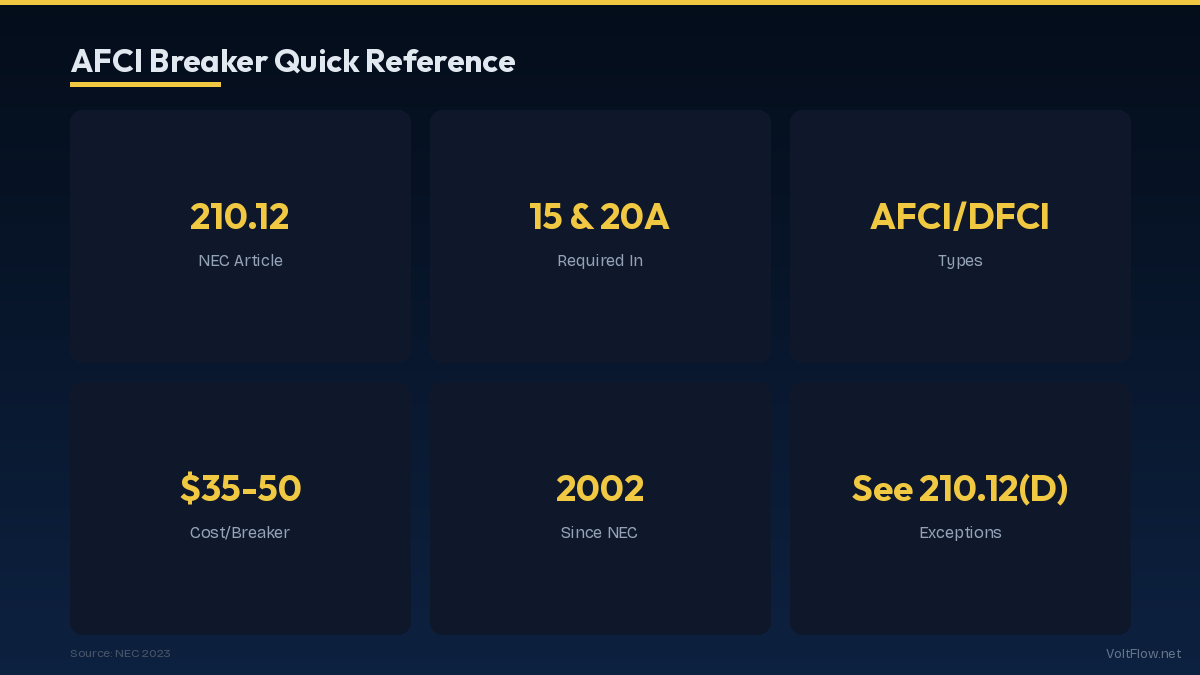
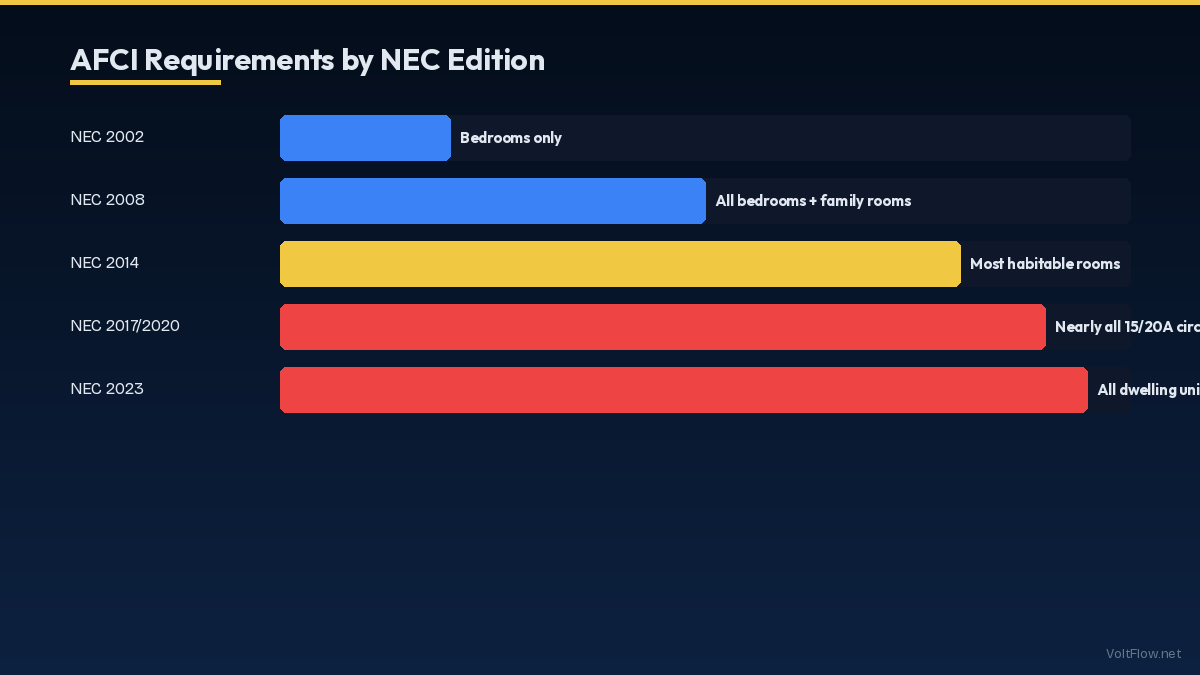
The NEC has steadily expanded AFCI requirements with each code cycle since their introduction in the 1999 NEC. The 2026 cycle requires AFCI protection in all 120-volt, 15-amp and 20-amp branch circuits supplying outlets and devices in the following areas: bedrooms (required since 2002 NEC), living rooms, family rooms, dining rooms, parlors, libraries, dens, recreation rooms, sunrooms, closets, hallways, and similar rooms (added in 2008 NEC), kitchens and laundry rooms (added in 2014 NEC), and basements, attached garages, and attics with habitable space (added in 2017-2020 NEC cycles). The practical effect is that virtually every 15-amp and 20-amp circuit in a dwelling unit requires AFCI protection. The main exceptions are dedicated equipment circuits for large appliances like HVAC systems, well pumps, and sump pumps that operate on dedicated circuits not serving general-purpose outlets. Bathroom circuits are covered by GFCI requirements rather than AFCI, though combination AFCI/GFCI breakers are available for areas requiring both types of protection. Outdoor circuits, swimming pool circuits, and garage door opener circuits on dedicated circuits are also excluded from AFCI requirements. For new construction, compliance is straightforward: the electrician installs AFCI breakers in every required circuit during the initial wiring. For renovations and additions, the NEC requires AFCI protection when any of the following occur: new circuits are added to the areas listed above, existing circuits are extended or modified, outlets are added or replaced in the listed areas, or a panel replacement occurs. The panel replacement trigger is significant because it means that a simple panel swap from a Federal Pacific or Zinsco panel to a modern panel requires adding AFCI breakers on all applicable circuits, substantially increasing the cost of the panel upgrade. Some jurisdictions apply AFCI requirements retroactively during any electrical work that opens a permit, while others apply them only to new circuits. Check with your local building department for the specific application rules in your jurisdiction. Local amendments to the NEC can either expand or limit the federal code requirements.
How Arc Fault Breakers Work: Technology Explained
Understanding how AFCIs detect arcs helps explain why they are effective at preventing fires and why they sometimes trip when no real hazard exists. An electrical arc is a discharge of electricity across a gap between two conductors. Arcs generate intense heat exceeding 10,000 degrees Fahrenheit at the arc point, hot enough to ignite wood, insulation, and other building materials in milliseconds. Standard breakers detect only overcurrent conditions where the total current exceeds the breaker rating. But a dangerous arc can occur at current levels well below the breaker trip threshold. A 5-amp arc across a damaged wire inside a wall is invisible to a 20-amp breaker but generates enough heat to start a fire. AFCIs detect arcs by analyzing the electrical waveform on the circuit using microprocessor-based electronics. Arcs produce characteristic signatures in the current waveform: random, high-frequency noise superimposed on the normal 60 Hz sine wave, along with specific patterns of current interruption and re-establishment that differ from normal load signatures. The AFCI electronics continuously sample the circuit current and compare the waveform against a library of arc signatures stored in the processor firmware. When the processor identifies an arc signature with sufficient confidence, it trips the breaker within milliseconds, de-energizing the circuit before the arc can ignite surrounding materials. There are two types of arcs that AFCIs must detect. Series arcs occur when a break in a single conductor creates a gap that electricity arcs across, such as a wire that has been damaged by a nail, rodent, or excessive bending. The total circuit current during a series arc may be no higher than normal operating current, making these invisible to standard breakers. Parallel arcs occur between two conductors, such as hot-to-neutral or hot-to-ground arcs caused by damaged insulation allowing the conductors to approach each other. Parallel arcs can draw high currents that a standard breaker eventually detects, but the AFCI detects them faster, often before significant heating occurs. Modern combination-type AFCIs detect both series and parallel arcs and are the only type that meets current NEC requirements. Older branch-feeder type AFCIs that detected only parallel arcs are no longer code-compliant for new installations. All AFCIs sold in 2026 are combination type, so there is no risk of purchasing the wrong type from current stock at electrical supply stores.
AFCI Breaker Costs and Installation
AFCI breakers cost significantly more than standard breakers, which is the primary complaint from homeowners and builders about the expanded requirements. Understanding the costs helps you budget appropriately for new installations and renovations. A standard 15-amp or 20-amp single-pole breaker costs $5-$12 depending on the brand and whether it is a plug-on or bolt-on type. The equivalent AFCI breaker from the same manufacturer costs $30-$45. Combination AFCI/GFCI breakers that provide both types of protection in a single device cost $40-$55. For a new home with 20 circuits requiring AFCI protection, the additional cost for AFCI breakers versus standard breakers is approximately $500-$800 in materials alone. For a typical 2,000-square-foot new construction home with 25-30 total circuits of which 20-22 require AFCI protection, the total AFCI breaker cost is approximately $600-$990. This adds roughly $0.30-$0.50 per square foot to the home construction cost, a modest amount in the context of total construction costs of $150-$300 per square foot. Retrofit installation during a panel upgrade or renovation project costs more due to the need to verify compatibility between AFCI breakers and existing wiring. Not all AFCI breakers work perfectly with all existing wiring configurations, and some circuits may experience nuisance tripping that requires investigation and correction. Budget $50-$100 per circuit for professional AFCI retrofit including the breaker, testing, and troubleshooting any nuisance trip issues. The total cost to retrofit AFCI protection in an existing home during a panel upgrade ranges from $1,000-$2,500 for 20 circuits, on top of the panel upgrade cost itself. Some homeowners ask whether AFCI outlets can be used instead of AFCI breakers to reduce cost. AFCI outlets do exist and cost $25-$35 each, but they protect only the downstream portion of the circuit beyond the outlet. They do not protect the wiring between the panel and the outlet, which is where many arc faults occur. Most electricians and inspectors prefer AFCI breakers because they protect the entire circuit from panel to the last outlet. The NEC permits either method, but breaker-based protection is more complete and is the industry standard approach.
Nuisance Tripping: Causes and Solutions
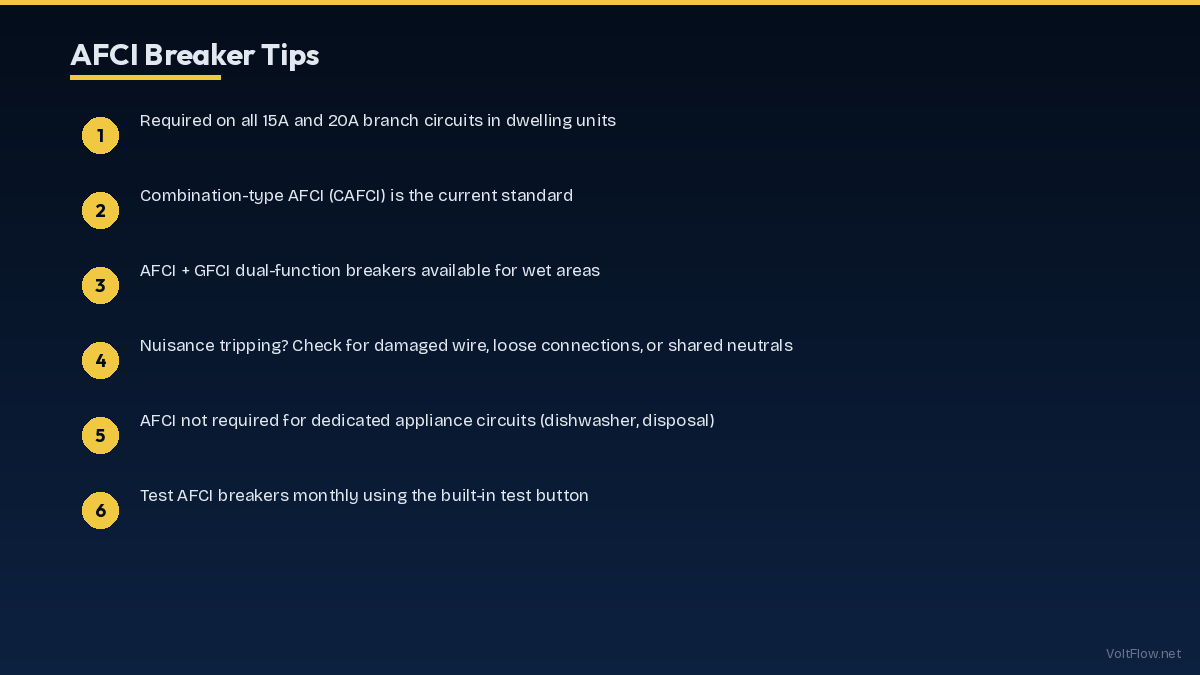
The most common complaint about AFCI breakers is nuisance tripping, the breaker trips when no actual arc fault hazard exists. While early AFCI technology in the 2000s was genuinely prone to false trips, modern combination AFCIs are significantly more reliable. However, certain conditions still cause legitimate nuisance trips that require attention and troubleshooting. Appliances with brushed motors are the most frequent cause of nuisance AFCI trips. Vacuum cleaners, treadmills, power tools with universal motors, and some older kitchen appliances generate electrical noise from brush-to-commutator contact that resembles arc signatures. Modern AFCIs include filtering algorithms that distinguish motor brush noise from dangerous arcs, but older or heavily worn motors may produce noise outside the normal filtering range. The solution is usually replacing the appliance with a brushless motor model or using the appliance on a different circuit. Damaged or deteriorated wiring can cause AFCI trips that are not nuisance trips at all, they are the AFCI correctly detecting a real arc hazard. Wiring with cracked insulation from age, rodent damage, or improper stapling can arc intermittently, and the AFCI detection of these arcs is exactly what the device is designed to do. If an AFCI trips repeatedly on a specific circuit, have an electrician inspect the wiring for damage before assuming the breaker is at fault. Loose connections at outlets, switches, wire nuts, and breaker terminals cause arcing that AFCIs correctly detect. Backstab connections on outlets, where the wire pushes into a spring-loaded hole instead of wrapping around a screw terminal, are particularly prone to loosening over time and arcing. Replacing backstab connections with screw terminal connections often resolves recurring AFCI trips. This is both an AFCI compatibility improvement and a genuine safety improvement. Incompatible dimmer switches can interfere with AFCI operation. Some older dimmer switches produce electrical noise that triggers AFCI trips, particularly when dimmed to low levels. LED-compatible dimmers from major manufacturers like Lutron, Leviton, and Legrand are designed and tested for AFCI compatibility. If you experience AFCI trips when using a dimmer, replacing the dimmer with an AFCI-compatible model usually resolves the issue at a cost of $15-$25. Long wire runs with high-impedance loads can create waveform distortions that trigger false AFCI trips in some cases. This is more common in circuits feeding LED lighting at the end of runs exceeding 75-100 feet. Reducing the wire run length or upsizing the wire to reduce impedance can resolve these trips. If you experience persistent nuisance tripping that cannot be resolved through the above steps, consult your electrician about upgrading to the latest generation AFCI breaker from your panel manufacturer. Each new generation includes improved algorithms with better discrimination between genuine arcs and benign electrical noise signatures.
AFCI vs GFCI: Understanding the Difference
AFCIs and GFCIs are often confused because both are specialized circuit protection devices installed in the electrical panel or at outlets. However, they protect against completely different hazards and are not interchangeable. AFCIs protect against fire by detecting electrical arcs. An arc fault occurs when electricity jumps across a gap in damaged or deteriorated wiring, generating intense heat that can ignite surrounding building materials. AFCIs monitor the current waveform for arc signatures and trip the circuit in milliseconds when an arc is detected. The primary hazard AFCIs address is fire in the building structure, often inside walls where damage is invisible until a fire starts. GFCIs protect against electrocution by detecting ground faults. A ground fault occurs when electricity leaks from the intended circuit path through a person, water, or other unintended conductor to ground. GFCIs compare the current flowing through the hot conductor to the current returning through the neutral. If the difference exceeds 4-6 milliamps, indicating current is leaking through an unintended path, the GFCI trips in milliseconds. The primary hazard GFCIs address is electric shock to people, particularly in wet locations like bathrooms, kitchens, garages, and outdoor areas. The NEC requires GFCIs wherever water and electricity may interact, and AFCIs wherever fire risk from concealed wiring damage is a concern. Some areas require both types of protection. Kitchens need AFCI protection for the branch circuits and GFCI protection at the countertop outlets. Garages need AFCI for the branch circuits and GFCI for the outlets. Combination AFCI/GFCI breakers, also called dual-function breakers, provide both types of protection in a single device. These cost $40-$55 per breaker compared to $30-$45 for AFCI-only and $25-$35 for GFCI-only breakers. For circuits that require both AFCI and GFCI protection, a single dual-function breaker is more cost-effective and space-efficient than separate AFCI breaker plus GFCI outlet combinations. Major manufacturers including Square D, Eaton, and Siemens offer dual-function breakers in 15-amp and 20-amp configurations for their residential panel lines. When planning new circuits or panel upgrades, specify dual-function breakers for all circuits in areas requiring both AFCI and GFCI protection. This simplifies the panel layout, reduces the number of devices to maintain, and ensures complete protection without the coordination issues that can arise when separate AFCI breakers and GFCI outlets interact on the same circuit.
Future of AFCI Requirements and Smart Protection
AFCI requirements will continue expanding in future NEC code cycles, and the technology itself is evolving toward smarter, more connected protection that integrates with home automation and energy management systems. The NEC code development committee is considering extending AFCI requirements to 240-volt circuits in future cycles. Currently, AFCI protection applies only to 15-amp and 20-amp 120-volt circuits. Adding 240-volt circuit protection would cover ranges, dryers, EV chargers, and other high-power circuits where arc faults can generate even more heat due to higher voltage. Manufacturers are developing 240-volt AFCI breakers in anticipation of this expansion, though cost and availability remain limited in 2026 for 240-volt models. Smart AFCI breakers with communication capabilities are entering the market from manufacturers like Span, Eaton, and Leviton. These breakers connect to home automation systems and smartphone apps, providing real-time notifications when an arc is detected and the circuit trips. Instead of discovering a tripped breaker when the lights go out, you receive a push notification explaining which circuit tripped and why. Some smart breakers can distinguish between arc types and provide diagnostic information that helps electricians locate wiring problems faster. Machine learning algorithms in next-generation AFCI breakers promise to further reduce nuisance tripping while improving genuine arc detection sensitivity. These breakers learn the normal electrical signatures of the appliances on their circuit and adjust their detection thresholds accordingly. A breaker that learns your vacuum cleaner produces specific motor noise will stop tripping when you vacuum while maintaining full sensitivity to actual arc faults with different waveform characteristics. The combination of AFCI and energy monitoring in smart panel systems like the Span Panel provides dual benefits: fire protection and detailed energy consumption data from a single device. As these systems mature and prices decrease, the argument for smart panels over conventional panels strengthens. The incremental cost of AFCI and energy monitoring capabilities in a smart panel is offset by the elimination of separate AFCI breakers, separate energy monitoring hardware, and the labor to install and configure multiple devices. For homeowners planning any electrical panel work in 2026, budgeting for AFCI protection on all required circuits is not optional, it is code-mandated in virtually every jurisdiction. Understanding the requirements, costs, and technology helps you make informed decisions about standard versus smart AFCI implementations and ensures your home meets both the letter and the spirit of the fire safety codes.