How Many Outlets Per Circuit? 2026 NEC Rules & Best Practices
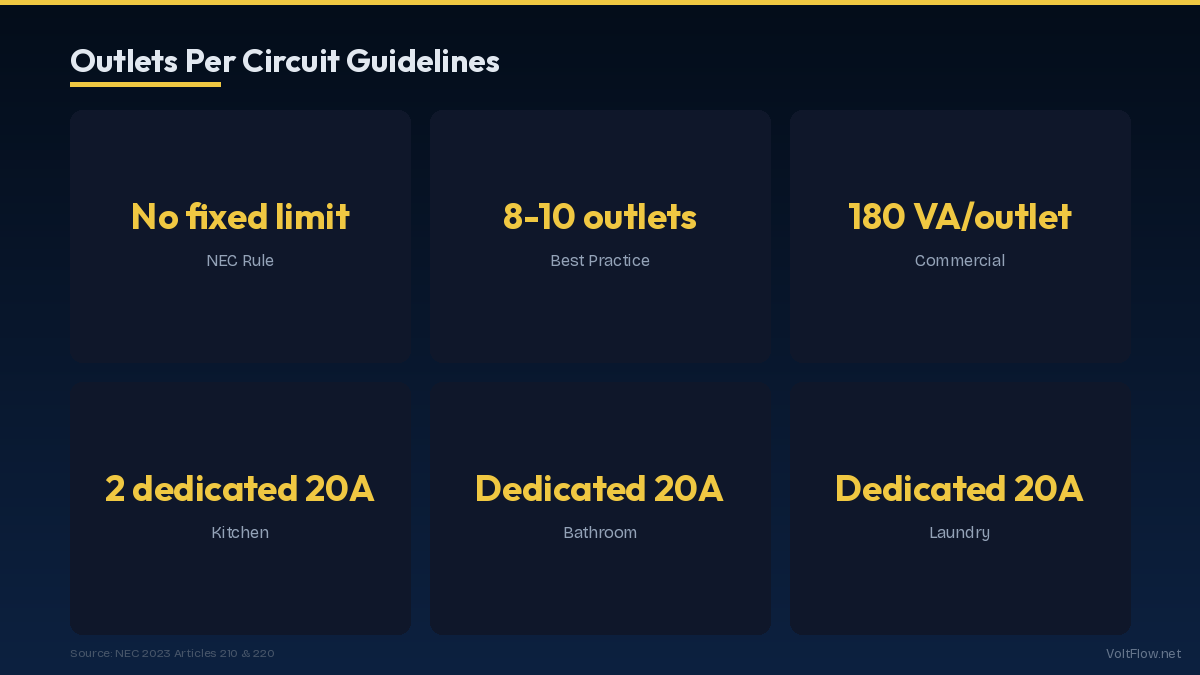
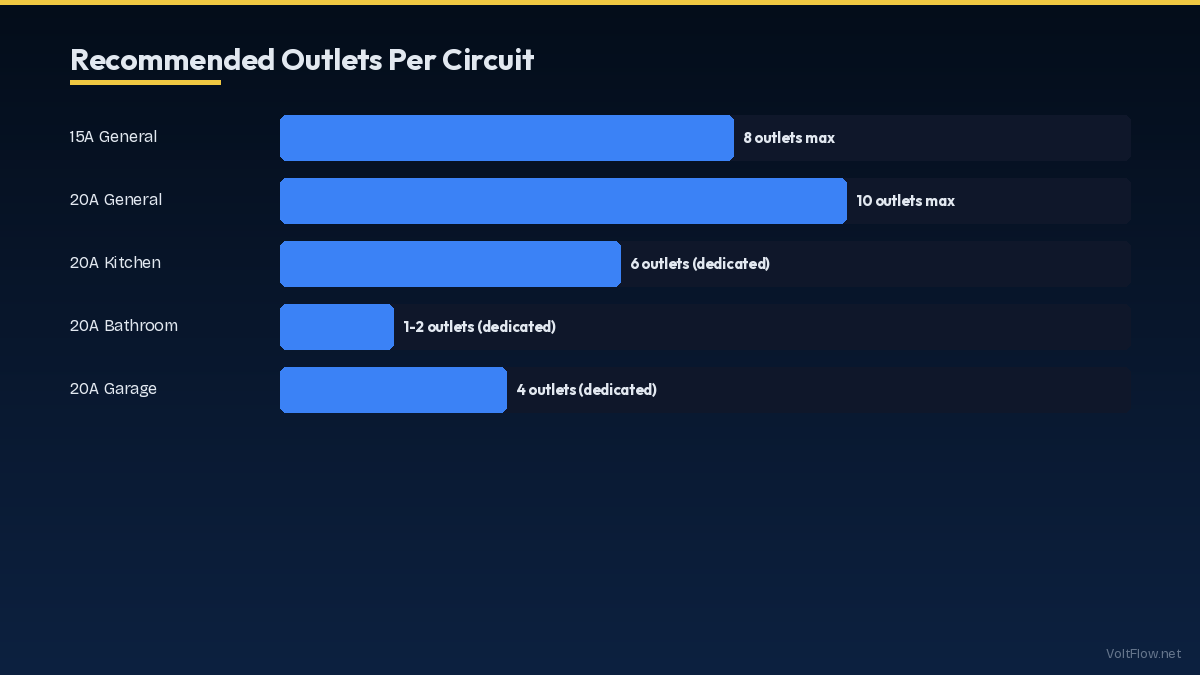
The NEC does not set a hard maximum number of outlets per circuit for residential wiring, but practical limits and professional guidelines keep circuits safe and functional. The general industry standard is 8-10 outlets per 15-amp circuit and 10-13 outlets per 20-amp circuit. However, kitchens, bathrooms, and laundry rooms have specific NEC rules that override the general guidelines. This guide covers every NEC outlet requirement room by room.
What the NEC Actually Says About Outlets Per Circuit
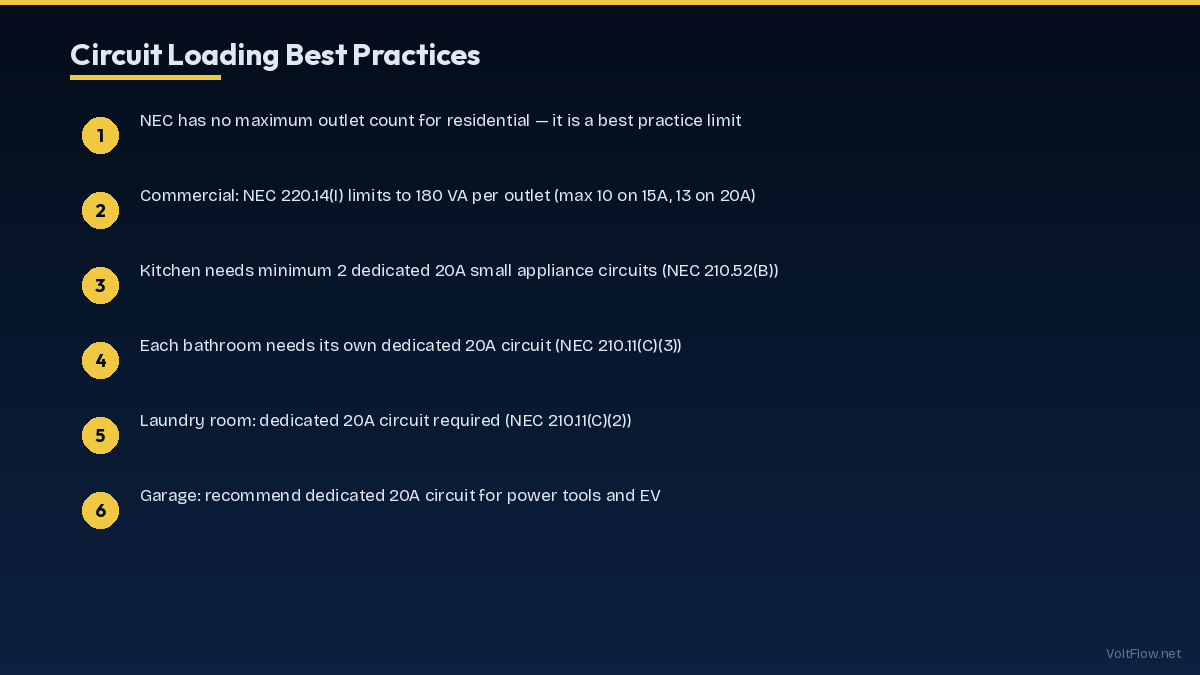
The NEC takes an indirect approach to limiting outlets per circuit. Rather than specifying a maximum number, it sets rules about circuit capacity, outlet placement, and dedicated circuit requirements that effectively limit how many outlets you can safely wire on a single circuit. NEC 220.14(J) assigns a load of 180 VA per general-purpose receptacle outlet for commercial load calculations, but this provision explicitly does not apply to dwelling units. For residential occupancies, the NEC uses a per-square-foot calculation of 3 VA per square foot for the combined lighting and general receptacle load per NEC Table 220.12, rather than counting individual outlets. This means the code treats your general lighting and receptacle circuits as a combined pool of capacity allocated by floor area, not by the number of outlet boxes. The practical implication is that the NEC leaves the specific number of outlets per circuit to the judgment of the electrician, guided by the overall load calculation and the specific circuit requirements for dedicated circuits in certain rooms. However, exceeding practical limits creates problems even if no specific code section is violated. A 15-amp circuit can deliver a maximum of 1,800 watts. With 12 outlets on the circuit, each outlet can support an average of only 150 watts before the total load reaches 1,800 watts. If someone plugs a 1,500-watt space heater into one outlet and a 400-watt computer setup into another, the circuit trips even though 10 outlets are unused. The more outlets on a circuit, the higher the probability that combined loads will exceed capacity. Professional electricians typically follow industry guidelines of 8-10 outlets per 15-amp circuit and 10-13 per 20-amp circuit. These numbers provide adequate capacity for typical residential loads while minimizing nuisance trips from coincidental heavy usage. Some jurisdictions have adopted local amendments that codify these guidelines into enforceable requirements, so check with your building department for any local maximums. Many experienced electricians err on the conservative side, wiring 6-8 outlets per circuit in living areas. This approach costs slightly more in wire and breakers but results in a home where circuits rarely trip and the homeowner never thinks about which appliances are on which circuit. The small additional cost during construction saves years of frustration from overloaded circuits in everyday use.
Kitchen Circuit Requirements: NEC Dedicated Circuits
The kitchen has the strictest outlet circuit requirements of any room in the house because it contains more high-wattage appliances concentrated in a small area than any other space. NEC 210.52(B) requires a minimum of two 20-amp small appliance branch circuits to serve the countertop receptacle outlets in the kitchen. These circuits cannot serve any outlets outside the kitchen and dining area, and they cannot serve lighting or any permanently connected appliances like the dishwasher or garbage disposal. The two-circuit minimum exists because countertop appliances like toasters at 1,000-1,500 watts, coffee makers at 800-1,200 watts, stand mixers at 300-500 watts, blenders at 400-700 watts, and toaster ovens at 1,200-1,800 watts can easily overload a single 20-amp circuit when used simultaneously during meal preparation. With two circuits, the electrician distributes outlets so that adjacent outlets alternate between circuits. This way, the toaster and coffee maker plugged into outlets next to each other are on separate circuits. Beyond the two countertop circuits, the NEC requires additional dedicated circuits for specific kitchen appliances. The dishwasher needs its own 15-amp or 20-amp dedicated circuit per NEC 210.52(B)(1) Exception 2, which allows the dishwasher to be on one of the small appliance circuits if it is a cord-connected unit, but most electricians install a separate dedicated circuit. The garbage disposal needs its own dedicated circuit, typically a 15-amp circuit with 14 AWG wire. If the disposal is switched and cord-connected, it can share a circuit with the dishwasher using a split-switched outlet, but again most modern installations use separate circuits for reliability. The range or cooktop requires a dedicated 240-volt circuit as discussed in the range wiring guide. The microwave, if built-in or over-the-range, is typically on its own dedicated 20-amp circuit because it draws 1,200-1,800 watts and runs for extended periods. A countertop microwave can use one of the two small appliance circuits. The refrigerator should be on its own dedicated 15-amp or 20-amp circuit. While the NEC does not explicitly require this, the refrigerator runs 24 hours a day and should not be on a circuit that might trip from other appliance use, leaving your food to spoil. Almost all electricians and inspectors treat the refrigerator circuit as a practical requirement. In total, a modern kitchen typically has 5-7 dedicated circuits: two countertop small appliance circuits, one dishwasher, one disposal, one microwave, one refrigerator, and one range. This is why kitchens consume a disproportionate number of panel breaker spaces.
Bathroom, Laundry, and Garage Requirements
Beyond the kitchen, the NEC specifies dedicated circuit requirements for bathrooms, laundry rooms, and garages that limit how outlets in these rooms connect to circuits serving other areas. NEC 210.11(C)(3) requires at least one 20-amp circuit dedicated to bathroom receptacle outlets. This circuit can serve outlets in multiple bathrooms throughout the home, but it cannot serve outlets or lights in any other room type. The rationale is that bathroom appliances like hair dryers at 1,000-1,875 watts, curling irons at 200-450 watts, and electric shavers draw substantial current in a room where GFCI protection is critical. A separate circuit ensures that a tripped GFCI in the bathroom does not affect outlets in other rooms. Many electricians prefer to install a separate 20-amp circuit for each bathroom rather than running one circuit to serve all bathrooms. This avoids the situation where a tripped GFCI in the master bath kills the outlet in the guest bath on the other side of the house. The incremental cost of $100-$200 per additional bathroom circuit provides significant convenience. NEC 210.11(C)(2) requires at least one 20-amp circuit dedicated to the laundry room receptacle outlets. This circuit serves only the laundry room and cannot share outlets with any other room. The washing machine alone may draw 500-800 watts, and if you iron clothes or use other laundry appliances, the dedicated circuit prevents overloading. The electric dryer has its own separate 30-amp 240-volt circuit, which is independent of the laundry room receptacle circuit. NEC 210.52(G) requires at least one receptacle outlet in each attached garage and detached garage with electrical power. While the NEC does not specify a dedicated circuit for the garage, the GFCI requirement per NEC 210.8(A)(2) effectively encourages a separate circuit because GFCI-protected garage outlets tripping from tool use would otherwise affect outlets in other rooms on the same circuit. Most electricians install a dedicated 20-amp GFCI-protected circuit for the garage with 2-4 outlets spaced for workshop and vehicle access. For outdoor outlets, NEC 210.52(E) requires at least two receptacle outlets for one-family dwellings, one in the front and one in the back of the house, both readily accessible from grade level. These must be GFCI protected per NEC 210.8(A)(3). Outdoor outlets can share a circuit with each other but should not share circuits with indoor outlets because GFCI trips from outdoor moisture or equipment use would kill indoor outlets on the shared circuit.
Outlet Spacing Rules: NEC 210.52
The NEC does not just regulate how many outlets share a circuit, it also dictates where outlets must be placed throughout the home to ensure that no point along a wall is more than 6 feet from an outlet. This spacing rule, found in NEC 210.52(A), means that outlets must be installed so that no point along the floor line of any wall space is more than 6 feet, measured horizontally, from a receptacle outlet. In practical terms, this requires an outlet every 12 feet along continuous wall space, since an appliance cord can reach 6 feet in either direction from an outlet. The 12-foot spacing rule applies to all wall spaces 2 feet or wider. A wall segment less than 2 feet wide, such as the space between two doorways, does not require an outlet. However, a wall segment 2 feet or wider does require an outlet regardless of how close the nearest outlet on an adjacent wall might be. Countertop receptacles in kitchens follow a tighter spacing rule per NEC 210.52(C). No point along the countertop wall line can be more than 24 inches from a receptacle. This means an outlet is required every 48 inches along the countertop backsplash. Any countertop space 12 inches or wider requires a receptacle. Island and peninsular countertops with a long dimension of 24 inches or more and a short dimension of 12 inches or more require at least one receptacle outlet. Hallways 10 feet or longer require at least one receptacle outlet per NEC 210.52(H). This outlet must be accessible from the hallway without entering a room. Many homes built before the 2000s lack hallway outlets, and adding them during renovation is a common NEC-required upgrade. Foyers and entryways exceeding 60 square feet require outlet placement per the standard 6-foot rule. Smaller foyers are exempt from the outlet spacing requirement but often receive an outlet anyway for vacuum cleaner access and holiday decorating convenience. These spacing requirements determine the minimum number of outlets in each room, which in turn affects how many circuits the home needs. A typical 2,000-square-foot home requires 40-60 receptacle outlets to meet NEC spacing rules, distributed across 6-10 general-purpose circuits plus the dedicated circuits for kitchen, bathroom, laundry, and garage areas.
Practical Circuit Loading Guidelines by Room
While the NEC provides the legal framework, practical experience guides how electricians distribute outlets across circuits for optimal daily performance. Here are room-by-room recommendations that go beyond code minimums to create a home where circuits never trip during normal use. Living rooms and family rooms typically have 6-10 outlets along the walls following the 12-foot spacing rule. Place these on one or two 15-amp circuits. If the room has a home theater system drawing 500-800 watts continuously, dedicate one circuit to the entertainment center wall and use a second circuit for the remaining outlets. This prevents the TV and sound system from sharing a circuit with a vacuum cleaner or space heater. Bedrooms typically need 4-6 outlets each. Two bedrooms can usually share a single 15-amp circuit with 8-12 outlets total, as bedroom loads are typically light: phone chargers, alarm clocks, table lamps, and occasional laptop use rarely exceed 500 watts combined between two bedrooms. However, a bedroom that also serves as a home office with a computer setup, monitor, printer, and desk lamp should have its own dedicated circuit since these devices can draw 500-800 watts continuously. Home offices have become a critical circuit planning consideration since 2020. A dedicated 20-amp circuit for the home office ensures that a computer, dual monitors, printer, desk lamp, and occasional space heater can operate without tripping. A UPS (uninterruptible power supply) on this circuit protects equipment from brief power interruptions and provides enough runtime to save work and shut down gracefully during outages. Basements and bonus rooms often end up with the most outlets per circuit because they are wired as an afterthought during finishing. Resist the temptation to daisy-chain 15 or more outlets on a single circuit just because the room is large. Plan for 8-10 outlets per circuit and run additional circuits for areas with specific high-draw uses like workshop corners, home gym equipment, or entertainment zones. Attic spaces that are finished into living areas require outlets per the same spacing rules as any other living space. These outlets must be on AFCI-protected circuits. The long wire runs to attic outlets may require voltage drop calculations and larger wire to maintain adequate voltage at the end of the run.
Common Mistakes and How to Fix Overloaded Circuits
Overloaded circuits are the most common electrical complaint in existing homes, and the root cause is almost always too many high-draw devices on a single circuit. Understanding why circuits overload helps you fix existing problems and prevent them in new work. The most common overloaded circuit scenario involves a bedroom circuit shared with a home office. The circuit handles 6 bedroom outlets plus 4 office outlets on a single 15-amp circuit. When the computer setup draws 400 watts, the desk lamp draws 100 watts, a phone charger draws 20 watts, and someone turns on a 1,500-watt space heater because the office is cold, total demand hits 2,020 watts. The 15-amp breaker, rated for 1,800 watts, trips. The immediate solution is to move the space heater to a different circuit or replace it with a smaller 750-watt model that keeps the circuit under capacity. The long-term solution is to add a dedicated 20-amp circuit for the home office, which costs $200-$400 and permanently resolves the issue. Kitchen countertop circuits trip most often during meal preparation when multiple heating appliances run simultaneously. If your toaster at 1,200 watts and coffee maker at 900 watts are on the same 20-amp circuit and someone turns on the blender at 500 watts, the total of 2,600 watts exceeds the 2,400-watt capacity of a 20-amp circuit. The solution is to ensure adjacent countertop outlets are on different circuits so that appliances used simultaneously draw from separate circuits. If your kitchen has only one countertop circuit, adding the required second circuit costs $200-$400 and brings the kitchen into NEC compliance while solving the tripping problem. Garage and workshop circuits frequently overload when power tools with high startup surge share circuits with other equipment. A table saw drawing 15 amps continuous plus a shop vacuum at 8 amps exceeds a 20-amp circuit when both run simultaneously. The solution is separate 20-amp circuits for the main workbench area and the tool area, allowing the saw and vacuum to operate on independent circuits. For homes with pervasive overloading across multiple circuits, a panel capacity evaluation may reveal that the entire home needs more circuits rather than just redistributing loads. Adding 4-6 circuits during a panel upgrade or sub-panel addition costs $800-$1,500 in total and resolves chronic overloading throughout the home. This is often the most cost-effective solution for homes built in the 1970s-1990s that have fewer circuits than modern usage demands. When in doubt about whether a circuit is overloaded, use a clamp ammeter to measure the actual current on the circuit wire at the panel. If the reading approaches or exceeds 80 percent of the breaker rating during normal use, the circuit is a candidate for splitting into two circuits or offloading some outlets to an adjacent circuit with more available capacity.