Cost to Charge a Tesla at Home 2026: Complete Breakdown by Model
Charging a Tesla at home is one of the biggest financial advantages of owning an electric vehicle. In 2026, the average cost to fully charge a Tesla ranges from $7-$10 for a Model 3 to $14-$18 for a Model X or Cybertruck, depending on your local electricity rate. That translates to roughly $30-$60 per month for typical driving, compared to $150-$250 per month for gasoline. This guide breaks down the exact charging costs by model, electricity rate, and charging method so you can calculate your specific savings.
Charging Cost by Tesla Model in 2026
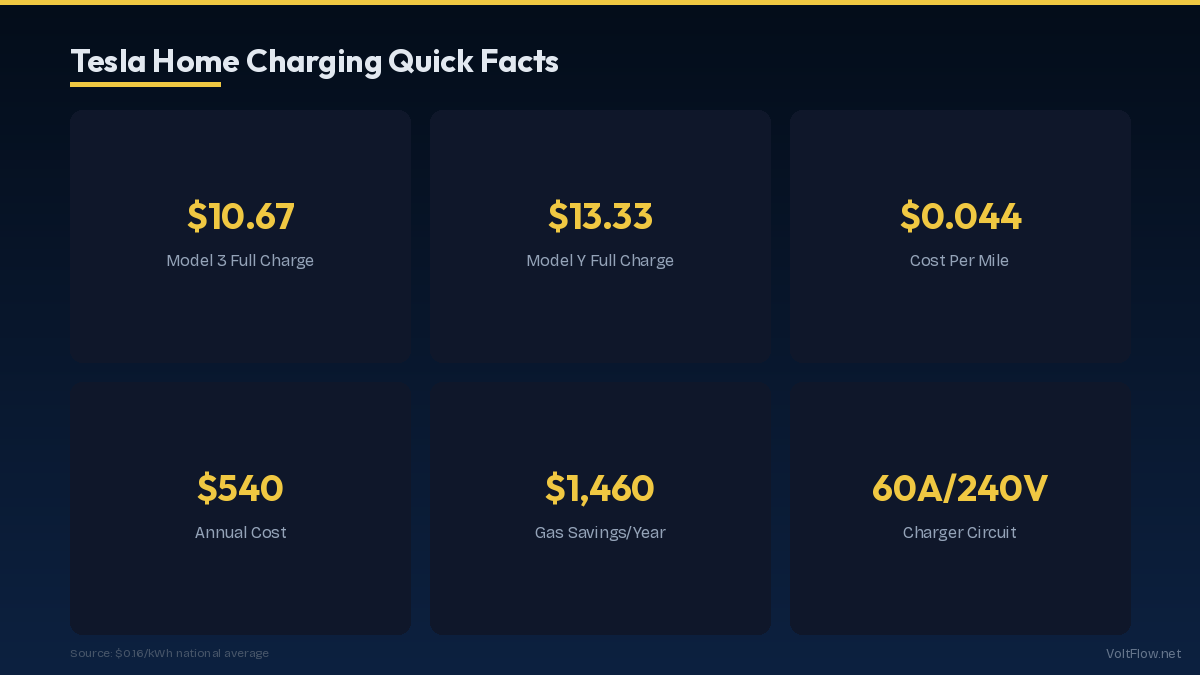
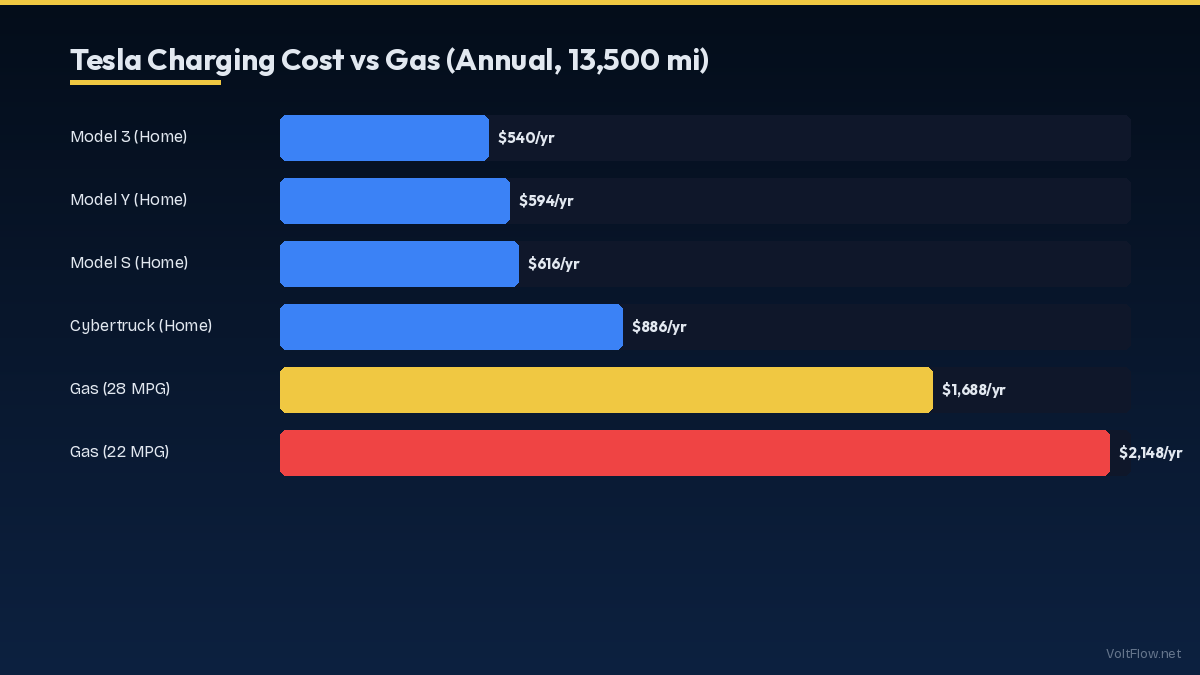
Each Tesla model has a different battery capacity and energy efficiency, which directly determines your charging cost. The Tesla Model 3 Standard Range Plus has a 60 kWh usable battery capacity and an EPA efficiency rating of approximately 3.8 miles per kWh. At the national average electricity rate of $0.16 per kWh, a full charge from zero to 100 percent costs $9.60 and provides roughly 228 miles of range. In practice, most owners charge from 20 percent to 80 percent, which costs about $5.76 and adds approximately 137 miles. Monthly cost for the average American driving 1,000 miles per month is approximately $42. The Tesla Model 3 Long Range has a 75 kWh battery and similar efficiency at about 3.9 miles per kWh. A full charge costs $12.00 at $0.16 per kWh and delivers around 293 miles. Monthly charging cost for 1,000 miles is approximately $41 since the larger battery is slightly more efficient on the highway. The Tesla Model Y, the best-selling EV in America, has a 75 kWh battery with an efficiency of about 3.4 miles per kWh due to its larger size and higher aerodynamic drag. A full charge costs $12.00 and provides approximately 255 miles. Monthly cost for 1,000 miles is roughly $47. The Tesla Model S with its 100 kWh battery costs $16.00 for a full charge at $0.16 per kWh, delivering about 370 miles of range. Despite the higher per-charge cost, the longer range means fewer charging sessions and similar monthly costs of $43 for 1,000 miles driven. The Tesla Model X has a 100 kWh battery but lower efficiency at about 2.9 miles per kWh due to its size and weight. A full charge costs $16.00 and provides approximately 290 miles. Monthly cost is approximately $55 for 1,000 miles. The Cybertruck with its 123 kWh battery pack in the top trim is the most expensive Tesla to charge. A full charge costs $19.68 at $0.16 per kWh and delivers roughly 320 miles. Monthly cost for 1,000 miles is approximately $62. Even at this highest Tesla charging cost, you are still saving significantly compared to the equivalent full-size truck consuming $200-$300 in gasoline monthly.
How Electricity Rates Affect Your Charging Cost
The single biggest variable in your home charging cost is your electricity rate, and rates vary enormously across the United States. At the low end, states like Louisiana ($0.10/kWh), Oklahoma ($0.11/kWh), and Idaho ($0.11/kWh) make Tesla ownership extremely affordable. Charging a Model Y in Louisiana costs about $29 per month for 1,000 miles of driving. At the high end, California ($0.28/kWh), Connecticut ($0.26/kWh), and Massachusetts ($0.27/kWh) push monthly charging costs significantly higher. That same Model Y in California costs approximately $82 per month for 1,000 miles. However, even at California rates, you are saving money compared to gasoline. A comparable gas SUV averaging 25 MPG at $4.50 per gallon costs $180 per month for 1,000 miles, more than double the electric charging cost even in the most expensive electricity market. Time-of-use (TOU) rate plans can dramatically reduce your charging cost. Many utilities offer special EV rates or TOU plans with off-peak rates 40-60 percent lower than standard rates. For example, Pacific Gas and Electric in California offers an EV rate plan with off-peak electricity at $0.17 per kWh between midnight and 3 PM compared to peak rates of $0.45 per kWh. By scheduling your Tesla to charge during off-peak hours, which is built into the Tesla app and car software, you can cut your charging cost nearly in half. Check with your utility company about available EV rate plans. Some require a separate meter for the EV charger ($200-$500 installation cost) while others apply the TOU rates to your entire home consumption. Calculate whether the overall savings from cheaper overnight electricity offset any higher peak-time rates for daytime usage. In most cases, households that shift laundry, dishwashing, and EV charging to off-peak hours save $30-$80 per month on their total electric bill, more than covering any increased peak rates. Solar panel owners have an even better deal. If your solar system produces enough to cover your EV charging, your effective charging cost drops to zero on a marginal basis. A typical 8 kW solar system produces enough surplus electricity to charge a Tesla Model Y for 12,000-15,000 miles per year. The electricity your panels produce during peak sunshine hours offsets the electricity your car consumes during overnight charging through net metering credits.
Level 1 vs Level 2 Home Charging
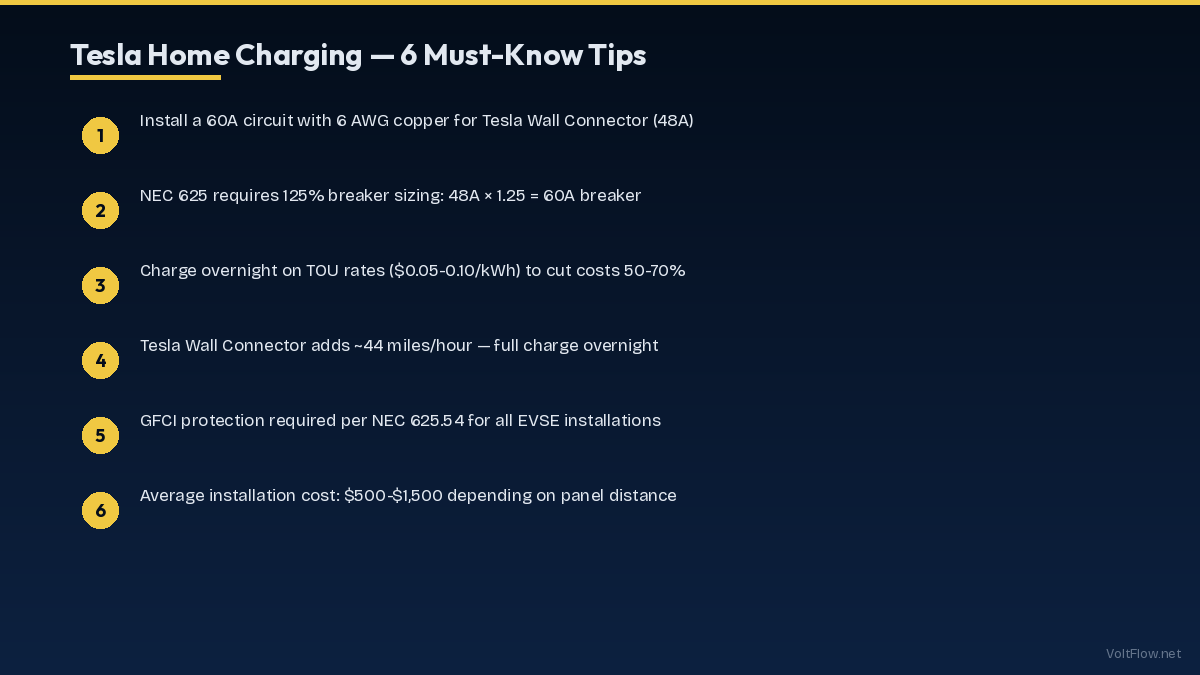
Tesla home charging comes in two flavors that differ in speed, cost, and convenience. Level 1 charging uses the standard 120-volt household outlet and the mobile connector that comes with your Tesla (or sold as an accessory for newer models). It adds approximately 3-5 miles of range per hour, meaning a full overnight charge of 10-12 hours adds only 30-60 miles. Level 1 charging is essentially free to set up since you already have the outlet. It works acceptably for low-mileage drivers who drive less than 30 miles per day and can charge every night. The electricity cost per kWh is identical to Level 2 since you are paying the same rate regardless of charging speed. However, Level 1 charging is slightly less efficient, losing about 10-15 percent of energy to heat during the longer charging session compared to 5-8 percent losses with Level 2. Level 2 charging uses a 240-volt outlet (typically NEMA 14-50) and either the Tesla Wall Connector or a third-party charger like ChargePoint Home Flex or Grizzl-E. Level 2 adds 25-44 miles of range per hour depending on the amperage. A 48-amp Tesla Wall Connector on a 60-amp circuit delivers the maximum 44 miles per hour, fully charging a Model 3 in about 6 hours. The Tesla Wall Connector costs $475 for the unit itself. Installation of a 240-volt circuit from your panel to the garage or carport runs $500-$1,500 depending on distance and complexity. Total Level 2 setup cost is typically $975-$2,000. Third-party Level 2 chargers cost $400-$700 for the unit and work with the same 240-volt circuit. The installation cost for the circuit is the same regardless of which charger you choose. Some third-party chargers offer features Tesla does not, like built-in energy monitoring, cable management systems, or the ability to charge non-Tesla EVs if your household has multiple brands. When calculating the return on investment for Level 2 charging installation, consider that the improved charging efficiency saves approximately $50-$100 per year in electricity compared to Level 1 for the average driver. The convenience value is harder to quantify but substantial. Level 2 charging means you never worry about having enough range for an unexpected trip because your car charges fully every night. Many Tesla owners describe the transition from Level 1 to Level 2 as transformative for the daily ownership experience. If you plan to keep the EV for five or more years, Level 2 installation pays for itself in efficiency savings alone while providing daily convenience that Level 1 cannot match.
Home Charging vs Supercharger Cost Comparison
While this guide focuses on home charging, understanding Supercharger costs provides context for the savings you achieve by charging at home. Tesla Supercharger rates in 2026 vary by location but typically range from $0.35 to $0.50 per kWh for non-members and $0.30 to $0.40 per kWh for Tesla Premium Connectivity subscribers or Charging Membership holders. Some locations charge per-minute during idle time after charging is complete. Charging a Model Y from 20 to 80 percent at a Supercharger costs approximately $16-$22 compared to $5-$8 at home. That is roughly three times the home charging cost. Over the course of a year driving 12,000 miles, exclusive Supercharger use would cost approximately $900-$1,200 compared to $350-$550 for home charging. The $400-$700 annual savings from home charging means a Level 2 installation pays for itself within two to three years in Supercharger savings alone. There are situations where Supercharger use makes sense regardless of cost. Road trips beyond your battery range obviously require Supercharging. Tesla V3 and V4 Superchargers deliver up to 250 kW, adding 200 miles of range in about 15 minutes. For road trips, the Supercharger network is fast, reliable, and well-located along major travel corridors. Apartment dwellers and renters without home charging access may rely on Superchargers as their primary charging method. In this scenario, the cost-per-mile for a Tesla is still significantly lower than gasoline but higher than for homeowners who charge overnight. The cost premium for Supercharger-only charging is approximately $40-$60 per month over home charging for a typical driver. Workplace charging is an increasingly common middle ground. Many employers offer Level 2 charging at little or no cost as an employee benefit. If your workplace provides free charging, your Tesla fuel cost drops to zero for daily commuting, with only occasional Supercharger costs for road trips. Even paid workplace charging at $0.15-$0.25 per kWh is comparable to home charging and avoids the need for home charging infrastructure if your daily commute is short enough to top up fully during work hours.
Calculating Your Personal Monthly Charging Cost
To calculate your exact monthly Tesla charging cost, you need three numbers: your monthly driving distance, your specific Tesla model efficiency, and your electricity rate. Here is the formula and a worked example. Monthly charging cost equals monthly miles driven divided by miles per kWh efficiency, multiplied by your electricity rate per kWh. For a Model Y owner driving 1,200 miles per month in Texas with an electricity rate of $0.12 per kWh and an efficiency of 3.4 miles per kWh: 1,200 divided by 3.4 equals 353 kWh consumed, multiplied by $0.12 equals $42.35 per month. Compare this to a gasoline Toyota RAV4 getting 30 MPG with gas at $3.20 per gallon: 1,200 divided by 30 equals 40 gallons, multiplied by $3.20 equals $128 per month. The Tesla saves $85.65 per month or $1,028 per year in fuel costs alone. Your actual efficiency may vary from EPA ratings based on several factors. Cold weather reduces efficiency by 20-40 percent due to battery heating and cabin heating requirements. A Model Y that gets 3.4 miles per kWh in summer might average 2.2 miles per kWh in a Minnesota winter. Highway driving at 75-80 MPH reduces efficiency by 15-25 percent compared to city driving due to aerodynamic drag. Aggressive acceleration and frequent hard braking reduce efficiency by 10-20 percent compared to smooth driving. Running climate control, particularly heating, adds 1-3 kWh per hour of driving. To get your real-world efficiency, check the Energy screen in your Tesla which shows actual Wh per mile over recent trips. Divide 1,000 by this number to get miles per kWh. Most owners find their real-world annual average is 10-20 percent lower than the EPA rating. For annual cost calculations, multiply your monthly cost by 12, but account for seasonal variation. Summer months with mild weather and longer days are your cheapest charging months. Winter months in cold climates can nearly double your per-mile energy consumption. A reasonable approach is to calculate summer and winter costs separately and average them for an annual estimate. Track your charging costs for the first few months of Tesla ownership using the Tesla app, which shows energy consumed per charge session. Cross-reference this with your electricity bill to verify your effective rate and calculate your actual cost. Many Tesla owners find their real-world costs are close to or even below these estimates, especially if they take advantage of TOU rates and charge during the cheapest overnight hours.
Maximizing Savings: Tips to Reduce Charging Cost
Beyond choosing the right electricity rate plan, several strategies can further reduce your Tesla home charging cost. Setting your charge limit to 80 percent for daily driving is the most impactful single change. Charging above 80 percent is less efficient because the battery management system slows charging speed to protect battery health. The last 20 percent of charge takes nearly as long as the first 80 percent and generates more waste heat. Unless you need maximum range for a specific trip, an 80 percent charge limit saves energy, money, and battery degradation. Preconditioning your Tesla while it is still plugged into the charger saves significant energy in cold weather. When you preheat the cabin and battery using wall power instead of battery power, you avoid consuming stored energy for heating. The Tesla app allows you to schedule departure times so the car preconditions automatically. In winter, this practice saves $15-$30 per month compared to heating the car from battery power after unplugging. Tire pressure directly affects efficiency. Underinflated tires increase rolling resistance and energy consumption. Check tire pressure monthly and maintain the Tesla-recommended pressure, which is typically 42-45 PSI for most models. Every 1 PSI below recommended pressure reduces efficiency by approximately 0.3 percent, which adds up over 12,000 miles per year. Regenerative braking should be set to Standard (the maximum setting) to recapture the most energy during deceleration. Tesla models with single-pedal driving capability can recapture 15-25 percent of the energy used in stop-and-go city driving. Learning to drive smoothly with regenerative braking improves your effective efficiency by 10-15 percent compared to aggressive driving with frequent braking. If you have solar panels, time your charging to coincide with peak solar production when possible. While net metering credits make the math equivalent, direct solar-to-car charging avoids any transmission losses and utility fees that might apply in your jurisdiction. Some Tesla owners with solar and a home battery use the Tesla app to charge only from solar surplus, reducing their EV charging cost to effectively zero. Finally, consider whether a dedicated EV meter makes sense for your situation. Some utilities offer EV-specific rates that are 30-50 percent lower than standard residential rates but require a separate meter and circuit. The meter installation costs $200-$500 plus the electrician fee, but the ongoing savings of $20-$50 per month can recoup the installation cost within one to two years. Ask your utility about EV-specific rate options and calculate the break-even point for your driving patterns.