Home EV Charging vs Public Charging Cost 2026: Full Comparison
Charging your EV at home costs roughly one-third to one-half what you pay at public stations. In 2026, home charging averages $0.16/kWh ($4-$8 per session) compared to $0.35-$0.50/kWh ($15-$25 per session) at DC fast chargers. Over a year of typical driving, that difference adds up to $500-$1,200 in savings for home chargers. This guide compares every aspect of home versus public charging so you can optimize your charging strategy and minimize your EV fuel costs.
Cost Per kWh: Home vs Level 2 Public vs DC Fast Charging
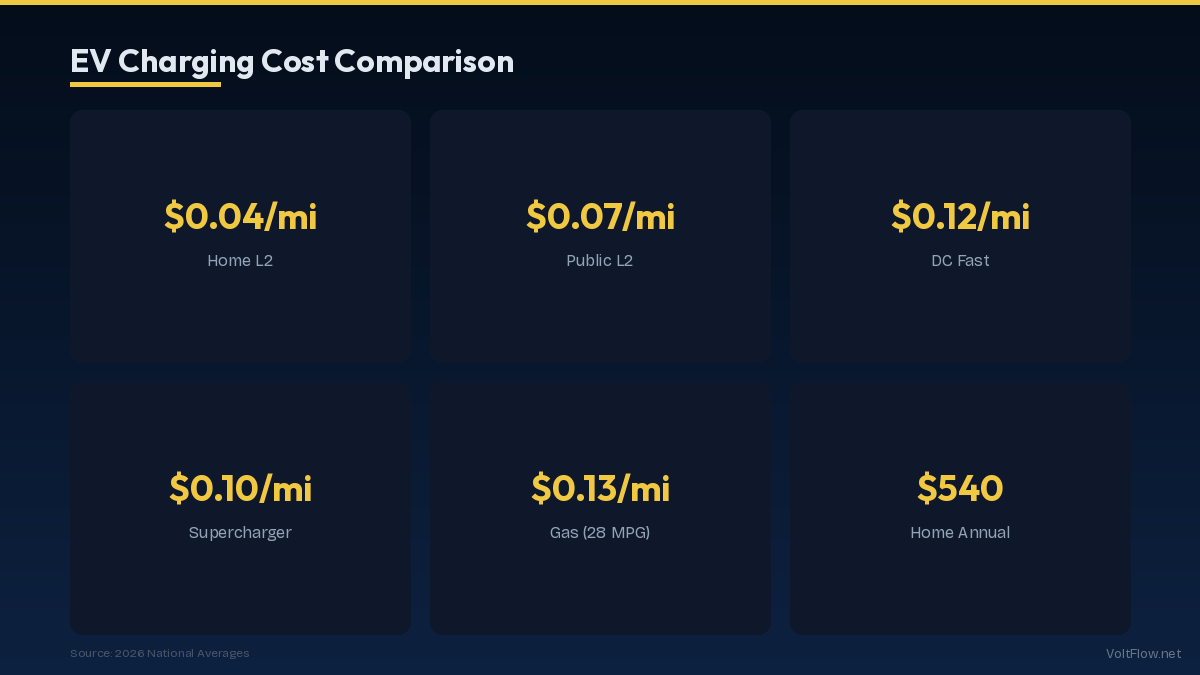
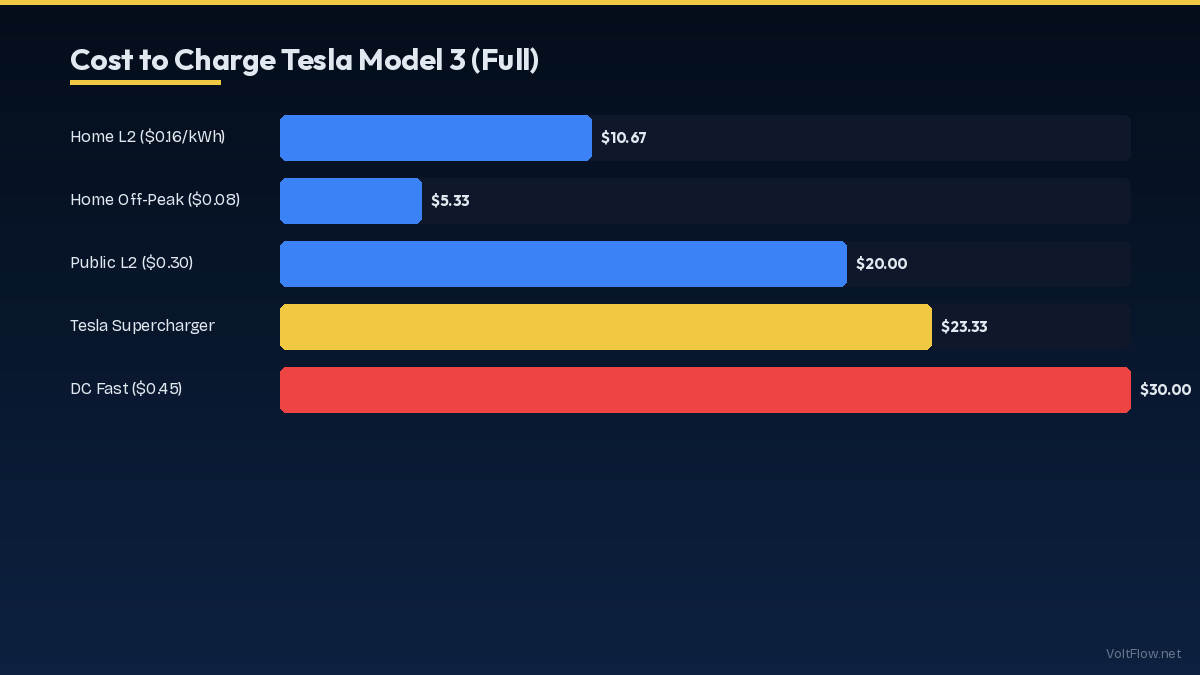
The cost comparison between charging locations involves three tiers with fundamentally different pricing structures. Home charging uses your residential electricity rate, which averages $0.16 per kWh nationally in 2026. With time-of-use plans, overnight home charging drops to $0.08-$0.12 per kWh in many markets. A typical charging session adding 30 kWh to your battery costs $4.80 at the average rate or $2.40-$3.60 at off-peak TOU rates. There are no session fees, idle fees, or membership costs, you pay only for the electricity consumed. Public Level 2 charging stations, found at shopping centers, workplaces, hotels, and parking garages, charge $0.20-$0.35 per kWh in most networks. ChargePoint stations typically range from $0.20-$0.30 per kWh depending on the site host pricing. Some locations charge by the hour instead of by the kWh, typically $1-$3 per hour for 6-7 kW delivery. A 30 kWh session at a public Level 2 station costs $6-$10.50, roughly 30-100 percent more than home charging. Some public Level 2 stations are free, particularly at workplaces and hotels that offer charging as an amenity. Free workplace charging effectively eliminates your commute fuel cost entirely. DC fast charging is the most expensive option at $0.35-$0.60 per kWh across major networks. Tesla Superchargers average $0.35-$0.45 per kWh depending on location and membership status. Electrify America charges $0.43-$0.48 per kWh for non-members and offers a $4 per month membership that reduces rates to $0.36-$0.40 per kWh. EVgo charges $0.35-$0.45 per kWh with a $6.99 monthly membership reducing rates by $0.05-$0.10 per kWh. A 30 kWh DC fast charging session costs $10.50-$18, roughly two to four times the home charging cost. Many DC fast charging networks also impose idle fees of $0.40-$1.00 per minute after your session completes if you leave your car plugged in, adding potential surcharges of $5-$20 if you are not prompt about moving your vehicle. The pricing gap between home and public charging exists because public charging operators must cover the cost of the charging equipment, installation, land lease or parking space costs, network connectivity, payment processing, customer support, maintenance, and profit margin on top of the electricity cost. Home charging avoids all these overhead costs since you already own the electrical infrastructure.
Annual Cost Comparison for Typical Driving Patterns
Translating per-session costs into annual totals reveals the true financial impact of your charging strategy. The average American drives approximately 13,500 miles per year. Using a mid-efficiency EV like the Tesla Model Y at 3.4 miles per kWh, annual energy consumption is approximately 3,970 kWh. Charging exclusively at home at $0.16 per kWh costs $635 per year. With off-peak TOU rates at $0.10 per kWh, annual cost drops to $397. This compares to gasoline costs of $1,800-$2,250 per year for a comparable gas SUV averaging 25 MPG at $3.50-$4.50 per gallon. Home charging saves $1,165-$1,853 per year compared to gasoline even before considering the additional savings of avoiding oil changes, transmission maintenance, and brake pad replacements that EVs largely eliminate. Charging exclusively at public Level 2 stations at $0.28 per kWh costs $1,112 per year. This still saves $688-$1,138 compared to gasoline but costs $477 more per year than home charging. For apartment dwellers without home charging access, public Level 2 remains economically attractive compared to gas, just not as attractive as home charging. Charging exclusively at DC fast chargers at $0.45 per kWh costs $1,787 per year. This nearly eliminates the fuel cost advantage over gasoline and is roughly $1,152 more expensive per year than home charging. No rational EV owner should use DC fast charging as their primary method if home or workplace charging is available. DC fast charging is a road trip convenience tool, not an everyday fueling strategy. The optimal strategy for most EV owners combines home charging for 85-90 percent of needs with occasional DC fast charging for road trips. This mixed approach costs approximately $680-$750 per year, saving $1,050-$1,500 compared to gasoline. If your workplace offers free Level 2 charging, your effective annual charging cost drops further to $300-$400 since you charge primarily at work for free and at home only on weekends and evenings. The financial case for installing a home Level 2 charger is clear: the $975-$2,000 installation cost is recovered in 1-2 years through the difference between home and public charging costs, and the savings continue for the lifetime of the charger which typically exceeds 10 years.
Charging Speed and Convenience Factor Comparison
Beyond cost, charging speed significantly affects the practical convenience of each option and influences how you integrate charging into your daily routine. Home Level 2 charging at 32-48 amps adds 25-44 miles of range per hour. An overnight session of 8-10 hours adds 200-440 miles, far more than most drivers need daily. The convenience of waking up to a full battery every morning, without any detour to a charging station, is the primary quality-of-life advantage of home charging. You spend zero minutes per week at a charging station, the car charges while you sleep, eliminating the time cost entirely. Home Level 1 charging at 120 volts adds only 3-5 miles per hour, or 30-50 miles overnight. This is adequate for low-mileage drivers under 30 miles per day but insufficient for average commuters. Level 1 requires no installation cost but trades convenience for slow charging that may not keep up with daily driving needs. Public Level 2 stations add 15-30 miles per hour depending on the station output and your vehicle acceptance rate. A typical shopping trip of 1-2 hours adds 15-60 miles, which supplements home charging effectively but cannot serve as a primary charging method for high-mileage drivers. The main convenience drawback is availability, popular stations may be occupied, requiring you to wait or find an alternative. Apps like PlugShare and the ChargePoint app show real-time station availability but cannot guarantee a spot will be free when you arrive. DC fast chargers add 150-300 miles per hour at peak charging speeds, with most sessions completing in 20-40 minutes. This approaches the convenience of gas station refueling but still takes 3-5 times longer than filling a gas tank. Highway corridor fast chargers from Tesla Supercharger, Electrify America, and the expanding NEVI-funded network are well positioned for road trip stops but add meaningful time to long journeys. Planning stops around charging availability and speed requires more thought than gas stations, though navigation systems in modern EVs automate this route planning effectively. The time cost of public charging is meaningful when calculated annually. If public charging requires a 10-minute detour plus 30 minutes of charging time twice per week, you spend approximately 35 hours per year on charging logistics. At a personal time value of $20-$50 per hour, that implicit cost of $700-$1,750 per year makes the convenience argument for home charging even stronger than the cost argument alone.
Battery Health Impact of Different Charging Methods
Your charging method affects your EV battery longevity, and the difference between regular home charging and frequent DC fast charging is significant over the life of the vehicle. Lithium-ion batteries degrade through a combination of calendar aging which occurs regardless of use, cycle aging from charge and discharge cycles, and thermal stress from heat generated during charging. DC fast charging generates substantially more heat than Level 2 charging because it pushes much higher current through the battery in a shorter time. A Level 2 home charger delivers 7-11 kW of power, warming the battery by only a few degrees above ambient temperature. A 150-250 kW DC fast charger can raise battery temperature by 15-25 degrees Celsius during a session, accelerating chemical degradation of the cells. Studies of Tesla fleet data from research organizations show that vehicles primarily charged at home retain 90-95 percent of original battery capacity after 100,000 miles, while vehicles that relied heavily on DC fast charging retained only 85-90 percent. That 5-10 percentage point difference translates to 15-30 miles of lost range, which may not seem dramatic but compounds over the life of the vehicle. Over 200,000 miles, the difference grows to 10-15 percentage points. Most EV manufacturers recommend limiting DC fast charging to when it is genuinely needed for travel and using Level 2 for daily charging. Tesla and BMW vehicle software actively manages fast charging speed based on battery temperature and state of charge to protect longevity, automatically reducing charge speed above 80 percent state of charge regardless of the charger capability. Home charging also allows you to implement battery-friendly habits more easily. Setting your daily charge limit to 80 percent and charging only when the battery drops below 20-30 percent keeps the battery in the optimal 20-80 percent range where degradation is minimized. Smart home chargers and vehicle apps make this automatic. Fast charging typically pushes to 80 percent and then slows dramatically, but the urgency of road trip stops often leads owners to charge to 90-100 percent for maximum range, which is harder on the battery when combined with the fast charging heat. The bottom line is that home Level 2 charging is not just cheaper and more convenient, it is actively better for your vehicle long-term value and battery health.
Solutions for Apartment Dwellers and Renters
Not every EV owner has access to home charging, and this reality significantly affects the economic and convenience calculus. Approximately 36 percent of American households rent, and many homeowners lack a garage or dedicated parking space near an electrical panel. Here are the practical alternatives and their costs. Workplace charging is the best substitute for home charging. If your employer offers Level 2 charging, even at cost, you can replenish your daily commute range during work hours. Free workplace charging is becoming increasingly common as companies use it for employee recruitment and retention and to meet corporate sustainability goals. If your employer does not offer charging, request it, the cost to install a few Level 2 stations is modest for most businesses and may qualify for federal tax credits of up to 30 percent. Destination charging at shopping centers, gyms, restaurants, and movie theaters supplements workplace charging for renters. Planning your errands around charging availability takes some adjustment but becomes routine within a few weeks. Many destination chargers offer 1-3 hours of free charging as a customer amenity, enough to add 15-60 miles while you shop or eat. Public Level 2 networks like ChargePoint, Blink, and local utility-sponsored stations provide reliable charging for renters at $0.20-$0.35 per kWh. Monthly membership plans from some networks reduce per-kWh costs. The ChargePoint monthly plan and EVgo Plus membership provide predictable charging costs that simplify budgeting for renters who rely on public infrastructure. Curbside charging infrastructure is expanding in many cities. New York, Los Angeles, San Francisco, and other major metros are installing curbside Level 2 chargers integrated into streetlights, parking meters, and bollards. These public stations bring charging closer to apartment buildings where off-street parking is unavailable. Portable Level 2 chargers that plug into dryer outlets offer a creative solution for renters with laundry room access. Products like the Lectron portable charger plug into a standard NEMA 14-30 dryer outlet, providing Level 2 charging speed without permanent installation. You plug in when charging and unplug when done. This requires landlord permission and is only practical if the outlet is accessible near your parking spot. If none of these options work and you must rely primarily on DC fast charging, factor the higher per-kWh cost into your EV ownership decision. At $0.45 per kWh, annual charging costs approach gasoline levels, reducing the financial advantage of EV ownership significantly.
Building Your Optimal Charging Strategy
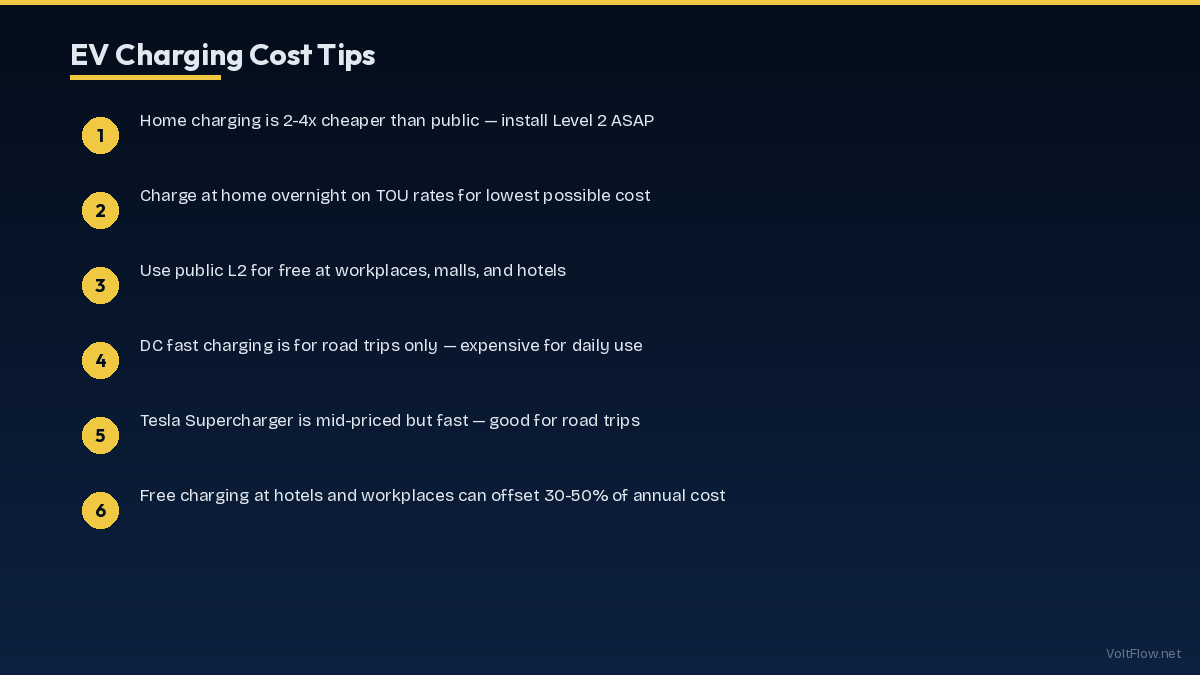
The ideal charging strategy minimizes cost, maximizes convenience, and protects your battery. Here is how to build yours based on your living situation and driving patterns. For homeowners with a garage or carport, install a Level 2 home charger and make it your primary charging method for 85-95 percent of your energy needs. Set your charge limit to 80 percent for daily driving. Enable time-of-use scheduling to charge at the cheapest overnight rate. Use DC fast charging only during road trips. Expected annual cost for 13,500 miles at $0.12 per kWh off-peak is approximately $400. For homeowners without a garage but with outdoor parking near the panel, install a weatherproof Level 2 outlet with a NEMA 14-50 receptacle and in-use cover on the exterior wall nearest your parking spot. Run the cable across the driveway only while charging and store it when not in use. The cost and convenience is similar to garage installations with slightly different cable management needs. For renters with workplace charging access, charge at work during the day as your primary method. Use destination charging for supplemental needs when running errands on weekends. Use DC fast charging only for long trips. Expected annual cost for 13,500 miles is $100-$300 if workplace is free, or $600-$900 at paid workplace stations. For renters without any regular Level 2 access, use a combination of public Level 2 and DC fast charging. Subscribe to network memberships that reduce per-kWh costs. Plan weekly charging sessions at public Level 2 during shopping or errands. Use DC fast charging when time-pressed. Expected annual cost is $1,000-$1,400. For all EV owners regardless of situation, track your charging costs monthly using your vehicle app or charging network app. Compare your actual cost per mile against your initial projections and adjust your charging mix if costs are higher than expected. The major networks regularly adjust pricing, so re-evaluate your subscriptions and preferred stations quarterly. The investment in home charging infrastructure pays for itself remarkably fast. A $1,500 home charger installation saving $500-$1,200 per year versus public charging has a payback period of 1-3 years. Over 10 years of EV ownership, home charging saves $5,000-$12,000 compared to relying on public infrastructure. Combined with the gasoline savings of $10,000-$18,000 over the same period, an EV with home charging delivers total fuel savings of $15,000-$30,000 across a decade of ownership.