NEC Rapid Shutdown Requirements 2026: Solar Safety Rules Explained
NEC rapid shutdown requirements protect firefighters and first responders from dangerous rooftop voltages during solar emergencies. The 2026 NEC requires that solar conductors within the array boundary be reduced to 80 volts or less within 30 seconds of initiating rapid shutdown. This module-level requirement effectively mandates microinverters or module-level power electronics on virtually all new residential solar installations. This guide explains the requirements, compliant equipment, and costs.
What Is Rapid Shutdown and Why It Exists
Rapid shutdown is a safety requirement that ensures solar panels on a roof can be de-energized quickly when firefighters need to work on or near the roof. Without rapid shutdown, solar panels continue generating dangerous DC voltage as long as sunlight hits them, regardless of whether the inverter is turned off or the AC disconnect is opened. A typical residential solar string operates at 300-600 volts DC, lethal levels that cannot be turned off at the panel or inverter because the panels themselves are the power source. When firefighters ventilate a roof during a fire, they cut through roofing materials with axes and saws. If they cut through a solar cable carrying 400 volts DC, they face electrocution risk. Even after the fire department disconnects the home from the grid and shuts down the inverter, the DC wiring from the panels to the inverter remains energized at high voltage during daylight hours. Rapid shutdown addresses this hazard by requiring that all conductors within a defined boundary around the solar array reduce to safe voltage levels within 30 seconds of initiating the shutdown. The initiation is typically triggered by opening the AC disconnect, turning off the inverter, or pressing a dedicated rapid shutdown button. Once initiated, module-level electronics on each panel reduce its output voltage to 1 volt or less per panel, dropping the total system voltage to safe levels within the required time. The NEC first introduced rapid shutdown in the 2014 edition with requirements for conductors outside the array boundary. The 2017 NEC extended the requirement to conductors within the array boundary, effectively requiring module-level electronics at each panel. The 2020 and 2023 NEC cycles refined the requirements, and the 2026 cycle continues these module-level requirements with additional clarifications about equipment listing and testing standards. The requirement applies to all new solar installations and major modifications to existing systems in jurisdictions that have adopted the NEC 2017 or later. Most of the United States has adopted some version of the rapid shutdown requirement, though specific adoption varies by state and local jurisdiction. Check with your local authority having jurisdiction to confirm which NEC edition applies to your installation.
NEC 690.12: The Technical Requirements
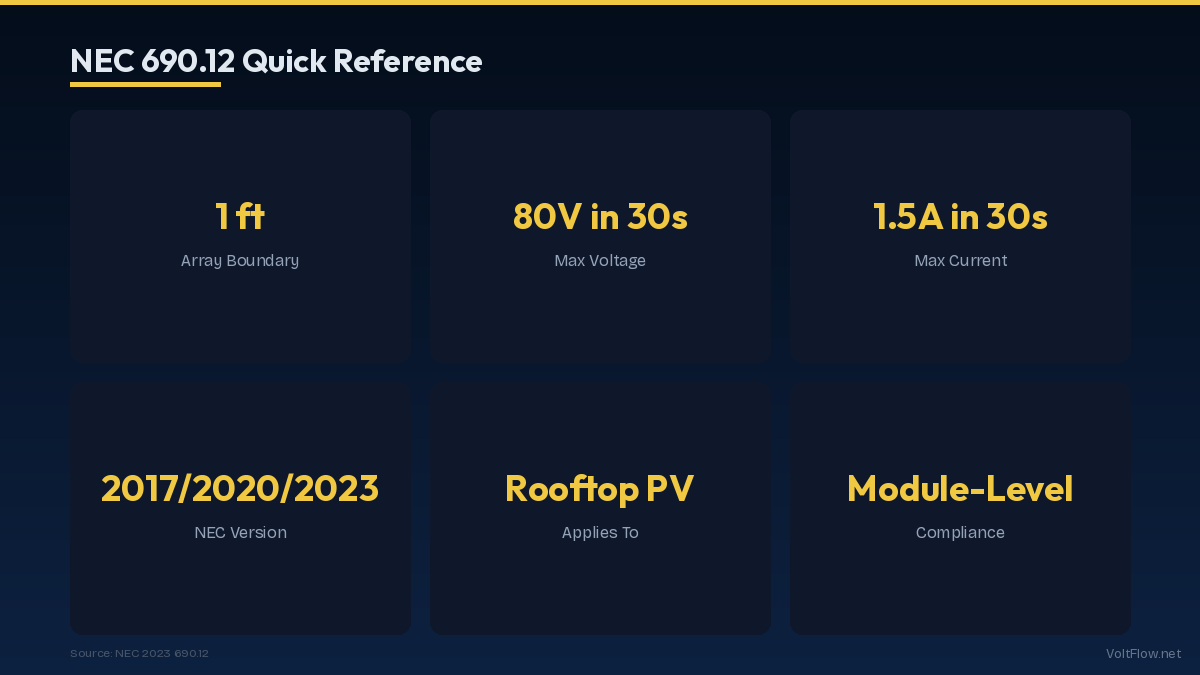
NEC Section 690.12 specifies the exact rapid shutdown performance requirements. Understanding these details helps installers, inspectors, and homeowners verify that a system meets code. The 2026 NEC requires that PV system circuits within the array boundary be limited to not more than 80 volts within 30 seconds of rapid shutdown initiation. The array boundary is defined as 12 inches from the edge of the array in all directions plus the area beneath the array. Any conductors, including the DC wiring between panels and from panels to the rooftop junction box, must comply within this boundary. The 80-volt threshold was chosen because it is below the level considered immediately dangerous to life and health (IDLH) for DC voltage. While any voltage can cause injury under certain conditions, 80 volts DC is unlikely to cause fatal electrocution through intact skin under typical conditions a firefighter might encounter. The 30-second time limit ensures that the system reaches safe voltage quickly enough to protect first responders who may arrive on the roof within minutes of the rapid shutdown initiation. Rapid shutdown must be automatically initiated when the service disconnect or inverter is turned off. This means the safety function is not optional or dependent on someone pressing a specific button. Any action that disconnects the solar system from the grid or shuts down the inverter automatically triggers rapid shutdown at the module level. Equipment that provides rapid shutdown must be listed to UL 3741, the Standard for Photovoltaic Hazard Control. This listing ensures the equipment has been tested to verify it actually reduces voltage within the required time and maintains safe voltage indefinitely while sunlight is present. Look for the UL 3741 listing on any module-level electronics your installer proposes. Some older MLPE devices may be listed to UL 1741 but not UL 3741. Confirm the specific listing with your inspector before installation. The NEC also requires a rapid shutdown label on the service disconnect or meter socket. The label must be reflective, durable, and include the words "PHOTOVOLTAIC SYSTEM EQUIPPED WITH RAPID SHUTDOWN" along with a graphical representation of the array location on the building. Fire department personnel rely on this label to know the system has rapid shutdown capability and that the roof will be at safe voltage levels shortly after they initiate the shutdown at the disconnect.
Compliant Equipment: Microinverters vs Optimizers vs MLPE
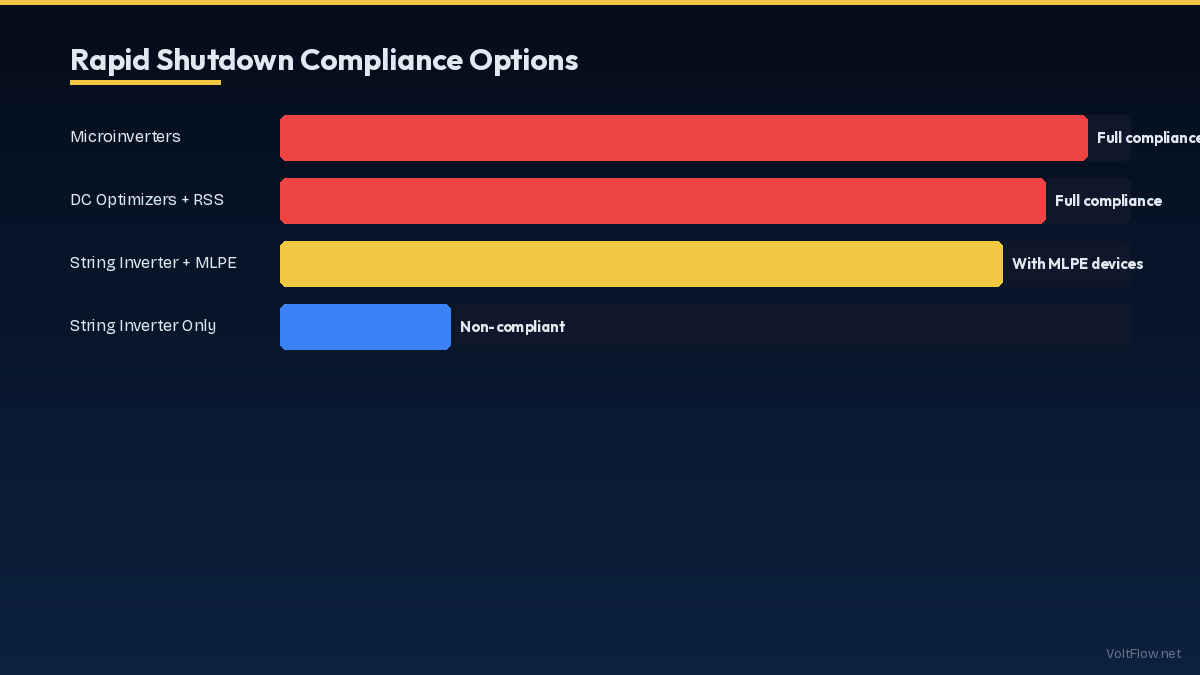
Three categories of equipment meet the NEC rapid shutdown requirements. Each has different performance characteristics, costs, and installation considerations. Microinverters convert DC to AC at each individual panel, eliminating DC wiring on the roof entirely. Since the output of each microinverter is 240 volts AC instead of 300-600 volts DC, and the microinverter shuts down completely when the grid connection is lost, there is no high-voltage DC hazard at any time. Microinverters inherently comply with rapid shutdown without any additional equipment. Enphase IQ8 series microinverters are the dominant residential microinverter product in 2026, installed on approximately 50 percent of new residential systems. Each IQ8 microinverter costs $130-$180 and handles one panel. For a 20-panel system, microinverter cost is approximately $2,600-$3,600. The advantages beyond rapid shutdown compliance include panel-level monitoring, better performance in partial shading, and no single point of failure since one failed microinverter affects only one panel. DC power optimizers paired with a string inverter provide an alternative approach. Each optimizer is a DC-to-DC converter mounted under or behind each panel. During normal operation, optimizers allow the string inverter to control each panel maximum power point independently, improving performance by 5-15 percent compared to a standard string inverter. During rapid shutdown, the optimizers reduce each panel output to 1 volt, dropping the string voltage to safe levels within seconds. SolarEdge P-series optimizers are the leading product at $50-$80 per optimizer, paired with a SolarEdge string inverter at $1,500-$2,500. Total system cost for a 20-panel system is approximately $2,500-$4,100 for the optimizers plus the inverter cost. SolarEdge systems provide panel-level monitoring and excellent shade performance while maintaining the higher conversion efficiency of a centralized inverter. Standalone module-level power electronics or MLPE devices that provide only the rapid shutdown function without optimizer or microinverter capabilities are available at $20-$40 per panel. These low-cost devices meet the rapid shutdown requirement while allowing the use of a standard string inverter without per-panel optimization. For budget-conscious installations where shade performance is not a concern, standalone MLPE plus a basic string inverter provides the lowest total system cost at $400-$800 for the MLPE devices for a 20-panel system plus a string inverter at $1,000-$2,000. However, you lose the monitoring and shade performance benefits that optimizers and microinverters provide.
Cost Impact of Rapid Shutdown Compliance
The rapid shutdown requirement adds cost to every solar installation compared to a basic string inverter system without module-level electronics. Understanding the cost premium helps homeowners evaluate quotes and make informed decisions about equipment choices. A basic string inverter system without rapid shutdown compliance, which is no longer code-compliant for new installations in most jurisdictions, costs approximately $0.25-$0.35 per watt for the inverter. A 8 kW system string inverter costs $2,000-$2,800. Adding the cheapest rapid shutdown compliance through standalone MLPE devices adds approximately $0.05-$0.10 per watt or $400-$800 for an 8 kW system. Total inverter-side cost is $2,400-$3,600. Choosing SolarEdge optimizers for both rapid shutdown compliance and panel-level optimization adds approximately $0.15-$0.25 per watt for the optimizers on top of the SolarEdge inverter cost. Total inverter-side cost for an 8 kW SolarEdge system is $3,500-$5,000. Choosing Enphase microinverters, which provide the most complete rapid shutdown solution with no DC wiring at all, costs approximately $0.35-$0.50 per watt. Total microinverter cost for an 8 kW system is $2,800-$4,000, with no separate inverter needed. The cost premium for rapid shutdown compliance over a non-compliant string inverter is $400-$2,000 depending on the approach chosen. For an 8 kW system costing $22,000 total, this represents a 2-9 percent premium. The 30 percent federal tax credit applies to the full system cost including the rapid shutdown equipment, reducing the net premium to $280-$1,400. Most solar professionals recommend the optimizer or microinverter approach over standalone MLPE because the monitoring, shade performance, and warranty benefits provide long-term value that exceeds the modest cost premium. The energy production improvement of 5-15 percent from per-panel optimization typically adds $100-$300 per year in additional generation, recovering the cost premium in 3-7 years. For new installations in 2026, the rapid shutdown equipment cost is simply part of the system price, similar to how airbags are part of a car price. All competitive quotes include compliant equipment, and the choice between microinverters and optimizers is a feature and performance decision rather than a compliance decision. Both approaches meet code, and both provide valuable benefits beyond the safety requirement.
Existing Systems: Retrofitting for Rapid Shutdown
Solar systems installed before rapid shutdown requirements were adopted in your jurisdiction are generally grandfathered and do not need retrofitting. However, certain modifications to existing systems can trigger the requirement to bring the entire system into compliance. Major modifications that typically trigger rapid shutdown requirements include replacing the inverter with a new model, adding panels that increase system capacity by more than a specified threshold (varies by jurisdiction, often 10-20 percent), reroofing that requires removing and reinstalling the solar array, and relocating panels to a different section of the roof. Minor modifications that typically do not trigger the requirement include replacing individual failed panels with equivalent models, repairing wiring without changing the system configuration, and replacing the monitoring equipment or communication gateway. The cost to retrofit an existing string inverter system with rapid shutdown compliance depends on the approach. Adding standalone MLPE shutdown devices to each panel costs $20-$40 per device plus $200-$400 in labor for a 20-panel system, totaling $600-$1,200. This is the least disruptive approach because it adds devices to the existing DC wiring without replacing any major components. Upgrading to SolarEdge optimizers requires replacing the string inverter with a SolarEdge inverter and adding optimizers to each panel. Total retrofit cost is $4,000-$6,500 including labor. This is a more significant upgrade but provides the optimizer benefits for the remaining 15-20 years of the system lifespan. Upgrading to Enphase microinverters requires replacing the string inverter and adding a microinverter to each panel. This is the most complete retrofit at $5,000-$8,000 but eliminates all rooftop DC wiring and provides the most complete safety solution. For systems approaching the end of their inverter warranty period at 10-15 years, an inverter replacement is coming regardless. Timing the rapid shutdown retrofit to coincide with the inverter replacement eliminates the labor duplication of two separate roof visits and reduces the incremental cost of compliance.
Inspection, Labeling, and Fire Department Considerations
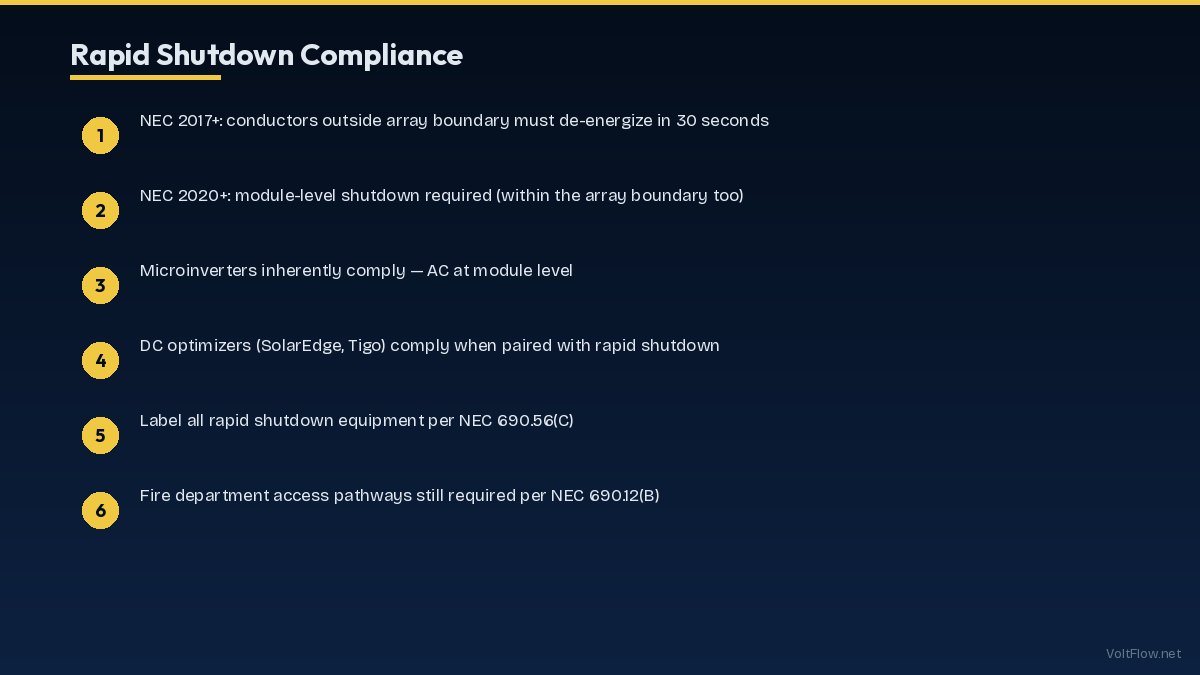
Rapid shutdown compliance involves more than just installing the right equipment, proper labeling, documentation, and inspection are required to close the permit and ensure first responders can use the safety features effectively. The rapid shutdown initiation device, which is typically integrated into the AC disconnect or inverter shutdown, must be clearly labeled. NEC 690.56(C) requires a plaque at the rapid shutdown initiation device that reads "PHOTOVOLTAIC SYSTEM EQUIPPED WITH RAPID SHUTDOWN." The plaque must be reflective, weather-resistant, and have letters at least 3/8 inch tall with white text on red background. Additional labels are required on the main service disconnect indicating the presence of a solar system and its rapid shutdown capability. Building-integrated labels showing the location and extent of the solar array on the roof must be placed at the main electrical service per NEC 705.10. These labels help firefighters identify where solar panels are located before they climb onto the roof. Some jurisdictions require a roof access map posted near the electrical service showing the array footprint, access pathways for firefighters, and the location of rapid shutdown controls. This map requirement is becoming more common as solar penetration increases and fire departments develop solar-specific emergency procedures. During the permit inspection, the inspector will verify that the rapid shutdown equipment is properly installed and listed to UL 3741, all labels are correctly placed and legible, the system reduces to 80 volts or less within 30 seconds of initiating shutdown, the initiation device is readily accessible (typically at the AC disconnect or meter location), and the array boundary setbacks from roof edges and ridges comply with NEC 690.12(B) which requires 18-inch pathways along ridges and edges for firefighter access. A common inspection failure is missing or incorrect labeling. Ensure all labels are installed before scheduling the inspection. Another common failure is the rapid shutdown initiation not being connected to the AC disconnect, meaning the system does not automatically shut down when the disconnect is opened. Verify this integration during installation testing. Fire departments across the country are developing protocols specific to buildings with solar panels. Many fire departments now include solar system identification in their pre-incident planning for residential areas. Some departments have adopted policies of not ventilating roofs with solar panels due to structural concerns from the panel weight and the difficulty of cutting around panel wiring, even with rapid shutdown. Homeowners should consider notifying their local fire department about their solar installation and providing a copy of the system layout drawing. This proactive communication helps ensure the fastest and safest emergency response if needed.