What Size Wire for 50-Amp Breaker? 2026 NEC Complete Guide
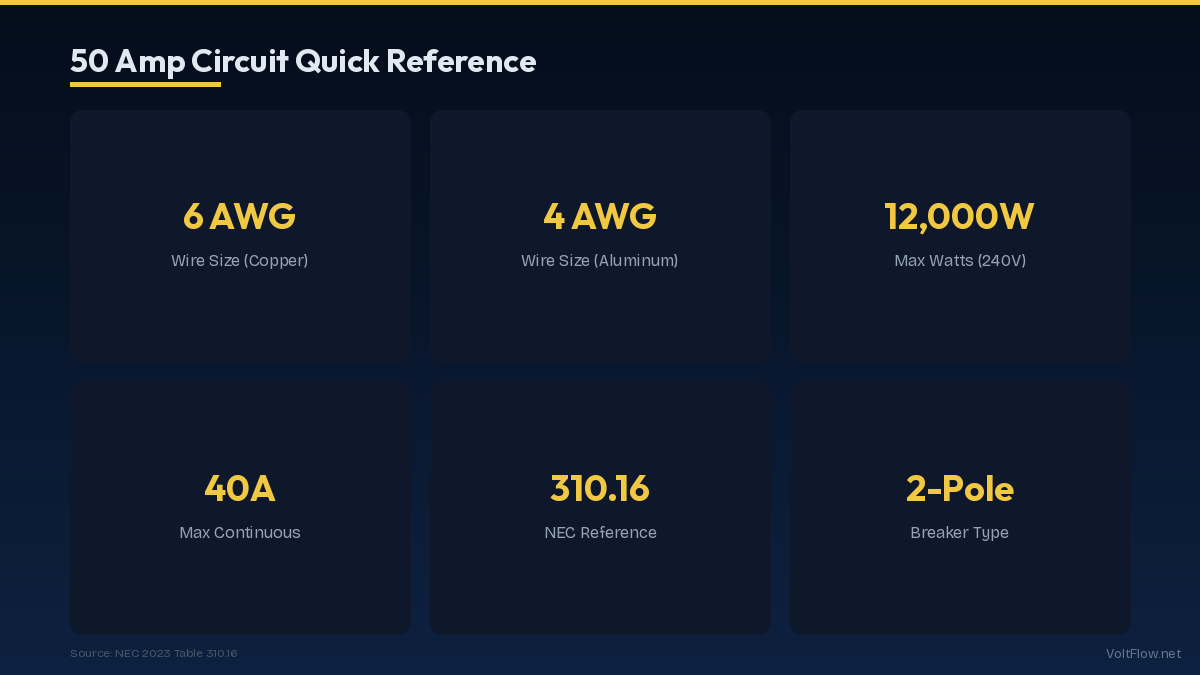
A 50-amp breaker requires 6 AWG copper wire or 4 AWG aluminum wire per NEC Table 310.16. This applies to electric ranges, EV chargers, RV outlets, welders, and sub-panel feeders. Using undersized wire on a 50-amp circuit is a fire hazard, the wire overheats inside the wall before the breaker trips. This guide covers every 50-amp application with wire types, voltage drop calculations, and installation requirements.
NEC Wire Size for 50-Amp Circuits
The NEC establishes minimum wire sizes for 50-amp circuits through Table 310.16, which lists the allowable ampacity of insulated conductors by gauge, material, and insulation temperature rating. For copper conductors at the 60-degree Celsius column commonly used for residential NM-B cable, 6 AWG carries 55 amps, which is the minimum gauge that exceeds the 50-amp breaker rating. The NEC requires the wire ampacity to equal or exceed the breaker rating per Section 240.4. For copper conductors at the 75-degree column used when equipment terminations are rated for 75 degrees, 6 AWG carries 65 amps. This provides even more headroom above the 50-amp breaker rating. For aluminum conductors at 75-degree terminations, 4 AWG carries 65 amps and is the minimum gauge for 50-amp circuits. Using aluminum wire two sizes larger than copper provides equivalent ampacity because aluminum has approximately 62 percent of the conductivity of copper. This is not a compromise in safety when proper aluminum installation practices are followed. The cable designation for a 50-amp circuit using NM-B copper cable is 6/3 NM-B, which contains three insulated conductors of 6 AWG (black hot, red hot, and white neutral) plus a bare 6 AWG ground wire. For circuits that do not require a neutral, such as baseboard heater circuits, 6/2 NM-B is used, containing two insulated conductors plus ground. For aluminum, the equivalent cable is 4/3 SER for four-wire circuits. SER cable is rated for service entrance and feeder applications and is commonly used for sub-panel feeders and large appliance circuits where the cost savings over copper justify the slightly larger cable diameter. A 50-amp circuit can also use individual THWN or THHN conductors pulled through conduit. This method uses four individual wires: a black 6 AWG hot, a red 6 AWG hot, a white 6 AWG neutral, and a green 6 AWG ground. Individual conductors in conduit are common for exterior runs and runs through areas subject to physical damage where NM-B cable is not permitted.
Common 50-Amp Circuit Applications
Several residential appliances and systems use 50-amp circuits, each with specific wiring requirements beyond the basic wire size. Electric ranges and cooktops are the most common 50-amp residential circuit. The standard installation uses a 50-amp double-pole breaker, 6/3 NM-B cable, and a NEMA 14-50R four-prong outlet. The four-prong configuration provides two hots for 240 volts, a neutral for the 120-volt components like the oven light and clock, and a ground for safety. Homes built before 1996 may have the older NEMA 10-50 three-prong outlet without a separate ground. While existing 10-50 outlets are grandfathered, any new installation or replacement must use the four-prong 14-50 configuration. EV charger circuits at 40 amps use a 50-amp breaker with 6 AWG wire because the NEC 125-percent continuous load rule requires the circuit to be rated at 125 percent of the charger continuous draw. A 40-amp charger times 1.25 equals 50 amps. The outlet is typically a NEMA 14-50R for plug-in chargers or the charger is hardwired to the circuit. This is the most popular residential EV charging configuration, providing approximately 30-32 miles of range per hour. RV outlets use the NEMA 14-50R outlet on a 50-amp circuit, identical to a range outlet. The same wire, breaker, and outlet serve both applications. If you are installing an outdoor RV hookup, the outlet must be in a weatherproof while-in-use cover and GFCI protected per NEC 210.8. Sub-panel feeders at 50 amps serve small sub-panels in workshops, additions, or outbuildings. A 50-amp feeder using 6 AWG copper supports a sub-panel with 5-8 branch circuits for lighting, outlets, and small 240-volt tools. The sub-panel feeder requires four conductors: two hots, one neutral, and one ground. The neutral and ground buses in the sub-panel must be separate. Welders and plasma cutters in home workshops typically require 50-amp circuits. A 240-volt welder rated at 40-50 amps uses a NEMA 6-50R outlet, which has three prongs: two hots and one ground. No neutral is needed because welders use only 240 volts with no 120-volt components. The wiring uses 6/2 NM-B cable with two insulated conductors plus ground, or individual conductors in conduit for workshop environments.
Voltage Drop on 50-Amp Circuits: Distance Limits
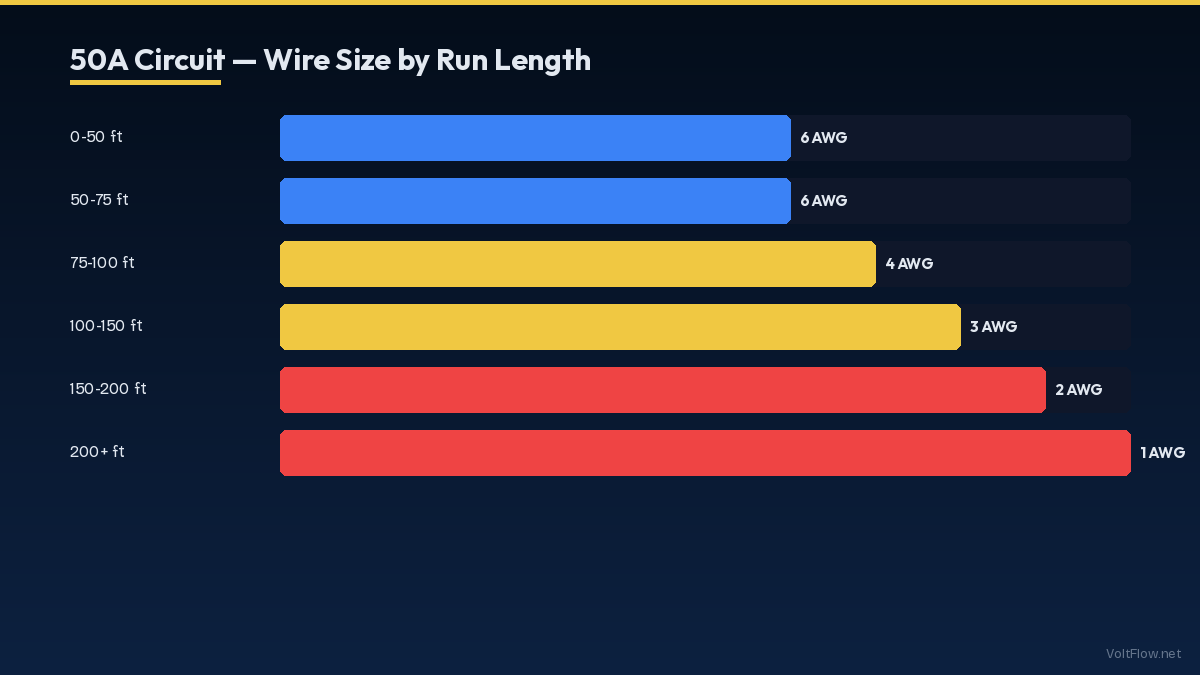
Wire size for 50-amp circuits is determined by both ampacity and voltage drop. Ampacity sets the minimum wire size for safety, but voltage drop may require larger wire for long runs to maintain adequate voltage at the appliance. The NEC recommends maximum 3 percent voltage drop for branch circuits. On a 240-volt circuit, 3 percent equals 7.2 volts, meaning the voltage at the outlet should be at least 232.8 volts under full load. Using the voltage drop formula for 6 AWG copper at 50 amps: at 25 feet the drop is 0.8 percent, well within limits. At 50 feet the drop is 1.6 percent, still excellent. At 75 feet the drop reaches 2.4 percent, acceptable. At 100 feet the drop hits 3.2 percent, slightly over the 3 percent recommendation. At 125 feet the drop reaches 4.0 percent, requiring an upgrade to 4 AWG copper. The practical guideline is that 6 AWG copper works for 50-amp circuits up to approximately 80-85 feet. Beyond that distance, upgrading to 4 AWG copper keeps voltage drop under 3 percent out to approximately 130 feet. For runs exceeding 130 feet, 3 AWG copper maintains compliance to approximately 165 feet. For aluminum wire, the voltage drop distances are shorter due to higher resistivity. 4 AWG aluminum at 50 amps reaches 3 percent voltage drop at approximately 65 feet. For runs beyond 65 feet with aluminum, 2 AWG aluminum extends the range to about 100 feet. The cost difference between 6 AWG and 4 AWG copper is approximately $1.50-$2.00 per foot. For a 100-foot run, upgrading costs about $150-$200 in additional wire expense. This is a modest investment to maintain proper voltage at the appliance and avoid equipment performance problems. An electric range operating at 228 volts instead of 240 volts due to excessive voltage drop heats elements more slowly, extends cooking times, and wastes energy. An EV charger at reduced voltage charges more slowly and may display voltage error warnings. Spending the extra $150-$200 on properly sized wire avoids these ongoing performance issues for the life of the circuit.
Copper vs Aluminum for 50-Amp Circuits
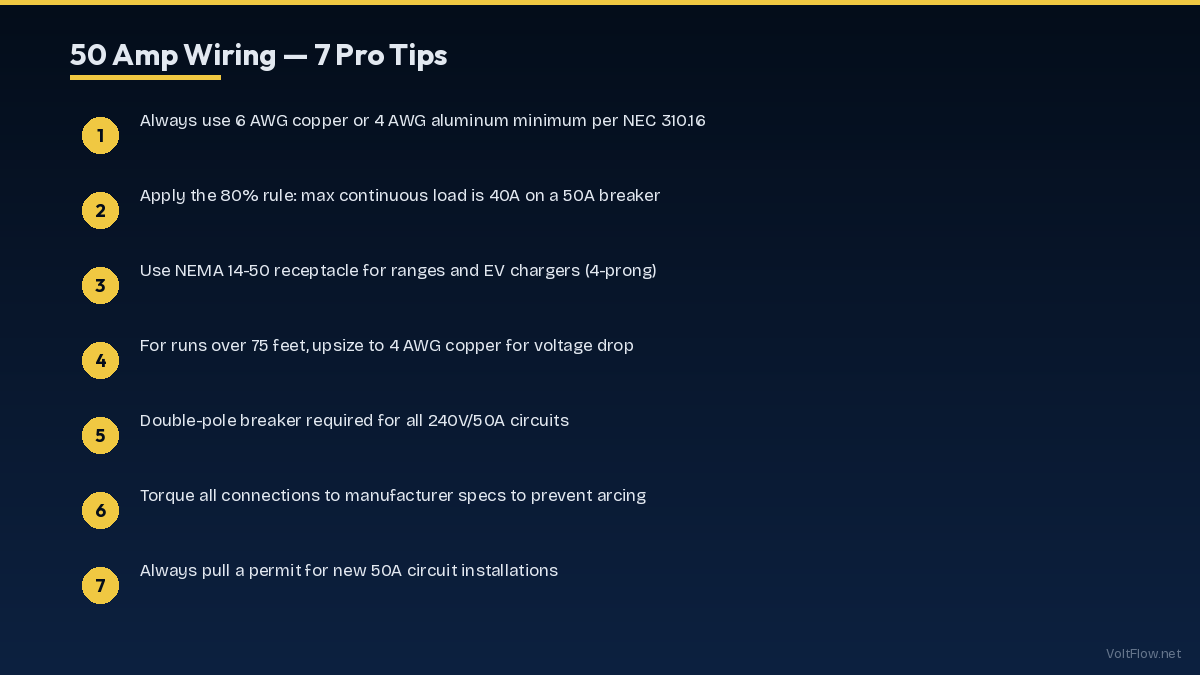
Both copper and aluminum conductors are safe and code-compliant for 50-amp circuits when properly sized and installed. The choice between them involves cost, installation considerations, and connection reliability trade-offs. Copper advantages include smaller physical size for equivalent ampacity, better long-term connection stability, compatibility with all terminal types, and easier handling during installation. Copper 6 AWG for a 50-amp circuit has an outside diameter of approximately 0.162 inches, making it manageable to bend and route through tight spaces. Copper connections maintain their torque and contact pressure over decades with minimal maintenance. Aluminum advantages center on cost. Aluminum 4 AWG for the same 50-amp circuit costs approximately 50-60 percent less per foot than copper 6 AWG, despite being a larger gauge. For a 100-foot run, the copper cable costs approximately $350-$500 while equivalent aluminum costs $150-$250. The $200-$250 savings becomes significant for long runs or multi-circuit projects. Aluminum disadvantages require specific installation practices to mitigate. Aluminum expands and contracts more than copper during heating and cooling cycles, which can loosen connections over time. Anti-oxidant compound must be applied to all aluminum connections to prevent oxide layer formation that increases resistance. All terminals and connectors must be rated for aluminum (marked AL or AL-CU). Failing to follow these practices on aluminum connections creates high-resistance connections that overheat. The historical concerns about aluminum wiring relate specifically to small-gauge (15-amp and 20-amp) aluminum branch circuits used in homes built in the 1960s-1970s. These circuits used 12 and 14 AWG aluminum wire with devices not designed for aluminum connections. Modern large-gauge aluminum (4 AWG and larger) for 50-amp and higher circuits does not share these historical problems because the larger wire and terminations tolerate thermal cycling better and all modern panels and equipment above 30 amps are rated for aluminum terminations. For most 50-amp residential circuits with runs under 50 feet, copper is the standard choice because the cost difference is small and the installation is simpler. For longer runs exceeding 75 feet, sub-panel feeders, and any installation where multiple high-amperage circuits are being run simultaneously, aluminum provides meaningful cost savings that justify the additional installation care. When using aluminum, always verify that the outlet, breaker, and any junction box connectors are rated for aluminum. Apply anti-oxidant paste to all connections. Torque all terminals to manufacturer specifications using a torque screwdriver or wrench. These steps take an extra 5-10 minutes per connection and cost $5-$10 in anti-oxidant compound for the entire circuit, trivial compared to the wire savings.
Cable Types and Installation Methods for 50-Amp
The physical routing and environment of your 50-amp circuit determines which cable type and installation method meets code requirements. NM-B cable at 6/3 gauge is the standard choice for interior residential runs. The cable routes through walls, floors, and ceilings, secured with cable staples every 4.5 feet and within 12 inches of each box per NEC 334.30. NM-B is approved for dry interior locations only and must not be exposed in locations subject to physical damage, which means it cannot run exposed below 8 feet in a garage or workshop. The minimum bending radius for 6/3 NM-B is approximately 7.5 inches (five times the cable diameter), which matters when routing around corners and through tight spaces. UF-B cable at 6/3 gauge is required for direct burial underground runs to detached garages, RV hookups, or outdoor outlets. UF-B must be buried at least 24 inches deep when without additional protection, or 18 inches deep when under a concrete slab or in rigid conduit. The solid plastic jacket of UF-B makes it harder to strip than NM-B. Use a UF cable stripper tool rather than a utility knife to avoid nicking the conductor insulation inside the tight jacket. Individual THWN or THHN conductors in conduit provide the most flexible installation option for 50-amp circuits. EMT (Electrical Metallic Tubing) conduit is common for exposed interior runs in garages and workshops. PVC conduit is used for underground runs where it provides physical protection for the conductors. Liquid-tight flexible conduit connects the last few feet from rigid conduit to equipment like spa panels and outdoor disconnect boxes. For conduit sizing, four 6 AWG THWN conductors fit comfortably in 3/4-inch EMT or 3/4-inch Schedule 40 PVC per NEC conduit fill tables (Chapter 9, Table C1 for EMT and Table C2 for PVC). The conduit fill for four 6 AWG conductors is approximately 30 percent of the 3/4-inch conduit area, well under the 40 percent maximum for more than two conductors. Junction boxes along 50-amp circuit runs must be sized per NEC 314.16 box fill calculations. Each 6 AWG conductor counts as 5 cubic inches. A standard 4-inch square metal box at 30.3 cubic inches accommodates four 6 AWG conductors plus clamps and devices. For runs requiring splices or direction changes, use the largest box that fits the installation space to provide working room for the large-gauge conductors and maintain proper conductor separation.
Installation Tips and Common Mistakes
Working with 6 AWG wire for 50-amp circuits presents challenges that electricians and DIY enthusiasts should anticipate. The wire is significantly stiffer and harder to manipulate than the 12 or 14 AWG wire used for general-purpose circuits. Here are practical tips and common mistakes to avoid. Pulling 6/3 NM-B cable through finished walls requires patience and the right technique. The cable is approximately 0.7 inches in diameter and very stiff, making tight turns through wall cavities difficult. Use a fish tape to route the path first, then attach the cable to the fish tape with electrical tape and pull steadily. Apply cable lubricant to reduce friction during long pulls. For runs through the attic, lay the cable across the tops of ceiling joists and secure with staples. Do not force 6/3 cable through holes drilled in studs unless the holes are at least 1.25 inches in diameter to prevent insulation damage. Outlet connections on NEMA 14-50 and similar outlets require proper terminal identification. The two hot terminals are typically brass colored, the neutral terminal is silver colored, and the ground terminal is green colored. Verify the terminal markings on your specific outlet model before connecting wires. Reversing hot and neutral creates a dangerous condition that a plug tester will detect. Always test after installation. Torque specifications matter more on 50-amp circuits than on 15 or 20-amp circuits because higher currents generate more heat at connection points. A loose connection on a 50-amp circuit can draw a sustained 50-amp arc that generates extreme heat, far more dangerous than a loose connection on a 15-amp circuit. Tighten breaker terminals, outlet terminals, and wire nut connections to manufacturer-specified torque values. A calibrated torque screwdriver costs $25-$50 and pays for itself in fire prevention. Common mistakes include using 8 AWG wire on a 50-amp breaker, which is undersized and a fire hazard. The 8 AWG wire is rated for only 40 amps at 60-degree terminations. While some references show 8 AWG at 50 amps on the 75-degree column, this rating requires both the breaker and outlet to be listed for 75-degree terminations, which not all residential equipment meets. Always use 6 AWG copper for 50-amp circuits to eliminate any ambiguity. Another common mistake is forgetting the ground wire when running conduit. In NM-B cable, the ground is included automatically. When pulling individual conductors through conduit, you must include a separate green 6 AWG ground wire. The metal conduit itself can serve as an equipment grounding conductor per NEC 250.118 for EMT, but most electricians pull a separate ground wire anyway for reliability. Using NM-B cable in locations where it is not permitted, such as exposed in garages below 8 feet, attached to the underside of floor joists in unfinished basements, or outdoors, is another frequent violation. Use appropriate cable types or conduit methods for these locations as described in the cable types section above.