Home Battery Storage Australia 2026: Cost, Rebates & Best Systems
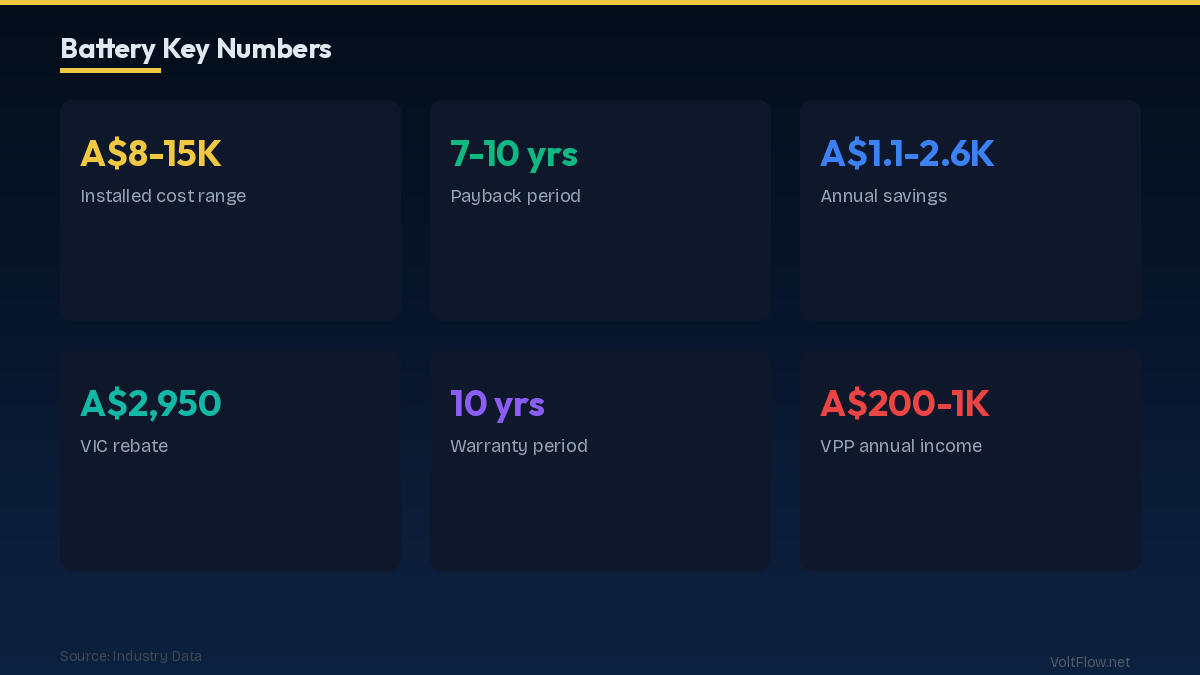
Home battery storage in Australia costs A$8,000-$16,000 installed for a 10-15 kWh system in 2026. Combined with solar panels, a battery increases self-consumption from 30-40% to 70-85%, saving an additional A$600-$1,400 per year beyond solar alone. South Australia has the best battery economics with 5-8 year payback. State rebates of up to A$3,000 are available in some jurisdictions. This guide covers costs, top brands, and the financial case by state.
Battery Costs by Brand and Capacity
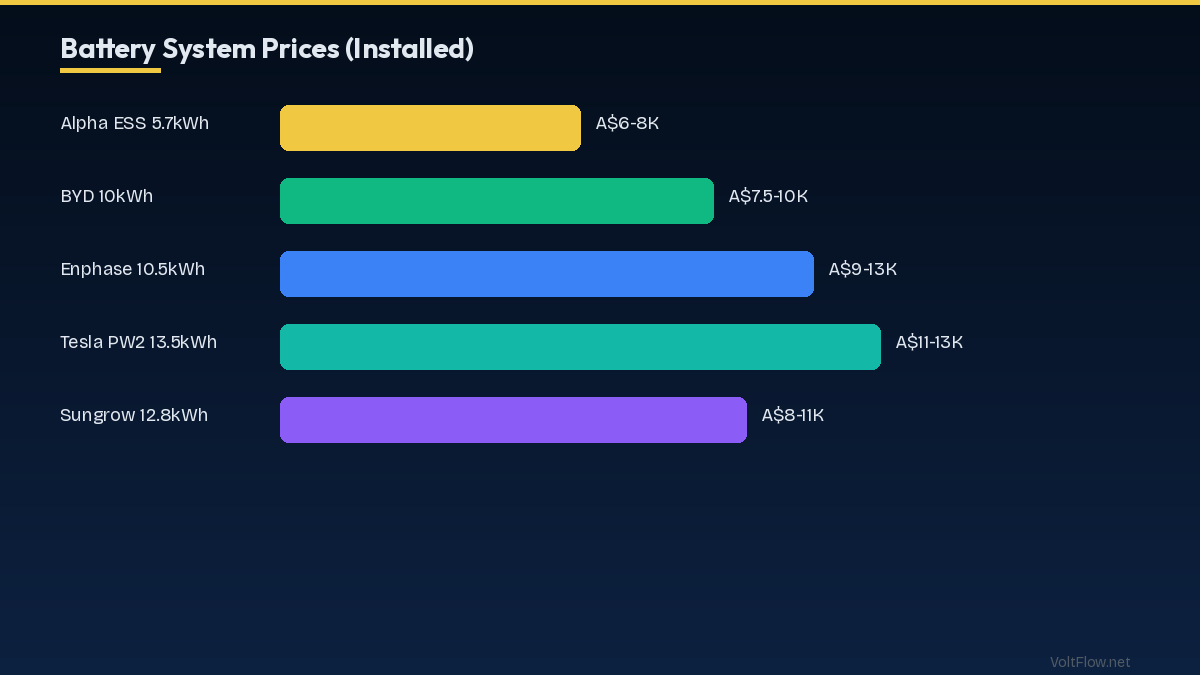
The Australian residential battery market in 2026 is competitive with several established brands offering proven systems. Tesla Powerwall 2 at A$12,000-$14,500 installed provides 13.5 kWh usable capacity with integrated backup gateway for whole-home blackout protection. The Powerwall dominates the premium segment with excellent reliability and the Tesla app providing complete monitoring and control. The integrated inverter simplifies new installations but requires a separate solar inverter for retrofit to existing solar systems. GivEnergy systems have rapidly grown in popularity in Australia due to competitive pricing and excellent monitoring. The 5.2 kWh battery at A$5,000-$6,500 installed is ideal for small households. The 9.5 kWh version at A$7,500-$9,500 covers most average homes. GivEnergy batteries stack to 15+ kWh for larger requirements. Their hybrid inverter handles both solar and battery, reducing total system cost for new installations by A$1,500-$2,500 compared to separate components. BYD HVM and HVS modular batteries are widely used by Australian installers due to flexibility and competitive pricing. The HVS series starts at 5.12 kWh modules at A$4,500-$6,000 each installed, expandable to 12.8 kWh. The HVM series starts at 8.28 kWh at A$7,000-$9,000. BYD uses Lithium Iron Phosphate chemistry with excellent cycle life of 6,000+ cycles at 80% depth of discharge. Enphase IQ Battery at A$7,500-$10,000 per 5 kWh module integrates with Enphase microinverter systems. The modular design allows 5-40+ kWh configurations. Each module operates independently, providing redundancy that other systems lack. SolarEdge Home Battery at A$8,000-$11,000 for 9.7 kWh is DC-coupled with SolarEdge inverters for 94% round-trip efficiency versus 88-90% for AC-coupled systems. Budget options including Pylontech US3000C at A$1,200-$1,500 per 3.5 kWh module paired with a Sungrow or GoodWe hybrid inverter provide the lowest cost entry point. A 10.5 kWh Pylontech system with hybrid inverter costs A$6,000-$8,500 installed, significantly below branded alternatives.
Battery Payback by State
Battery financial returns vary dramatically across Australian states because the value of stored energy depends on the difference between your import rate and the FiT rate you forgo by storing rather than exporting. South Australia offers the fastest battery payback at 5-8 years due to the highest import rates of 35-45c and lowest FiT rates of 3-6c per kWh. A 10 kWh battery shifting 3,000 kWh from export to self-consumption saves (35c minus 5c) times 3,000 equals A$900 per year from solar shifting alone. Adding TOU arbitrage of charging overnight at 18c and discharging during peak at 42c adds approximately A$400 per year. Total annual benefit of A$1,300 on a A$9,000 battery produces 6.9 year payback. VPP participation adds A$200-$400 improving payback to 5-7 years. New South Wales achieves 7-11 year payback. Import rate of 31c minus FiT of 7c gives 24c per kWh solar shifting value. A 10 kWh battery saves approximately A$720 per year from solar shifting plus A$250 from TOU arbitrage. Total A$970 on a A$9,000 battery gives 9.3 year payback before VPP income. Victoria achieves 8-12 year payback. Import rate of 30c minus FiT of 5c gives 25c value per shifted kWh. Total savings of approximately A$850 on a A$9,000 battery gives 10.6 year payback. Queensland achieves 9-14 year payback due to lower import rates of 27c reducing the value of each shifted kWh. The lower electricity costs that make Queensland attractive for living also reduce battery returns. Western Australia achieves 8-12 year payback. The DEBS scheme complicates the calculation because afternoon exports already earn 10c from 3-9 PM, reducing the value gain from battery storage during those hours compared to states with flat 5c FiT. Battery value in WA comes primarily from shifting morning and midday exports at 2.25c to evening self-consumption at 32c. Tasmania achieves 10-15 year payback at the longest in Australia. Moderate import rates and relatively generous FiT reduce the incentive for battery storage. Tasmanian batteries are justified primarily by backup power value rather than financial return.
State Battery Rebates and Incentives
Several Australian states offer battery-specific rebates that improve the financial case. Victoria Solar Homes Battery Programme provides rebates for battery installations in eligible postcodes. The rebate value varies by battery capacity and postcode, typically A$1,000-$2,800. Eligibility requires a household income below a threshold, an existing or concurrent solar installation, and use of a CEC-approved installer. The programme has a limited number of rebates available each release, which are often fully subscribed within days. Register for notifications on the Solar Victoria website to be alerted when new rebates are released. South Australia Home Battery Scheme provided substantial subsidies historically but has evolved into the Virtual Power Plant programme where battery owners receive ongoing payments for grid services rather than upfront rebates. Enrolling in SA Power Networks VPP via participating retailers provides A$200-$500 per year in ongoing income that effectively subsidises the battery cost over its lifetime. The ACT Sustainable Household Scheme provides interest-free loans of up to A$15,000 for battery storage and solar installations. While not a rebate, the zero-interest financing over 10 years makes battery investment cash-flow positive from year one for households whose annual savings exceed the loan repayments. Queensland has no dedicated battery rebate in 2026 but the state interest-free loan scheme for energy efficiency improvements may cover battery installations. NSW has no state battery rebate but some local council programmes and electricity retailer incentive schemes provide targeted support. Check your local council sustainability programme and your retailer battery offerings. Federal level, no direct battery rebate exists but batteries installed with solar qualify for STC credits if the combined system is installed simultaneously. The STC value for the battery component is modest at A$200-$500 but contributes to reducing the overall system cost. Battery installations also qualify for the instant asset write-off for eligible small businesses using the battery for business purposes.
Choosing the Right Battery Size
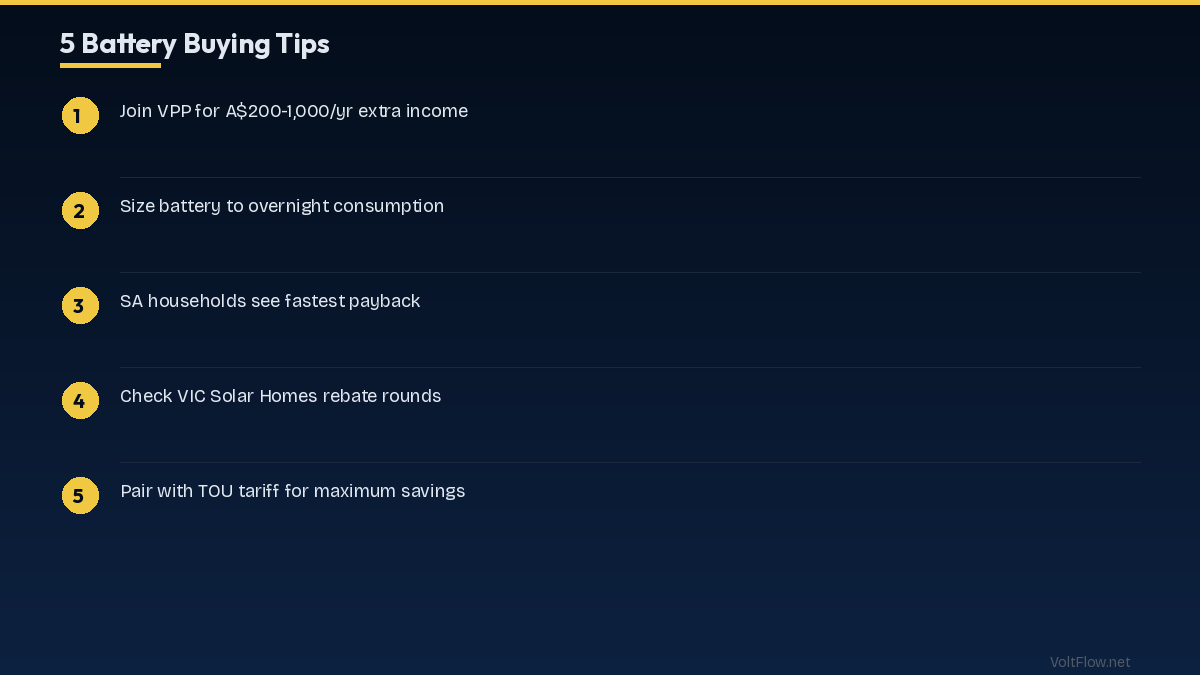
Selecting the optimal battery capacity requires matching the battery to your solar surplus, consumption pattern, and budget rather than simply buying the largest available system. An undersized battery fills early and misses late-afternoon solar surplus. An oversized battery never fills completely, wasting money on unused capacity. Calculate your daily solar surplus by reviewing your inverter monitoring data for the past 12 months. If your 6.6 kWp system generates 25 kWh on a typical summer day and your daytime consumption is 10 kWh, your daily surplus is 15 kWh in summer. In winter, the surplus may drop to 5-8 kWh. A 10 kWh battery captures most of the winter surplus and approximately two-thirds of the summer surplus. A larger 15 kWh battery captures more summer surplus but the additional 5 kWh of capacity sits empty for half the year. Consider your evening consumption pattern from your smart meter data. If your household consumes 8-12 kWh between 5 PM and midnight, a 10 kWh battery covers this evening load from stored solar, minimising grid imports. If evening consumption exceeds 15 kWh due to EV charging or electric cooking, a larger battery or accepting some grid imports during the evening may be the practical balance. For typical Australian households, a 10 kWh battery provides the optimal balance of cost and value. It captures the daily solar surplus on most days, covers the evening consumption peak, and provides 4-8 hours of backup during power outages for essential loads. A 5 kWh battery suits small households, apartments, or budget-conscious buyers who want some battery benefit at minimum cost. A 13-15 kWh battery suits larger households, EV owners, or homeowners who prioritise maximum self-consumption and longer backup duration. When choosing between battery sizes from the same manufacturer, calculate the marginal payback of the larger option. If upgrading from 10 kWh to 15 kWh costs an additional A$3,500 but the extra 5 kWh provides only A$200 per year in additional value due to the additional capacity sitting empty much of the year, the marginal payback of 17.5 years makes the upgrade a poor investment. The base 10 kWh investment with better payback is the smarter financial choice.
Installation and Technical Requirements
Battery installation in Australia must be performed by a Clean Energy Council accredited installer to qualify for rebates and ensure warranty validity. The installation process takes one day for a typical residential system. Site assessment determines the battery location, which must provide adequate ventilation, protection from direct sunlight and rain if outdoors, and comply with the manufacturer specified operating temperature range of typically 0 to 50 degrees Celsius. Most Australian batteries are installed in garages, on external walls in shaded positions, or in dedicated battery enclosures. Fire safety spacing from windows, doors, and combustible materials must comply with AS/NZS 5139 the Australian standard for battery installation. The standard requires minimum clearances of 600mm from windows and doors and specifies ventilation requirements based on the battery chemistry and capacity. LFP batteries have less stringent requirements than NMC chemistry due to their inherently lower fire risk. Electrical connection can be AC-coupled or DC-coupled. AC coupling connects the battery through its own inverter to the AC side of your switchboard, working alongside any existing solar inverter. This is the simplest retrofit approach and works with any solar system. DC coupling connects the battery directly to a hybrid inverter that also manages the solar panels, providing higher efficiency but requiring either a new hybrid inverter or a compatible existing inverter. Your installer handles all electrical connections, testing, and commissioning. The battery management system is configured for your tariff structure and preferences: charge from solar only, charge from grid during off-peak, discharge during peak, and backup reserve percentage for blackout protection. Network connection approval from your DNSP may be required for battery systems above certain capacity thresholds. Your installer manages the application process. Most residential systems of 10-15 kWh in single-phase homes are approved within 5-10 business days. Three-phase homes and larger systems may require additional assessment. After installation, register your battery with your electricity retailer for any VPP or export programmes. Monitor performance through the manufacturer app for the first month to verify the system is operating as expected with charge and discharge cycling correctly aligned to your tariff schedule.
Battery vs Generator for Backup Power
Australian homeowners, particularly in bushfire-prone and storm-affected regions, increasingly consider battery storage for backup power. Understanding the differences between battery and generator backup helps you choose the right solution for your risk profile. A battery provides instant, silent, automatic backup when the grid fails. The transition from grid to battery power takes milliseconds, so sensitive electronics and medical equipment experience no interruption. A 10 kWh battery provides 4-8 hours of backup for essential loads including lights, refrigerator, internet router, and phone charging. Combined with solar panels, a battery-plus-solar system provides indefinite daytime backup and 6-12 hours overnight, potentially lasting through multi-day outages if loads are managed carefully. A generator provides unlimited runtime backup as long as fuel is available. A portable petrol generator at A$800-$2,000 provides 3-8 kW of output for manual connection to selected appliances or via a manual transfer switch. A standby generator at A$8,000-$20,000 starts automatically when the grid fails and powers the entire house. Generators produce noise of 55-75 decibels, require fuel storage and regular maintenance, and cannot be used indoors due to carbon monoxide emissions. For most suburban Australian homeowners who experience 2-6 short power outages per year lasting 1-8 hours, a battery provides the most practical backup solution. The outages are short enough for the battery to handle, the backup is automatic and silent, and the battery provides daily financial value from solar optimisation that a generator cannot match. For rural properties in bushfire zones where outages can last days and access for fuel delivery may be restricted, a larger battery system of 20-30 kWh with solar recharging or a hybrid battery-plus-generator solution provides the most resilient setup. The battery handles short outages and daily solar management while the generator provides extended backup when the battery alone cannot cope. The cost comparison favours batteries for properties with solar panels because the battery provides both backup value and daily financial return. A A$10,000 battery saving A$800-$1,200 per year in electricity effectively costs the net present value of the backup function at approximately A$2,000-$4,000 after subtracting the energy savings value. A A$10,000 standby generator providing only backup with annual maintenance costs of A$300-$500 and no energy savings has a much higher effective cost for the backup function alone.