Solar Feed-In Tariff Australia 2026: Rates by State & Retailer
Australian solar feed-in tariffs range from 2.25c to 15c/kWh in 2026, far below the 60c premium rates of a decade ago. With retail electricity at 28-45c/kWh, self-consumption saves 3-10x more than exporting. The key to maximising solar value is understanding your state minimum FiT, finding retailers offering premium rates, and using batteries or smart scheduling to consume more of what you generate.
Feed-In Tariff Rates by State in 2026
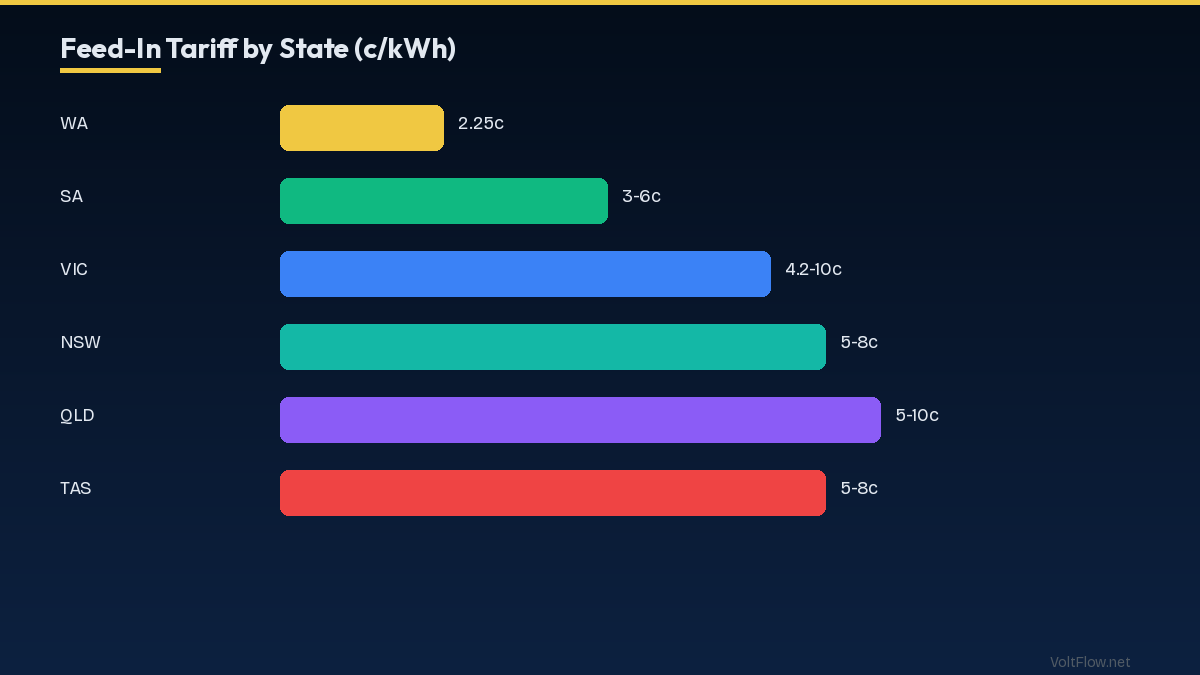
Feed-in tariff rates vary by state, retailer, and sometimes by time of day. The state regulator sets a minimum or benchmark rate, but retailers can offer higher rates to attract solar customers. In New South Wales, the benchmark FiT is 5-6c per kWh with no mandatory minimum. Competitive retailers offer 7-12c. The best NSW rates come from retailers like Energy Locals and Amber Electric who offer time-varying export rates that pay more during peak demand periods. In Victoria, the Essential Services Commission sets a minimum FiT of 4.2c per kWh. Most retailers offer 5-10c, with some premium plans reaching 12-15c for the first 10 kWh exported per day. The Victorian minimum is reviewed annually and has decreased from 11.3c in 2017-18 as solar penetration increased and wholesale midday prices dropped. In Queensland, the government sets a benchmark of 5-7c per kWh. Ergon Energy in regional QLD offers 6.5-8c. SE Queensland retailers offer 5-12c. Queensland high solar generation means more surplus for export, making the FiT rate particularly important for QLD homeowners. In South Australia, no mandatory minimum exists but competitive pressure keeps most retailers at 3-8c. SA extreme midday wholesale price suppression from massive rooftop solar capacity means the wholesale value of midday exports is often near zero or negative, which is why FiT rates are lowest here. However, SA also has the highest retail rates, making self-consumption far more valuable than export. In Western Australia, the Distributed Energy Buyback Scheme provides a time-varying FiT: 10c per kWh from 3-9 PM, 2.25c at all other times. This unique structure rewards afternoon and evening generation from west-facing panels rather than the traditional north-facing orientation that maximises total production but exports most during the low-value midday period. In Tasmania, Aurora Energy offers 8-10c per kWh as the primary retailer in the state. The relatively stable hydro-dominated grid maintains consistent wholesale prices, supporting a moderate FiT rate without the extreme midday suppression seen in mainland states.
Why Self-Consumption Beats Export
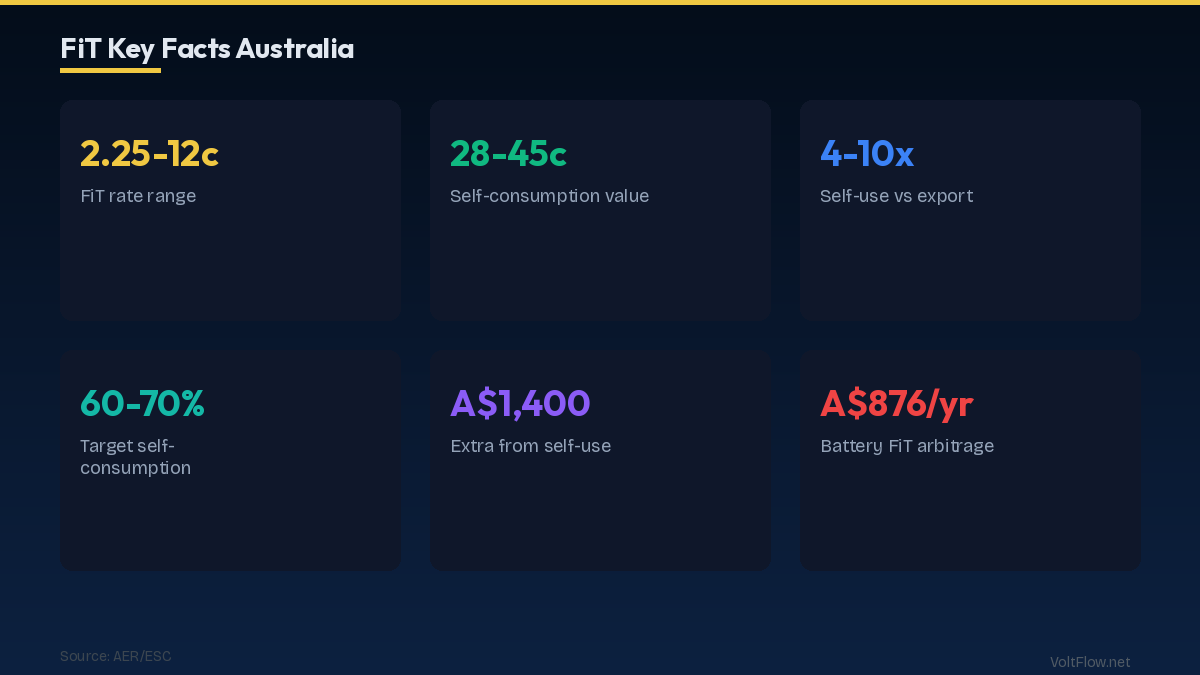
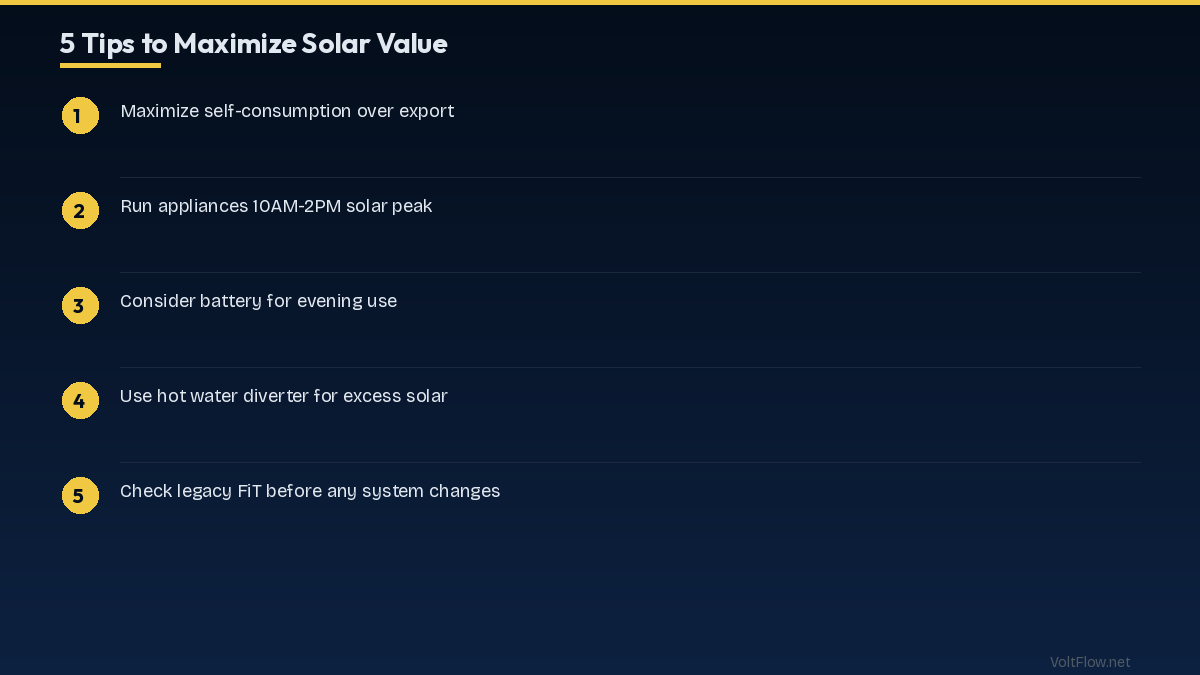
The fundamental economics of solar in Australia have shifted from the early days when premium feed-in tariffs of 44-66c per kWh made export highly profitable. In 2026, with FiT rates of 3-12c per kWh and retail import rates of 28-45c per kWh, every kWh you consume directly from your solar panels saves 3-10 times more than exporting it. Consider a homeowner in NSW with retail rate of 31c and FiT of 7c. Each kWh consumed directly saves 31c in avoided imports. Each kWh exported earns only 7c. The self-consumed kWh is worth 4.4 times more than the exported kWh. Over a year, increasing self-consumption from 30% to 70% on a 6.6 kWp system generating 9,500 kWh shifts approximately 3,800 kWh from export to self-consumption. The value gain is 3,800 times (31c minus 7c) equals A$912 per year in additional savings, the equivalent of installing a second solar system. This is why batteries have become the primary tool for solar optimisation rather than simply maximising panel count. A 10 kWh battery costing A$8,000-$12,000 that shifts 2,500-3,000 kWh per year from export to self-consumption captures an additional A$600-$720 in annual value on top of any tariff arbitrage. Without changing your FiT rate or adding panels, a battery can nearly double your solar savings. Several strategies increase self-consumption without a battery. Run your washing machine, dishwasher, and dryer during peak solar hours using delayed start timers. Heat your hot water during the day using a timer on the electric element or a solar diverter device. Charge your EV during the day if you are home using a solar-aware charger. Run pool pumps and air conditioning during solar hours rather than overnight. Pre-cool the house during afternoon solar production before the evening peak consumption period. These behavioral shifts can increase self-consumption from 30% to 45-55% without any equipment investment, capturing A$200-$400 in additional annual value.
Time-Varying Feed-In Tariffs: The Future of Solar Export
The traditional flat-rate FiT is being replaced by time-varying export rates that reflect the actual wholesale value of solar electricity at different times of day. This shift rewards solar owners who can export during high-demand periods rather than flooding the grid with midday surplus. The Western Australia DEBS is the most established time-varying FiT in Australia, paying 10c from 3-9 PM and 2.25c at other times. This structure explicitly values afternoon and evening generation when grid demand is highest and solar contribution is most needed. WA homeowners with west-facing panels that produce more during the afternoon earn significantly more than those with traditional north-facing installations. Amber Electric offers a wholesale pass-through model where your export earns the spot wholesale price for your region every 30 minutes. During periods of high demand and low supply, wholesale prices can spike to 50c-$15 per kWh, earning solar exporters exceptional short-term income. During midday surplus periods, wholesale prices may drop to zero or negative, meaning your export earns nothing. A battery paired with Amber pricing charges from solar or cheap wholesale and discharges during price spikes, maximising the value of time-varying rates. Several mainstream retailers now offer peak and off-peak export rates similar to the WA model. The typical structure pays 8-12c for exports during the 3-9 PM peak window and 3-5c during off-peak hours. These tariffs reward solar owners with batteries who can store midday generation and export during the higher-value peak window when the grid needs the energy most. For homeowners considering new solar installations in 2026, the trend toward time-varying FiTs has implications for panel orientation. Traditional advice to maximise annual generation by facing panels north is being challenged by the financial advantage of west-facing panels that generate more during the high-value afternoon peak. A hybrid north-west split, with some panels north for total generation and some west for afternoon value, may optimise financial returns better than an all-north array. Your installer should model the financial return under your specific tariff structure using actual pricing data rather than defaulting to the traditional north-facing recommendation.
How to Find the Best Feed-In Tariff
Finding the best FiT rate requires comparing retailers beyond just the export rate because the combination of import rate, daily supply charge, and FiT determines your total annual cost. A retailer offering 12c FiT but 35c import may cost you more overall than a retailer offering 6c FiT but 25c import if you import significant evening electricity. Use the state government comparison tools to model your total annual cost including both import and export. Enter your solar system size and estimated generation to see how different retailer import and export rates combine to produce your net annual bill. The lowest net bill is your best overall deal, regardless of which retailer offers the highest FiT in isolation. Some retailers offer tiered FiT rates that pay a premium rate for the first 10-14 kWh exported per day and a lower rate beyond that threshold. These tiered plans benefit smaller solar systems that rarely exceed the threshold but provide diminishing returns for larger systems that export heavily. Calculate your typical daily export volume and compare the effective average FiT rate across all exported kWh. Retailer FiT rates change frequently, often quarterly. Set a calendar reminder to review your FiT rate every 3-6 months and compare against current market offers. Switching retailers is straightforward and typically takes 2-4 weeks. There is no cost to switch in most cases, and your solar system continues generating normally during the transition. Some retailers lock FiT rates for a fixed period of 12-24 months while others offer variable rates that change with market conditions. Fixed rates provide certainty for financial planning. Variable rates may be higher or lower than fixed depending on wholesale market movements. If you expect wholesale prices to rise due to coal plant closures or increasing demand, locking in a current fixed rate protects your export income. If you expect wholesale prices to fall further as more solar is installed, variable rates may be preferable. For the most engaged solar owners, Amber Electric wholesale pass-through model provides the highest potential income but with significant variability. Track your daily earnings for a month before committing long-term to verify the wholesale model works for your export pattern and risk tolerance.
Feed-In Tariff History and Future Outlook
Understanding the trajectory of Australian FiT rates helps set realistic expectations for your solar investment return over its 25-year lifespan. The premium FiT era from 2008-2013 offered rates of 44-66c per kWh in most states, often guaranteed for 10-20 years. These generous rates were designed to kickstart residential solar adoption when system costs were A$15,000-$25,000 for a modest 1.5-3 kWp system. The high FiT rates made solar financially attractive despite the high upfront cost and created Australia early solar boom. Customers who locked in these premium rates are still receiving them in some states, earning A$2,000-$5,000 per year from export alone. The transition period from 2014-2019 saw premium rates expire for new installations and replacement with market-based rates of 6-20c per kWh. System costs fell dramatically to A$4,000-$8,000 for 5-6.6 kWp, making solar viable even at lower FiT rates. The declining FiT shifted the value proposition from export income to self-consumption savings. The current era from 2020-2026 features FiT rates of 2-12c per kWh reflecting the reality that midday solar generation often exceeds grid demand, suppressing wholesale prices to near zero. The duck curve, where solar floods the grid at midday creating oversupply then rapid ramp-up in the evening, drives the FiT below the cost of even operating existing generators during midday hours. Looking forward to 2027-2030, FiT rates are expected to remain low at 2-8c for flat midday export as more rooftop solar is installed each year. However, time-varying FiT rates for afternoon and evening export are likely to increase as coal plants retire and grid demand grows from EVs and electrification. Homeowners with batteries positioned to export during the 4-8 PM peak may earn 15-25c per kWh for peak exports by 2030, substantially above current flat FiT rates. The STC rebate scheme reducing annually until 2030 will increase the upfront cost of new systems by A$300-$500 per year. Combined with potential FiT improvements for time-shifted export, the net impact on solar economics is approximately neutral through the end of the decade. The case for installing solar remains strong regardless of the FiT trajectory because self-consumption savings are driven by retail rates which are expected to remain at 30-45c or higher.
Maximising Solar Export Value: Practical Strategies
Beyond choosing the best FiT rate, several practical strategies increase the total income from your solar exports. Shift the timing of your exports by using a battery to store midday generation and export during the 3-9 PM peak period when time-varying FiT rates are highest. A 10 kWh battery shifting 8-10 kWh of export from midday (earning 3-5c per kWh) to peak (earning 8-12c per kWh) increases daily export income by approximately A$0.40-$0.70, or A$146-$256 per year. This adds to the self-consumption value the battery already provides. Participate in Virtual Power Plant programmes where your battery is aggregated with thousands of others to provide grid services. AGL Virtual Power Plant, Origin Loop, and Tesla Energy Plan all offer VPP programmes in Australia. Typical VPP income is A$200-$500 per year for a 10-13 kWh battery, earned by allowing the aggregator to discharge your battery during grid stress events. You retain full control during non-event periods and can set a minimum battery reserve for your own backup needs. Use the Amber Electric platform for wholesale pass-through pricing if you have a battery and are comfortable with variable pricing. Amber exposes you to the wholesale market where prices spike during peak demand events, earning 50c-$5+ per kWh for exports during these brief periods. A battery that exports 10 kWh during a $1.50 per kWh spike earns A$15 from a single event, more than a week of standard FiT income. These spikes occur 20-50 times per year, potentially earning A$200-$1,000 annually from wholesale arbitrage. Optimise your panel orientation for maximum value rather than maximum generation. In states with time-varying FiT like WA, west-facing panels produce 15-20% less total energy than north-facing panels but produce 30-40% more during the high-value 3-9 PM window. The financial return from west-facing panels can exceed north-facing despite lower total generation. Model your specific tariff structure with both orientations before deciding. Consider expanding your system size if you have remaining roof space and your FiT supports it. The marginal cost of additional panels during an existing installation is only A$300-$500 per panel compared to A$800-$1,200 per panel for a separate future installation. Even at a low FiT of 5c per kWh, each additional 400W panel generating 650-750 kWh per year earns A$33-$38 in export income, paying back the A$300-$500 marginal cost in 8-15 years. Combined with any self-consumption from the additional generation, payback shortens to 5-10 years.