Solar Panels Australia Cost 2026: Price, Rebate & Payback by State
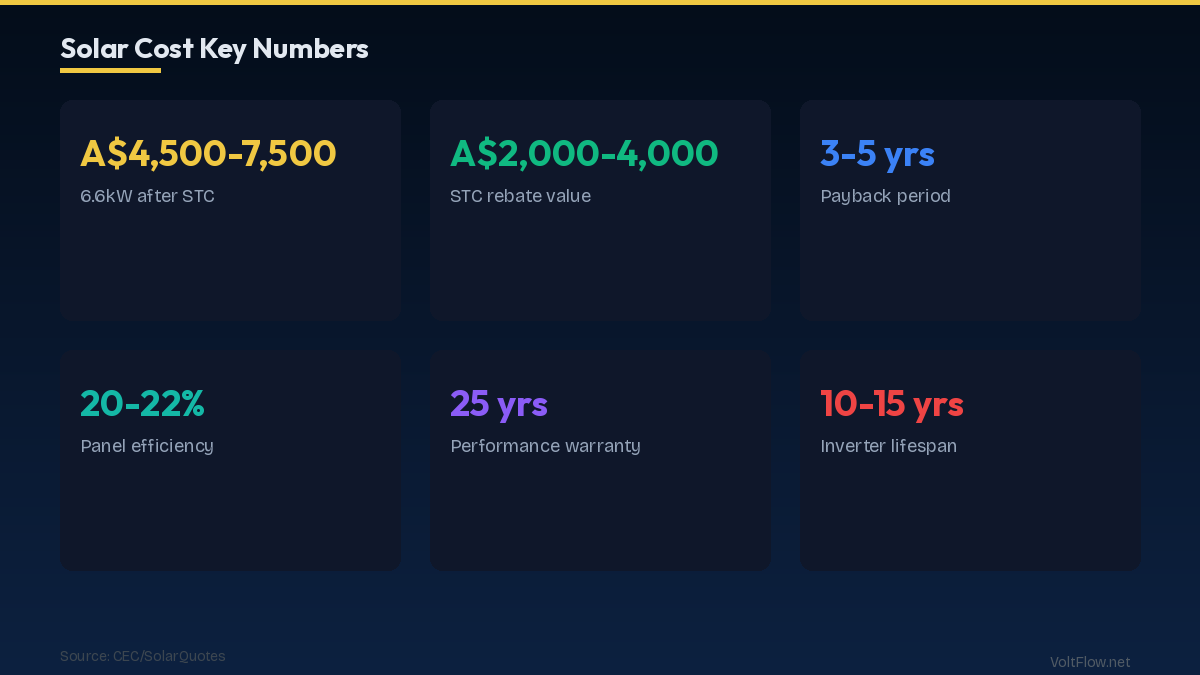
A 6.6kWp solar system in Australia costs A$4,500-$7,500 after the STC rebate in 2026, making it one of the cheapest countries in the world for residential solar. The Small-scale Technology Certificate rebate provides an upfront discount of A$2,000-$4,000 depending on your location and system size. Payback periods of 3-5 years in most states make solar the single best financial investment available to Australian homeowners. This guide covers costs, rebates, and returns state by state.
Solar System Costs After STC Rebate by State
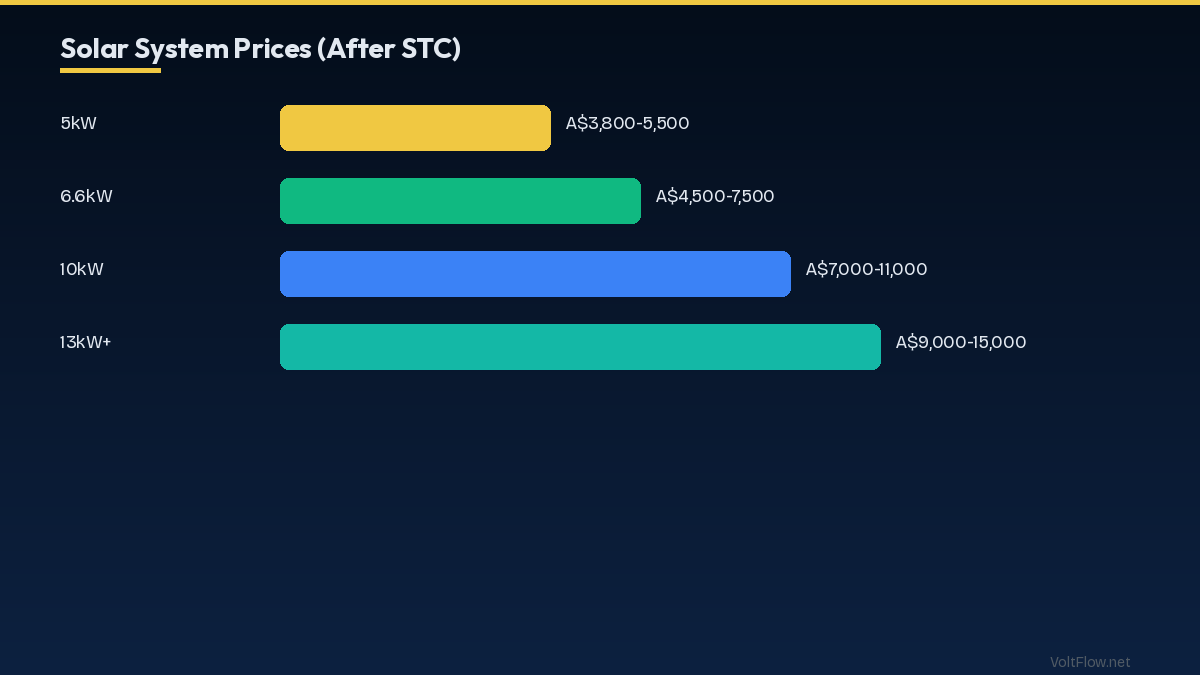
The cost of a residential solar system in Australia varies by state due to different levels of competition, installation complexity, and the STC rebate amount which is calculated based on your location deeming period and the current STC trading price. In New South Wales, a 6.6 kWp system costs A$4,500-$6,500 after the STC rebate. Sydney has the most competitive installer market in Australia with dozens of active companies. Budget systems from tier-2 panel manufacturers start at A$4,000 while premium systems using REC, SunPower, or Q Cells panels with Enphase microinverters cost A$6,000-$7,500. The STC rebate in NSW provides approximately A$2,500-$3,200 upfront discount for a 6.6 kWp system. In Victoria, the same system costs A$3,800-$6,000 after combining the federal STC rebate with the Victorian government Solar Victoria rebate of up to A$1,400. This stacking of federal and state incentives makes Victoria the cheapest state for solar installation. The Solar Victoria rebate requires using a Clean Energy Council approved retailer and has an income test for some applicants. In Queensland, costs of A$4,000-$5,800 after STC reflect the high solar irradiance that makes Queensland systems generate more electricity than identical systems further south. More generation means faster payback despite similar installation costs. In South Australia, costs of A$4,200-$6,200 after STC are offset by the state having the highest electricity rates in Australia. A system that costs the same as one in Queensland but offsets A$0.40 per kWh rather than A$0.28 produces dramatically better financial returns. In Western Australia, costs of A$4,500-$6,500 after STC with the added benefit of the Distributed Energy Buyback Scheme that pays 10c per kWh for exports during the 3-9 PM peak period. In Tasmania, costs of A$5,000-$7,000 are slightly higher due to the smaller installer market, but reasonable electricity rates and adequate solar resource still produce positive returns.
Understanding the STC Rebate: How It Works
The Small-scale Technology Certificate scheme is Australia primary solar incentive and provides a significant upfront discount on system cost. Understanding how STCs work helps you verify that your installer is passing through the full rebate value. When you install a solar system, it creates a number of STCs based on the system size in kilowatts, your location zone from 1 (highest solar resource in northern Australia) to 4 (lowest in southern Tasmania), and the remaining deeming period until the scheme ends in 2030. Each STC has a trading value that fluctuates but typically trades at A$36-$39 each in 2026, close to the A$40 clearing house price. A 6.6 kWp system in Sydney (zone 3) with a deeming period of approximately 4 years creates roughly 75-85 STCs with a total value of approximately A$2,700-$3,300. The installer assigns the STCs to a registered agent and deducts the rebate from your invoice. You never handle the certificates directly. To verify you are receiving the full STC rebate, ask your installer how many STCs the system creates and what value they are assigning per certificate. Multiply the number of STCs by the per-certificate value and compare to the discount shown on your quote. Some installers inflate the pre-rebate price and then show a larger rebate deduction to make the discount appear more impressive while the net price is the same or higher than competitors. Always compare the final out-of-pocket price between quotes, not the size of the rebate deduction. The STC scheme is legislated to reduce annually and end in 2030. Each year, the deeming period decreases, creating fewer STCs per system and reducing the rebate value. A system installed in 2026 receives a larger rebate than the identical system installed in 2028. This annual reduction creates a legitimate urgency to install sooner rather than later, though the reduction per year is modest at approximately A$300-$500. State-level rebates stack on top of the federal STC scheme. Victoria Solar Homes programme provides up to A$1,400. New South Wales has no additional state rebate in 2026. South Australia occasionally offers battery storage rebates. Queensland has targeted rebates for specific demographics. Check your state government energy website for current incentive programmes.
Payback Period by State and System Size
Solar payback period is the time required for electricity savings and export income to equal the upfront system cost. Australian payback periods are among the shortest in the world due to high solar irradiance, reasonable system costs, and relatively high electricity rates. In South Australia, a 6.6 kWp system at A$5,200 average cost generates approximately 28 kWh per day. At self-consumption of 40% and SA electricity rate of 38c per kWh with feed-in of 6c per kWh: annual savings equal (11.2 kWh times A$0.38 times 365) plus (16.8 kWh times A$0.06 times 365) equals A$1,553 plus A$368 equals A$1,921 per year. Payback: 2.7 years. This is the fastest payback in Australia due to the highest electricity rates. In New South Wales, the same system at A$5,500 generates approximately 26 kWh per day. At 30c per kWh and 7c feed-in: annual savings of A$1,517. Payback: 3.6 years. In Victoria (with state rebate), at A$4,200 net cost generating 22 kWh per day at 30c and 5c feed-in: annual savings of A$1,206. Payback: 3.5 years. The lower generation is offset by the lower system cost from the state rebate. In Queensland at A$4,800 cost generating 30 kWh per day at 27c and 8c feed-in: annual savings of A$1,450. Payback: 3.3 years. Queensland high generation compensates for lower rates. In Western Australia at A$5,200 generating 28 kWh per day with the DEBS scheme paying 10c from 3-9 PM: annual savings of approximately A$1,400. Payback: 3.7 years. The premium afternoon export rate rewards west-facing panels. In Tasmania at A$5,800 generating 20 kWh per day at 28c and 9c feed-in: annual savings of A$1,029. Payback: 5.6 years, the longest in Australia but still excellent by global standards. System size affects payback differently in each state. Larger systems produce more excess generation that earns only the low feed-in rate, extending the marginal payback on additional panels. A 6.6 kWp system typically provides the optimal balance between self-consumption value and excess generation. Systems of 10 kWp or larger are justified for homes with EVs, pools, or electric hot water that can absorb the additional daytime generation through smart timing.
Best Solar Panels and Inverters for Australian Conditions
The Australian solar market offers panels and inverters from budget to premium tiers. Choosing the right equipment affects performance, longevity, and warranty support in Australian conditions. Budget panels from Trina Solar, JA Solar, Longi, and Canadian Solar cost A$0.25-$0.35 per watt and offer solid performance with 25-year product warranties and output guarantees of 84-87% at year 25. These tier-1 manufacturers produce reliable panels used in utility-scale solar farms worldwide. For most Australian homeowners seeking maximum financial return, budget tier-1 panels offer the best value because the payback period is shorter due to lower upfront cost. Mid-range panels from Q Cells, REC, and Tindo Solar (Australian made) cost A$0.35-$0.50 per watt. Q Cells panels feature advanced cell technology with higher efficiency of 21-22% compared to 20-21% for budget panels. REC Alpha series panels offer excellent shade performance and a 25-year comprehensive warranty. Tindo Solar manufactures in Adelaide, supporting Australian manufacturing and providing domestic warranty support. Premium panels from SunPower and Maxeon cost A$0.50-$0.70 per watt but deliver the highest efficiency of 22-25%, the best shade performance, and industry-leading 40-year warranties. For homes with limited roof space where maximum output per square metre matters, premium panels justify the higher cost. For string inverters, Fronius, SMA, and Sungrow dominate the Australian market. Fronius Primo series at A$1,200-$1,800 is considered the gold standard for reliability and monitoring capability. SMA Sunny Boy at A$1,100-$1,600 offers comparable quality. Sungrow at A$800-$1,200 provides excellent value with good performance. Enphase microinverters at A$150-$200 per panel provide the best shade performance and individual panel monitoring but increase total system cost by A$800-$1,500 compared to a string inverter. They are strongly recommended for roofs with partial shading, multiple orientations, or complex layouts. Hybrid inverters from GoodWe, Sungrow, and Fronius handle both solar panels and battery storage in one unit, avoiding the need to add a separate battery inverter later. If you plan to add a battery within 3-5 years, installing a hybrid inverter now saves A$1,000-$2,000 in future equipment and installation costs. All equipment installed in Australia must be Clean Energy Council approved and installed by a CEC accredited installer to qualify for the STC rebate.
Solar Panel Performance in Australian Climate Conditions
Australia extreme climate conditions including intense heat, UV radiation, coastal salt air, and bushfire risk create specific challenges for solar panel performance and longevity. Understanding how panels perform under these conditions helps you set realistic expectations and choose appropriate equipment. High temperatures reduce solar panel output because photovoltaic cells become less efficient as they heat up. The temperature coefficient of most panels is minus 0.3 to minus 0.4 percent per degree Celsius above the standard test condition of 25 degrees. On a 40-degree day with panels reaching 65-70 degrees on the roof, output drops by 12-18% compared to the rated power. This means a 400-watt panel produces only 328-352 watts during the hottest part of the day. Over a year, temperature losses reduce total generation by 5-10% in southern Australia and 8-15% in northern Australia compared to nameplate capacity. Panel technology affects temperature performance. N-type panels including TOPCon and heterojunction have lower temperature coefficients of minus 0.26 to minus 0.30 percent per degree, performing 5-8% better in hot weather than standard P-type PERC panels at minus 0.35 to minus 0.40 percent. For installations in tropical Queensland, Northern Territory, and Western Australia, the performance advantage of N-type panels is most significant. UV degradation is more aggressive in Australia than in Europe or North America due to higher UV index. The Australian UV index regularly reaches 11-14 in summer compared to 6-8 in European summer. Quality panels with UV-stable encapsulant and backsheet materials withstand this exposure for 25-30 years, but cheap panels with inferior materials may show yellowing and output loss within 10-15 years. Stick with CEC approved panels from tier-1 manufacturers to ensure UV durability. Coastal installations within 1 kilometre of the ocean face salt mist corrosion that attacks aluminium frames and mounting hardware. Specify marine-grade or salt-mist certified panels and mounting systems for coastal properties. Stainless steel or anodised aluminium mounting hardware resists corrosion far better than standard galvanised steel. The additional cost of marine-grade hardware is A$200-$500 but prevents premature failure in coastal environments. Bushfire zones rated BAL-12.5 and above have specific requirements for solar installations including ember-resistant conduit, non-combustible mounting, and adequate setbacks from roof edges. Your CEC installer will advise on bushfire compliance requirements for your specific BAL rating.
Adding Battery Storage: When and Why
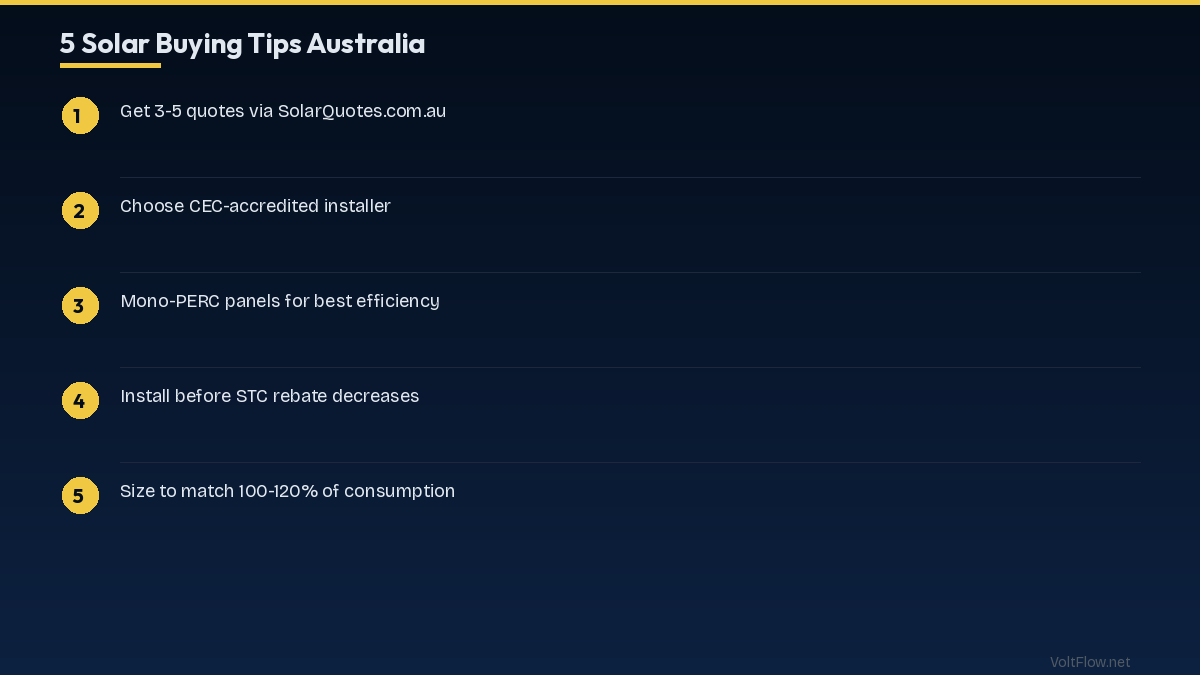
The decision to add battery storage to an Australian solar system depends on your electricity tariff, self-consumption goals, and backup power requirements. Battery prices continue to fall, making the economics increasingly attractive in 2026. The primary financial case for batteries in Australia is the gap between feed-in tariff rates and import rates. When your solar exports earn 5-8c per kWh but you pay 30-40c to import electricity in the evening, a battery that shifts solar surplus to evening use captures a spread of 22-35c per kWh. A 10 kWh battery cycling daily captures approximately 3,000 kWh of this spread per year, producing A$660-$1,050 in annual value. Battery costs in Australia range from A$8,000-$15,000 installed for 10-15 kWh systems. At A$800-$1,000 annual savings from solar shifting alone, payback is 8-15 years. Adding time-of-use tariff arbitrage where the battery charges from cheap grid overnight and discharges during peak adds A$200-$400 per year, improving payback to 6-12 years. Virtual power plant programmes from retailers like AGL, Origin, and Amber add A$100-$500 per year in additional income, potentially reducing payback to 5-10 years. South Australia offers the best battery economics due to the highest electricity rates and the highest TOU spread. A 10 kWh battery in SA combined with smart tariff management can save A$1,200-$1,600 per year with payback of 5-8 years. Victoria and NSW achieve payback of 7-12 years. Queensland and WA 8-14 years. For most Australian homeowners installing solar for the first time in 2026, the recommended approach is to install a hybrid inverter that supports future battery addition but defer the battery purchase by 2-3 years. Battery prices are expected to fall 10-15% per year, making the same battery significantly cheaper in 2028-2029. The hybrid inverter costs only A$300-$500 more than a standard inverter and avoids the A$1,000-$2,000 cost of adding a separate battery inverter later. If backup power during grid outages is a priority due to storm exposure, bushfire risk, or medical equipment needs, the battery provides immediate value beyond the financial return. Many Australian solar buyers in SA and Queensland add batteries primarily for blackout protection, with the financial return being a secondary benefit.