Electricity Rates Australia by State 2026: Complete Price Guide
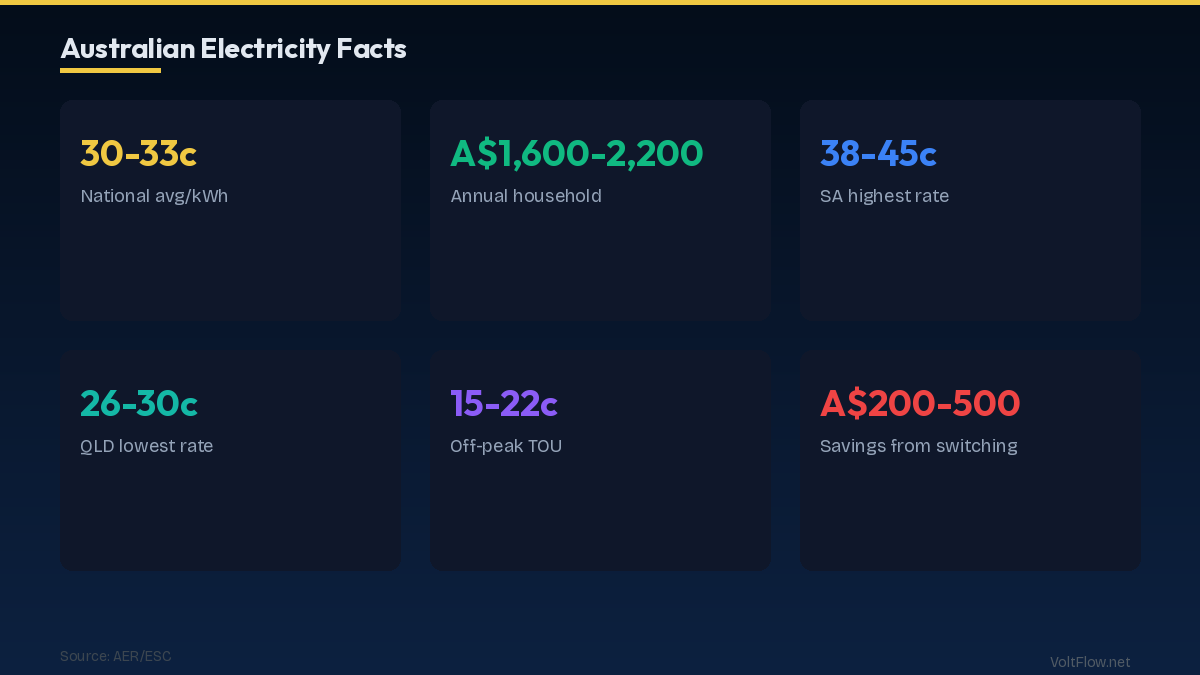
Australian electricity prices vary dramatically by state, from 25c/kWh in Queensland to 45c/kWh in South Australia during peak hours. The national average sits at approximately 30-33c/kWh for residential customers in 2026. Understanding your state rates, tariff structures, and the difference between flat-rate and time-of-use pricing is essential for calculating solar savings, EV charging costs, and appliance running expenses. This guide covers rates in every state and territory with money-saving strategies.
National Average and How Australian Electricity Pricing Works
The average Australian residential electricity rate in 2026 is approximately 30-33 cents per kWh, though this figure masks enormous variation between states, retailers, and tariff types. Australian electricity bills typically consist of two components: a daily supply charge of 80c-$1.50 per day just for being connected to the grid, and a usage charge per kWh consumed. Some retailers offer block tariffs where the rate changes based on consumption levels, the first 10 kWh per day might cost 28c while usage above that threshold costs 35c. Others offer flat rates where every kWh costs the same regardless of volume. Time-of-use tariffs are increasingly common and charge different rates depending on when you use electricity. Peak rates of 35-50c per kWh apply during afternoon and evening hours when demand is highest. Off-peak rates of 15-22c per kWh apply overnight and sometimes during the middle of the day when solar generation floods the grid. Shoulder rates of 25-32c per kWh cover the transition periods. The Australian Energy Regulator sets the Default Market Offer in New South Wales, South Australia, and South East Queensland, which caps the maximum price retailers can charge customers on standing offers. Victoria has its own Victorian Default Offer set by the Essential Services Commission. These regulatory price caps ensure that customers who do not actively shop for a better deal are protected from excessive pricing, similar to the UK Ofgem price cap. Electricity pricing in Australia is influenced by several factors. Wholesale market prices set by the National Electricity Market determine the base cost of generation. Network charges for poles, wires, and substations typically represent 40-50% of your bill. Environmental scheme costs including the Renewable Energy Target and state-based feed-in tariff obligations add 5-10%. Retailer margins and operating costs account for the remainder. The network charge component is why states with extensive, sparse networks like South Australia and Queensland tend to have higher rates, the infrastructure cost is spread across fewer customers per kilometre of powerline.
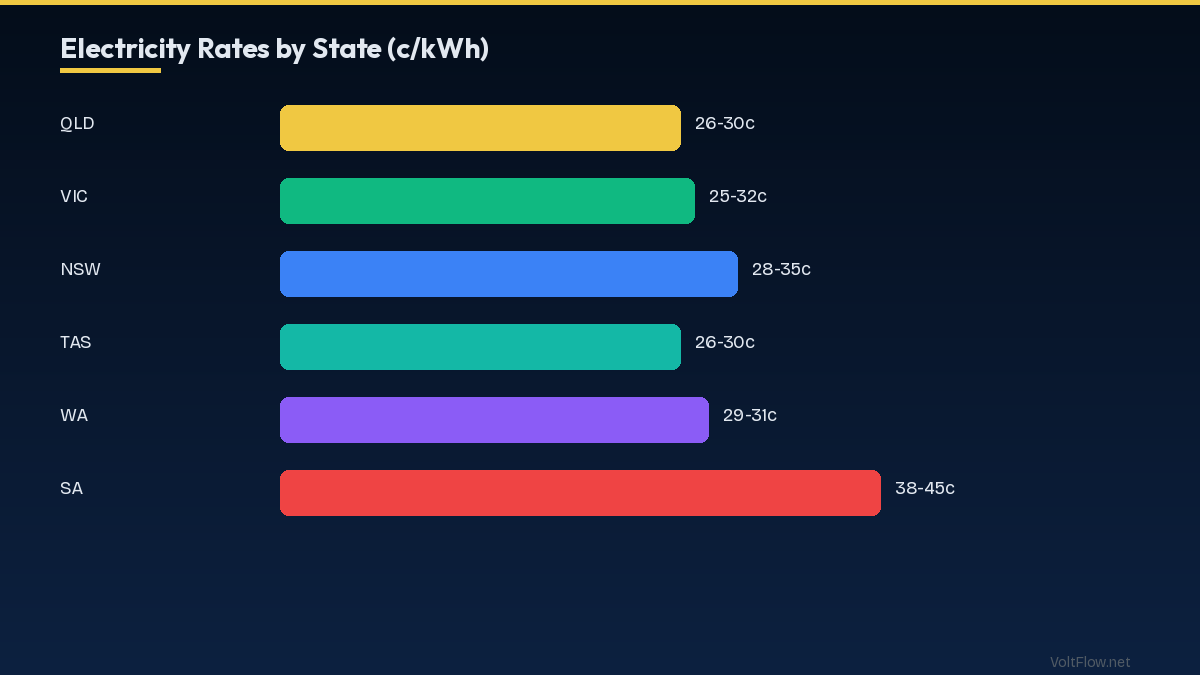
Electricity Rates by State: 2026 Comparison
New South Wales averages 28-35c per kWh on flat-rate tariffs with the Default Market Offer setting the ceiling at approximately 34.6c per kWh for the reference price. Sydney households on competitive market offers can find rates of 26-30c. Time-of-use tariffs offer peak rates of 38-48c, shoulder at 28-32c, and off-peak at 17-22c. The NSW solar feed-in tariff averages 5-8c per kWh, making self-consumption far more valuable than export. Victoria averages 27-32c per kWh under the Victorian Default Offer of approximately 31.7c. Melbourne residents on competitive offers achieve 25-29c. Victoria has the most competitive retail market in Australia with dozens of active retailers. Time-of-use tariffs offer peak at 35-45c, shoulder at 25-30c, and off-peak at 16-21c. The Victorian solar feed-in tariff minimum is 4.2c per kWh set by the Essential Services Commission, with some retailers offering 8-12c. Queensland averages 25-30c per kWh in South East Queensland where the competitive retail market operates under the Default Market Offer. Regional Queensland customers on Ergon Energy regulated tariffs pay similar rates. Queensland benefits from abundant solar generation that suppresses wholesale prices during daylight hours. Time-of-use tariffs offer peak at 32-42c and off-peak at 15-20c. South Australia has the highest average rates at 35-45c per kWh, driven by high network costs, limited interconnection, and historical dependence on gas generation. SA also has the highest solar penetration in the country, creating extreme midday price suppression and high evening peak prices. Time-of-use tariffs range from peak 42-55c to off-peak 18-25c. The large spread makes SA the best state for battery storage economics. Western Australia averages 30-35c per kWh under the Synergy regulated tariff. WA operates outside the National Electricity Market with its own Wholesale Electricity Market. The regulated residential tariff provides price stability but limits competitive retail choice. Tasmania averages 26-30c through Aurora Energy, benefiting from extensive hydroelectric generation that provides low-cost baseload power. The ACT averages 25-30c with some of the most competitive retail offers in the country. Northern Territory averages 28-32c through the regulated Power and Water Corporation tariff.
Time-of-Use vs Flat Rate: Which Saves More?
The choice between time-of-use and flat-rate tariffs can save or cost you hundreds of dollars per year depending on your consumption pattern. Understanding when TOU tariffs work in your favour is essential for making the right choice. Time-of-use tariffs benefit households that can shift significant electricity consumption away from peak afternoon and evening hours of 2-8 PM or 3-9 PM depending on the retailer. The peak-to-off-peak price difference of 15-30c per kWh creates substantial savings for households that charge EVs overnight, run pool pumps during off-peak hours, use timers on washing machines and dishwashers to operate overnight, have battery storage that charges off-peak and discharges during peak, or have solar panels that cover most daytime consumption leaving only evening peak to manage. A household shifting 30% of their 20 kWh daily consumption from peak to off-peak saves approximately $1.50-$3.00 per day or $550-$1,100 per year. This makes TOU tariffs highly attractive for solar-plus-battery households and EV owners. Flat-rate tariffs suit households with predictable daytime consumption that cannot be easily shifted. Working-from-home households with constant daytime computer and air conditioning loads, families with children at home during the day, and households without solar, battery, or EV have limited ability to shift consumption and may pay more on TOU tariffs because their afternoon and evening usage attracts the premium peak rate. To determine which tariff type saves you money, ask your retailer for a bill comparison based on your actual smart meter data. Most retailers can model your consumption pattern against both flat and TOU tariffs and show you the annual cost under each. If you have a smart meter, which is now standard in most Australian states, your half-hourly data makes this comparison highly accurate. If you do not have a smart meter, request one from your retailer, they are free in most states and enable access to better tariff options.
Solar and Battery Impact on Electricity Costs
Solar panels and battery storage fundamentally change your relationship with electricity pricing by reducing your dependence on grid imports and creating opportunities to profit from time-based pricing differentials. A typical 6.6 kWp solar system in Australia generates 24-32 kWh per day depending on location, covering most or all of the average household daily consumption of 16-20 kWh. However, the timing mismatch between solar generation peaking at midday and household consumption peaking in the evening means that without a battery, 50-70% of solar generation is exported to the grid at the low feed-in tariff rate of 3-12c per kWh. At an average self-consumption rate of 30-40%, a 6.6 kWp system saves $800-$1,400 per year through avoided imports at 30c per kWh plus export income at 5-10c per kWh. Adding a 10 kWh battery increases self-consumption to 70-85%, boosting annual savings to $1,400-$2,200. The battery captures midday solar surplus worth 5-10c in export value and releases it during the evening when it offsets 30-45c peak imports, a net value gain of 20-40c per kWh shifted. On time-of-use tariffs, the battery value increases further because the evening peak rate is 35-50c rather than the flat 30c. A well-configured solar-plus-battery system on a TOU tariff can reduce annual electricity costs from $2,200-$3,000 down to $300-$600, an 80-90% reduction. The remaining cost is the daily supply charge that applies regardless of consumption. Some Australian retailers now offer virtual power plant programmes where your battery participates in grid services and receives bonus payments of $200-$500 per year. Amber Electric offers wholesale pass-through pricing where your battery can charge at negative wholesale prices (you get paid to charge) and discharge during wholesale spikes, potentially earning $500-$1,000 per year for active participants. These advanced strategies require smart tariff integration and automated battery management but represent the frontier of home energy economics in Australia.
How to Find the Cheapest Electricity Plan
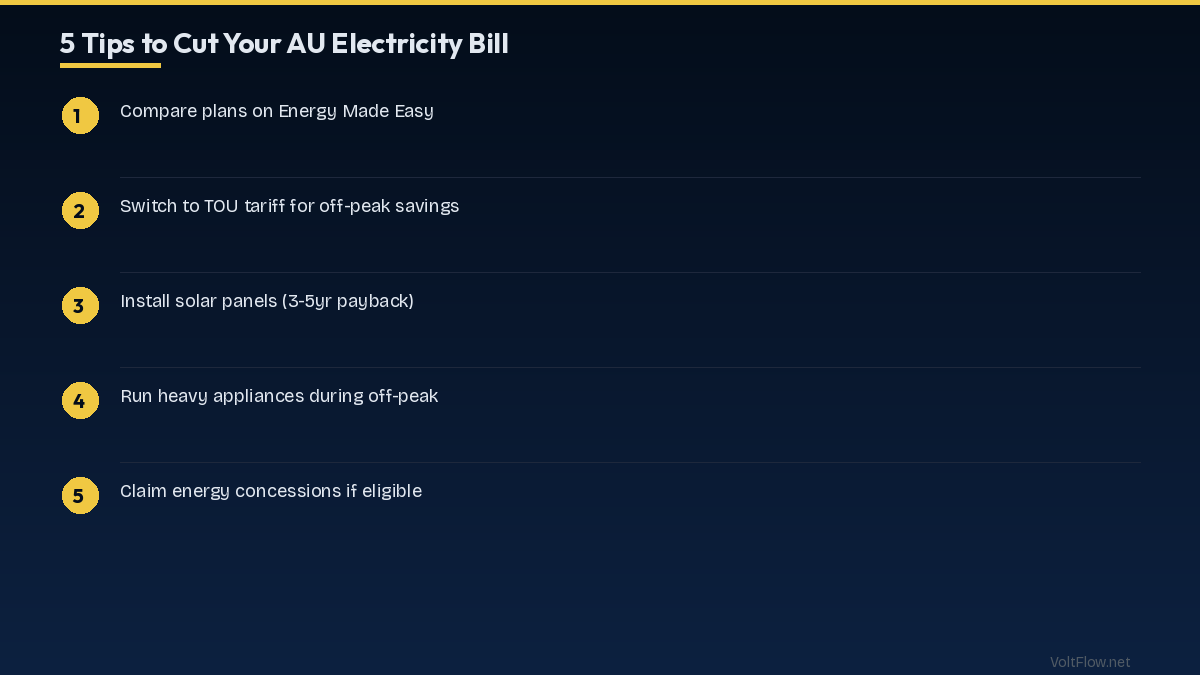
The Australian retail electricity market is complex with dozens of retailers in deregulated states offering hundreds of different plans. Finding the cheapest plan for your specific situation requires a systematic approach. Start with the government comparison website Energy Made Easy at energymadeeasy.gov.au for NSW, SA, ACT, and SEQ, or the Victorian Energy Compare site at compare.energy.vic.gov.au for Victoria. These independent comparison tools use your actual smart meter data or estimated consumption to show available plans ranked by annual cost. Unlike commercial comparison sites, the government tools show all available plans including those from retailers that do not pay referral commissions. Enter your address and current consumption to see plans sorted by estimated annual cost. The cheapest plan for a 4,000 kWh per year household may be completely different from the cheapest for a 7,000 kWh household because of different rate structures and daily supply charges. Pay attention to the tariff type and whether it matches your usage pattern. Compare the total estimated annual cost not just the per-kWh rate, because daily supply charges vary from 80c to $1.50 per day, adding $292-$548 per year regardless of consumption. A plan with a higher kWh rate but lower daily charge may be cheaper overall for low-consumption households. Check for conditional discounts that require on-time payment, direct debit, email billing, or other conditions. Missing a condition can increase your bill by 5-15%. Guaranteed discount plans offer a fixed percentage below the regulated reference price, providing certainty that your rate will remain competitive. Review the solar feed-in tariff if you have panels. Some retailers offer premium feed-in rates of 10-15c per kWh to attract solar customers, while others offer the minimum regulated rate. The feed-in tariff difference can be worth $200-$500 per year for a typical 6.6 kWp system. For EV owners, look for plans with cheap off-peak or overnight rates. Some retailers offer dedicated EV plans with overnight rates of 8-15c per kWh. AGL, Origin, and Amber Electric all offer EV-specific tariff options. Switch retailers at least annually. The Australian retail electricity market rewards active shoppers and penalises loyalty. Most introductory discounts expire after 12 months, and your plan automatically rolls to a more expensive standard rate. Set a calendar reminder to compare plans each year and switch if a better offer is available.
Reducing Your Electricity Bill: State-Specific Strategies
Each Australian state has unique characteristics that create specific opportunities for reducing electricity costs beyond generic advice. In New South Wales, the most impactful strategy is switching to a competitive market offer if you are on the default tariff. The gap between the Default Market Offer and the best competitive offer is typically $200-$400 per year. Solar panels with battery storage are highly effective given the 5-8c feed-in tariff that makes self-consumption the priority. In Victoria, the competitive retail market means aggressive shopping can find rates 15-20% below the Victorian Default Offer. The VIC government solar rebate of up to $1,400 reduces upfront solar costs. The minimum feed-in tariff of 4.2c is the lowest mandated rate in Australia, making batteries particularly valuable for capturing solar surplus. In Queensland, high solar irradiance means solar panels generate 20-30% more than equivalent systems in Melbourne. The relatively low electricity rates of 25-30c mean solar payback periods are slightly longer in dollar terms despite higher generation, but the combination of high generation and EV ownership still produces strong returns. In South Australia, the highest electricity rates in the country make every efficiency measure and solar-plus-battery investment more valuable. A 10 kWh battery in SA saves $300-$500 more per year than the same battery in Queensland simply because each kWh shifted from peak to off-peak is worth more. SA is also the best state for Amber Electric wholesale pricing because wholesale volatility creates the most arbitrage opportunities. In Western Australia, the regulated Synergy tariff limits retail competition but the Distributed Energy Buyback Scheme provides a tiered solar export payment of 10c per kWh from 3-9 PM and 2.5c at other times. This peak export rate rewards west-facing solar panels that generate during the afternoon peak, a unique strategy not available in other states. In Tasmania, the abundant hydroelectric generation means relatively low and stable rates. The main saving opportunity is ensuring you are on Aurora Energy best available plan and considering solar despite the lower irradiance because even moderate generation offsets meaningful bill amounts at 26-30c per kWh. Energy efficiency measures including LED lighting, draft sealing, and insulation upgrades provide universal savings across all states. The federal government Energy Rating label on appliances helps identify the most efficient models. Replacing a 15-year-old refrigerator with a new 5-star model saves approximately $100-$150 per year in electricity. Upgrading halogen downlights to LED saves $50-$100 per year for a typical home with 20 downlights.