Cable Sizing Australia 2026: AS/NZS 3000 Complete Guide
Cable sizing under AS/NZS 3000 (the Wiring Rules) requires balancing current-carrying capacity, voltage drop, and earth fault loop impedance, the same three checks as BS 7671 but with Australian-specific tables and conditions. A 7kW EV charger needs 6mm² TPS on a 32A MCB. A 10kW cooktop needs 6mm² on a 32A MCB. This guide covers the AS/NZS 3000 cable sizing method for Australian residential installations with worked examples.
AS/NZS 3000 Cable Sizing Method
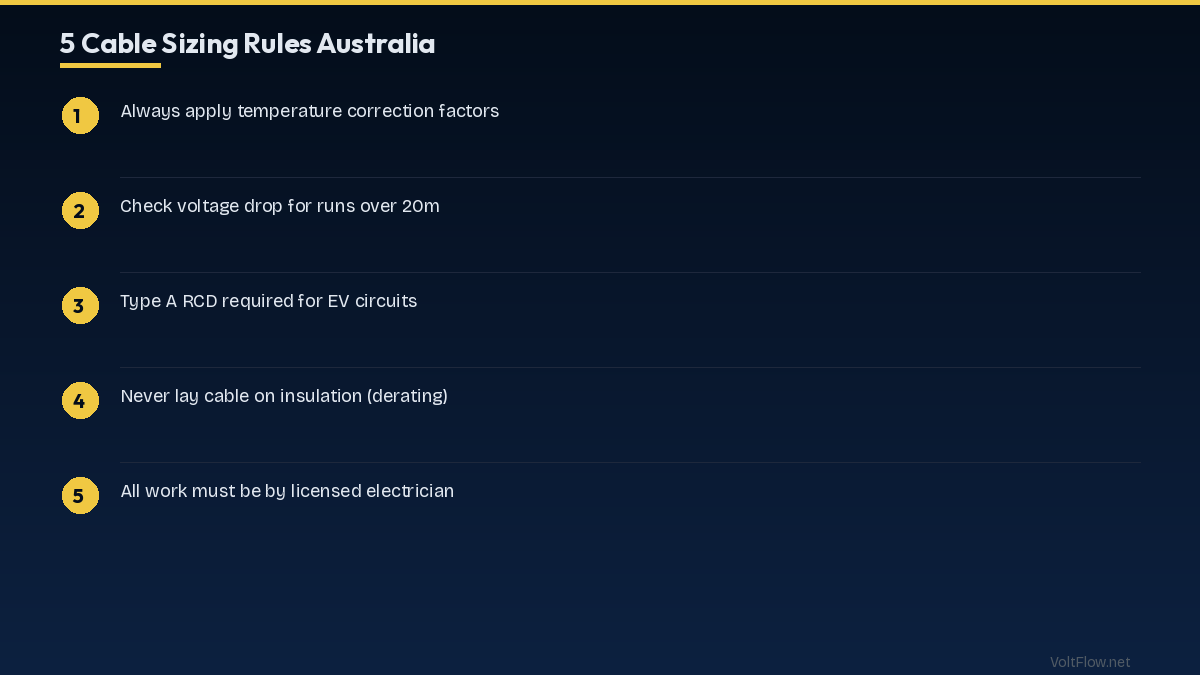
AS/NZS 3000 Section 3 specifies the cable sizing requirements for Australian electrical installations. The method requires three simultaneous checks, and the cable must pass all three. The most restrictive check determines the minimum cable size. The first check is current-carrying capacity per AS/NZS 3008.1.1. The cable must carry the design current without exceeding its temperature rating. The design current is determined by the connected load, and the cable rating must equal or exceed the protective device rating. Correction factors for ambient temperature, cable grouping, and thermal insulation modify the base ampacity. Australian ambient temperature corrections differ from BS 7671 because Australian reference ambient is 40 degrees Celsius (not 30 degrees as in BS 7671), reflecting the hotter Australian climate. This means Australian cable ratings already account for warm conditions, and correction factors apply only above 40 degrees. For cables in roof spaces reaching 50-60 degrees during Australian summers, ambient temperature correction factors of 0.82-0.91 apply per AS/NZS 3008 Table 4. The second check is voltage drop per AS/NZS 3000 Clause 3.6. Maximum voltage drop from the point of supply to any point of utilisation is 5% of nominal voltage. At 230V, that is 11.5V. Voltage drop is calculated using mV/A/m values from AS/NZS 3008 tables. For flat TPS (thermoplastic sheathed) cable common in Australian residential wiring, the voltage drop values differ slightly from British twin-and-earth due to different conductor configurations and insulation specifications. The third check is earth fault loop impedance to ensure the protective device disconnects within 0.4 seconds for final circuits per AS/NZS 3000 Table 8.2. The maximum earth fault loop impedance Zs for a 32A Type B MCB is 1.44 ohms. For a 20A Type B MCB, Zs maximum is 2.30 ohms. These values are similar to BS 7671 but not identical due to slight differences in MCB trip curve specifications between IEC and AS/NZS standards. In practice, for most Australian residential installations with cable runs under 40 metres, the current-carrying capacity check determines the cable size. Voltage drop becomes the controlling factor for runs exceeding 30-40 metres depending on the circuit current.
Common Australian Residential Cable Sizes
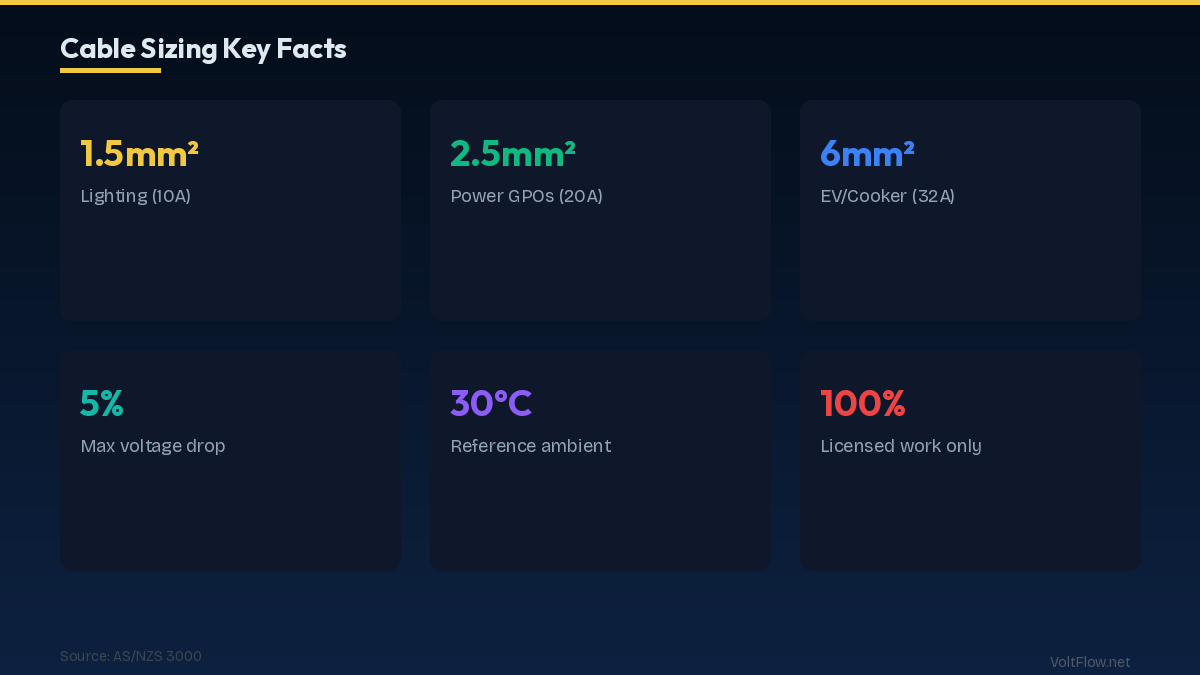
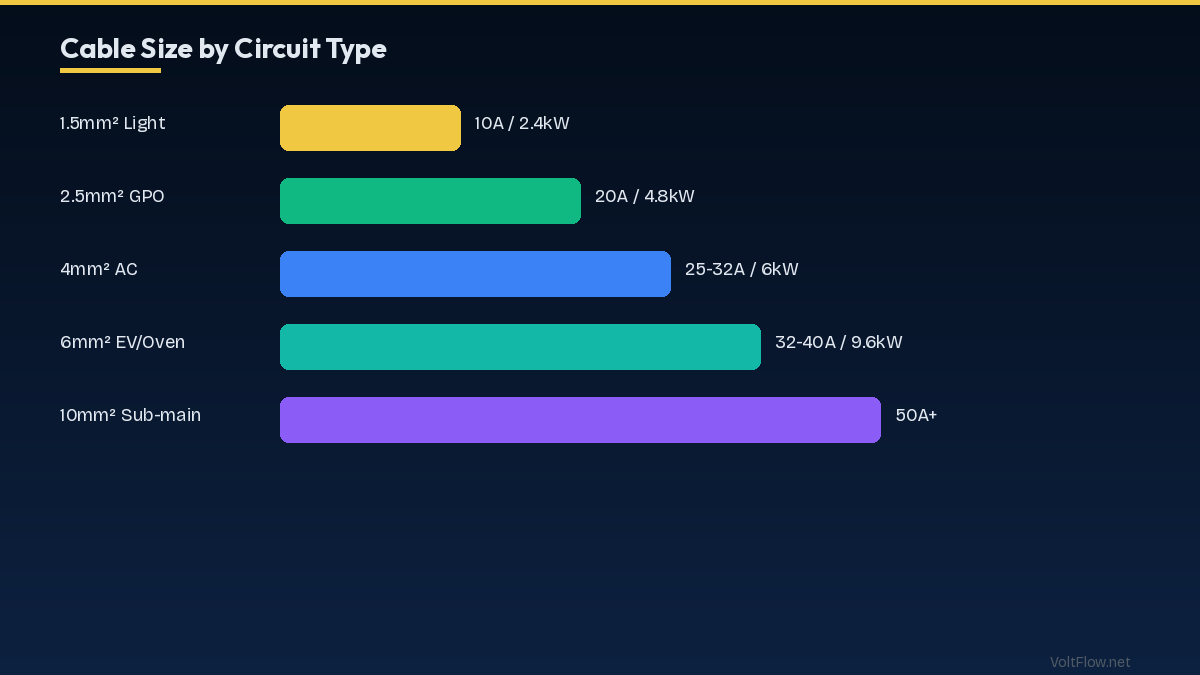
Australian residential wiring uses TPS (Thermoplastic Sheathed) cable, the local equivalent of British twin-and-earth. The standard cable sizes and their applications cover the vast majority of domestic installations. 1mm² TPS on a 10A MCB serves lighting circuits with a maximum current rating of 14A when clipped to a surface in free air at 40 degrees ambient. This is the standard Australian lighting cable providing ample capacity for LED lighting loads that rarely exceed 3-5A per circuit. Maximum recommended run length before voltage drop exceeds 5% at full 10A load is approximately 45 metres. 1.5mm² TPS on a 16A MCB is an alternative lighting cable for longer runs or circuits with higher loads. Current rating of 17.5A. Some electricians standardise on 1.5mm² for all lighting to provide voltage drop headroom. 2.5mm² TPS on a 20A MCB serves standard power circuits including general power outlets throughout the home. Current rating of 23A. In Australia, ring circuits are not used, all power circuits are radial. Each radial circuit can serve a maximum of 12 power points in a living area. The maximum run length at 20A before exceeding 5% voltage drop is approximately 35 metres. 4mm² TPS on a 25A or 32A MCB serves dedicated circuits for air conditioning units, large fixed appliances, and some cooktops. Current rating of 30A. Also used for longer power circuit runs where 2.5mm² would exceed voltage drop limits. 6mm² TPS on a 32A or 40A MCB serves EV charger circuits at 7kW, cooktop circuits up to 10kW, and hot water system circuits. Current rating of 38A when clipped direct. This is the workhorse cable for high-power residential circuits. Maximum run at 32A before voltage drop exceeds 5% is approximately 25 metres. 10mm² TPS on a 40A or 50A MCB serves large cooktops above 10kW, oven and cooktop combination circuits, and sub-main cables for secondary switchboards. Current rating of 49A. 16mm² TPS on a 63A MCB serves as sub-main cable from the meter box to the main switchboard in most Australian homes. Also used as feeder cable to large secondary switchboards in outbuildings.
Voltage Drop Calculations: Australian Examples
Voltage drop is frequently the determining factor for cable size on longer Australian residential circuits, particularly for high-current loads installed far from the switchboard. Australian homes are often larger and more spread out than British homes, making long cable runs more common. Example one: 7kW EV charger 30 metres from the switchboard. Design current 30.4A on a 32A MCB using 6mm² TPS cable. The mV/A/m value for 6mm² flat TPS at operating temperature is approximately 7.3. Voltage drop equals 7.3 times 32 times 30 divided by 1,000 equals 7.01 volts. As percentage: 7.01 divided by 230 equals 3.05%. This passes the 5% limit but consumes over 60% of the voltage drop budget. If other upstream losses exist in the sub-main cable, the total may approach 5%. For this borderline case, upgrading to 10mm² with mV/A/m of 4.4 gives 4.22 volts or 1.84%, much more comfortable. Example two: air conditioning unit 25 metres from switchboard. Design current 15A on a 20A MCB using 2.5mm² TPS cable. mV/A/m value of 18. Voltage drop equals 18 times 20 times 25 divided by 1,000 equals 9.0 volts or 3.91%. Passes the 5% limit but is getting close. If the unit is 35 metres away: 18 times 20 times 35 divided by 1,000 equals 12.6 volts or 5.48%, FAILS. The cable must be upgraded to 4mm² at mV/A/m of 11 giving 7.7 volts or 3.35% at 35 metres. Example three: sub-main feed to a granny flat 40 metres from the main switchboard. Design current 50A on a 63A MCB using 16mm² TPS cable. mV/A/m of 2.8. Voltage drop equals 2.8 times 63 times 40 divided by 1,000 equals 7.06 volts or 3.07%. Passes comfortably. At 60 metres: 2.8 times 63 times 60 divided by 1,000 equals 10.58 volts or 4.60%, still passes but leaves little margin. The Australian 40-degree ambient reference temperature means that cables in typical residential installations at 25-35 degrees ambient actually run cooler than the rated conditions, providing a natural safety margin on current-carrying capacity that partially compensates for any voltage drop concerns.
Cable Types for Australian Conditions
Australian climate conditions including extreme heat, UV radiation, termite risk, and flood exposure create specific requirements for cable selection and installation that differ from European and American practices. TPS cable or Thermoplastic Sheathed cable is the Australian standard for interior residential wiring, equivalent to NM-B in the US and twin-and-earth in the UK. Australian TPS uses V-75 PVC insulation rated for 75 degrees Celsius conductor temperature, compared to the 70-degree rating common in some international standards. The higher temperature rating provides additional margin in Australian roof spaces where summer temperatures routinely exceed 50 degrees Celsius. Australian TPS cable includes an uninsulated earth conductor, similar to British practice. Cable colours follow the Australian standard: red for active (equivalent to brown in the harmonised system), black for neutral (equivalent to blue), and bare or green/yellow for earth. The harmonised colours brown, blue, and green/yellow are increasingly used in new installations but both systems are currently accepted under AS/NZS 3000. For outdoor and underground cable runs, Australian electricians use either orange circular cable in rigid or flexible conduit, or direct-burial rated cable. Conduit provides mechanical protection and allows future cable replacement. Heavy-duty orange conduit at 25-32mm diameter is the standard for underground residential cable routes. Burial depth requirements under AS/NZS 3000 are 500mm minimum for domestic installations in private ground, or 300mm under concrete pathways. SWA (Steel Wire Armoured) cable is less commonly used in Australian residential installations compared to the UK. The preference for conduit over armoured cable reflects the termite risk in many Australian regions, plastic conduit provides a physical barrier against termite damage to cable insulation, while SWA cable relies on the armour which termites may bridge by building mud tubes over. In termite-prone areas of Queensland, Northern NSW, Northern Territory, and Western Australia, all underground cable routes should use conduit with sealed termite-resistant fittings at entry points to the building. UV degradation affects cables exposed to direct sunlight in Australia more severely than in temperate climates. The Australian UV index regularly reaches 11-14, more than double typical European levels. Any cable exposed to sunlight must be UV-stabilised or enclosed in UV-resistant conduit. Standard grey PVC conduit degrades in Australian sun within 5-10 years. Black UV-resistant conduit lasts 25-30 years in direct sun exposure and should be specified for all outdoor above-ground cable runs.
Switchboard Cable Connections and Termination
Proper cable termination at the switchboard and at electrical accessories is critical for safety and long-term reliability. Australian wiring practice follows AS/NZS 3000 requirements for connection methods, conductor preparation, and torque specifications. At the switchboard, cable sheath must be stripped back to allow individual conductors to reach their respective terminals without excess length creating a bird nest of conductors inside the switchboard. The sheath should enter the switchboard enclosure through a properly fitted cable gland or cable entry that provides strain relief and prevents the cable from being pulled out. Active conductors connect to the MCB or RCBO terminal. Neutral conductors connect to the neutral bar. Earth conductors connect to the earth bar. All terminals must be tightened to the manufacturer specified torque, typically 2-2.5 Nm for residential switchgear. Under-torqued connections loosen over time from thermal cycling and vibration, creating high-resistance joints that overheat and potentially cause fire. Over-torqued connections damage the conductor or terminal, also creating reliability problems. A calibrated torque screwdriver at A$40-$80 ensures consistent and correct tightening. Only one conductor per terminal unless the terminal is specifically listed for multiple conductors. Double-tapping or placing two conductors under a terminal designed for one is a code violation and fire hazard in Australia just as in every other country. If additional connections are needed, use appropriate junction methods such as a terminal strip or additional MCB position. At power outlets and switches, conductors must be stripped to the correct length to engage fully with the terminal without exposed copper outside the terminal. Australian GPOs (General Purpose Outlets) use either screw terminals or spring-loaded terminals. For screw terminals, form a clockwise hook in the conductor so tightening the screw pulls the conductor into the terminal rather than pushing it out. Loop-in wiring methods at light fittings must ensure that all connections are accessible and that the fitting can be removed for maintenance without disturbing the circuit wiring. Junction boxes used for cable joins must be accessible after installation, they cannot be buried inside walls or above fixed ceilings without access panels. All connections in junction boxes must use appropriate connectors such as screw terminal strips or spring-loaded lever connectors. Twist-and-tape joints are not permitted under AS/NZS 3000.
Hiring a Licensed Electrician in Australia
All electrical wiring work in Australia must be performed by a licensed electrician. Understanding the licensing system, what to look for, and how to verify credentials protects you from unqualified operators and ensures your work meets AS/NZS 3000. Each Australian state and territory issues its own electrical licences. A Queensland licence does not automatically authorise work in NSW or Victoria. However, mutual recognition agreements allow licensed electricians to work across state borders after registering with the destination state regulator. The main licence classes relevant to residential work are Electrical Contractor licence which authorises a business to contract for electrical work and is required by the business owner or principal, Electrical Mechanic or Electrician licence held by individual tradespeople who perform the physical work under a contractor licence, and Restricted Electrical Licence held by specialists in specific areas like solar installation, air conditioning, or data cabling. To verify a licence, check the state electrical safety regulator website. In Queensland, the Electrical Safety Office database at worksafe.qld.gov.au. In NSW, Fair Trading at fairtrading.nsw.gov.au. In Victoria, Energy Safe Victoria at esv.vic.gov.au. Each state provides free online licence verification where you can confirm the electrician name, licence number, current status, and any conditions or restrictions. When getting quotes, request the electrician licence number and verify it online before accepting any quote. Ask whether the quote includes all materials, testing, certification, and any required switchboard upgrades. Ensure the quote specifies compliance with AS/NZS 3000 current edition. After completion, you must receive a Certificate of Compliance or Electrical Safety Certificate confirming the work meets AS/NZS 3000. This certificate is a legal requirement and should be kept with your property records. Some states require the electrician to lodge the certificate with the state regulator within a specified timeframe, creating an independent record that can be verified during property sales or insurance claims. For solar, battery, and EV charger installations, ensure your electrician holds the relevant Clean Energy Council accreditation in addition to their electrical licence. CEC accreditation is required for STC rebate eligibility and demonstrates specific competency in renewable energy system installation beyond general electrical qualifications.