Switchboard Upgrade Cost Australia 2026: Pricing & What to Expect
A switchboard upgrade in Australia costs A$800-$2,500 for a standard residential replacement, or A$1,500-$4,000 if additional circuits, RCD upgrades, or safety switch compliance work is needed. Old ceramic fuse boards and asbestos switchboards must be replaced for safety. All new switchboards require RCD (safety switch) protection on every circuit under current AS/NZS 3000 regulations. This guide covers costs, regulations, and when you need an upgrade.
Switchboard Upgrade Cost Breakdown
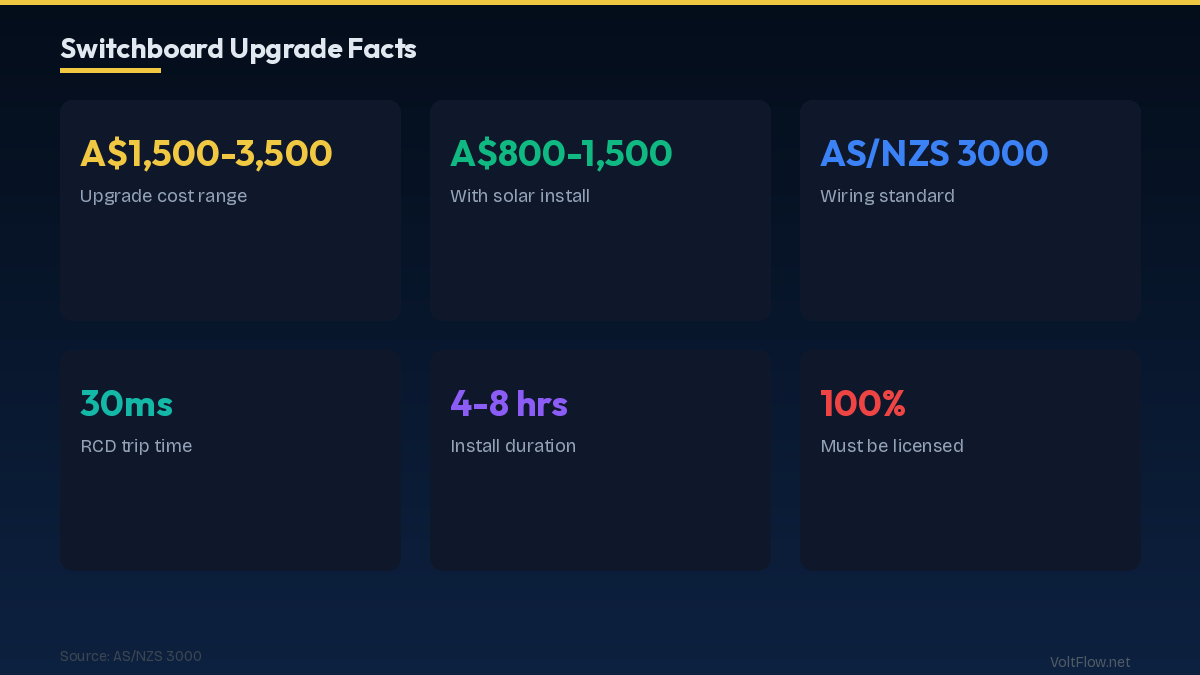
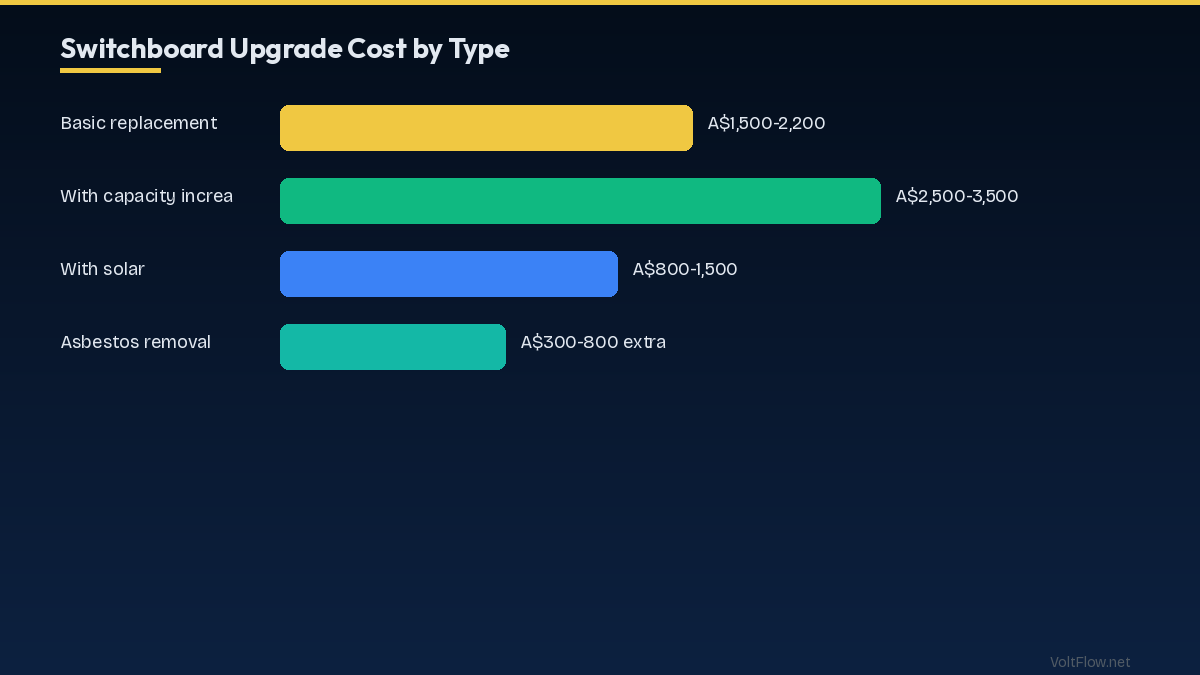
The cost of a switchboard upgrade depends on the complexity of the installation, the number of circuits, and whether additional safety work is required. A basic switchboard replacement from an old ceramic fuse board or miniature circuit breaker board to a modern RCBO-protected switchboard costs A$800-$1,500. This covers a new switchboard enclosure at A$100-$250, RCBOs for each circuit at A$25-$40 each times 8-12 circuits equals A$200-$480, main switch at A$50-$80, installation labour of 4-6 hours at A$80-$120 per hour equals A$320-$720, electrical testing and Certificate of Compliance at A$100-$200, and connection and disconnection fees to the distributor if required at A$0-$200. A switchboard upgrade with additional circuits costs A$1,500-$2,500. This applies when you are adding new circuits for an EV charger, air conditioning, solar system, or additional power circuits alongside the switchboard replacement. Each new circuit adds A$150-$300 for cable, RCBO, and installation. An upgrade with remedial work costs A$2,000-$4,000. Older properties may have wiring defects discovered during the switchboard replacement that must be addressed for safety and certification. Common issues include deteriorated cable insulation requiring partial rewire, inadequate earthing system needing new earth electrodes, missing or damaged neutral connections, and asbestos-containing switchboard backing requiring licensed asbestos removal at A$300-$800. A complete rewire with new switchboard for a 3-bedroom house costs A$8,000-$15,000 depending on house size, construction type (brick versus weatherboard versus double-brick), and accessibility of cable routes. Full rewires are needed for homes with rubber-sheathed wiring from pre-1960s or severely deteriorated TPS cable from the 1960s-1970s.
When You Need a Switchboard Upgrade
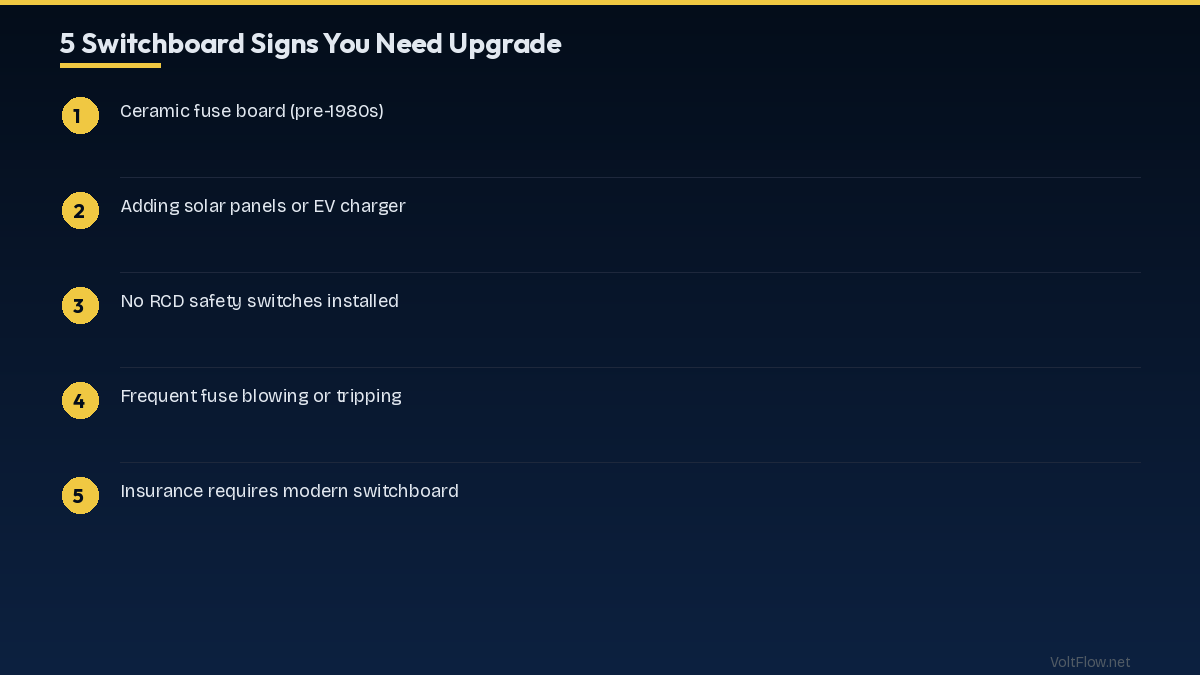
Several situations trigger the need for a switchboard upgrade, from safety emergencies to regulatory compliance and capacity requirements. Old ceramic fuse boards with rewireable fuses should be replaced as a high priority. These boards lack RCD (safety switch) protection, meaning a fault that should trip instantly may instead energise metal appliance casings at lethal voltage. Ceramic fuses also lack the precision of modern MCBs and may fail to disconnect during overcurrent conditions, allowing wires to overheat inside walls. If your switchboard has round ceramic fuse holders with exposed copper fuse wire, schedule a replacement promptly. Switchboards containing asbestos require urgent replacement by a licensed asbestos removalist followed by a licensed electrician. Asbestos was commonly used as backing material in switchboards manufactured before 1990. Do not attempt to remove or work on an asbestos switchboard yourself. Disturbing asbestos releases microscopic fibres that cause serious lung disease. Your electrician can visually assess whether asbestos is likely present, but definitive identification requires a sample tested by an accredited laboratory. Adding a solar system, battery, or EV charger to your home often triggers a switchboard upgrade because the existing board lacks capacity for the additional circuits and protective devices. Many solar installers include a switchboard upgrade in their quote if the existing board is inadequate, combining both jobs to reduce total cost. Buying or selling a property increasingly involves switchboard assessment. Building inspectors and pre-purchase electrical reports flag old ceramic fuse boards, missing RCD protection, and switchboards in poor condition as safety defects. Addressing these before listing your property avoids price negotiations and demonstrates diligence. Insurance companies may require switchboard upgrades as a condition of cover for homes with outdated or dangerous electrical installations. Some insurers specifically exclude homes with ceramic fuse boards or known unsafe wiring from coverage.
RCD (Safety Switch) Requirements Under AS/NZS 3000
RCD protection is the most critical safety feature of a modern switchboard. Understanding the requirements ensures your upgrade meets current standards and provides maximum protection for your household. AS/NZS 3000 requires RCD protection with a maximum rated residual current of 30 milliamps on all final subcircuits in new installations. This means every power circuit, every lighting circuit, and every dedicated appliance circuit must have its own RCD protection. The most common implementation is RCBO (Residual Current Breaker with Overcurrent protection) devices that combine MCB overcurrent protection with RCD earth leakage protection in a single device for each circuit. An RCBO-based switchboard costs more than an RCD-split board but provides superior selectivity. A fault on the kitchen circuit trips only the kitchen RCBO, leaving all other circuits operating normally. On a split-load RCD board, the same fault trips the RCD protecting the entire group, potentially disconnecting 4-6 circuits simultaneously. For existing installations, the AS/NZS 3000 requirements apply when the switchboard is replaced, new circuits are added, or existing circuits are modified. A like-for-like MCB replacement on an existing circuit does not trigger the RCD requirement, but most electricians recommend adding RCD protection during any switchboard work as the cost is modest and the safety benefit is substantial. Type A RCDs are now required for EV charger circuits under AS/NZS 3000 because EV chargers with DC charging components can produce DC fault currents that Type AC RCDs cannot detect. A Type A RCBO costs A$50-$80 compared to A$25-$40 for a Type AC RCBO. Your electrician must install the correct type for each circuit based on the connected load characteristics. The cost of RCBO protection across a typical 10-12 circuit switchboard is A$250-$480, or approximately A$150-$280 more than an MCB-only board. This modest premium provides life-saving protection against electric shock for every circuit in your home. Given that electrical shock from faulty appliances and damaged wiring causes several deaths and hundreds of injuries in Australia each year, RCD protection is not optional for safety, it is essential.
Choosing the Right Electrician for Your Upgrade
A switchboard upgrade is safety-critical work that directly affects every electrical circuit in your home. Selecting the right licensed electrician ensures quality work, proper certification, and reliable protection for your family. Verify the electrician licence with your state electrical safety regulator before accepting any quote. In Queensland, check the Electrical Safety Office database. In NSW, check Fair Trading. In Victoria, check Energy Safe Victoria. In SA, check the Office of the Technical Regulator. In WA, check the Building and Energy division. Each state provides free online licence verification. Get at least three written quotes from licensed electrical contractors. Each quote should specify the exact switchboard brand and model, the number and type of protective devices specifying RCBO versus RCD plus MCB, any additional work like new circuits or earthing upgrades, full electrical testing and Certificate of Compliance, and the expected completion time and whether power will need to be disconnected by the distributor. Compare quotes on total value rather than lowest price. A quote that is A$400 below competitors may use cheaper switchgear with shorter warranty, fewer RCBO-protected circuits, or may exclude testing and certification. Ask specifically whether the quote includes RCBO protection on every circuit or the less desirable split-load RCD configuration. Check reviews on Google, Hipages, ServiceSeeking, or local community groups. Look for consistent mention of timeliness, clean workmanship, thorough testing, and clear communication. Electricians who rush switchboard work or skip comprehensive testing create hidden risks that may not become apparent until a fault occurs months or years later. After completion, you should receive a Certificate of Compliance or Electrical Safety Certificate confirming AS/NZS 3000 compliance, a completed switchboard schedule identifying every circuit and its protective device, and test results for all circuits including RCD trip times, insulation resistance, and earth fault loop impedance. Keep these documents permanently with your property records.
What Happens During a Switchboard Upgrade
Understanding the switchboard upgrade process helps you prepare for the day and minimise disruption to your household. The work typically takes 4-8 hours for a standard replacement. Before the electrician arrives, clear the area around your switchboard. Remove stored items, shelving, and anything within one metre. If the switchboard is in a cupboard, empty it completely. The electrician needs full access to the board, incoming cables, and outgoing circuit cables. Power will be off for most of the installation period, typically 3-6 hours. Plan accordingly: charge phones and devices beforehand, have a thermos of hot water or cold drinks available, know that your fridge and freezer will be fine for 6 hours with doors closed, and plan activities outside the home for children who rely on screen entertainment. In some states, the distribution network service provider must disconnect and reconnect the service. Your electrician arranges this as part of the job. The DNSP sends a technician to remove the service fuse or disconnect at the meter box, the electrician replaces the switchboard while the supply is dead, then the DNSP returns to reconnect. Some DNSPs charge A$100-$200 for this service, while others provide it free. In Victoria, the process may involve an Authorised Service Provider coordinated by your electricity distributor. The installation sequence is: disconnect supply, remove old switchboard, mount new switchboard enclosure, connect main switch and RCBOs, reconnect all circuit cables to their correct RCBOs, reconnect the supply, test every circuit for correct operation, commission RCDs by testing trip times, label the switchboard schedule, and issue the Certificate of Compliance. After the upgrade, your electrician walks you through the new switchboard, explaining how to identify each circuit from the schedule and how to reset a tripped RCBO. Each RCBO has a test button that should be pressed every three months to verify the RCD mechanism operates correctly. This 30-second task is the only maintenance your switchboard needs.
Switchboard Upgrade for Solar, Battery, and EV Readiness
If you are considering solar panels, battery storage, or an EV charger in the next few years, upgrading your switchboard now to accommodate these future additions saves money and disruption compared to doing two separate upgrade projects. A solar-ready switchboard upgrade includes a main switch upgrade to handle bidirectional power flow if required by your distributor, spare RCBO positions for the solar inverter circuit at 20-32A depending on system size, space for a generation meter or smart meter configuration for export measurement, and adequate switchboard size with 24-36 positions to accommodate all current and future circuits. The incremental cost to make a switchboard solar-ready during an upgrade is approximately A$100-$300 for the additional positions and a slightly larger enclosure. A battery-ready switchboard includes space for a battery inverter circuit RCBO at 32-50A, provision for a backup changeover switch or critical loads panel that isolates essential circuits during grid outages, and space for CT clamp monitoring connections that the battery management system uses to track household consumption. Battery readiness adds approximately A$100-$200 to the switchboard upgrade cost. An EV-ready switchboard includes a spare 32A RCBO position for the future EV charger circuit and a Type A RCD specification for the EV circuit. Adding EV readiness costs approximately A$50-$100 for the RCBO position reservation and Type A device specification. Combined, making your switchboard ready for solar, battery, and EV adds approximately A$200-$500 to a standard upgrade, far less than the A$500-$1,000 cost of returning to modify the switchboard later when each new system is installed. When briefing your electrician for the upgrade, provide a list of all currently planned and potential future electrical additions so they can size the switchboard appropriately. Explain that you want a future-proof installation even if you are not installing solar, battery, or EV charger immediately. A proactive electrician will appreciate this forward planning and design an installation that serves your needs for the next 20 years rather than just meeting current requirements.