EV Charging Cost Australia 2026: Home vs Public Pricing Guide
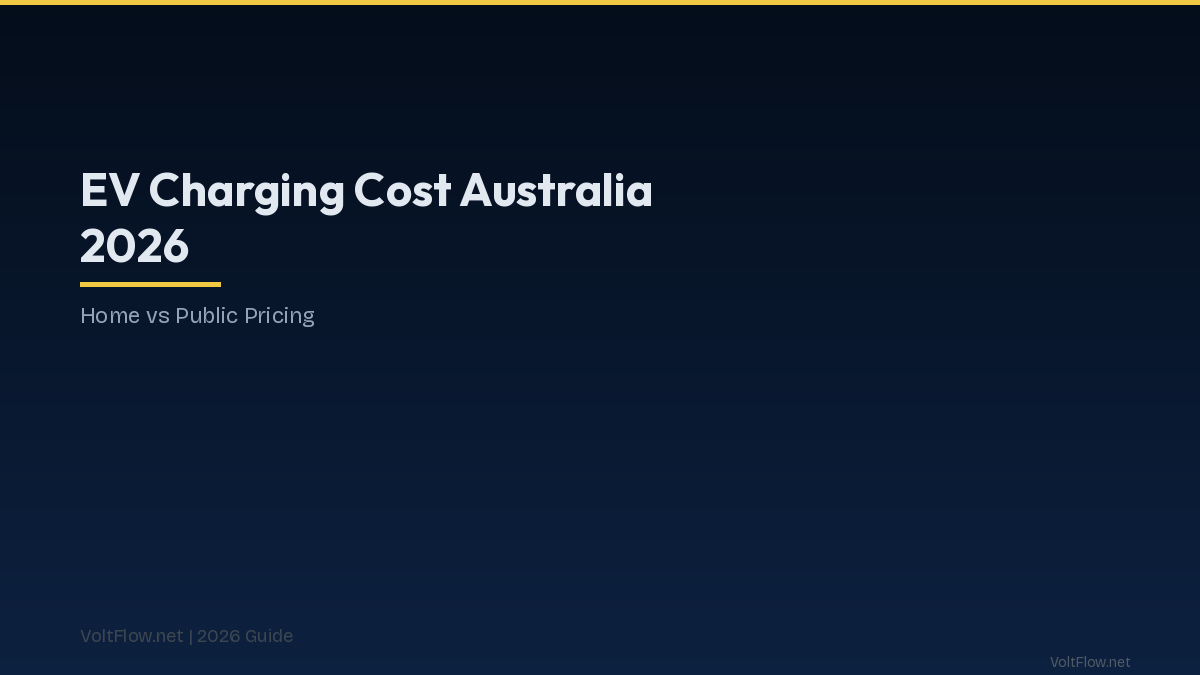
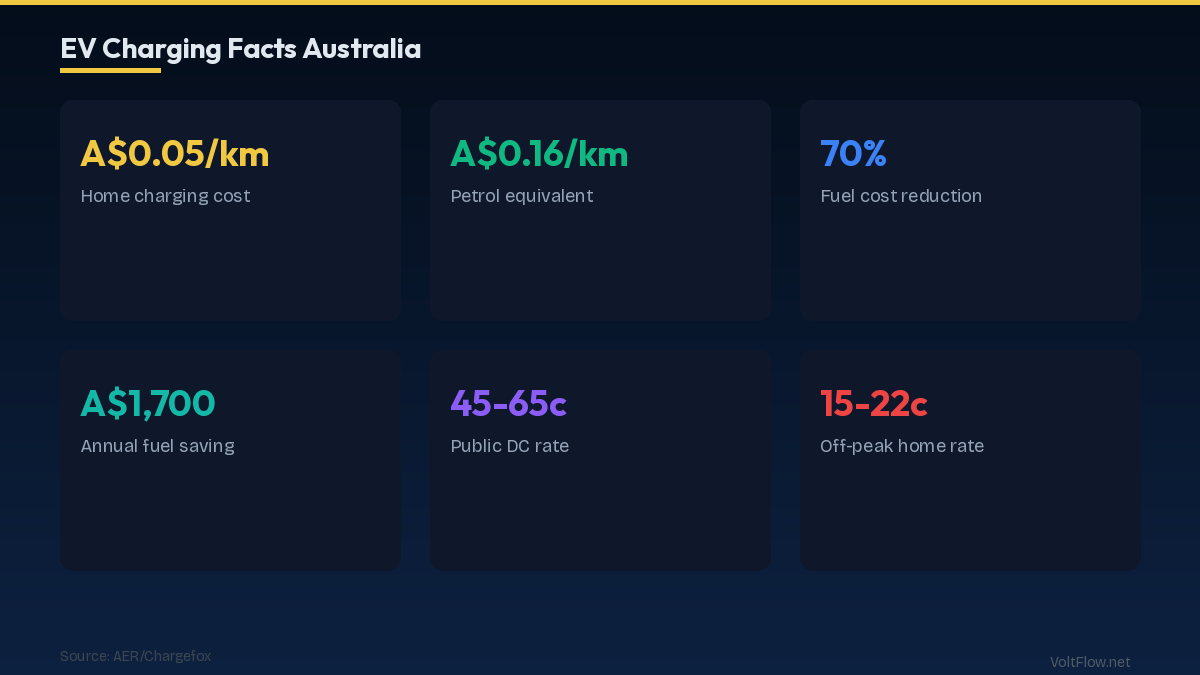
Charging an EV at home in Australia costs approximately A$0.05/km at 30c/kWh compared to A$0.16/km for petrol, a 70% fuel cost saving. Off-peak home charging at 18c/kWh drops the cost to just A$0.03/km. Public DC fast charging costs 45-65c/kWh, making it 2-3x more expensive than home charging. This guide breaks down EV charging costs across all Australian states with annual savings calculations.
Home Charging Costs by State
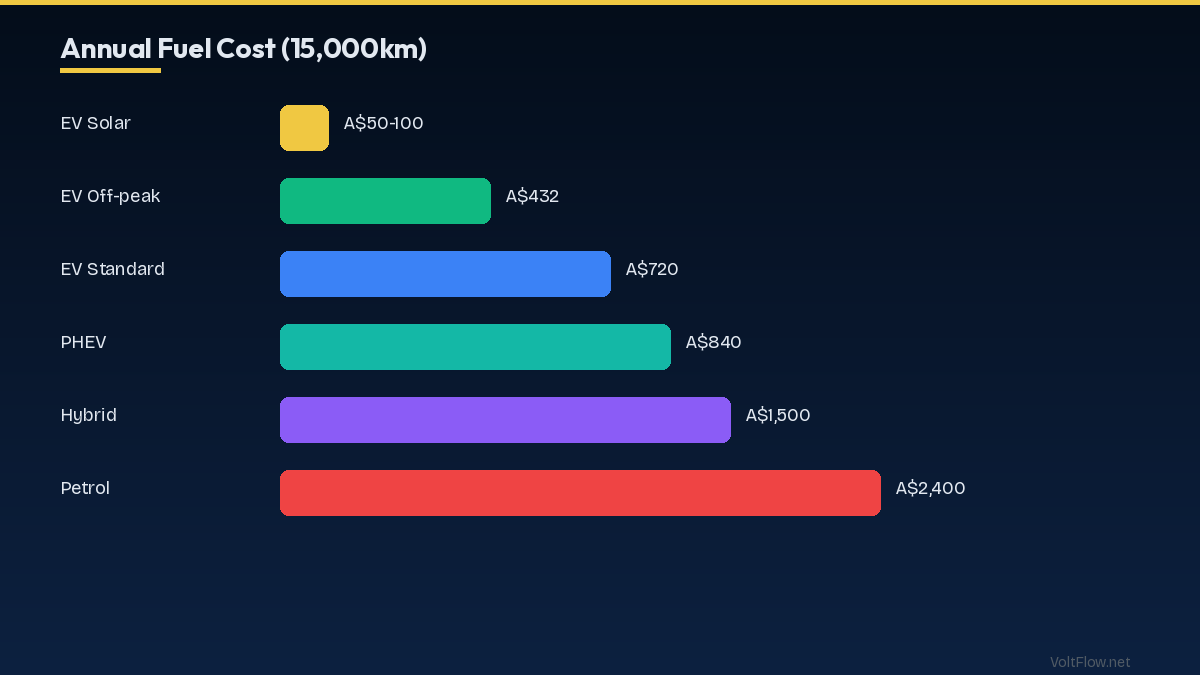
Home EV charging costs vary across Australia because electricity rates differ by state. At the average rate in each state, here is what home charging costs per kilometre for a typical EV consuming 16 kWh per 100 km. In New South Wales at 31c per kWh average, home charging costs A$0.050 per km. Annual cost for 15,000 km is A$744. In Victoria at 30c per kWh, A$0.048 per km and A$720 annually. In Queensland at 27c per kWh, A$0.043 per km and A$648 annually. In South Australia at 38c per kWh, A$0.061 per km and A$912 annually. In Western Australia at 32c per kWh, A$0.051 per km and A$768 annually. In Tasmania at 28c per kWh, A$0.045 per km and A$672 annually. Off-peak and time-of-use tariffs dramatically reduce these costs. On off-peak rates of 15-22c per kWh available in most states between 10 PM and 7 AM, charging costs drop to A$0.024-$0.035 per km. Annual cost for 15,000 km at 18c off-peak is just A$432, roughly A$3.50 per week for a car. This is the primary reason EV ownership is financially compelling in Australia. For comparison, a petrol car averaging 8 litres per 100 km at A$2.00 per litre costs A$0.16 per km or A$2,400 per year for 15,000 km. The EV saves A$1,488-$1,968 per year on fuel alone at standard home charging rates, or A$1,488-$1,968 at off-peak rates. Over a 5-year ownership period, fuel savings of A$7,440-$9,840 substantially offset the higher purchase price of most EVs compared to equivalent petrol cars. Solar panel owners who charge their EV from surplus solar generation effectively charge for free. A 6.6 kWp system produces enough daily surplus to add 120-180 km of range during sunny months. A smart EV charger like the myenergi Zappi or Fronius Wattpilot automatically diverts only solar surplus to the car, ensuring you do not draw from the grid. Free solar EV charging for 8-9 months of the year reduces annual charging costs to just A$100-$200 for grid charging during winter and cloudy periods.
Public Charging Network Costs in Australia
Public EV charging in Australia spans multiple networks with varying pricing structures and speeds. Understanding the cost differences helps you minimise expenses during road trips and away-from-home charging. Chargefox is Australia largest EV charging network with over 900 locations. Ultra-rapid chargers at 350 kW are priced at 55-65c per kWh depending on state. Fast chargers at 50 kW cost 45-55c per kWh. AC destination chargers at 7-22 kW cost 30-45c per kWh or are free at some locations. A Chargefox subscription at A$12.99 per month reduces rapid charging rates by approximately 15%. For frequent road trip users, the subscription saves money after just 2-3 rapid charging sessions per month. Tesla Superchargers are now open to non-Tesla vehicles at most Australian locations through the Tesla app. Pricing is 55-65c per kWh for non-Tesla vehicles and 45-55c for Tesla owners. Tesla V3 and V4 Superchargers deliver 150-250 kW, providing 250 km of range in approximately 20 minutes. JOLT provides free EV charging at selected locations in Sydney, Melbourne, Brisbane, Adelaide, and Canberra. Each session provides 7 kWh free, enough for approximately 40-45 km of range. JOLT chargers are 7 kW AC units that charge slowly but the free electricity makes them attractive for topping up while shopping or dining. Evie Networks operates 50 kW and 150 kW chargers along highway corridors. Pricing is 45-60c per kWh with contactless payment. AmpCharge, BP Pulse, and several other networks are expanding across Australia. Most use contactless payment or app-based billing. Pricing across these networks ranges from 40-65c per kWh. For cost comparison: a Tesla Model 3 charging from 10% to 80% at home at 30c per kWh costs approximately A$12. The same charge at a 50 kW public charger at 55c costs approximately A$22. At a 350 kW ultra-rapid charger at 65c, it costs approximately A$26. Home charging is consistently 50-60% cheaper than public rapid charging, reinforcing the importance of home charging infrastructure for EV economics.
EV vs Petrol Annual Cost Comparison
The total fuel cost comparison between EV and petrol provides compelling evidence for EV adoption in Australia, with savings increasing in higher-mileage scenarios and high-electricity-rate states. For a driver covering 15,000 km per year in New South Wales, the EV charged 90% at home on the standard rate and 10% at public rapid chargers costs approximately A$815 per year in electricity. The equivalent petrol car at 8L per 100 km and A$2.00 per litre costs A$2,400. Annual fuel saving: A$1,585 or A$132 per month. Over 5 years: A$7,925. For a high-mileage driver covering 25,000 km per year in Victoria on off-peak home charging at 18c per kWh with 5% public rapid charging, EV fuel cost is approximately A$780 per year. The petrol equivalent costs A$4,000. Annual saving: A$3,220 or A$268 per month. Over 5 years: A$16,100. This saving alone exceeds the EV price premium for many models. For a South Australia driver covering 15,000 km on TOU off-peak at 20c per kWh, EV cost is A$480 annually. Petrol equivalent at A$2.00 is A$2,400. Annual saving: A$1,920. The combination of SA highest electricity rates (making peak avoidance valuable) and standard petrol costs creates the largest absolute savings in Australia for EV owners who charge during off-peak periods. Beyond fuel, EVs save on servicing costs. No oil changes save approximately A$200-$300 per year. Regenerative braking extends brake pad life to 100,000+ km versus 40,000-60,000 km for petrol, saving A$200-$400 per service interval. No timing belt or spark plug replacements save A$500-$1,000 over a 5-year ownership period. Total annual running cost advantage including fuel and maintenance for an EV over a comparable petrol car in Australia is A$2,000-$3,500 per year depending on the state, mileage, and charging strategy. This makes the financial case for EV ownership overwhelming for high-mileage drivers and strong even for average-mileage households, particularly as EV purchase prices continue to fall with increasing model availability and competition in the Australian market.
Home EV Charger Installation in Australia
Installing a dedicated home EV charger in Australia costs A$1,500-$3,000 fully installed for a 7 kW single-phase wallbox or A$2,500-$4,500 for a 22 kW three-phase unit. Understanding the options, installation requirements, and available incentives helps you choose the right setup. A 7 kW single-phase charger is the standard for most Australian homes that have a single-phase power supply. It charges at approximately 40 km of range per hour, adding 280-320 km during an overnight 8-hour charge. Popular models include the myenergi Zappi at A$2,000-$2,500 installed, which offers solar integration and eco-charging modes. The Fronius Wattpilot at A$1,800-$2,200 integrates with Fronius solar inverters. The OCPP-compliant Wallbox Pulsar Plus at A$1,500-$2,000 provides smart scheduling and app control. A 22 kW three-phase charger suits homes with three-phase power and drivers who need faster charging. It adds approximately 120 km per hour, fully charging most EVs in 3-4 hours. Three-phase chargers are particularly useful for households with multiple EVs or commercial use of the vehicle requiring rapid turnaround. Installation requirements include a dedicated circuit from the switchboard with appropriate circuit protection, typically a 32A MCB for single-phase or 32A three-pole MCB for three-phase. RCD protection is mandatory. The charger must be installed by a licensed electrician, and the installation must comply with AS/NZS 3000 (the Wiring Rules). Some states require notification to the distribution network operator before installation. State and territory incentives for EV charger installation vary. The ACT offers up to A$2,000 for home charger installation through the Sustainable Household Scheme. Victoria offers a A$100 discount through the Zero Emissions Vehicle subsidy programme. NSW, QLD, SA, WA, and TAS do not currently offer specific home charger rebates but various local council and electricity retailer incentive programmes may be available. Check your state government energy website for current offers. For homes with solar panels, a solar-compatible smart charger like the Zappi or Wattpilot maximises free charging from solar surplus. These chargers communicate with your solar inverter to adjust charging speed based on available surplus power, ensuring you charge your EV for free when the sun shines rather than drawing expensive grid power.
Charging an EV from Solar Panels
Australia exceptional solar resource makes solar-powered EV charging particularly attractive. A home solar system can provide free fuel for your EV during the sunny months and heavily subsidised charging year-round. A typical 6.6 kWp solar system generates 24-32 kWh per day in summer and 12-18 kWh in winter depending on location. An average EV commute of 40-60 km per day requires approximately 7-10 kWh of charging. During sunny months, the solar system produces 2-3 times the EV charging requirement with surplus available for household use and grid export. A smart EV charger with solar integration operates in several modes. In solar-only mode, the charger draws power exclusively from solar surplus, adding charge slowly during sunny hours as surplus fluctuates. In boost mode, the charger draws maximum power from a combination of solar and grid for fast charging when needed. In scheduled mode, the charger runs during off-peak grid hours overnight regardless of solar. The optimal strategy combines solar charging during the day when working from home or when the car is parked at home, with overnight off-peak grid charging when solar is unavailable. This dual approach minimises grid costs while ensuring the EV is always adequately charged. Annual savings from solar EV charging depend on how much of your charging can be done during solar production hours. A homeowner who works from home and charges primarily from solar surplus saves approximately A$600-$800 per year in avoided grid charging costs compared to standard-rate grid charging. Combined with household solar savings, the total system return improves by 15-25%. For households where the car is away during peak solar hours, a home battery provides an alternative pathway. The battery stores solar surplus during the day and releases it to the EV charger in the evening or overnight. A 10 kWh battery captures enough solar surplus for approximately 60-65 km of daily EV range, covering the average Australian commute. The battery serves dual purpose: managing household peak consumption and enabling solar EV charging outside solar hours. West-facing solar panels are particularly useful for late-afternoon EV charging. While south-facing panels in Australia maximise total daily production, west-facing panels produce 80-85% of south-facing output with peak production shifted to 2-5 PM when many drivers return home. If your roof has west-facing space, allocating 30-40% of panels to the west orientation can improve direct solar-to-EV charging by 20-30% compared to all panels facing north.
Best EV Charging Apps and Road Trip Planning
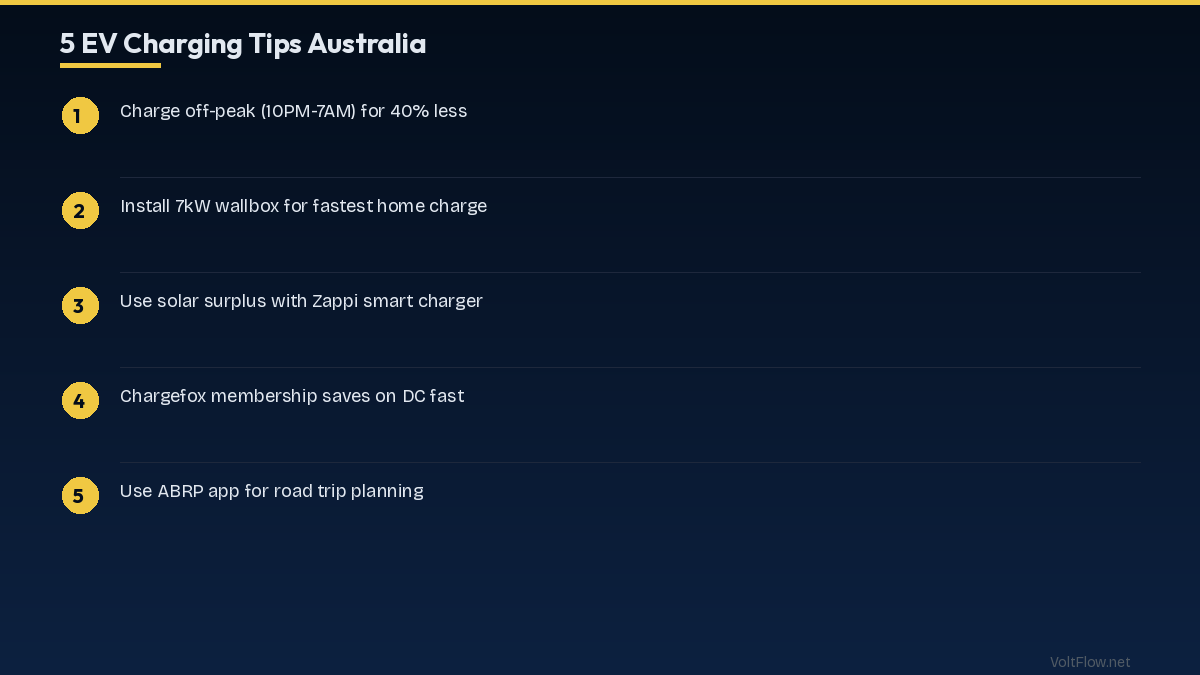
Navigating Australia public charging network requires the right apps and planning tools, especially for long-distance road trips where charger spacing and availability matter. PlugShare is the most complete EV charging map for Australia, showing every public charger across all networks with real-time availability status, user reviews, photos, and pricing information. Filter by charger speed, connector type, and network to find the right charger for your needs. PlugShare is essential for road trip planning and discovering free chargers at hotels, shopping centres, and other destinations. A Better Routeplanner or ABRP is the gold standard for EV road trip route planning. Enter your vehicle model, starting charge level, and destination, and ABRP calculates the optimal charging stops considering your battery capacity, charging curve, elevation changes, weather, and speed. It shows predicted charge levels at each stop and total journey time including charging breaks. ABRP works for all EV models and all Australian charging networks. The Chargefox app is essential if you use the Chargefox network, which includes most ultra-rapid chargers along major Australian highways. The app shows real-time charger availability, allows session initiation and payment, and provides charging history and cost tracking. The monthly subscription option reduces per-kWh rates for frequent users. Tesla owners use the Tesla app and in-car navigation which automatically route through Tesla Superchargers and show real-time availability. The Tesla navigation system is highly accurate in predicting charge requirements and optimal stop locations for Australian road trips. For popular road trip routes, typical charging stop spacing is 150-250 km along major highways. The Sydney to Melbourne route via the Hume Highway has charging every 100-150 km including several ultra-rapid options. Sydney to Brisbane via the Pacific Highway is well covered with stops every 120-200 km. Melbourne to Adelaide has fewer options with gaps of 200-250 km in some sections, requiring careful planning. Perth to regional WA destinations have growing but sparse coverage, with some routes requiring full battery departure and careful range management. Before any road trip, check charger availability on PlugShare or your preferred network app. Plan at least one backup charging option for each stop in case your primary choice is occupied or out of service. Start long road trip days with a full charge, and charge to 80-90% at each stop rather than rushing to continue at lower charge levels, as this provides a safety buffer for unexpected detours or charger issues.