UK Domestic Electrical Regulations 2026: Part P, BS 7671 & DIY Rules

UK domestic electrical work is governed by Part P of the Building Regulations and BS 7671 (18th Edition Wiring Regulations). Notifiable work like new circuits, consumer unit changes, and bathroom or kitchen wiring must be done by a registered electrician or notified to building control. Non-notifiable work like replacing switches, sockets, and light fittings can be done DIY. This guide explains what you can and cannot legally do in your home.
Part P Building Regulations: What Is Notifiable Work?
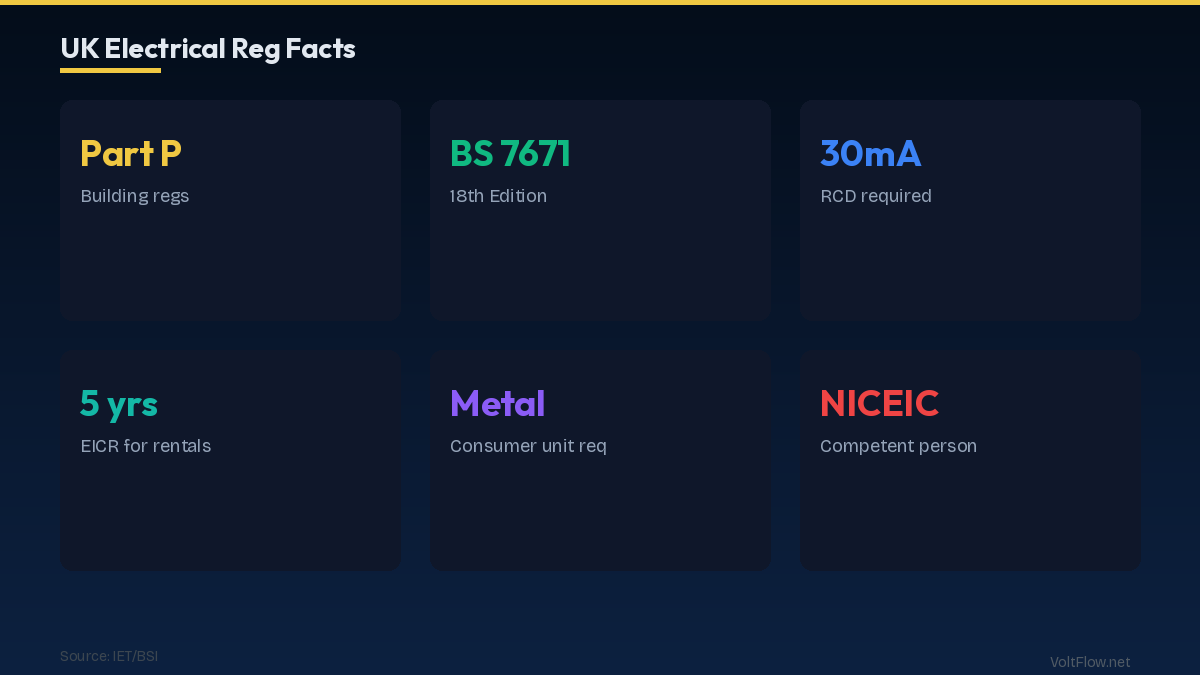
Part P of the Building Regulations for England and Wales classifies electrical work into notifiable and non-notifiable categories. Notifiable work requires either a registered electrician who can self-certify or notification to your local building control body before work begins. The distinction exists to ensure that high-risk electrical work meets safety standards while allowing homeowners to perform simple, low-risk tasks themselves. Notifiable work includes all of the following: installing a new circuit or extending an existing circuit, replacing or upgrading a consumer unit or fuse board, any electrical work in bathrooms and shower rooms, any electrical work in kitchens that involves new circuits not like-for-like replacement, installing an electric vehicle charger, adding outdoor wiring for garden lighting or power outlets, installing electric underfloor heating, and any electrical work in swimming pool or sauna zones. The common thread is that notifiable work involves new circuits or modifications to existing circuits that could introduce safety hazards if done incorrectly. A new circuit creates new potential fault paths. Consumer unit work involves handling the incoming supply. Bathroom and kitchen circuits operate near water. These higher-risk activities require professional competence or independent verification. For notifiable work, you have two options. Option one is hiring an electrician registered with a competent person scheme such as NICEIC, NAPIT, ELECSA, or STROMA. Registered electricians can self-certify their own work without involving building control. They issue a BS 7671 Electrical Installation Certificate and a Part P compliance certificate, and they notify the local building control on your behalf within 30 days of completion. This is the simplest and most common route. Option two is doing the work yourself or hiring an unregistered electrician, and notifying building control before work begins. Building control charges a fee of £150-£300 to inspect the work. They verify compliance with BS 7671 and issue the Part P completion certificate. This option is legal but more expensive and time-consuming than using a registered electrician. The work must still meet BS 7671 technical standards regardless of who performs it. Failure to notify building control for notifiable work is a criminal offence that can result in enforcement action requiring you to have the work inspected or even removed. It also creates problems when selling your home because the buyer solicitor will request Part P certificates for any electrical work done since 2005.
Non-Notifiable Work: What You Can Do as DIY
Non-notifiable electrical work can be performed by anyone without involving registered electricians or building control, provided the work meets the technical standards of BS 7671. This allows homeowners to perform simple electrical tasks that carry lower safety risk. Non-notifiable work includes replacing existing switches, sockets, and light fittings with like-for-like equivalents. Swapping a single switch for a dimmer switch, replacing a damaged socket, or changing a ceiling light fitting are all non-notifiable. You can also replace the cable for a single circuit in the same route as the existing cable, for example replacing a damaged section of cable behind a wall that you are renovating. Adding additional sockets or fused spurs to an existing ring or radial circuit in rooms other than kitchens, bathrooms, and special locations is non-notifiable. This means you can add an extra double socket in your living room by connecting a spur from an existing socket, as long as the circuit has capacity and the work is technically correct. Replacing a like-for-like cooker control switch or adding a connection plate for a built-in appliance is non-notifiable as long as no new circuit wiring is involved. Installing low-voltage wiring for doorbells, telephone extensions, thermostats, and data cabling is non-notifiable because these operate at safe extra-low voltage below 50V AC. While this work is non-notifiable, it must still comply with BS 7671 technical requirements. Incorrect wiring of a socket or switch can create shock hazards, fire risks, and equipment damage. If you are not confident in your electrical knowledge, hiring a professional even for non-notifiable work is the safer choice. The cost of having an electrician replace a socket or light fitting is typically £40-£80 per item. Key safety rules for DIY electrical work include always isolating the circuit at the consumer unit and verifying it is dead with a voltage tester before touching any wiring, using the correct cable size for the circuit, ensuring all connections are secure with properly tightened terminals, testing the circuit with a plug-in socket tester after completing the work, and never working on or near the consumer unit or meter because these components handle the incoming supply at full mains voltage and current.
BS 7671: The Technical Standard Behind UK Wiring
BS 7671, also known as the IET Wiring Regulations, is the technical standard that specifies how electrical installations must be designed, installed, tested, and certified in the UK. The current version is the 18th Edition with Amendment 2, published by the Institution of Engineering and Technology. Every electrical installation in the UK, whether done by a professional or a DIY homeowner, must comply with BS 7671. The standard covers conductor sizing, protection against electric shock and fire, circuit design, earthing and bonding, testing and verification, and documentation requirements. While Part P determines who can do the work and whether notification is required, BS 7671 determines how the work must be done technically. Key BS 7671 requirements for residential installations include protection against electric shock through a combination of basic protection using insulation and barriers, and fault protection using automatic disconnection of supply within specified times of 0.4 seconds for final circuits. The dual protection approach ensures safety even if one layer fails. RCD protection is required for virtually all circuits in new installations and for any modified circuits in existing installations. A 30mA RCD disconnects the supply if even a small leakage current flows to earth, protecting against electric shock from damaged insulation or contact with live parts. The 18th Edition significantly expanded RCD requirements compared to earlier editions. Every circuit must have overcurrent protection from an MCB or fuse rated to protect the cable from overheating. The MCB rating must not exceed the cable current-carrying capacity after applying the correction factors for ambient temperature, grouping, and thermal insulation discussed in the cable sizing guide. Circuit documentation requirements include an Electrical Installation Certificate for new installations and an Electrical Installation Condition Report for periodic inspections of existing installations. These certificates record the test results that verify the installation meets BS 7671 requirements. Homeowners should retain all electrical certificates and provide them to buyers when selling the property.

Scotland and Northern Ireland: Different Rules
While England and Wales share Part P of the Building Regulations, Scotland and Northern Ireland have their own regulatory frameworks that differ in important ways. Understanding the rules for your specific jurisdiction prevents legal and safety issues. Scotland uses the Building (Scotland) Regulations 2004, which include electrical safety requirements in Section 4 (Safety) of the Technical Handbooks. The Scottish approach differs from Part P in several ways. There is no concept of notifiable versus non-notifiable work in Scotland. Instead, all electrical work that requires a building warrant must comply with the Scottish building standards. A building warrant is required for new buildings, extensions, and significant alterations, but not for like-for-like replacements or minor modifications within an existing installation. Electrical work that forms part of a warranted project must be verified by an approved certifier of construction, which is an electrician registered with an approved body such as SELECT (the Scottish electrical trade body) or NICEIC. The technical standard for electrical installations in Scotland is BS 7671, the same as England and Wales. The practical differences are mainly in the notification and certification process rather than the technical requirements. Scottish homeowners can perform the same types of DIY electrical work as their English and Welsh counterparts, with the same recommendation to use qualified electricians for anything beyond simple like-for-like replacements. Northern Ireland uses the Building Regulations (Northern Ireland) 2012. Part P equivalent requirements exist but are administered differently through local councils. The technical standard is again BS 7671. Registered electricians in Northern Ireland are typically members of NICEIC or NAPIT, the same schemes that operate in England and Wales. The Republic of Ireland, while not part of the UK, uses a separate set of regulations based on the ETCI National Rules for Electrical Installations (ET 101). These are broadly similar to BS 7671 but differ in specific requirements for earthing arrangements, socket outlets (Ireland uses the same BS 1363 plug system as the UK), and certification procedures. Work on properties near the Northern Ireland border should verify which jurisdiction applies to the property address.
Consumer Unit Regulations and Requirements
The consumer unit, sometimes called the fuse board, is the central distribution point for all circuits in your home and is subject to specific regulations that go beyond standard circuit wiring requirements. Since January 2016, all new and replacement consumer units installed in domestic premises in England must have their enclosure made from non-combustible material, typically steel or another metal rather than plastic. This regulation was introduced following concerns about plastic consumer units contributing to the spread of electrical fires. Scotland and Wales followed with similar requirements. The regulation means that if you replace your consumer unit or install a new one, it must be a metal-clad unit. Popular brands include Hager, Schneider Electric, MK, and Wylex. Metal consumer units cost approximately £100-£200 for the enclosure without MCBs and RCDs, compared to £30-£80 for plastic units that are no longer acceptable for new installations. Consumer unit replacement is always notifiable work under Part P, regardless of whether the internal circuits are modified. The work must be done by a registered electrician or notified to building control. The electrician must issue an Electrical Installation Certificate covering the new consumer unit and test all circuits for correct operation with the new protective devices. Modern consumer units use RCBO protection on each circuit rather than splitting circuits between RCD-protected groups. An RCBO combines MCB overcurrent protection with RCD earth leakage protection in a single device for each circuit. This means a fault on one circuit trips only that circuit RCBO rather than disconnecting multiple circuits on the same RCD group. RCBO-based consumer units cost more at £300-£500 total for a typical home compared to £150-£300 for a split-load RCD design, but the improved selectivity and convenience justify the premium for most homeowners. The total cost for a consumer unit upgrade in 2026 including the metal enclosure, RCBOs for all circuits, installation labour, testing, and certification is typically £500-£1,000 for a straightforward replacement where the existing circuits are in good condition.

Electrical Certificates and When You Need Them
UK electrical regulations require specific certificates for different types of electrical work. Understanding which certificate applies to your situation ensures compliance and protects you when selling your property. An Electrical Installation Certificate or EIC is required for all new electrical installations and for significant alterations to existing installations. This includes new circuits, consumer unit replacements, rewiring, and any notifiable work under Part P. The EIC documents the design, construction, and inspection and testing of the electrical work. It includes schedules of test results for every circuit covering insulation resistance, earth fault loop impedance, RCD trip times, and polarity verification. The EIC must be issued by the electrician who performed or supervised the work. A Minor Electrical Installation Works Certificate or MEIWC is used for minor additions and changes to existing circuits that do not involve new circuits. Adding a spur for a new socket outlet, adding a new light point to an existing lighting circuit, or adding a fused connection unit are examples of work covered by a MEIWC. The MEIWC requires fewer test results than a full EIC and is simpler to complete. An Electrical Installation Condition Report or EICR is not a completion certificate but a periodic inspection report that assesses the overall condition of an existing electrical installation. An EICR is recommended every 10 years for owner-occupied dwellings and is required every 5 years for rental properties under the Electrical Safety Standards in the Private Rented Sector Regulations 2020. The EICR uses a classification system: Code C1 means danger present requiring immediate action, Code C2 means potentially dangerous and requiring urgent remedial action, Code C3 means improvement recommended but not immediately dangerous, and Code FI means further investigation required. Landlords must obtain an EICR before renting a property and at five-year intervals thereafter, providing a copy to tenants within 28 days. Failure to comply can result in fines of up to £30,000 per breach. When selling your home, the buyer solicitor may request electrical certificates for any work done during your ownership. Missing certificates for notifiable work can delay or complicate the sale. If certificates are unavailable, the buyer may require an EICR to verify the installation is safe, or may request a price reduction to cover the cost of professional inspection and any remedial work.