Consumer Unit Upgrade Cost UK 2026: Prices, Rules & What to Expect

A consumer unit upgrade in the UK costs £500-£1,000 for a standard replacement with modern RCBOs, or £700-£1,500 if additional circuits or remedial work is needed. Since 2016, all new consumer units must be metal-clad (non-combustible), and the work must be done by a registered electrician under Part P. This guide covers costs, what is included, and when you need an upgrade.
Consumer Unit Upgrade Costs Breakdown
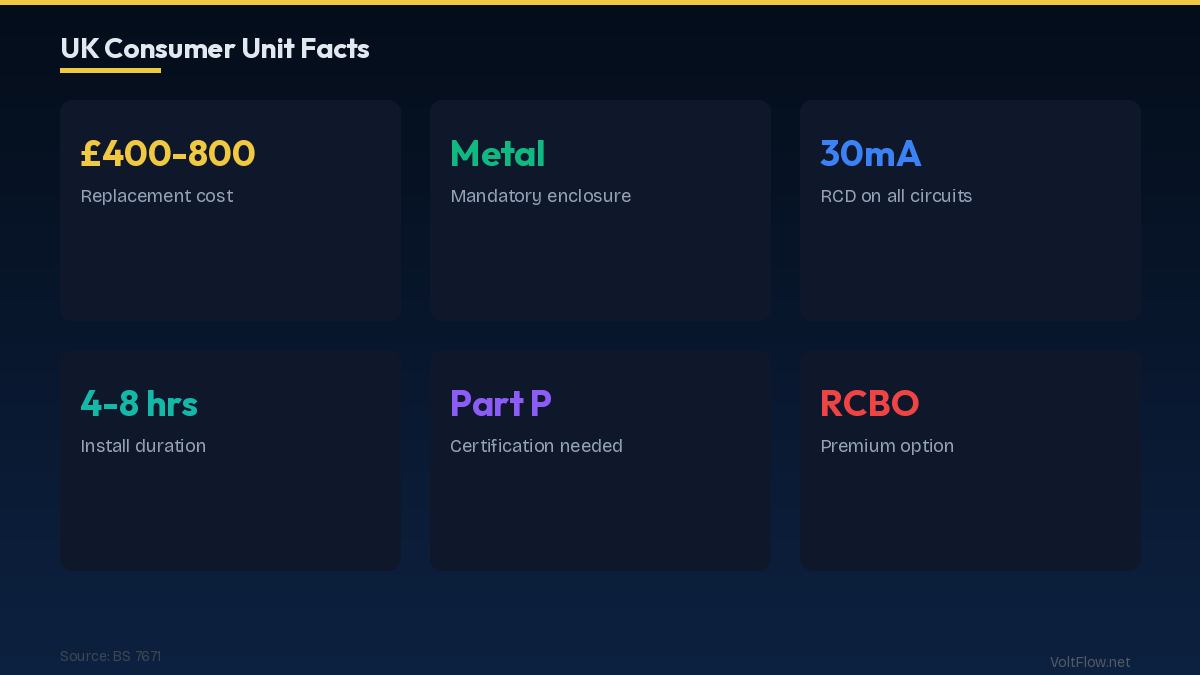
The cost of a consumer unit upgrade depends on the complexity of the installation, the number of circuits, and whether additional work is needed beyond the simple unit swap. A like-for-like replacement of an existing consumer unit with a modern metal-clad unit with RCBOs costs £500-£800. This covers a new consumer unit enclosure at £100-£200, RCBO protective devices at £20-£35 each times 8-12 circuits equals £160-£420, main switch at £30-£50, installation labour of 4-6 hours at £40-£60 per hour equals £160-£360, electrical testing and certification at £50-£100, and Part P notification included in the registered electrician fee. An upgrade with additional circuits costs £700-£1,200. This scenario applies when you need new circuits for an EV charger, kitchen ring, shower, or outdoor lighting alongside the consumer unit replacement. Each additional circuit adds £100-£200 for cable, MCB or RCBO, and labour. An upgrade with remedial work costs £800-£1,500. Older properties may have wiring that does not meet current standards. While a consumer unit replacement does not require bringing the entire installation up to current code, the electrician must ensure that the existing circuits work safely with the new protective devices. Common remedial work includes replacing worn or damaged cables in the consumer unit area, upgrading the earthing and bonding to current standards, and replacing non-conforming connections discovered during testing. A full rewire with consumer unit, which is a complete replacement of all cables throughout the house plus a new consumer unit, costs £3,000-£6,000 for a 3-bedroom house. This is a major project taking 5-10 days and involves lifting floorboards, accessing voids, and replastering. A full rewire is typically only necessary for pre-1970s properties with rubber-sheathed or lead-sheathed cable that has degraded beyond safe use. When getting quotes, ensure each quote includes the consumer unit and all protective devices, testing of all existing circuits, an Electrical Installation Certificate, and Part P notification. Quotes that exclude testing or certification are incomplete and should be questioned.
When Do You Need a Consumer Unit Upgrade?
Several situations trigger the need for a consumer unit upgrade, ranging from safety concerns to regulatory requirements and practical capacity needs. An old rewireable fuse board with ceramic fuse holders and bare copper fuse wire should be replaced as a priority. These boards lack RCD protection, which is the primary defense against electric shock from earth faults. Without RCDs, a fault that should trip instantly may instead energise metal appliance casings, creating lethal shock risk. Rewireable fuses also lack the precision of modern MCBs and may not disconnect quickly enough to protect cables from overheating during overcurrent faults. A plastic consumer unit installed before the 2016 metal enclosure regulation is not immediately dangerous but should be replaced when other electrical work triggers a consumer unit upgrade. The metal enclosure requirement was introduced after investigations found that plastic enclosures could contribute to fire spread by melting and allowing flames to access cables inside the unit. A consumer unit with insufficient capacity for your electrical needs requires replacement when you add high-power circuits. Adding an EV charger requires a spare way for a 32A RCBO. Adding an electric shower may require a 45A RCBO. If your consumer unit has no spare ways and cannot accommodate additional protective devices, replacement with a larger unit is necessary. A consumer unit that has been damaged by water ingress, physical impact, or previous poor workmanship should be replaced to ensure the integrity of all connections and protective devices. Signs of damage include burn marks on the enclosure or connections, a smell of burning when the unit is under load, loose or corroded connections visible through the cover, and breakers that do not trip when tested. If you have an EICR (Electrical Installation Condition Report) with C1 or C2 classifications relating to the consumer unit, the identified defects must be remedied, which often means replacing the unit. Landlords with EICR defects must address them within 28 days for C1 and a reasonable timescale for C2, as failure to comply is a criminal offence under the Electrical Safety Standards in the Private Rented Sector Regulations.
Metal Consumer Unit Regulation Explained
The requirement for non-combustible consumer unit enclosures, introduced by Amendment 3 to BS 7671:2008 (effective January 2016), applies to all new installations and replacements in domestic premises. This regulation fundamentally changed the consumer unit market from predominantly plastic to predominantly metal enclosures. The regulation requires that consumer units in domestic premises be enclosed in a non-combustible material compliant with product standard BS EN 61439-3. In practice, this means steel or other metal enclosures. Plastic consumer units, even those marketed as flame-retardant, do not meet this requirement and cannot be installed as new or replacement units in homes. The regulation was prompted by fire investigation data showing that consumer units were involved in a significant number of domestic electrical fires. While the fires typically started due to poor connections or overloaded circuits rather than the enclosure material, plastic enclosures melted and burned, allowing flames to spread to surrounding building materials. Metal enclosures contain the fire within the unit, providing valuable time for the protective devices to trip and for occupants to respond. All major consumer unit manufacturers now produce metal-clad ranges. Hager, Schneider Electric (formerly known by the brand names Square D and Merlin Gerin in the UK market), MK, Wylex, and BG all offer complete metal consumer unit ranges. Prices are 50-100% higher than the equivalent plastic units they replaced, adding £50-£100 to the cost of a consumer unit upgrade compared to pre-2016 prices. The regulation applies to consumer units only, not to other distribution boards used in non-domestic premises. Small distribution boards used in outbuildings, garages, and annexes that are separate from the main dwelling may not need to be metal-clad depending on the specific installation circumstances. Your electrician will advise based on the specific application. If you are buying a property with a plastic consumer unit, it does not need immediate replacement simply because it is plastic. The regulation is not retrospective. However, any future modification to the consumer unit or addition of circuits will likely trigger a full replacement with a metal unit. Budget for this cost when planning any future electrical work.

RCDs vs RCBOs: Which Is Better?
Modern consumer units use either Residual Current Devices or RCDs protecting groups of circuits, or Residual Current Breaker with Overload or RCBOs protecting individual circuits. Understanding the difference helps you choose the better option and understand your electrician quote. An RCD-based consumer unit, also called a split-load or dual-RCD board, divides circuits into two groups, each protected by a separate 63A or 80A RCD. The left group might protect upstairs lighting, downstairs sockets, and the shower circuit. The right group protects downstairs lighting, upstairs sockets, the cooker, and the immersion heater. Each group also has individual MCBs for overcurrent protection on each circuit. The advantage of this design is lower cost because you need only 2 RCDs plus individual MCBs rather than individual RCBOs for every circuit. The disadvantage is that a fault on any circuit in a group trips the RCD for the entire group, disconnecting all circuits in that half of the consumer unit. A fault on the downstairs socket circuit could trip the RCD that also protects the upstairs lights, plunging the upstairs into darkness for a fault that has nothing to do with the lighting circuit. An RCBO-based consumer unit provides individual RCD and MCB protection combined in a single device for each circuit. A fault on the downstairs socket circuit trips only that circuit RCBO. All other circuits continue operating normally. This selectivity is the primary advantage of RCBOs and is strongly recommended for modern installations. The disadvantage is cost: RCBOs at £20-£35 each versus MCBs at £5-£10 each increase the total consumer unit cost by £120-£300 for a typical 10-12 circuit installation. Most electricians in 2026 recommend RCBO boards as the standard unless budget is a primary constraint. The improved selectivity prevents the frustrating experience of losing multiple circuits due to a single fault, which is particularly problematic if the tripped group includes the fridge-freezer circuit, allowing food to spoil while you are away. For the additional £120-£300 over the life of the installation, the RCBO board provides significantly better daily convenience and safety.
What to Expect During a Consumer Unit Upgrade
Knowing what happens during the installation helps you prepare your home and schedule appropriately. A standard consumer unit upgrade takes 4-8 hours and requires the electricity to be off for most of this time. Before the electrician arrives, clear the area around your consumer unit so they have unobstructed working access. Move any furniture, stored items, or wall-mounted shelves within 1 metre of the unit. If the consumer unit is in a cupboard, empty the cupboard completely. The electrician needs to see all cables entering and leaving the unit and have space for their tools and test equipment. The power will be off for approximately 3-6 hours during the main installation phase. Plan accordingly by charging your phone and any essential devices beforehand, having a flask of hot water or cold drinks available, ensuring medical equipment that requires electricity has battery backup, knowing that the fridge and freezer will be fine for 6 hours if you keep the doors closed, and considering the weather since electric heating will be unavailable during the installation. The installation sequence begins with isolating the supply at the main fuse or meter and verifying it is dead. The electrician photographs the existing consumer unit and labels every cable for identification during reconnection. The old unit is disconnected and removed. The new metal consumer unit is mounted in the same location if possible, or a new location if required for accessibility. Each circuit is connected to its designated RCBO or MCB, following the correct colour coding and ensuring secure terminal connections at the manufacturer specified torque. After all circuits are connected, the electrician performs a complete test of every circuit. Tests include continuity of protective conductors to verify the earth path is intact on every circuit, insulation resistance to confirm cable insulation is sound with no shorts or leaks, earth fault loop impedance to verify the protective devices will trip fast enough during a fault, RCD and RCBO trip testing to confirm each device disconnects within 300 milliseconds at rated current, and polarity verification to ensure live, neutral, and earth are correctly connected throughout. Test results are recorded on the Electrical Installation Certificate schedule. Any circuits that fail testing require investigation and repair before the certificate can be issued.

Choosing the Right Electrician for the Job
A consumer unit upgrade is a significant safety-critical job that must be done by a competent, registered electrician. Choosing the right professional ensures quality work, proper certification, and protection for your home and family. Verify registration with a competent person scheme. The electrician must be registered with NICEIC, NAPIT, ELECSA, STROMA, or another scheme recognised under Part P. Registration means they can self-certify notifiable work and are subject to regular competency assessments and inspections of their work. Ask for the registration number and verify it on the scheme website. Unregistered electricians can legally perform the work if building control is notified, but this adds £150-£300 in building control fees and introduces an external inspection dependency. Get at least three written quotes that detail the exact consumer unit make and model, the number and type of protective devices (specify RCBO versus RCD plus MCB), any additional work such as earthing upgrades or new circuits, all testing and certification included, the expected completion time, and the warranty on workmanship. Compare quotes on value rather than lowest price. A quote £200 below the others may use a cheaper consumer unit brand, fewer RCBO circuits in favour of the less desirable split-load RCD design, or may exclude comprehensive testing. Ask specifically whether the quote includes a full RCBO board or split-load RCD board. Check reviews on Checkatrade, Trustmark, MyBuilder, or Google Reviews. Look for consistency in positive reviews mentioning tidiness, communication, and proper testing, rather than just one or two reviews. Established electricians with 50 or more reviews provide the most reliable indicator of typical service quality. Confirm insurance. A registered electrician carries public liability insurance of at least £2 million and professional indemnity insurance. These protect you if the work causes damage to your property or if a defect in the work leads to a subsequent problem. Ask to see the insurance certificate if in doubt. After the work is complete, you should receive an Electrical Installation Certificate with full test results for every circuit, a Part P compliance certificate from the competent person scheme, a copy of the consumer unit warranty typically 2-5 years from the manufacturer, and a labelled circuit chart on the inside of the consumer unit door identifying every circuit. Keep all these documents safe as they will be requested during future property sales, insurance claims, and EICR inspections.