Economy 7 vs Standard Tariff UK 2026: Which Saves More?
Economy 7 offers 7 hours of cheap electricity at 10-15p/kWh during overnight hours but charges 28-35p/kWh during peak daytime hours. A standard flat tariff charges a consistent 24.5p/kWh at all times. Economy 7 only saves money if you shift at least 40% of your usage to off-peak hours, most households use only 20-30% at night, making standard tariffs cheaper for the majority of UK homes.
How Economy 7 Pricing Works
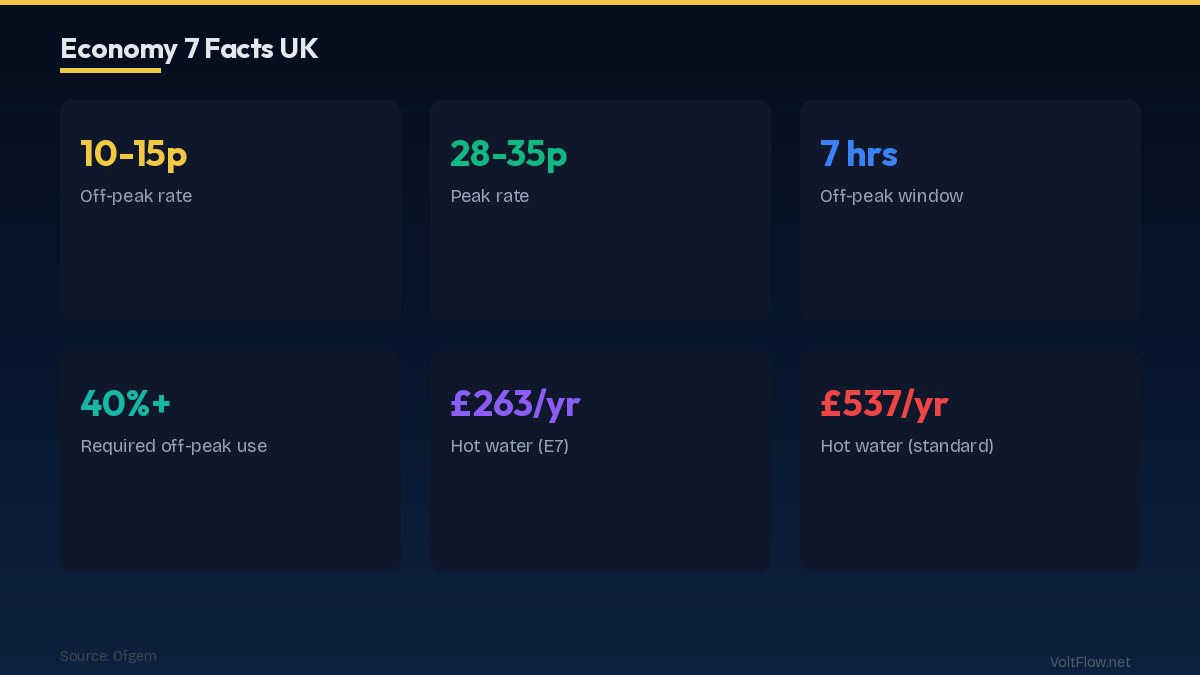
Economy 7 splits your electricity into two price tiers based on time of day. The off-peak period runs for 7 hours, typically from midnight to 7 AM, though the exact hours vary by supplier and region. Some suppliers run off-peak from 1 AM to 8 AM, while others split the hours into two blocks. Check with your supplier for your specific off-peak window. During off-peak hours, you pay 10-15p per kWh, roughly 40-60 percent less than the standard flat rate of 24.5p. During the remaining 17 peak hours, you pay 28-35p per kWh, significantly more than the standard rate. The standing charge on Economy 7 is typically the same as or slightly higher than a standard tariff. The key insight is that Economy 7 is not universally cheaper, it redistributes costs between time periods. The cheap night rate is subsidized by the expensive day rate. If most of your electricity use happens during the day, you pay more per unit for the majority of your consumption. The breakeven point depends on the specific rates your supplier offers. With a typical Economy 7 tariff of 12p off-peak and 30p peak versus a standard rate of 24.5p, the breakeven occurs when approximately 42 percent of your consumption is off-peak. Below 42 percent off-peak usage, the standard tariff is cheaper. Above 42 percent, Economy 7 saves money. The average UK household uses only 20-30 percent of electricity during the typical Economy 7 off-peak window, well below the 42 percent breakeven. This means Economy 7 costs the average household £50-£150 more per year than a standard tariff. The tariff was designed in an era when storage heaters and immersion water heating were common, and those specific use cases still make Economy 7 worthwhile. Economy 7 requires a specific two-register electricity meter that records day and night consumption separately. If you currently have a standard single-register meter, your supplier must install an Economy 7 meter before you can switch. Smart meters can support Economy 7 functionality without a physical meter change because they record half-hourly consumption data that the supplier splits into peak and off-peak.
Who Benefits Most from Economy 7
Economy 7 provides genuine savings for households that naturally concentrate electricity use during the overnight window. These specific use cases push off-peak consumption well above the 42 percent breakeven threshold. Storage heater homes are the original target market for Economy 7. Night storage heaters charge with cheap off-peak electricity overnight, storing heat in ceramic bricks, then release that heat throughout the day. A home fully heated by storage heaters shifts 50-70 percent of total electricity consumption to off-peak hours, well above the breakeven point. Annual savings compared to heating on a standard tariff range from £200-£400 depending on home size and insulation quality. However, storage heaters are increasingly being replaced by air source heat pumps which are more efficient on any tariff. Electric water heating on a timer saves significantly on Economy 7. An immersion heater heating a full tank overnight at 12p per kWh costs approximately £1.20 compared to £2.45 at the standard rate. Over a year, this saves approximately £450 for a household that heats water primarily overnight. The key is having a well-insulated hot water cylinder that maintains temperature throughout the day without needing a daytime boost. EV owners who charge exclusively overnight can shift 3,000-5,000 kWh per year to off-peak rates. At a saving of 12-15p per kWh compared to the Economy 7 peak rate, annual savings reach £360-£750. Even compared to the standard flat rate, the saving is £375-£625 per year. This makes Economy 7 increasingly attractive as EV adoption grows, provided the household can avoid other significant daytime electricity use that would incur the expensive peak rate. Home battery storage systems create an artificial time-shift by charging from the grid during off-peak Economy 7 hours and discharging during peak hours. A 10 kWh battery cycling daily could shift 3,650 kWh per year from peak to off-peak rates, saving approximately £475-£650 per year on Economy 7. However, the battery cost of £8,000-£12,000 means the payback from Economy 7 arbitrage alone takes 12-25 years, which exceeds most battery warranties. Battery economics improve significantly when combined with solar panels and multiple revenue streams. Households combining several of these use cases, storage heaters or heat pump with timer, overnight water heating, and EV charging, can push off-peak usage to 60-80 percent of total consumption, saving £400-£800 per year compared to a standard tariff. For these households, Economy 7 remains an excellent choice in 2026.
Who Should Avoid Economy 7
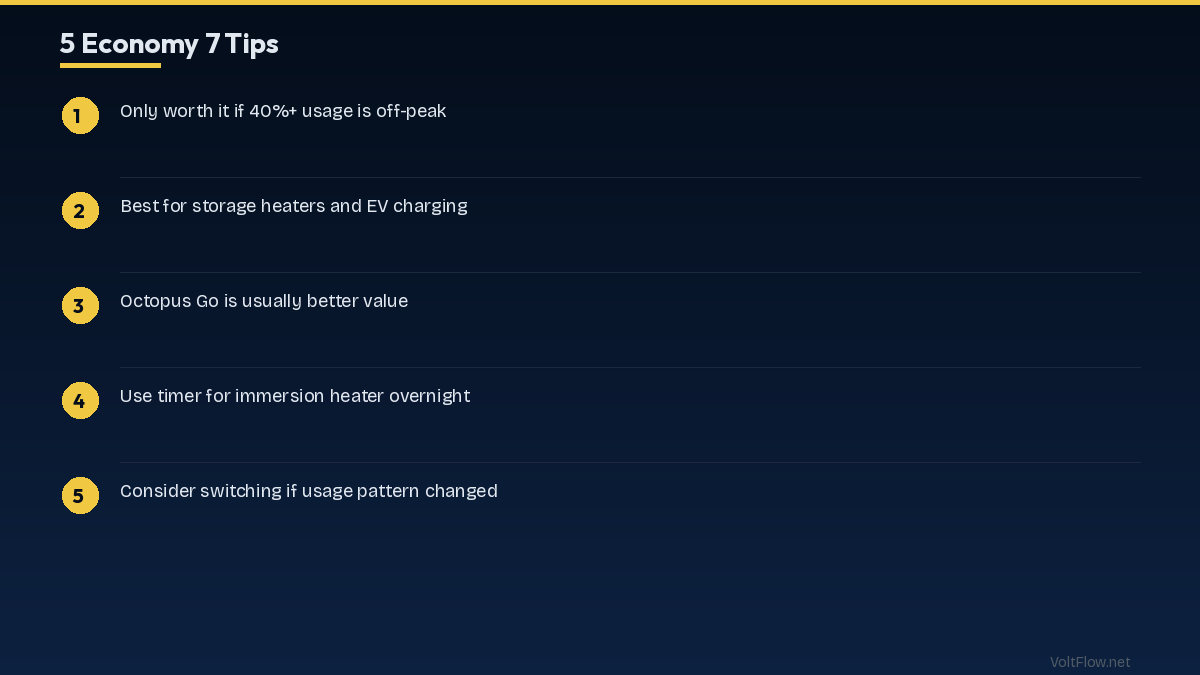
The majority of UK households, roughly 70-75 percent, would pay more on Economy 7 than on a standard flat tariff. Understanding why helps you avoid an expensive mistake. Working-from-home households are the worst candidates for Economy 7. If you are home during the day running a computer, monitors, desk lamp, kettle, and other office equipment, you consume substantial electricity at the expensive peak rate of 28-35p per kWh. A typical home office setup draws 300-600 watts for 8 hours, costing £0.67-£1.68 per day at Economy 7 peak rates versus £0.59-£1.18 at the flat rate. Over a year, the home office alone costs £30-£180 more on Economy 7. Families with children at home during daytime hours use significant electricity for cooking, entertainment, laundry during the day, and other activities that fall within peak hours. A family of four typically uses 60-75 percent of electricity during daytime, far above the Economy 7 breakeven threshold. Annual cost penalty ranges from £100-£250 compared to a standard tariff. Households with electric cooking face higher costs on Economy 7 because cooking inherently happens during peak hours. An electric oven used for one hour at dinner time uses 2-3 kWh at 30p per kWh on Economy 7, costing 60-90p versus 49-74p on the standard rate. If you cook daily with electric appliances, the annual premium on Economy 7 is £40-£80 just for cooking. Households without storage heaters, EV, or overnight water heating have limited ability to shift consumption to off-peak hours. The refrigerator and freezer run 24 hours and their overnight consumption is already counted, but they represent only 15-20 percent of total household electricity. Without a major overnight load, most households cannot reach the 40 percent off-peak threshold needed to break even. If you are currently on Economy 7 and suspect you are overpaying, check your meter readings. Divide your night reading total by your combined day-plus-night total to calculate your off-peak percentage. If it is below 40 percent, switching to a standard tariff will save you money. Contact your supplier to switch, which typically requires only a tariff change on your smart meter or, for traditional meters, a meter swap that most suppliers handle at no charge.
Economy 7 vs Economy 10 vs Octopus Go
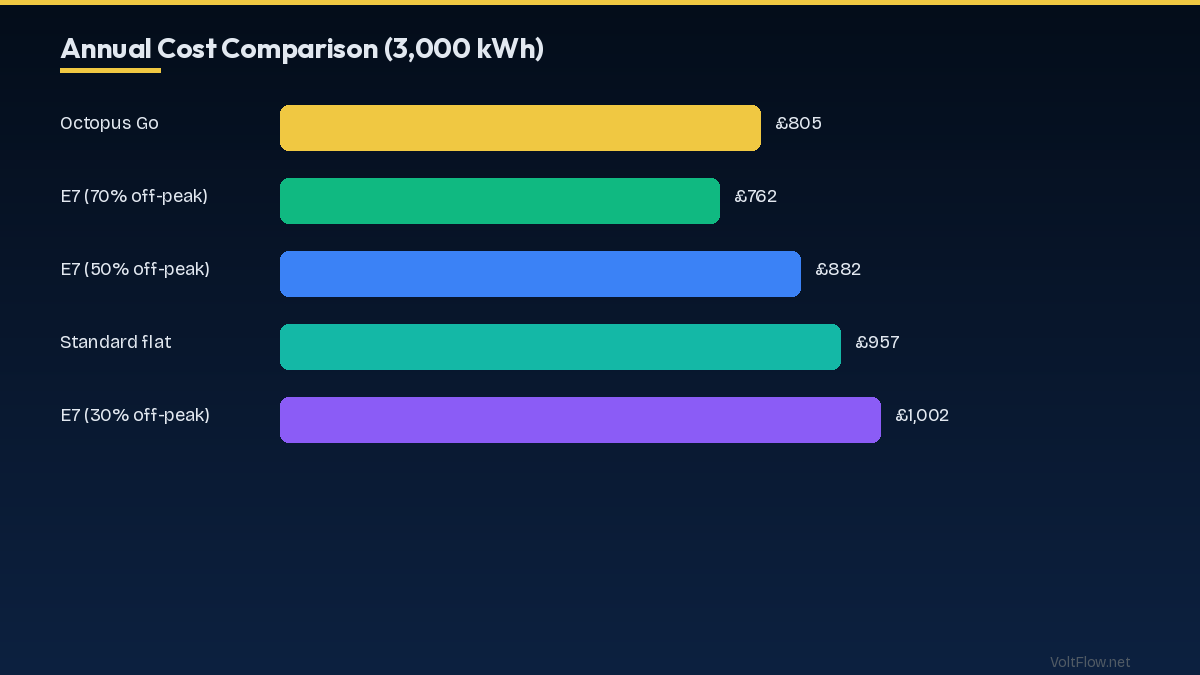
Economy 7 is not the only time-of-use tariff available to UK customers. Economy 10, Octopus Go, and other smart tariffs offer different structures that may better suit your usage pattern. Economy 10 provides 10 hours of off-peak electricity instead of 7, typically split into three blocks: 5 hours overnight, 3 hours in the afternoon, and 2 hours in the evening. The afternoon and evening off-peak blocks coincide with periods when many households actively use electricity, making it easier to reach the breakeven threshold. Economy 10 is less widely available than Economy 7 and is primarily offered in areas with specific metering infrastructure. If available in your area, Economy 10 may save more than Economy 7 for households that can shift some daytime consumption to the afternoon off-peak block. Octopus Go is a smart tariff from Octopus Energy designed specifically for EV owners. It offers a super-cheap rate of 7-9p per kWh during a 5-hour overnight window, typically midnight to 5 AM, with a standard rate of 24-27p per kWh during the remaining 19 hours. The peak rate is lower than Economy 7 peak rates, which means you pay less for daytime usage while still benefiting from cheap overnight EV charging. For EV owners, Octopus Go often saves more than Economy 7 because the daytime rate penalty is smaller. Octopus Agile takes time-of-use pricing further with half-hourly rates that change every 30 minutes based on wholesale prices. Rates can vary from negative prices during periods of high wind generation to 50p or more during evening peak demand. Agile rewards customers who actively manage their consumption, using electricity when prices are low and reducing usage when prices spike. It is the most hands-on tariff option and best suits tech-savvy households with smart home automation that can respond to price signals. Octopus Flux is designed for solar panel owners with battery storage. It provides premium export rates of 12-15p per kWh during the 4-7 PM peak, import rates of 24-27p during peak and 14-17p off-peak, and encourages battery cycling to capture the spread between import and export rates. For solar-plus-battery households, Flux can save £200-£400 per year compared to a standard tariff by optimizing the value of solar generation and battery cycling. When choosing between these tariffs, model your actual consumption pattern against each tariff structure. Comparison sites do not always include smart tariffs, so check the individual supplier websites for Octopus Go, Agile, and Flux pricing. Use a spreadsheet or online calculator to multiply your monthly day and night consumption by the specific rates to determine which tariff produces the lowest annual cost for your usage pattern.
Switching Between Economy 7 and Standard Tariff
If you have determined that Economy 7 is costing you more than a standard tariff, or conversely that your usage pattern would benefit from Economy 7, switching is straightforward but involves a few steps beyond a normal tariff change. Switching from Economy 7 to a standard tariff requires your supplier to change the meter registration from two-register to single-register. With a traditional Economy 7 meter, this may require a physical meter swap. With a smart meter, the change can be done remotely by reconfiguring the meter to record a single total rather than separate day and night readings. Most suppliers handle this at no charge, but some may charge £50-£100 for a meter visit if a physical swap is needed. The switch typically takes 2-4 weeks to complete. During the transition, you continue paying Economy 7 rates until the new tariff activates. Switching from a standard tariff to Economy 7 similarly requires a meter change to a two-register configuration. Smart meters can be reconfigured remotely. Traditional meters require a swap to an Economy 7 meter, which may involve installing a radio teleswitch that receives the off-peak timing signal or a more modern electronic meter with programmable time registers. Before switching to Economy 7, calculate your expected savings using actual consumption data. Most suppliers provide day and night consumption breakdowns on bills or through their app. If you do not have this data, install a smart plug energy monitor on your major overnight loads like the EV charger and water heater to estimate what percentage of your consumption can be shifted to off-peak hours. If the calculation shows borderline savings, Economy 7 is probably not worth the complexity. A saving of £20-£30 per year does not justify the inflexibility of needing to concentrate usage in specific hours. If the saving exceeds £100 per year, Economy 7 is clearly worthwhile. Consider the newer smart tariffs like Octopus Go or Agile as alternatives that may provide better savings with less rigid time windows. These tariffs are available to any customer with a smart meter and do not require a physical meter change. They can be activated within days rather than weeks, and you can switch away easily if the tariff does not suit your pattern.
Calculating Your Best Tariff: Worked Example
A practical worked example demonstrates how to compare tariffs using your actual consumption data. This method works for any UK household with access to their consumption figures. Take the Johnson family: a three-bedroom semi-detached house with an EV, gas central heating, and average daytime usage. Their annual electricity consumption is 4,200 kWh, broken down as follows from their smart meter data: 1,400 kWh overnight from midnight to 7 AM (33 percent), primarily EV charging at 1,000 kWh and refrigerator, freezer, and standby loads at 400 kWh; and 2,800 kWh during the day from 7 AM to midnight (67 percent), including cooking, laundry, entertainment, lighting, and home office. On a standard flat tariff at 24.5p per kWh: annual cost equals 4,200 times £0.245 equals £1,029 plus standing charge of £222.65 (61p times 365), totaling £1,251.65. On Economy 7 at 12p off-peak and 30p peak: annual cost equals 1,400 times £0.12 (£168) plus 2,800 times £0.30 (£840) plus standing charge £222.65, totaling £1,230.65. Economy 7 saves the Johnsons approximately £21 per year, marginal and not worth the hassle of managing consumption around off-peak hours. On Octopus Go at 8p off-peak (midnight to 5 AM) and 25p all other hours: they need to estimate how much of their overnight consumption falls within the narrower midnight-to-5 AM window rather than the full midnight-to-7 AM Economy 7 window. Assuming 85 percent of overnight use is within midnight to 5 AM (1,190 kWh at 8p, 210 kWh at 25p): annual cost equals 1,190 times £0.08 (£95.20) plus 3,010 times £0.25 (£752.50) plus standing charge £222.65, totaling £1,070.35. Octopus Go saves £181 compared to the standard tariff and £160 compared to Economy 7. For the Johnsons, Octopus Go is clearly the best option. This example illustrates why blanket advice about tariffs is misleading. Every household has a different consumption pattern, and the best tariff depends entirely on when you use electricity, not just how much. Get your half-hourly smart meter data from your supplier and model each available tariff to find your optimal choice.