EV Charging Cost UK 2026: Home vs Public vs Rapid Pricing
Charging an electric car in the UK costs £7-£12 at home for a full charge versus £25-£40 at public rapid chargers. Home charging at 24.5p/kWh gives a cost of approximately 5-7p per mile, compared to 14-18p per mile for petrol. This guide breaks down every charging option in the UK with exact costs for popular EV models, helping you plan the cheapest charging strategy.
Home Charging Costs: The Cheapest Way to Fuel an EV
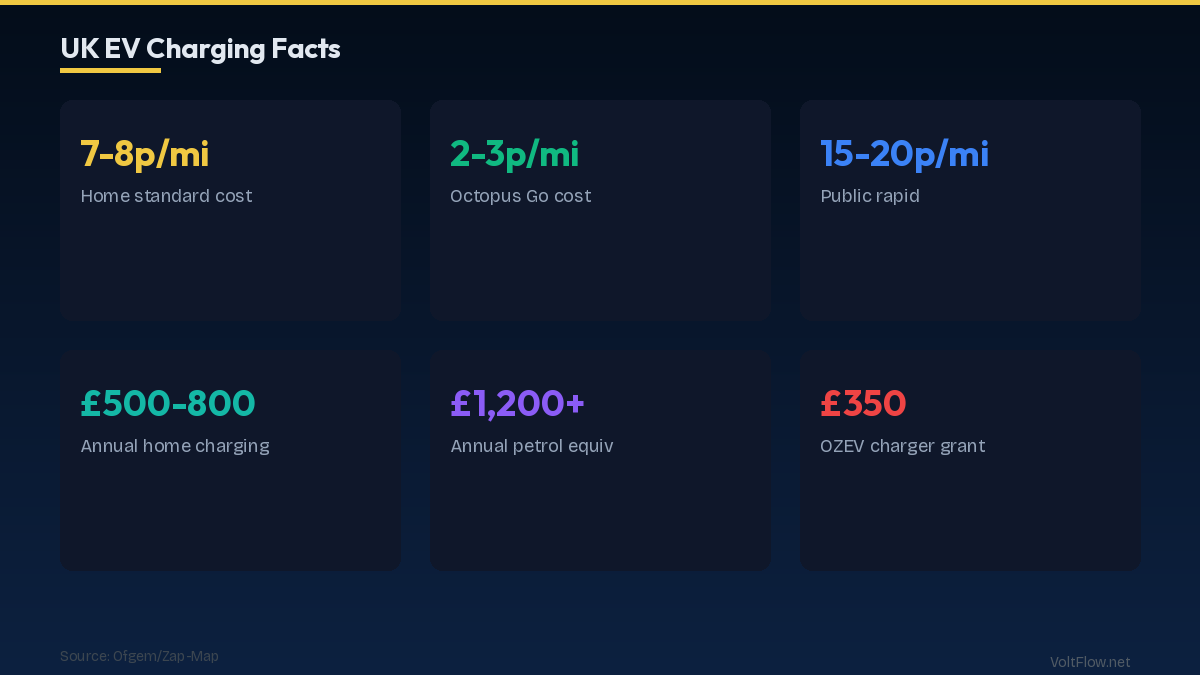
Home charging using a dedicated 7kW wallbox is by far the cheapest and most convenient way to charge an EV in the UK. At the standard Ofgem rate of 24.5p per kWh, a full charge costs vary by battery size: a Nissan Leaf with a 40 kWh battery costs approximately £9.80, a Tesla Model 3 Standard Range with a 57.5 kWh battery costs approximately £14.09, a Tesla Model Y with a 75 kWh battery costs approximately £18.38, a VW ID.4 with a 77 kWh battery costs approximately £18.87, a BMW iX with a 105 kWh battery costs approximately £25.73, and a Hyundai Ioniq 5 with a 73 kWh battery costs approximately £17.89. These costs translate to approximately 5-7p per mile depending on the vehicle efficiency. The Nissan Leaf averaging 3.5 miles per kWh costs 7p per mile. The Tesla Model 3 averaging 4 miles per kWh costs 6.1p per mile. For comparison, a petrol car averaging 40 MPG at £1.45 per litre costs approximately 16.4p per mile, more than double the EV home charging cost. Economy 7 or smart tariff overnight charging dramatically reduces costs further. At 10-12p per kWh on Economy 7 off-peak, or 7-9p per kWh on Octopus Go, a full Model 3 charge costs just £5.75-£6.90 instead of £14.09. Over 10,000 miles of driving per year, the difference between standard rate and overnight rate home charging saves £200-£400 annually. A 7kW home wallbox charges most EVs from 10 to 80 percent in 6-8 hours, making it ideal for overnight charging. Simply plug in when you arrive home and wake up to a charged car every morning with zero time spent at charging stations. The initial cost of a home charger and installation runs £800-£1,200 after the OZEV grant of £350 for eligible tenants and leaseholders. This investment pays for itself within 1-2 years through savings versus public charging. Homeowners in houses are no longer eligible for the OZEV grant but the £800-£1,200 investment still pays back quickly. Three-pin plug charging using the EVSE cable that comes with most EVs is the slowest home option at 2.3 kW, adding only 8-10 miles per hour. It costs the same per kWh as wallbox charging but the slower speed means longer charging times and less efficient energy transfer. Use three-pin charging only as a temporary solution while arranging wallbox installation.
Public Charging Network Costs in 2026
Public charging in the UK spans three speed tiers with dramatically different pricing. Understanding the cost structure helps you choose the cheapest option for each situation. Slow and fast public charging at 7-22 kW is available at supermarkets, car parks, workplaces, and on-street chargepoints. Pricing varies widely by network: Pod Point chargers at Tesco are free for the first hour of charging, giving you approximately 7-22 kWh depending on the charger speed. Osprey and BP Pulse fast chargers cost 45-55p per kWh. Source London on-street chargers in London cost 40-50p per kWh. Some workplace chargers are free as an employee benefit. At 45p per kWh, a full Model 3 charge at a public fast charger costs approximately £25.88, nearly double the home charging cost. Rapid charging at 50 kW is the mid-tier public option, available at service stations, retail parks, and dedicated charging hubs. Pricing ranges from 55-75p per kWh across major networks: Tesla Superchargers charge 55-65p per kWh for Tesla vehicles, and slightly more for non-Tesla vehicles using the open network. BP Pulse Rapids cost 65-75p per kWh without a subscription. InstaVolt charges 65-79p per kWh with no subscription needed. Osprey rapid chargers cost 70-79p per kWh. A 50 kW rapid charger adds approximately 150 miles of range in one hour. At 65p per kWh, charging a Model 3 from 10 to 80 percent costs approximately £26.16, taking about 50 minutes. Ultra-rapid charging at 100-350 kW is the fastest and most expensive option, available at motorway service stations and premium charging hubs. These chargers can add 100 miles of range in 10-15 minutes. Pricing runs 75-85p per kWh at most networks, with Ionity charging 69p per kWh for subscribers. A full ultra-rapid charge of a Model 3 costs approximately £35-£49, three to four times the home charging cost. Subscription plans can reduce public charging costs. BP Pulse offers a monthly subscription that reduces per-kWh rates. Tesla Supercharger membership provides lower rates for frequent users. If you regularly use a specific network, calculate whether the subscription fee is offset by the per-kWh savings based on your typical monthly public charging volume.
Cost Per Mile Comparison: EV vs Petrol vs Diesel
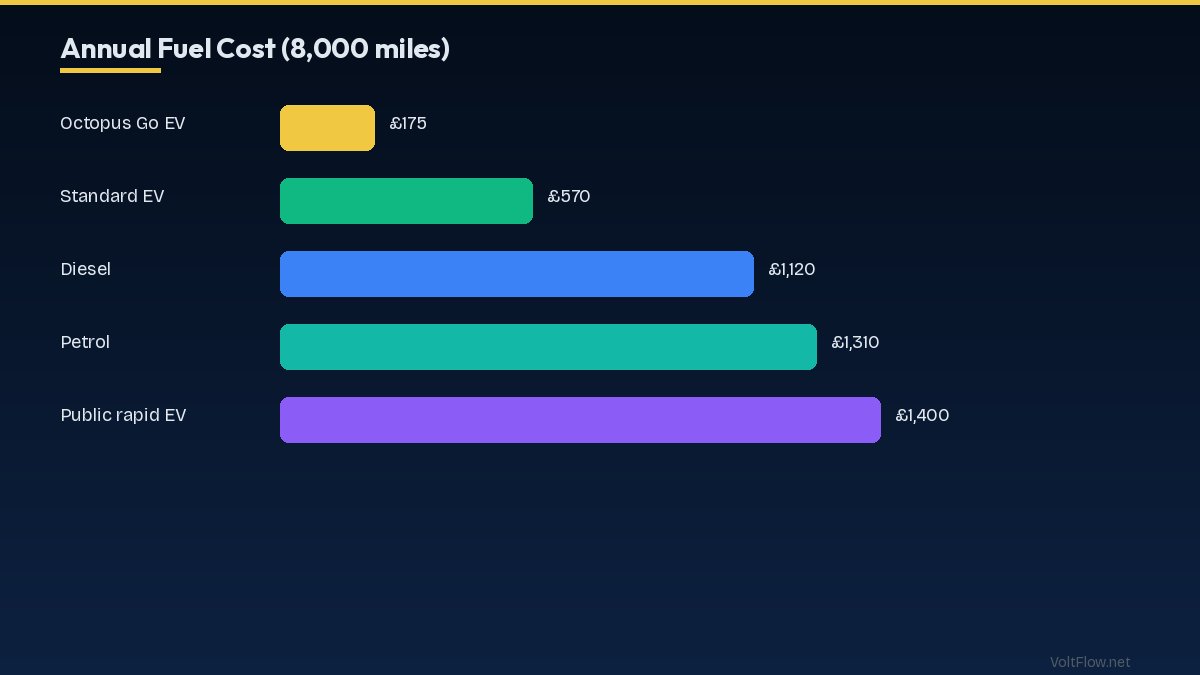
The cost-per-mile comparison puts EV charging savings into clear perspective and accounts for the different efficiency levels of each fuel type. EV home charging at the standard 24.5p per kWh rate produces a cost per mile of 5-7p depending on vehicle efficiency. The most efficient models like the Tesla Model 3 and Hyundai Ioniq 6 achieve 4-4.5 miles per kWh, costing 5.4-6.1p per mile. Larger, less aerodynamic EVs like the BMW iX and Mercedes EQS SUV achieve 2.5-3 miles per kWh, costing 8-10p per mile. The average across all EVs sold in the UK is approximately 6.5p per mile at home charging rates. EV overnight charging on Economy 7 at 12p per kWh drops the cost to 2.7-4.8p per mile. On Octopus Go at 8p per kWh, the cost drops to 1.8-3.2p per mile, virtually free motoring compared to any fossil fuel. EV public charging at the average rapid rate of 65p per kWh increases the cost to 14-26p per mile depending on the vehicle. This brings EV costs close to or even above petrol costs for inefficient EVs using expensive public chargers, which is why home charging is so important for EV economics. Petrol cars at the UK average fuel cost of £1.42 per litre and average real-world efficiency of 38 MPG cost approximately 16.9p per mile. Efficient models like the Toyota Yaris Hybrid at 55 MPG achieve 11.7p per mile. Thirsty models like a Range Rover at 25 MPG cost 25.7p per mile. Diesel cars at £1.50 per litre and average efficiency of 42 MPG cost approximately 16.2p per mile. The diesel advantage over petrol has narrowed as diesel fuel prices have increased and new diesel models have become rarer. Plug-in hybrids present a mixed picture. When running on electric power for short journeys of 20-40 miles, they achieve similar per-mile costs to full EVs. When the battery is depleted and the petrol engine operates, costs rise to petrol levels. Real-world PHEV owners who charge regularly achieve an average cost of 8-12p per mile, between full EV and petrol. The annual savings for an average UK driver covering 8,000 miles are: at home charging rates, an EV saves approximately £680-£840 per year versus petrol. At overnight rates, savings reach £950-£1,100. Even using public charging exclusively, savings are £0-£200 per year, making the charging strategy the primary determinant of EV running cost advantage.
EV Running Cost Calculator: Annual Totals
Projecting annual EV charging costs requires knowing your annual mileage, your vehicle efficiency, and your charging mix between home, work, and public stations. Here are complete annual cost projections for common UK scenarios. A commuter driving 10,000 miles per year in a Tesla Model 3 (4 miles per kWh) charging 90 percent at home on the standard rate and 10 percent at public rapid chargers pays: home charging 9,000 miles divided by 4 equals 2,250 kWh times £0.245 equals £551, plus public charging 1,000 miles divided by 4 equals 250 kWh times £0.65 equals £163. Total annual fuel cost: £714. The equivalent petrol car at 40 MPG and £1.42 per litre costs £1,612 per year, a saving of £898. A high-mileage driver covering 15,000 miles per year with overnight home charging on Octopus Go at 8p per kWh and 20 percent public rapid: home charging 12,000 miles divided by 4 equals 3,000 kWh times £0.08 equals £240, plus public charging 3,000 miles divided by 4 equals 750 kWh times £0.65 equals £488. Total: £728 per year. The equivalent petrol cost of £2,418 means annual savings of £1,690, enough to fund the EV finance payments or build a substantial saving over the ownership period. A city driver doing 5,000 miles per year with no home charging, relying entirely on public chargers averaging 55p per kWh: 5,000 miles divided by 4 equals 1,250 kWh times £0.55 equals £688 per year. The petrol equivalent at £806 saves only £118 per year. This scenario shows why EV ownership without home charging is economically marginal, the savings exist but are modest. For this driver, workplace charging availability would dramatically change the calculation. Beyond fuel costs, EVs save on maintenance. No oil changes save £100-£200 per year. Regenerative braking extends brake pad life to 100,000+ miles versus 40,000-60,000 miles for petrol cars, saving approximately £200-£400 over the ownership period. Road tax (VED) for EVs is now £190 per year after the 2025 change ending the zero-rate exemption, but remains cheaper than many petrol cars. Company car tax (BIK) remains at 2-3 percent for EVs versus 25-37 percent for petrol cars, making EVs exceptionally attractive for company car drivers who can save £2,000-£5,000 per year in tax.
Best UK Charging Networks and Apps
Navigating the UK public charging landscape requires knowing which networks offer the best combination of reliability, speed, and pricing. Here are the major networks ranked by value for money and reliability. Tesla Supercharger network leads in reliability at over 99 percent uptime and competitive pricing of 55-65p per kWh. Originally exclusive to Tesla vehicles, the network is now open to all EVs at most UK locations through the Tesla app. Supercharger speeds of 150-250 kW make it the fastest widely available network. Locations along major motorways and in urban areas provide good coverage for long journeys. InstaVolt offers contactless payment at every charger with no app or subscription needed, making it the most user-friendly network. Pricing of 65-79p per kWh is mid-range. Reliability is good at approximately 95 percent uptime. Charger speeds are typically 50 kW with some 125 kW installations. Gridserve Electric Highway has upgraded the former Ecotricity network at motorway services with 300 kW capable chargers. Pricing of 64-79p per kWh is competitive for motorway locations. Reliability has improved significantly from the old Ecotricity infrastructure. Contactless payment is available at all locations. BP Pulse is the largest UK network by charger count, with a mix of 7 kW, 50 kW, and 150 kW chargers at BP stations, Tesco stores, and other locations. Pricing ranges from 55-75p per kWh depending on speed and subscription status. Reliability has improved but remains inconsistent at some older installations. The BP Pulse app is required for some chargers. Osprey offers 50 kW and 75 kW chargers at retail parks and other locations, priced at 70-79p per kWh with contactless payment. Reliability is good. Coverage is strong in England but limited in Scotland and Wales. For route planning and finding available chargers, the Zap-Map app is essential. It shows all public chargers in the UK across all networks, with real-time availability status, pricing information, user reviews, and route planning with charging stops. The A Better Routeplanner (ABRP) app excels at route planning by calculating the optimal charging stops for your specific vehicle, accounting for battery temperature, elevation, weather, and charging curve to minimize total journey time.

Tips to Minimize UK EV Charging Costs
Several strategies reduce your EV charging costs below the standard rates, some requiring investment and others requiring only behavioral changes. Switch to a smart tariff for overnight charging. Octopus Go at 7-9p per kWh overnight saves approximately £350-£600 per year compared to the standard 24.5p rate for an average EV driver. The switch requires a smart meter (free from Octopus) and no other hardware changes. Set your vehicle charge timer to start at midnight and stop before 5 AM to capture the cheapest rate. Most EVs and all smart chargers support scheduled charging through their apps. Charge to 80 percent for daily use rather than 100 percent. Charging above 80 percent is slower and slightly less efficient because the battery management system reduces charging speed to protect battery longevity. Unless you need maximum range for a specific journey, 80 percent charge saves time and a small amount of electricity per session. Take advantage of free charging wherever available. Tesco Pod Point chargers offer free charging while you shop, adding 7-22 kWh per visit. Some workplaces offer free or subsidized charging. Hotels, leisure centres, and shopping centres increasingly offer free charging to attract customers. Plan road trip charging stops at the cheapest available rapid chargers rather than simply stopping at the first charger you see. Tesla Superchargers are typically 10-20p per kWh cheaper than other rapid networks. Gridserve stations at motorway services are often cheaper than BP Pulse or Osprey at the same services. Use Zap-Map to compare prices before you stop. Consider solar panels if you own your home. A 4 kWp solar system produces 3,400-4,000 kWh per year in the UK, more than enough to cover the 2,500-3,500 kWh an average EV needs annually. Charging your EV from solar electricity costs effectively zero per mile once the system has paid back its installation cost in 6-9 years. Even partial solar charging during summer months when production exceeds household demand provides free motoring for 6-8 months of the year. Combine a solar system with a home battery and smart charger to maximize self-consumption. The battery stores daytime solar surplus and releases it to the car charger overnight, capturing solar energy that would otherwise be exported to the grid at the lower Smart Export Guarantee rate of 4-15p per kWh. A system combining solar, battery, and smart EV charger can reduce annual EV charging costs to near zero.