EV Rebates & Incentives Australia 2026: State-by-State Guide
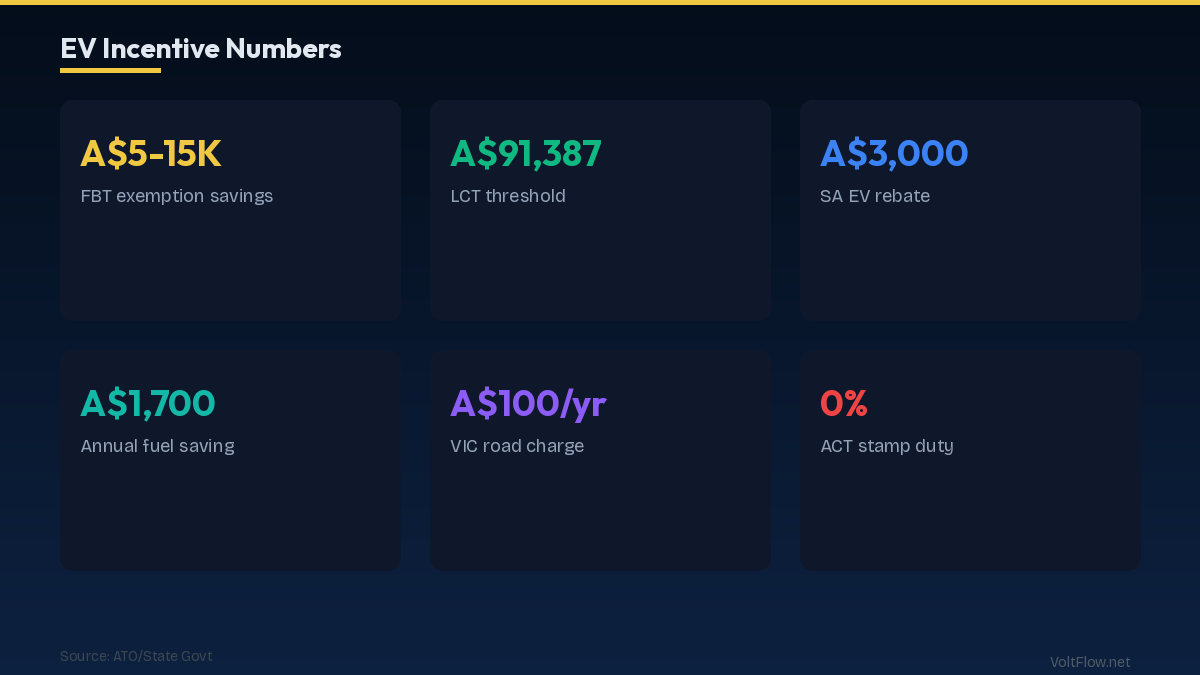
Australian EV incentives in 2026 include stamp duty exemptions saving A$1,500-$3,000, registration discounts, and state-specific rebates. While the federal government removed the fringe benefits tax exemption cap discussion, FBT exemption for EVs under $89,332 remains the most valuable incentive for salary-packaged vehicles, saving employees A$5,000-$15,000 per year in tax. This guide covers every federal and state incentive available to Australian EV buyers.
Federal EV Incentives: FBT Exemption Explained
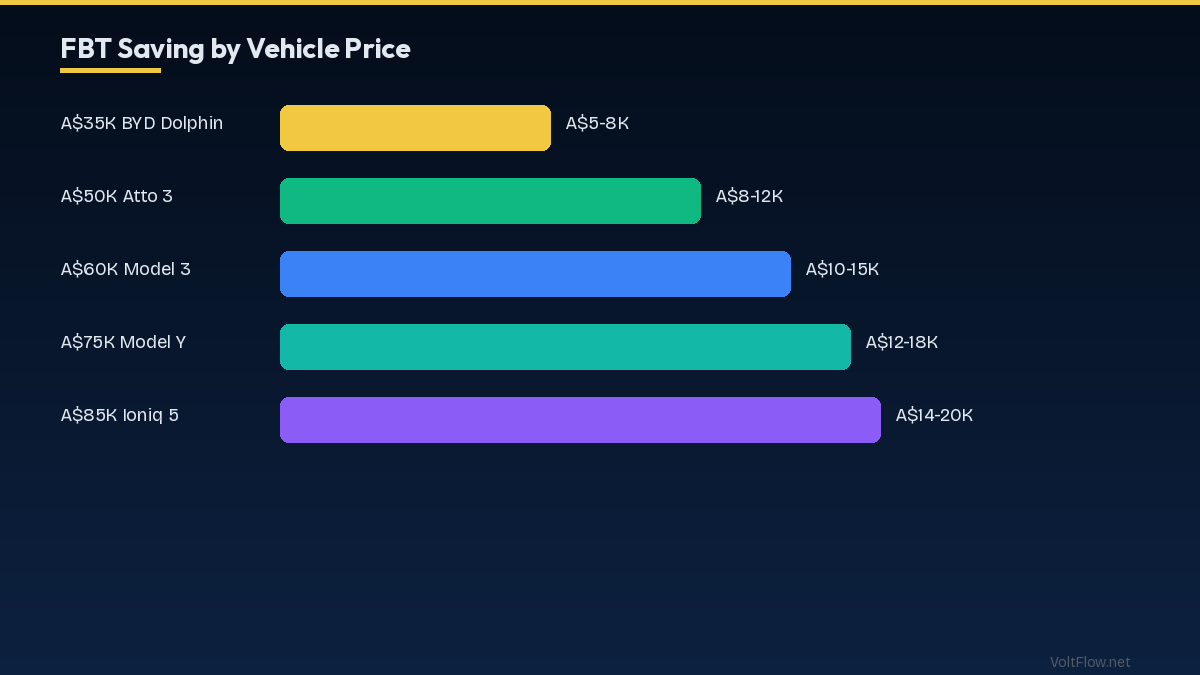
The federal Fringe Benefits Tax exemption for electric vehicles is the most financially significant EV incentive in Australia. Introduced in 2022, it exempts battery electric vehicles, hydrogen fuel cell vehicles, and plug-in hybrid EVs first used before April 2025 from FBT when provided through an employer as a salary sacrifice or novated lease. The FBT exemption applies to EVs with a value at first retail sale below the luxury car tax threshold for fuel-efficient vehicles, which is A$89,332 in 2025-26. This covers most popular EVs including the Tesla Model 3 and Model Y, BYD Atto 3 and Seal, Hyundai Ioniq 5 and Kona, MG ZS EV and MG4, Polestar 2, and Volvo EX30. The FBT saving is substantial. Without the exemption, an employee salary-packaging a A$55,000 EV would owe FBT of approximately A$10,000-$15,000 per year on the vehicle value. With the exemption, this FBT liability is zero. The employee effectively receives the car as a tax-free benefit, reducing the total cost of EV ownership by A$5,000-$15,000 per year compared to salary-packaging an equivalent petrol car. For a A$55,000 EV on a 3-year novated lease, the total saving over the lease period compared to purchasing outright is typically A$15,000-$25,000 when combining FBT exemption, GST savings, and income tax reduction from pre-tax salary contributions. This makes novated leasing the most cost-effective way to acquire an EV in Australia for employees whose employers offer salary packaging. The exemption also applies to associated costs including registration, insurance, maintenance, charging, and even home charger installation when packaged as part of the novated lease. This complete coverage means virtually all EV running costs can be paid from pre-tax salary, amplifying the tax advantage beyond just the vehicle cost itself. Employers benefit from offering EV salary packaging as a recruitment and retention tool with zero cost to the business. The FBT exemption eliminates the employer FBT liability that normally applies to company cars, making EVs the most tax-efficient vehicle benefit available. Many large Australian employers including banks, consulting firms, and government departments actively promote EV novated leasing to employees.
State Stamp Duty Exemptions and Registration Discounts
Most Australian states offer stamp duty exemptions or reductions for electric vehicles, providing upfront savings at the point of purchase. These savings are automatic and do not require separate applications. In New South Wales, EVs are exempt from stamp duty, saving approximately A$1,500-$3,000 on a typical EV purchase. NSW also offers a A$3,000 rebate for new EVs under A$68,750 through the NSW EV Strategy, though check current availability as programme funding is allocated in rounds. Annual registration for EVs in NSW is the same as petrol vehicles. In Victoria, EVs receive a A$100 registration discount annually. However, Victoria introduced a road user charge of 2.8c per km for EVs to compensate for lost fuel excise revenue. For a driver covering 15,000 km per year, this adds A$420 annually, partially offsetting other savings. The road user charge is controversial and has been challenged in court, so check current status. In Queensland, EVs are exempt from stamp duty, saving A$1,000-$2,500. Queensland offers a A$3,000-$6,000 rebate for new EVs depending on the vehicle price and whether you are a private or fleet buyer. Registration costs are the same as petrol vehicles. Queensland has no road user charge for EVs. In South Australia, EVs receive a stamp duty exemption saving A$1,500-$3,000 and a three-year registration exemption saving approximately A$200-$400 per year. SA has introduced a road user charge of 2.8c per km. In Western Australia, EVs receive a stamp duty exemption and A$3,500 rebate for battery EVs under A$70,000. WA has no road user charge. In Tasmania, EVs receive stamp duty exemption and a two-year registration waiver saving approximately A$500. In the ACT, EVs are exempt from stamp duty and receive two years free registration plus free public EV charging at government-operated chargers. The ACT is the most generous jurisdiction for EV incentives per capita. The combined state incentives save A$2,000-$6,000 at purchase plus A$200-$600 per year in ongoing registration discounts, making EVs increasingly price-competitive with equivalent petrol vehicles before considering the dramatic running cost savings.
Novated Leasing: The Smartest Way to Buy an EV
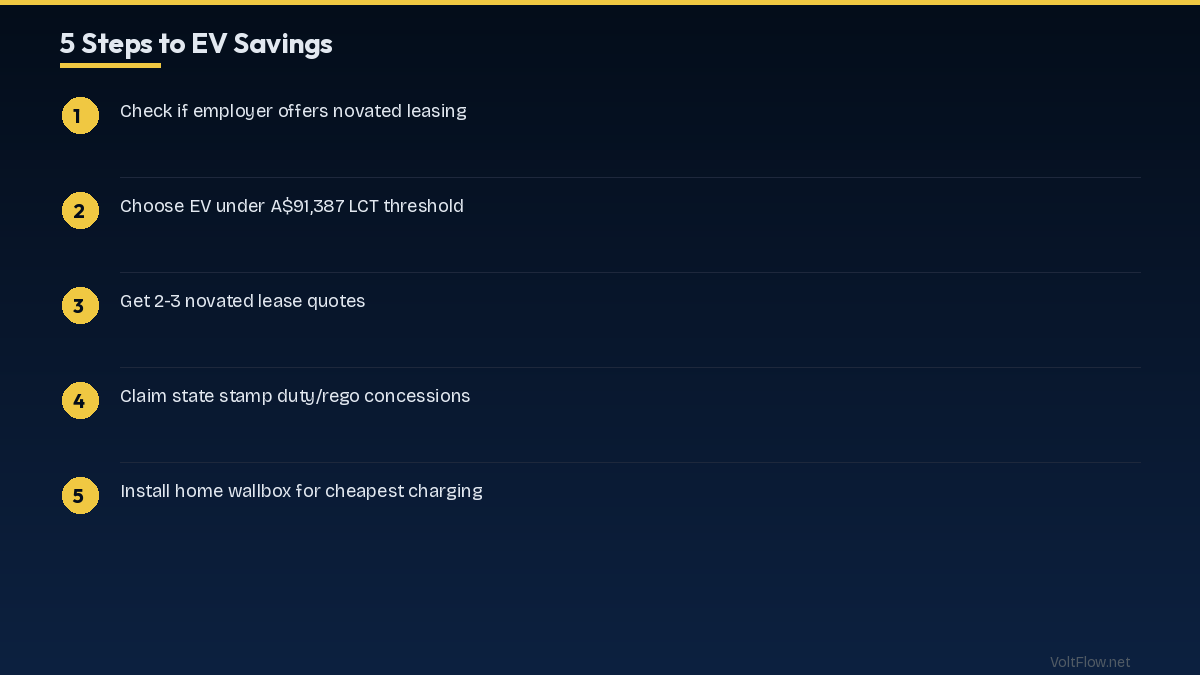
Novated leasing through salary sacrifice is the most financially advantageous way to acquire an EV in Australia due to the FBT exemption. Understanding how the numbers work reveals savings that make EV ownership significantly cheaper than equivalent petrol car ownership. A novated lease is a three-way agreement between you, your employer, and a leasing company. Your employer deducts lease payments from your pre-tax salary, reducing your taxable income. The leasing company owns the vehicle and you use it for the lease term, typically 3-5 years. At the end of the lease, you can pay the residual value to own the car, re-lease, or return it. For a A$55,000 Tesla Model 3, a 3-year novated lease with typical parameters: monthly pre-tax salary deduction of approximately A$1,200-$1,400 covering lease payments, insurance, registration, tyres, maintenance, and charging. Without the FBT exemption, you would owe FBT of approximately A$800-$1,000 per month on top of the lease payments. With the exemption, FBT is zero, saving you A$800-$1,000 per month or A$9,600-$12,000 per year. The effective monthly cost of driving a Tesla Model 3 on a novated lease is approximately A$900-$1,100 after tax savings, compared to A$1,400-$1,800 for an equivalent petrol car on a novated lease where FBT applies. The EV is A$500-$700 per month cheaper despite having a higher sticker price because the FBT exemption eliminates the tax penalty that normally applies to salary-packaged vehicles. To access novated leasing, your employer must offer salary packaging as an employee benefit. Most large employers do, including ASX-listed companies, government departments, universities, and hospitals. Smaller employers may not have a salary packaging arrangement but can establish one through a novated lease provider at no cost to the business. Novated lease providers including Maxxia, SG Fleet, LeasePlan, and Novated Lease Australia can arrange the lease and guide both you and your employer through the setup process. When calculating your novated lease budget, include all running costs in the package: lease payments, complete insurance, registration, scheduled servicing, tyres, roadside assistance, and home charging electricity. Including charging costs in the pre-tax package provides an additional 30-47% tax saving on your fuel costs depending on your marginal tax rate.
EV Price Parity: When EVs Match Petrol on Sticker Price
The sticker price gap between EVs and equivalent petrol cars is narrowing rapidly in Australia as Chinese manufacturers enter the market with competitive pricing. Understanding the current price landscape helps you evaluate when an EV makes financial sense even before incentives. In the small SUV segment, the MG ZS EV at A$33,990 drive-away competes directly with the petrol MG ZS at A$25,490. The A$8,500 premium is recovered in approximately 3.5-4 years from fuel and servicing savings. With a novated lease eliminating the FBT, the monthly cost of the EV version is actually lower than the petrol version from day one. The BYD Atto 3 at A$38,900 competes with the Hyundai Tucson petrol at A$37,000, near price parity on sticker alone. In the medium sedan segment, the BYD Seal at A$42,900 competes with the Toyota Camry at A$36,000-$42,000 for comparable trim levels. The Tesla Model 3 at A$54,900 competes with the BMW 3 Series at A$65,000-$75,000, making the Tesla cheaper on sticker price alone against its premium competitors. In the large SUV segment, the Tesla Model Y at A$55,900 competes with the BMW X3 at A$72,000 and the Mercedes GLC at A$75,000, again cheaper than its premium competitors. The BYD Sealion 6 at approximately A$45,000 competes with the Toyota RAV4 at A$40,000-$50,000. When total cost of ownership is calculated over 5 years including purchase, fuel, servicing, insurance, and registration minus incentives, most EVs are now cheaper than their petrol equivalents in Australia. A A$55,000 Tesla Model Y costs approximately A$28,000 less over 5 years than a A$55,000 petrol SUV when combining fuel savings of A$8,000-$10,000, servicing savings of A$3,000-$5,000, stamp duty savings of A$2,000-$3,000, and FBT savings of A$15,000-$25,000 on a novated lease. The total cost of ownership advantage accelerates as petrol prices rise and EV battery costs continue falling, making each successive model year more competitive. By 2028, most segments are expected to reach sticker price parity without incentives, at which point the running cost advantage makes EVs universally cheaper to own.
Fleet and Business EV Incentives
Australian businesses benefit from additional EV incentives beyond the personal FBT exemption, making fleet electrification financially attractive in 2026. The Instant Asset Write-Off allows businesses with annual turnover under A$10 million to immediately deduct the full cost of eligible assets including EVs up to the relevant threshold. For EVs under the luxury car tax threshold of A$89,332, the entire purchase price can be deducted in the year of acquisition, providing a tax deduction of A$89,332 times the company tax rate of 25-30% equals A$22,333-$26,800 in reduced tax. This compares to depreciating a petrol car over its effective life of typically 8 years, where the tax benefit is spread over many years rather than concentrated in year one. The Luxury Car Tax threshold for fuel-efficient vehicles is higher than for standard vehicles: A$89,332 versus A$71,849 in 2025-26. EVs below this threshold avoid LCT entirely. An EV priced at A$85,000 pays zero LCT while a petrol car at the same price pays LCT on the amount above A$71,849, adding approximately A$4,300 to the purchase cost. Fleet discount programmes from EV manufacturers offer additional savings for businesses purchasing multiple vehicles. Tesla Fleet provides 3-5% discounts for orders of 5 or more vehicles. BYD, MG, and other manufacturers offer similar fleet pricing. Combined with the instant asset write-off and FBT exemption, fleet EVs can be 30-40% cheaper than equivalent petrol fleet vehicles on a total cost of ownership basis. Charging infrastructure for business premises attracts the instant asset write-off as well. Workplace Level 2 chargers at A$2,000-$5,000 per unit and associated electrical work can be fully deducted in the year of installation, reducing the effective cost by 25-30% through the tax deduction. Providing workplace charging also supports employee EV adoption and can be included in novated lease packages as a benefit.
Road User Charges: The EV Tax Controversy
Victoria and South Australia have introduced road user charges for electric vehicles, collecting 2.8c per km driven to replace the fuel excise revenue that EVs do not generate. This charge is controversial and affects the total cost of EV ownership in those states. The Victorian EV road user charge of 2.8c per km was the first in Australia and was upheld by the High Court after a legal challenge. For a driver covering 15,000 km per year, the annual charge is A$420. For 20,000 km, it is A$560. While this adds to EV running costs, it does not eliminate the fuel cost advantage. An EV paying A$420 road user charge plus A$720 in electricity for 15,000 km totals A$1,140 versus petrol at A$2,400, still A$1,260 cheaper per year. South Australia road user charge of 2.8c per km follows the Victorian model with similar annual costs of A$420 for 15,000 km. SA has proposed increasing the rate in future years, potentially to 3.5-4c per km by 2028. Other states may introduce road user charges in coming years as EV adoption grows and fuel excise revenue declines. The federal government is monitoring the state schemes and may introduce a national road user charge to replace the state-level charges, potentially providing a uniform national rate rather than the current state-by-state patchwork. The road user charge is collected through odometer readings submitted annually or at registration renewal. EVs with connected telemetry like Tesla can submit odometer readings electronically. Other brands require a physical inspection or photo evidence of the odometer. Penalties apply for failing to report or for odometer tampering. Even with road user charges, the total cost of EV ownership remains significantly below petrol vehicles. The charge adds approximately 1.8c per km to EV running costs (on top of the 3-5c electricity cost) bringing total per-km costs to approximately 5-7c versus 16c for petrol. The 55-70% running cost advantage is reduced but not eliminated.