How Much Electricity Does a Heat Pump Use UK 2026: Running Cost Guide

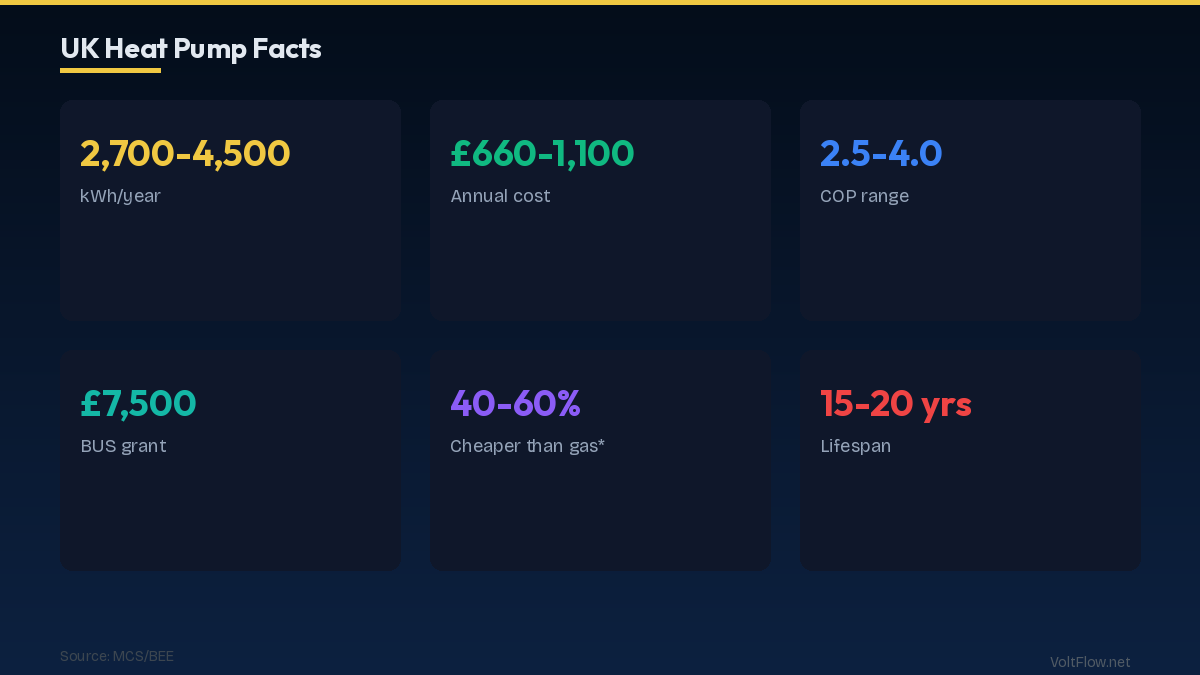
An air source heat pump in the UK uses 2,700-4,500 kWh/year of electricity to heat a typical home, costing £660-£1,100 at 24.5p/kWh. With a Coefficient of Performance (COP) of 2.5-4.0, heat pumps produce 2.5-4 units of heat per unit of electricity, making them 3-4x more efficient than direct electric heating and increasingly cheaper than gas boilers. The Boiler Upgrade Scheme provides a £7,500 grant toward installation costs.
Heat Pump Electricity Consumption by Home Type
A heat pump electricity consumption depends on your home heat loss rate, the outdoor temperature, the system COP, and how well the system is designed and installed. These factors combine to produce a wide range of real-world consumption figures across UK homes. A well-insulated home with EPC rating C or above typically requires 8,000-12,000 kWh of heat per year. With a seasonal COP of 3.0-3.5, the heat pump consumes 2,300-4,000 kWh of electricity to deliver this heat. At the standard Ofgem rate of 24.5p per kWh, annual heating electricity cost is £564-£980. This represents the best-case scenario and is achievable in homes built after 2000 with cavity wall insulation, at least 270mm loft insulation, double or triple glazing, and minimal draughts. An average UK home with EPC rating D requires 12,000-16,000 kWh of heat annually due to higher heat losses through walls, windows, and the roof. With a seasonal COP of 2.8-3.2, the heat pump consumes 3,750-5,714 kWh of electricity, costing £919-£1,400 per year. This is the typical scenario for most UK heat pump installations in existing homes. Improving insulation before or alongside heat pump installation reduces consumption and cost significantly. An older, poorly insulated home with EPC rating E or below may require 16,000-22,000 kWh of heat annually. A heat pump in this home consumes 5,000-8,800 kWh at a COP of 2.5-3.2, costing £1,225-£2,156 per year. At this level, running costs approach or exceed gas boiler costs, and the financial case for a heat pump weakens unless insulation is improved first. Heat pump installers should always recommend insulation measures for EPC E or below homes before sizing the heat pump. Hot water heating adds approximately 2,000-3,000 kWh of heat demand per year for a family of four. Heat pumps can heat water to 50-55 degrees Celsius efficiently, but legionella protection requires periodic heating to 60 degrees or above, which reduces the COP for water heating to 2.0-2.5. The electricity cost for hot water via heat pump is approximately £200-£370 per year, compared to £60-£90 for a gas boiler and £600-£900 for a direct immersion heater. Total annual electricity consumption for heating plus hot water ranges from 2,700 kWh for well-insulated homes to 7,500 kWh for larger or poorly insulated properties.
COP Explained: Why Heat Pumps Are So Efficient
The Coefficient of Performance is the metric that makes heat pumps fundamentally different from all other heating systems. Understanding COP explains why a heat pump using £800 of electricity can produce the same warmth as a gas boiler burning £1,200 of gas. COP measures the ratio of heat output to electricity input. A COP of 3.0 means the heat pump produces 3 kWh of heat for every 1 kWh of electricity consumed. The additional 2 kWh comes from heat energy extracted from the outdoor air using the refrigeration cycle. The heat pump does not create heat from electricity like a resistive heater, it moves heat from outside to inside, using electricity only to power the compressor and fans that drive the refrigeration cycle. This is why a heat pump produces 3-4 times more heat than the electricity it consumes, defying the intuition that you cannot get more energy out than you put in. You are not creating energy, you are harvesting ambient heat energy that already exists in the outdoor air. Seasonal COP or SCOP averages the COP across the entire heating season, accounting for the variation in outdoor temperature. COP is highest in mild weather at 5-15 degrees Celsius where the heat pump operates at COP 3.5-4.5, and lowest in very cold weather at minus 5 to 0 degrees where COP drops to 2.0-2.5. The UK mild maritime climate with winter temperatures typically between 0 and 10 degrees is well suited to air source heat pumps, producing seasonal COPs of 2.8-3.5 for well-designed installations. Several factors affect your achieved COP. Flow temperature is the most significant: lower flow temperatures produce higher COP. A system designed for 35-degree flow temperature achieves COP 3.5-4.0. A system running at 55-degree flow temperature for undersized radiators achieves only COP 2.0-2.5. This is why heat pump installations often include larger radiators or underfloor heating to allow lower flow temperatures. Defrost cycles reduce efficiency during cold, humid weather when ice forms on the outdoor unit. The heat pump periodically reverses its cycle to melt the ice, consuming energy without heating the house. In typical UK winters, defrost cycles reduce seasonal COP by approximately 0.2-0.3 compared to lab-tested COP values. System sizing matters enormously. An oversized heat pump cycles on and off frequently, reducing average COP because the startup phase is less efficient than steady-state operation. An undersized heat pump cannot maintain comfort temperature during the coldest days, requiring backup heating from a direct electric element at COP 1.0. Proper sizing by an experienced MCS-certified installer is essential for achieving the rated COP in practice.
Heat Pump vs Gas Boiler Running Costs in 2026
The running cost comparison between heat pumps and gas boilers depends on the electricity-to-gas price ratio and the heat pump COP. In 2026, the Ofgem rates are 24.5p per kWh for electricity and 6.2p per kWh for gas. The breakeven COP, where the heat pump costs the same to run as a gas boiler at 90 percent efficiency, is calculated as electricity price divided by gas price multiplied by boiler efficiency: 24.5 divided by 6.2 times 0.9 equals 3.56. This means a heat pump needs a seasonal COP above 3.56 to be cheaper than a modern condensing gas boiler on current tariffs. Well-designed installations in insulated homes achieve SCOP of 3.2-3.8, putting them right around the breakeven point. Some are cheaper than gas, some slightly more expensive, depending on the specific installation quality and home characteristics. For a typical home requiring 12,000 kWh of heat per year, the gas boiler at 90 percent efficiency consumes 13,333 kWh of gas at 6.2p, costing £827 per year. The heat pump at SCOP 3.2 consumes 3,750 kWh of electricity at 24.5p, costing £919 per year. At SCOP 3.5, the heat pump consumes 3,429 kWh, costing £840. At SCOP 3.8, it consumes 3,158 kWh, costing £774. The crossover point is clear: above SCOP 3.5, the heat pump wins; below SCOP 3.0, gas is cheaper. Smart tariff users change this calculation dramatically. On Octopus Go at 8p per kWh overnight, a heat pump with a thermal store that heats primarily overnight achieves effective heating costs of: 3,750 kWh at 8p equals £300 per year at SCOP 3.2. This is less than half the gas boiler cost and makes the financial case for heat pumps overwhelming. Even at SCOP 2.5, the overnight tariff cost of £384 undercuts gas at £827. The Renewable Heat Incentive has ended but the Boiler Upgrade Scheme provides a £7,500 capital grant that reduces the installation cost from £10,000-£14,000 to £2,500-£6,500. At annual running cost savings of £0-£500 compared to gas depending on COP, the payback on the remaining cost after the grant is 5-15 years. The non-financial benefits of eliminating gas combustion products from your home, reducing carbon emissions by 60-80 percent, and future-proofing against gas price increases add significant value beyond the pure running cost comparison.
The Boiler Upgrade Scheme: £7,500 Grant Details
The Boiler Upgrade Scheme or BUS is the UK government primary financial incentive for heat pump adoption, providing a £7,500 grant toward the cost of installing an air source heat pump or ground source heat pump. Understanding the eligibility rules and application process helps you access this substantial funding. Eligibility requirements include that the property must be in England or Wales with Scotland having its own Home Energy Scotland scheme. The property must have a valid Energy Performance Certificate or EPC with no outstanding recommendations for loft or cavity wall insulation. This does not mean you need a high EPC rating, but if the EPC recommends basic insulation measures, those should be completed before applying. The property must currently be heated by a fossil fuel system such as gas, oil, LPG, or coal. Properties already heated by electric storage heaters or other electric heating may not qualify. The heat pump must be installed by an MCS-certified installer. MCS certification ensures the installer has demonstrated competence in heat pump design, installation, and commissioning. Only MCS-certified installations qualify for the grant. The installer applies for the grant voucher through the Ofgem portal before starting the installation. Once approved, the voucher reserves the £7,500 funding. The installer then completes the work and claims the grant directly from Ofgem, deducting it from your invoice. You pay only the remaining balance. The grant covers air source heat pumps at £7,500, ground source heat pumps at £7,500, and biomass boilers at a lower amount. The grant has been extended and expanded since its initial launch, reflecting government commitment to heat pump deployment as part of the net zero strategy. Typical total installation costs for an air source heat pump in 2026 are £10,000-£14,000 for a straightforward installation in a well-insulated home with existing radiators that are adequate for low-temperature operation. Complex installations requiring new radiators, underfloor heating, a new hot water cylinder, or significant pipework modifications can reach £14,000-£18,000. After the £7,500 BUS grant, the homeowner contribution ranges from £2,500-£10,500. Demand for the BUS grant has increased significantly and the budget allocation is finite. Apply as early as possible once you have selected an MCS-certified installer and received a formal quotation. The voucher is valid for a set period, typically 3-6 months, within which the installation must be completed.
Maximizing Heat Pump Efficiency: Practical Tips
The difference between a heat pump installation that achieves COP 2.5 and one that achieves COP 3.5 is approximately £300-£500 per year in running costs. These practical tips help you get closer to the higher end of the efficiency range. Keep the flow temperature as low as possible. Every degree reduction in flow temperature increases COP by approximately 2-3 percent. Start at 35 degrees and increase only if the house cannot maintain comfortable temperature. If you need 45 degrees or above, consider upgrading your radiators to larger models or adding underfloor heating in key rooms to allow a lower flow temperature. Use weather compensation controls that automatically adjust the flow temperature based on outdoor temperature. On mild days at 10 degrees outside, the system runs at a low flow temperature and high COP. On cold days at 0 degrees, the flow temperature increases to maintain comfort. Without weather compensation, the system runs at a fixed flow temperature regardless of conditions, wasting efficiency on mild days. This feature is standard on all modern heat pump controllers but must be properly configured during commissioning. Run the heat pump at a constant low temperature rather than on a timer that turns it on and off. Heat pumps work most efficiently when maintaining a steady temperature because the startup phase is less efficient than continuous operation. The old gas boiler habit of turning the heating on for a few hours in the morning and evening does not work well with heat pumps. Instead, set a constant target temperature of 19-21 degrees and let the weather compensation controller manage the output. Insulate, insulate, insulate. Every pound spent on insulation reduces the heat demand that the heat pump must meet, directly lowering electricity consumption. Loft insulation to 300mm costs £300-£600 and saves 15-25 percent of heat loss. Cavity wall insulation costs £500-£1,500 and saves 15-35 percent. Draught-proofing costs £100-£300 and saves 5-15 percent. These measures improve comfort as well as reducing heat pump running costs. Ensure the outdoor unit has adequate airflow. The heat pump extracts heat from air passing over the outdoor coil. If the unit is enclosed, blocked by vegetation, or positioned in a corner where air cannot circulate freely, the available heat energy is reduced and the COP drops. Maintain a 300mm clearance on all sides and ensure the air outlet is not facing directly into a wall or fence. Regular maintenance keeps efficiency optimal. Annual servicing costs £100-£200 and includes checking refrigerant charge, cleaning the outdoor coil, verifying the controls and sensors are calibrated correctly, and testing the defrost cycle operation. A dirty outdoor coil reduces heat transfer efficiency by 5-15 percent, effectively reducing COP by 0.1-0.5, enough to add £50-£200 per year in running costs.

Heat Pump Electricity Consumption Month by Month
Heat pump electricity consumption varies dramatically across the year, following the heating demand pattern. Understanding the monthly profile helps you budget accurately and identify opportunities to reduce costs during peak consumption months. January and February are the highest consumption months, with heat pump electricity use of 400-700 kWh per month for a typical home. Outdoor temperatures averaging 3-6 degrees Celsius in most of England mean the COP runs at 2.5-3.0, the lower end of the range. These two months account for 25-30 percent of total annual consumption. Electricity costs of £98-£172 per month are the peak of the annual cycle. March sees consumption drop to 300-500 kWh as temperatures rise to 6-9 degrees average. COP improves to 3.0-3.5. The heating system runs fewer hours per day and at lower intensity, reducing daily consumption significantly compared to January. April and October are transition months with similar consumption of 150-300 kWh. The heat pump runs primarily during morning and evening hours when outdoor temperatures drop, but mild daytime temperatures of 10-14 degrees allow the system to idle for extended periods. COP during operating hours is 3.5-4.0. May through September sees minimal heating consumption of 0-100 kWh per month. The heat pump may run occasionally during cool mornings in May and September, but is largely idle for space heating. Hot water heating continues year-round, consuming approximately 80-120 kWh per month regardless of season. In June through August, total heat pump electricity consumption is almost entirely for hot water, costing approximately £20-£30 per month. November and December ramp up consumption to 300-600 kWh as temperatures drop and heating hours increase. December consumption approaches January levels by month end as the coldest weather arrives. The monthly variation means your electricity bill swings substantially between summer and winter. To smooth the financial impact, many households use their energy supplier estimated payment plan that spreads the annual cost evenly across 12 months. At an annual heat pump electricity cost of £900, the monthly direct debit is £75 regardless of whether that month actual consumption is £25 or £170. Understanding this monthly profile also reveals when smart tariff optimization has the most impact. Shifting to Octopus Go overnight charging of a thermal store saves the most money during January and February when consumption is highest. The same percentage saving on a smaller base in July barely matters. Focus your energy management efforts on the winter months for maximum financial benefit.