Home Battery Storage UK 2026: Cost, Grants & Best Systems

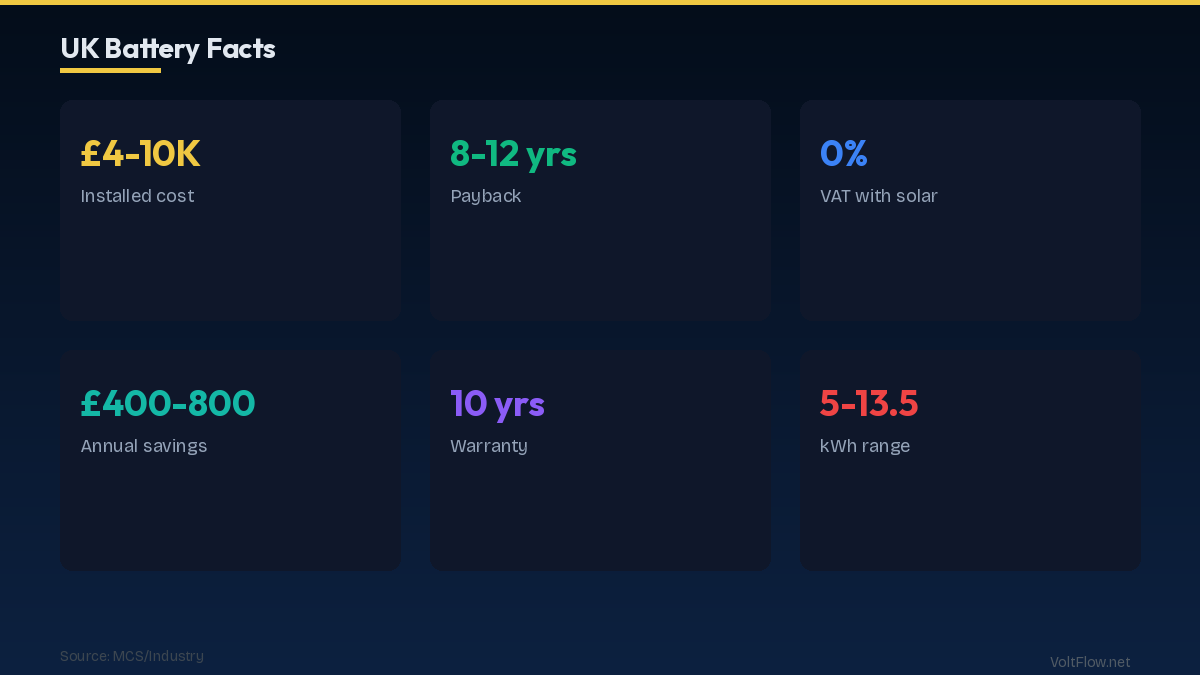
Home battery storage in the UK costs £4,500-£12,000 installed for a 5-13.5 kWh system in 2026. Combined with solar panels, a battery can cut your electricity bill by 60-80% by storing daytime solar surplus for evening use. With the Smart Export Guarantee paying just 4-15p/kWh for exports versus importing at 24.5p/kWh, keeping solar electricity in a battery rather than exporting it saves significantly more. This guide covers costs, top systems, and payback calculations for UK homes.
Home Battery Costs in the UK by Brand
The UK home battery market in 2026 offers several proven systems at varying price points. The Tesla Powerwall 2 remains the most recognised brand at £8,500-£10,500 installed, providing 13.5 kWh usable capacity with an integrated inverter and gateway. Its round-trip efficiency of 90% means you recover 12.15 kWh of the 13.5 kWh stored. Tesla backup gateway provides whole-home backup during power cuts, a feature that adds significant value for rural properties with unreliable grid supply. The GivEnergy range dominates the UK installer market with competitive pricing and modular options. The GivEnergy 5.2 kWh battery costs £3,500-£4,500 installed, while the 9.5 kWh version runs £5,500-£7,000. GivEnergy batteries stack to 30+ kWh for larger homes. Their hybrid inverter handles both solar and battery in one unit, reducing installation complexity and cost. The GivEnergy portal provides excellent monitoring and allows remote firmware updates that add new features over time. The Enphase IQ Battery 5P at £5,500-£7,500 per 5 kWh module integrates smoothly with Enphase microinverter solar systems. Each module is independent, providing redundancy, if one module fails, others continue operating. The modular approach lets you start with 5 kWh and expand later. SolarEdge Home Battery at £6,000-£8,000 for 9.7 kWh works exclusively with SolarEdge inverter systems, offering DC-coupled efficiency of 94% compared to 88-90% for AC-coupled systems. The Pylon Tech US3000C at £1,200-£1,500 per 3.5 kWh module is the budget option favoured by independent installers. Three modules providing 10.5 kWh cost £3,600-£4,500 for the batteries alone plus £1,500-£2,500 for the hybrid inverter and installation. Total system cost of £5,100-£7,000 undercuts branded solutions while delivering comparable performance. Fox ESS, Sunsynk, and Sofar also compete in this space with similar pricing. VAT on battery storage installed alongside solar panels is 0% in the UK, which reduces the effective cost by 20% compared to countries that charge full VAT on storage. Standalone battery installations without solar also qualify for 0% VAT when installed by an MCS-certified company.
Payback Period: When Does a Battery Pay for Itself?
Battery payback in the UK depends primarily on how you use the stored energy and which tariff you are on. Three distinct use cases produce very different payback timescales. Solar self-consumption maximisation is the most common battery use case. Without a battery, a typical 4 kWp solar system exports 50-60% of generation because production peaks at midday when the household is often empty. The exported electricity earns 4-15p/kWh under SEG while importing the same electricity back in the evening costs 24.5p/kWh. A battery captures the midday surplus and releases it in the evening, converting 4-15p export value into 24.5p avoided import, a net benefit of 10-20p per kWh shifted. A 10 kWh battery cycling once daily shifts approximately 3,000 kWh per year, saving £300-£600 annually. At an installed cost of £6,000-£8,000, payback is 10-20 years for solar self-consumption alone. Tariff arbitrage on time-of-use tariffs significantly improves battery economics. Charging from the grid overnight at Octopus Go rates of 8p/kWh and discharging during the 24.5p daytime rate produces a spread of 16.5p per kWh shifted. A 10 kWh battery cycling daily on this strategy shifts 3,650 kWh per year, saving approximately £602. Combined with solar self-consumption savings, total annual benefit reaches £900-£1,200, reducing payback to 5-8 years. Octopus Flux specifically rewards battery cycling with premium export rates during peak hours of 16p/kWh from 4-7 PM, cheap import at 14p overnight, and standard import of 27p during peak. A well-managed battery on Flux can achieve £800-£1,100 annual benefit from combined arbitrage, self-consumption, and premium export. Grid services and virtual power plant programmes provide additional income. Octopus Powerups pays battery owners for providing grid balancing services, earning £50-£200 per year in bonus payments. National Grid frequency response programmes are available through some battery manufacturers aggregation platforms, earning additional income when your battery responds to grid frequency changes. These programmes improve economics by 5-15% but are supplementary to the primary tariff arbitrage and self-consumption benefits. The realistic payback for a UK home battery in 2026 is 8-14 years for solar self-consumption only, 5-8 years with smart tariff arbitrage, and 4-7 years with combined solar, tariff arbitrage, and grid services. Battery warranties of 10-12 years mean the best scenarios achieve payback well within the warranty period.
Best Battery and Solar Combinations for UK Homes
Pairing the right battery with the right solar system maximises both performance and value. The optimal combination depends on your roof size, electricity consumption, and budget. A starter system for a small home consists of a 3.6 kWp solar array with 8-10 panels and a 5 kWh battery. Total installed cost is approximately £6,000-£8,000 including both solar and battery at 0% VAT. This system generates 2,800-3,400 kWh per year, the battery captures most of the daily surplus, and annual electricity savings reach £600-£900. Payback period is 7-11 years. Best suited for 1-2 bedroom homes or flats with limited roof space. A standard system for an average home uses a 4-5 kWp solar array with 10-12 panels and a 10 kWh battery. Total installed cost is £8,000-£12,000. Annual generation of 3,400-4,500 kWh covers most household consumption, with the battery shifting surplus to evening use. Annual savings of £900-£1,400 depending on tariff optimisation produce a payback of 6-10 years. This configuration covers the needs of most 3-bedroom semi-detached and terraced homes. A premium system for larger homes or EV owners uses a 6-8 kWp solar array with 14-20 panels and a 13-15 kWh battery. Total installed cost is £12,000-£18,000. Annual generation of 5,000-7,200 kWh can cover both household electricity and a significant portion of EV charging. Annual savings of £1,200-£2,000 including EV fuel offset produce a payback of 7-12 years. The larger battery capacity also provides meaningful backup during power cuts. For all combinations, the installer should size the battery to match the daily solar surplus rather than the total generation. A 4 kWp system generating 12-15 kWh on a sunny day with household consumption of 6-8 kWh produces a surplus of 4-9 kWh. A 5-10 kWh battery captures this surplus effectively. Oversizing the battery beyond the typical daily surplus wastes money on capacity that sits empty most days unless you plan to use tariff arbitrage to fill it from the grid overnight.
Installation Process and Requirements
Battery installation in the UK requires an MCS-certified installer for warranty validity and 0% VAT eligibility. The installation process follows a structured sequence from survey to commissioning. The initial survey assesses your existing electrical installation, solar system if present, consumer unit capacity, and the proposed battery location. Batteries can be installed indoors in a garage, utility room, or cupboard, or outdoors in a weatherproof enclosure. Indoor installation requires adequate ventilation, most lithium batteries generate minimal heat during operation but do require air circulation to maintain optimal operating temperature. The GivEnergy and Tesla Powerwall units are IP65 rated and suitable for outdoor installation on an exterior wall without additional enclosure. Electrical installation involves connecting the battery to either the existing solar inverter through an AC-coupled connection, or replacing the solar inverter with a hybrid inverter that manages both solar and battery through a DC-coupled connection. AC coupling is simpler for retrofit installations where you want to keep your existing solar inverter. DC coupling is more efficient, losing only 3-5% of energy in the charge-discharge cycle compared to 8-12% for AC coupling. For new solar-plus-battery installations, DC coupling through a hybrid inverter is the standard and most cost-effective approach. The installation typically takes one day for a straightforward setup. The installer mounts the battery, runs cables to the consumer unit or hybrid inverter, configures the battery management system, and commissions the system. Commissioning includes setting charge and discharge schedules, configuring tariff optimisation if the battery supports it, setting backup reserve percentage for power cut protection, and registering the system with the DNO if required. An MCS certificate is issued upon completion, which is required for SEG registration and confirms the installation meets the Microgeneration Certification Scheme standards. The installer also handles DNO notification if your combined solar and battery export capacity requires it. Most residential systems below 3.68 kW export do not require DNO approval, but larger systems or three-phase installations may need permission.
Smart Tariff Integration and Charging Strategies
Modern home batteries in the UK can be configured to automatically optimise charging and discharging based on your electricity tariff, maximising financial return without manual intervention. This capability transforms the battery from passive storage into an active energy trading system. GivEnergy batteries integrate with Octopus Energy tariffs through the GivEnergy cloud platform. When connected to your Octopus account, the battery automatically charges from the grid during the cheapest overnight periods and discharges during expensive peak hours. On Octopus Agile, the battery analyses half-hourly price forecasts and charges during negative or near-zero price periods that occur during high wind generation, then discharges during the 4-7 PM peak when prices regularly reach 30-45p/kWh. Tesla Powerwall integrates with the Tesla app which offers a Time-Based Control mode. You input your tariff peak and off-peak hours, and the Powerwall automatically charges from solar or cheap grid power and discharges during expensive periods. The Storm Watch feature in the app detects approaching severe weather via weather service integration and fully charges the battery in advance to maximise backup availability during potential power cuts. Myenergi Libbi battery integrates with their ecosystem including the Zappi EV charger and Eddi solar diverter. The combined system prioritises solar energy allocation between home consumption, battery charging, EV charging, and hot water heating based on user-defined priorities. This whole-home energy management approach maximises solar self-consumption across multiple loads. For maximum financial return, configure your battery with a dual strategy: overnight grid charging at the cheapest tariff rate from midnight to 5 AM, morning discharge to power breakfast and morning routine from 6-9 AM when rates increase, midday solar charging when available from 10 AM to 3 PM, and afternoon and evening discharge from 4-10 PM when rates are highest. This dual strategy of grid arbitrage plus solar storage typically saves £800-£1,200 per year for a 10 kWh battery, compared to £300-£600 from solar storage alone.
Battery Storage Without Solar: Is It Worth It?
An increasing number of UK homeowners are installing batteries without solar panels to take advantage of time-of-use tariff arbitrage. The economics work when the spread between peak and off-peak rates is large enough to cover the battery cost over its lifetime. On Octopus Go at 8p off-peak and 24.5p peak, charging a 10 kWh battery overnight at 8p and discharging during the day at 24.5p saves 16.5p per kWh shifted. After accounting for 10% round-trip energy losses, the net saving is approximately 14.35p per effective kWh. Cycling daily: 10 kWh times 0.90 efficiency times £0.1435 times 365 days equals £471 per year. On Octopus Agile with average off-peak of 10p and average peak of 35p, the spread widens to 25p per kWh before losses. Annual saving: 10 times 0.90 times £0.2150 times 365 equals £706. At an installed cost of £6,000-£8,000 for a 10 kWh battery without solar, payback is 8.5-17 years on Octopus Go or 8.5-11 years on Octopus Agile. These payback periods sit at or beyond the typical 10-12 year warranty. Standalone battery storage is therefore a marginal financial investment in the UK without solar, justified primarily if you value backup power during outages, you plan to add solar panels within the next few years and want the battery infrastructure in place, you have a three-phase supply with capacity for a larger battery that improves the economics through scale, or your utility offers a particularly lucrative grid services programme that adds £100-£300 per year in additional income. For most homeowners, adding solar panels alongside the battery dramatically improves the combined payback by adding solar self-consumption savings of £400-£800 per year on top of the tariff arbitrage income. The combined solar-plus-battery system typically pays back in 5-8 years, well within warranty coverage, making it a stronger financial proposition than battery alone.