Pool Pump Running Cost Australia 2026: Energy Saving Guide
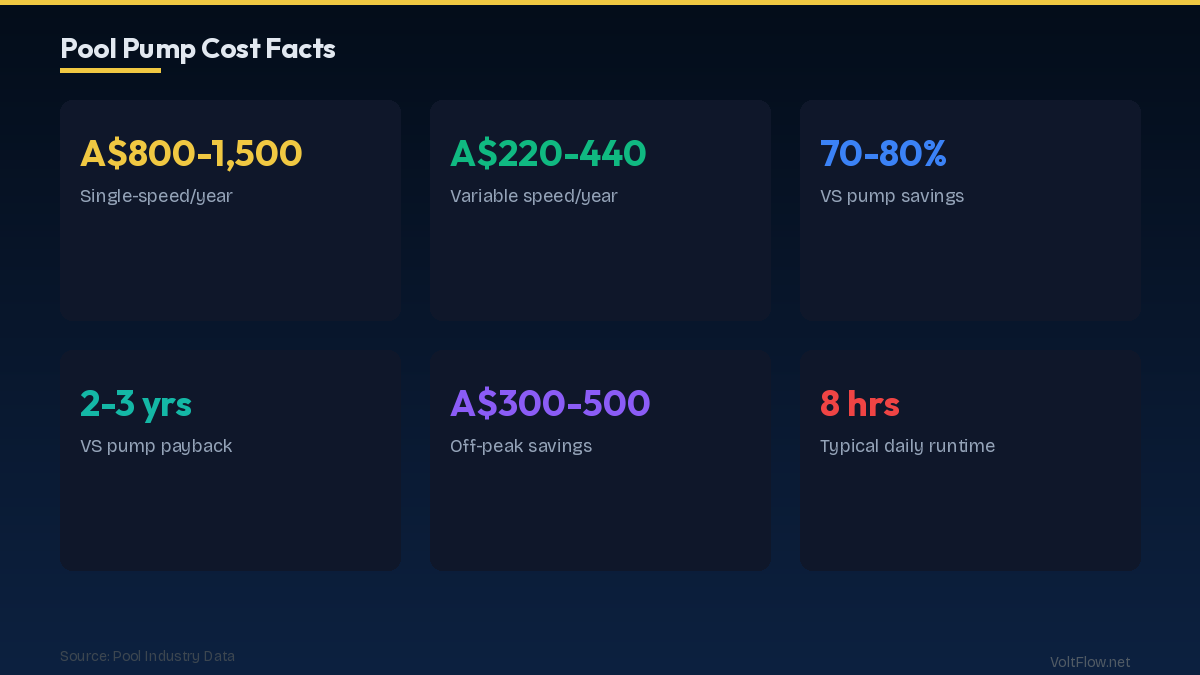
A pool pump is one of the most expensive appliances in Australian homes, costing A$600-$1,800 per year depending on pump type and electricity rate. A single-speed pump running 8 hours daily costs A$4-$6 per day, while a variable-speed pump doing the same filtration costs just A$0.80-$1.50 per day, an 80% reduction. With over 2.7 million residential pools in Australia, optimising pump costs saves households hundreds of dollars annually.
Pool Pump Running Cost by Pump Type
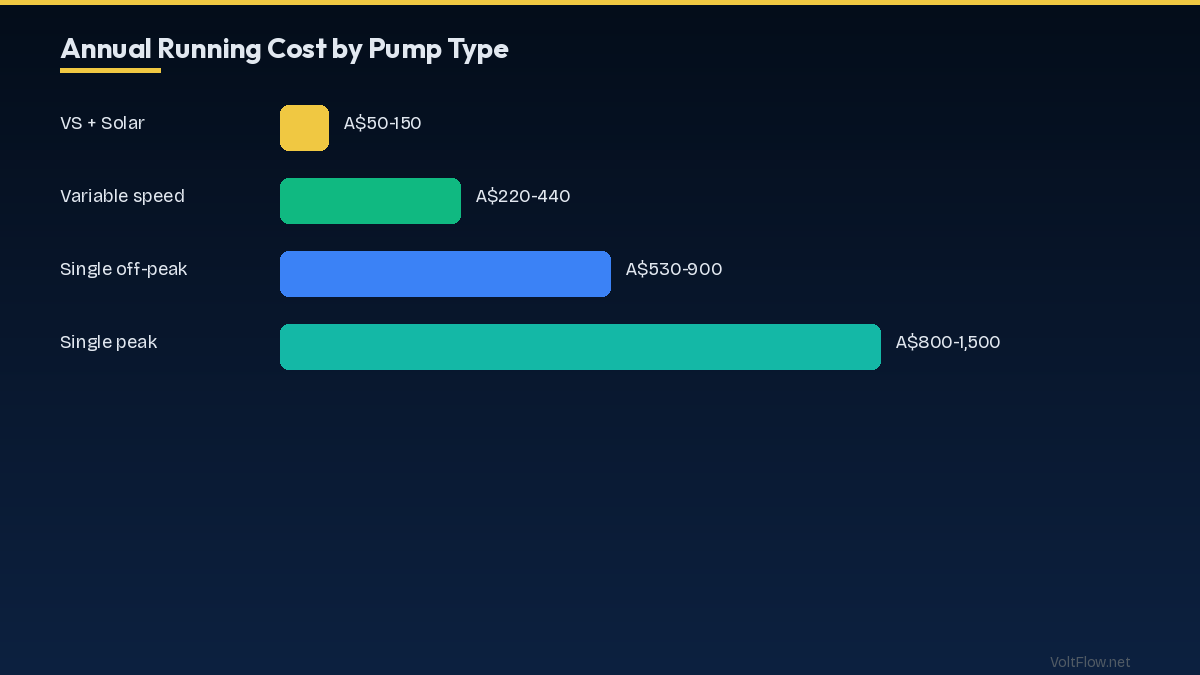
The type of pool pump you use determines 80% of your running cost. The three pump types, single-speed, dual-speed, and variable-speed, have dramatically different energy consumption due to the pump affinity laws which state that power consumption varies with the cube of speed. Single-speed pumps run at one fixed speed of approximately 2,850 RPM regardless of the task. A standard 1.0 HP single-speed pump draws approximately 1,200-1,500 watts continuously. Running this pump 8 hours per day at the Australian average electricity rate of 30c per kWh costs A$2.88-$3.60 per day or A$1,051-$1,314 per year. A larger 1.5 HP pump draws 1,800-2,200 watts, costing A$4.32-$5.28 per day or A$1,577-$1,927 per year. These costs make the pool pump the second or third most expensive appliance in a typical Australian home after air conditioning and water heating. Variable-speed pumps can operate at any speed from about 600 RPM to 3,000 RPM, with daily filtration running at 1,000-1,500 RPM. At 1,200 RPM, a variable-speed pump draws only 150-300 watts, roughly one-eighth of the single-speed equivalent. Running 10-12 hours daily for adequate filtration at low speed costs A$0.45-$1.08 per day or A$164-$394 per year. The pump affinity laws explain the dramatic savings: halving the pump speed reduces power consumption by a factor of eight. Running a pump at half speed for twice as long uses only one-quarter of the energy while filtering the same total volume of water through the pool. Water moves slower through the filter at lower speed, actually improving filtration quality by giving the filter media more contact time with each litre of passing water. Dual-speed pumps offer a middle ground at approximately 40-50% savings over single-speed, running on low speed for most filtration and switching to high speed for spa jets, water features, and backwashing. A 1.0 HP dual-speed pump on low speed draws approximately 350-500 watts, costing A$0.84-$1.20 per day or A$307-$438 per year at 8 hours low and 1 hour high daily. While better than single-speed, variable-speed pumps offer superior savings and flexibility.
Running Cost by State and Tariff Type
Your location and electricity tariff multiply the pump wattage to determine your actual cost. States with higher electricity rates and longer pool seasons face the highest annual pump costs. In South Australia at 38c per kWh average, a single-speed 1.0 HP pump running 8 hours daily costs A$1,330-$1,665 per year, the highest in Australia. A variable-speed pump reduces this to A$208-$500 per year. The annual saving of A$1,000-$1,450 means a variable-speed pump upgrade paying A$1,500-$2,500 installed pays for itself in just 1-2 years in SA. This is the fastest payback in the country. In New South Wales at 31c per kWh, single-speed costs A$1,087-$1,359 per year. Variable-speed costs A$170-$408 per year. Upgrade payback of 1.5-2.5 years. In Victoria at 30c per kWh, single-speed costs A$1,051-$1,314 per year. Victoria shorter pool season of 8-9 months allows reduced pump hours during winter, lowering annual costs slightly. Variable-speed costs A$164-$394 per year. In Queensland at 27c per kWh with year-round pool use, single-speed costs A$946-$1,183 per year. The lower rate is offset by running the pump 12 months rather than 8-9 months. Variable-speed costs A$148-$355. In Western Australia at 32c per kWh, single-speed costs A$1,122-$1,402 per year. Variable-speed costs A$175-$420 per year. On time-of-use tariffs, shifting the pump to off-peak hours of 15-22c per kWh reduces costs by an additional 30-50% beyond the pump type savings. A variable-speed pump on off-peak electricity in SA costs as little as A$110-$260 per year, a 92% reduction from a single-speed pump on standard rates. This combination of variable-speed technology and off-peak scheduling represents the maximum achievable pump cost reduction.
Variable-Speed Pump Upgrade: Cost and Payback
Upgrading from a single-speed to a variable-speed pump is the single highest-ROI improvement available to Australian pool owners. The upgrade costs A$1,500-$2,500 installed and saves A$700-$1,500 per year depending on your state and tariff. A quality variable-speed pump costs A$1,000-$1,800 for the unit. The Pentair IntelliFlo at A$1,500-$1,800, Astral Pool Viron at A$1,200-$1,500, and Davey Silensor at A$1,000-$1,300 are popular Australian models. All include built-in programmable timers and multiple speed presets. Installation labour costs A$300-$600 for a direct replacement where the new pump connects to existing plumbing. Most variable-speed pumps are designed as drop-in replacements for common single-speed models. If electrical upgrades are needed for the variable-speed controller, add A$100-$200. Payback calculation for a NSW homeowner: single-speed annual cost A$1,200. Variable-speed annual cost A$280. Annual saving A$920. Installed cost A$1,800. Payback: 2.0 years. After payback, the owner saves A$920 per year for the remaining 8-10 year pump lifespan. Lifetime savings of approximately A$7,400-$9,200 on a A$1,800 investment. Beyond energy savings, variable-speed pumps offer additional benefits. They run quieter at low speeds, typically 45-55 decibels compared to 65-75 dB for single-speed, eliminating noise complaints from neighbours. They last longer because bearings, seals, and motor windings experience far less stress at low speed. Expected lifespan of 8-12 years versus 5-8 years for single-speed. They improve water clarity because slower flow through the filter increases filtration efficiency. Many pool owners report reducing chemical costs by 10-20% after switching to variable-speed. Australian energy efficiency regulations now require variable-speed pumps for new pool installations and replacements above 0.75 kW. If your single-speed pump fails, its replacement will almost certainly be variable-speed regardless of your preference.
Solar-Powered Pool Pump Strategies
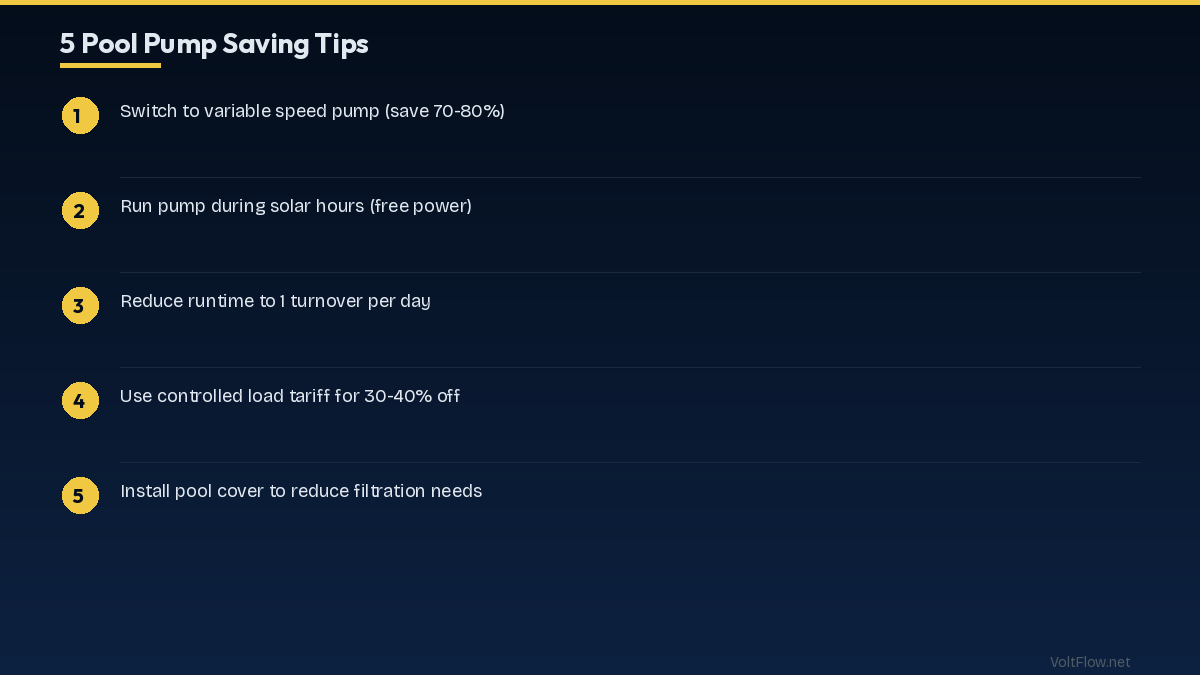
With 2.7 million pools in one of the world sunniest countries, combining solar panels with smart pool pump scheduling is a natural fit that can reduce pool pump electricity costs to near zero. A variable-speed pump at low speed draws only 150-300 watts, which is a tiny fraction of even a modest solar system output. A 5 kWp solar system producing 3-4 kW during the middle of the day generates 10-20 times the power needed to run a variable-speed pump. Running the pump during peak solar hours of 9 AM to 3 PM uses solar surplus that would otherwise be exported at the low feed-in rate of 3-12c per kWh. By consuming the solar electricity directly for pool filtration, you avoid importing grid electricity at 27-38c per kWh later in the day. The effective saving is the full retail rate avoided, not just the feed-in rate foregone. Smart pool controllers like the Astral Pool Connect and Pentair IntelliCenter can be programmed to run the pump during specific hours aligned with solar production. More advanced setups using a solar diverter or the myenergi Zappi-style controller connected to a pool pump circuit can dynamically adjust pump speed based on real-time solar surplus, running faster when more solar is available and slower or off when clouds pass. For pool owners without existing solar panels, a small dedicated solar system of 1-2 kWp installed specifically for the pool pump costs A$2,000-$4,000 and generates enough electricity to run a variable-speed pump for 6-10 hours daily during the sunny months. The system pays for itself in 3-5 years from avoided grid electricity costs and provides free pool pump operation for the remaining 20+ year panel lifespan. Pool covers complement solar pump operation by reducing filtration requirements. A solar blanket or pool cover reduces debris entry, evaporation, and heat loss, allowing shorter filtration cycles. Pool owners with covers can reduce daily pump run time by 2-3 hours, saving an additional A$100-$250 per year on top of the variable-speed and solar savings.
Pool Pump Sizing and Efficiency Tips
An oversized pump wastes energy while an undersized pump fails to provide adequate filtration. Proper sizing matches the pump flow rate to your pool volume and filter capacity. Calculate your pool volume: rectangular pools use length times width times average depth times 1,000 litres. A typical 8 by 4 metre pool at 1.4 metres average depth holds 44,800 litres. The pump should turn over the full pool volume at least once per day. At a variable-speed pump low setting of 100-150 litres per minute, one turnover takes 300-450 minutes or 5-7.5 hours. Running 8 hours provides comfortable margin for complete filtration. Most Australian residential pools are well served by a 0.75-1.0 HP variable-speed pump. Larger pools exceeding 70,000 litres or pools with spa jets, water features, or in-floor cleaning systems may need 1.5 HP. Oversizing by one step beyond necessary means the pump runs at even lower percentage of maximum speed for standard filtration, which actually improves efficiency further because the power curve drops with the cube of speed. Set the pump timer to run during the hottest part of the day when chlorine demand is highest and UV breaks down chlorine fastest. Running the pump from 10 AM to 4 PM maintains chlorine distribution and filtration during peak demand hours. If you have solar panels, this timing also aligns with maximum solar production, effectively making the pump operation free. In winter, reduce run time to 4-6 hours per day as lower temperatures reduce bacterial growth and chemical demand. Adjust seasonally: 8-10 hours in summer, 6-8 in autumn and spring, 4-6 in winter for most Australian climates. Queensland pool owners with year-round warm temperatures should maintain 6-8 hours minimum even in winter. Clean your filter regularly. A dirty filter increases back-pressure, forcing the pump to work harder and consume more energy. Clean cartridge filters every 2-4 weeks. Backwash sand filters when the pressure gauge reads 8-10 PSI above the clean starting pressure. A clean filter reduces pump energy consumption by 10-20% compared to a dirty filter approaching the backwash threshold. Check your pool plumbing for restrictions. Undersized pipes, 90-degree elbows, and partially closed valves increase hydraulic resistance, forcing the pump to work harder. Replacing old 40mm plumbing with 50mm pipe reduces resistance and allows the pump to achieve the same flow rate at lower speed, saving energy.
Smart Pool Automation for Maximum Savings
Modern pool automation systems combine variable-speed pump control, chemical monitoring, heating management, and scheduling into integrated platforms that optimise energy consumption without sacrificing water quality. The Astral Pool Connect system provides app-based control of pump speed, chlorinator output, heating, and lighting. It monitors water temperature, ORP (sanitiser level), and pH in real-time, adjusting pump speed and chlorinator output based on actual water conditions rather than fixed timers. On days when the pool is not used and conditions are stable, the system reduces pump run time and chemical dosing, saving energy and chemicals. On heavy-use days after a pool party, it increases filtration and sanitisation automatically. The Pentair IntelliCenter offers similar capabilities with the addition of energy monitoring that shows the cost of each pool system component in real time. The dashboard shows pump energy consumption, heater gas or electricity usage, and lighting costs per day and month. This visibility helps pool owners identify savings opportunities and verify that automation settings are delivering the expected results. Salt chlorinator integration with variable-speed pumps creates an additional efficiency opportunity. Salt chlorinators produce more chlorine at higher flow rates, but the pump running at high speed for chlorine production wastes energy on unnecessary filtration flow. Smart systems pulse the pump to high speed for 15-30 minutes when chlorine is needed, then return to low speed for filtration. This targeted approach produces adequate chlorine with minimal energy waste. Heating optimisation through automation provides significant savings for heated pools. A pool heat pump draws 2-5 kW and is most efficient when running during the warmest part of the day when the COP is highest. The automation system schedules heat pump operation during solar hours to use free solar electricity and during the warmest ambient temperatures to maximise COP. A pool cover used in conjunction with heat pump scheduling reduces heat loss by 75-90%, allowing shorter heating cycles and lower energy consumption. Investment in a complete pool automation system of A$1,500-$3,500 on top of a variable-speed pump typically saves an additional A$200-$500 per year beyond pump efficiency alone, through optimised chemical dosing, intelligent heating scheduling, and reduced unnecessary pump operation. Combined with a variable-speed pump and solar panels, total pool operating cost can be reduced from A$2,500-$4,000 per year to under A$500 per year, an 80-90% reduction that pays for the automation investment within 3-7 years.