Electric Hot Water Running Cost Australia 2026: System Comparison
Electric hot water heating costs A$400-$1,200 per year in Australia depending on your system type. A standard electric element tank costs A$800-$1,200/year, while a heat pump hot water system costs just A$200-$400/year, a 65-75% reduction. With government rebates of A$1,000-$2,000 available for heat pump upgrades, switching from an electric element to a heat pump is one of the best energy investments Australian homeowners can make.
Running Cost by Hot Water System Type
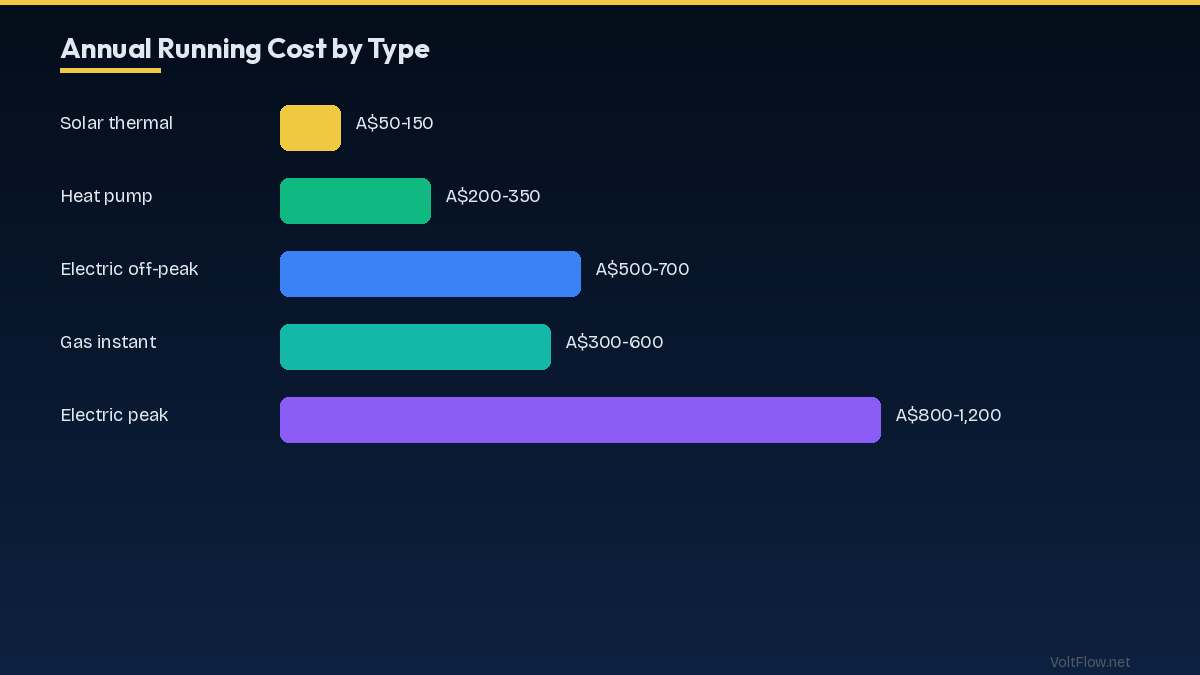
Australian homes use four main types of electric hot water systems, each with dramatically different running costs. Understanding the differences helps you choose the most cost-effective option for your household. Electric element storage tanks are the most common and most expensive to run. A standard 250-litre tank with a 3.6 kW element heats water to 60-65 degrees Celsius, consuming approximately 8-12 kWh per day for a family of four. At the national average rate of 30c per kWh, annual cost is A$876-$1,314. On a controlled load tariff at 15-18c per kWh, annual cost drops to A$438-$788, a significant saving that makes controlled load the minimum recommendation for any electric element system. Heat pump hot water systems use a refrigeration cycle to extract heat from ambient air and transfer it to the water, achieving a Coefficient of Performance of 2.5-3.5. This means they produce 2.5-3.5 kWh of hot water heat for every 1 kWh of electricity consumed. A heat pump system for the same family of four consumes only 3-5 kWh per day, costing A$329-$548 per year at 30c per kWh. The A$500-$900 annual saving over an electric element on standard tariff makes heat pumps the clear winner for electric water heating. Instantaneous electric hot water units heat water on demand without a storage tank. They draw 18-27 kW of power during use, requiring dedicated high-amperage circuits. While they eliminate standby heat losses, their high instantaneous draw means each shower costs A$0.80-$1.50 in electricity. Annual cost depends entirely on usage volume but typically ranges from A$600-$1,000 for a family of four, cheaper than a poorly insulated tank but more expensive than a heat pump. Solar hot water systems with electric boost use rooftop solar thermal panels to heat water directly, with an electric element providing backup on cloudy days and during periods of high demand. Annual electricity cost for the boost element is typically A$150-$400 depending on climate and system sizing. The solar thermal panels provide 60-80% of the hot water energy for free from sunlight, making these systems the cheapest to run after heat pump systems.
Heat Pump Hot Water: The Best Upgrade
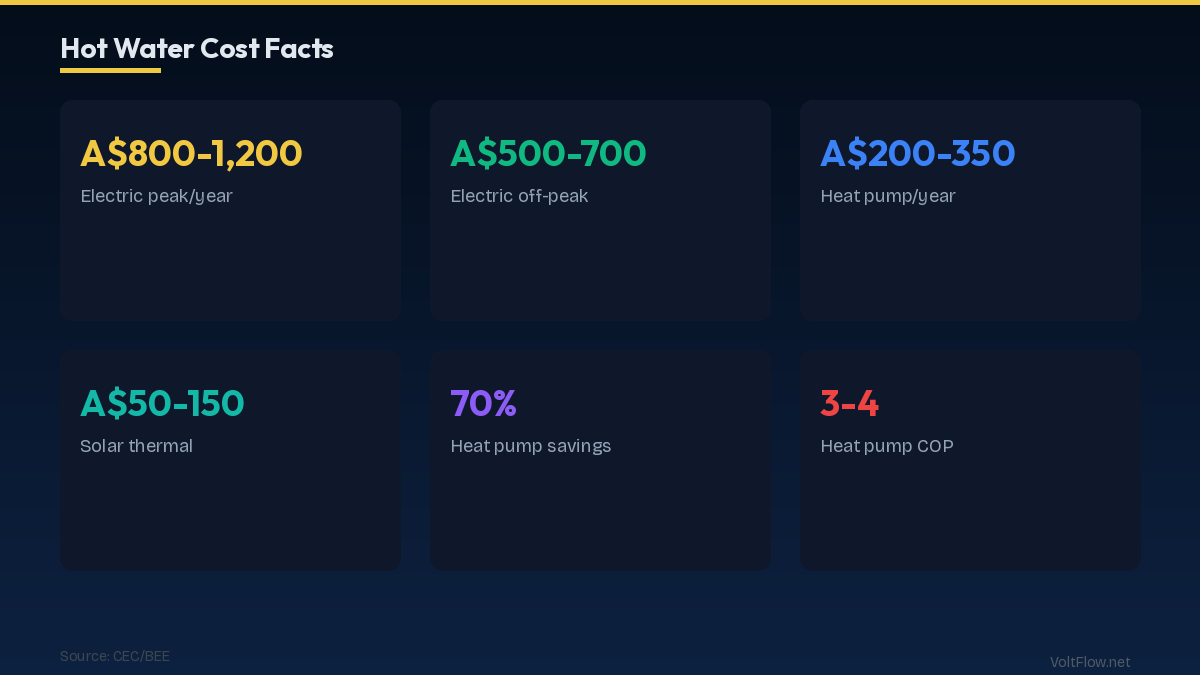
Heat pump hot water systems have become the recommended upgrade path for Australian homes replacing aging electric element tanks. The combination of excellent energy efficiency, government rebates, and falling prices makes heat pumps the most cost-effective water heating solution in 2026. How heat pump hot water works: the system uses a small compressor and refrigerant cycle to extract heat energy from the surrounding air and transfer it to the water in the storage tank. Even when outdoor air temperature is 10 degrees Celsius, there is sufficient heat energy in the air for the heat pump to operate effectively. The process is identical to how a reverse-cycle air conditioner works, but instead of heating room air, it heats water. Popular Australian heat pump hot water systems include the Reclaim Energy CO2 heat pump at A$3,500-$4,500 installed, which uses natural CO2 refrigerant and achieves COP of 4.0-5.0 in mild climates. The Sanden Eco at A$4,000-$5,000 is a premium Japanese-designed split system with the compressor unit separate from the tank, offering quiet operation and excellent cold-weather performance. The Rheem AmbiHeat at A$2,500-$3,500 is a popular mid-range option with integrated tank and compressor. The iStore at A$2,800-$3,800 offers smart connectivity and solar integration. The Chromagen Midea at A$2,000-$3,000 is the budget option with solid performance. Government rebates significantly reduce the upfront cost. The federal Small-scale Technology Certificate scheme provides A$600-$1,000 in STC value for heat pump hot water systems, applied as an upfront discount by the installer. Victoria Solar Homes programme adds up to A$1,000 for hot water heat pump upgrades. NSW Energy Savings Scheme provides A$600-$1,200 in certificates. Some state programmes stack, reducing the out-of-pocket cost to A$1,000-$2,500 for a fully installed heat pump system. At annual savings of A$500-$900 over an electric element tank, the rebate-adjusted payback period is just 1-4 years. The heat pump then provides A$500-$900 in annual savings for its remaining 10-15 year lifespan, delivering total lifetime savings of A$5,000-$12,000.
Controlled Load vs Standard Tariff for Hot Water
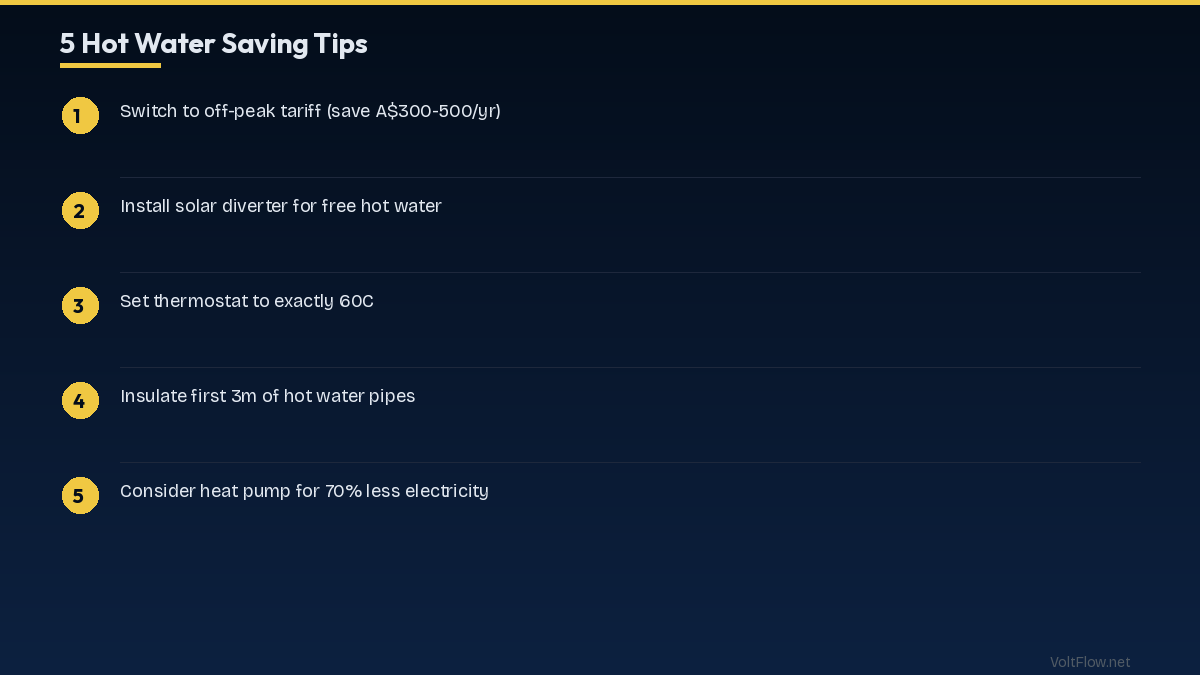
If upgrading to a heat pump is not immediately practical, moving your existing electric element tank to a controlled load tariff is the single most impactful change you can make to reduce hot water costs. A controlled load circuit operates during off-peak hours at 12-18c per kWh versus the standard tariff of 28-38c per kWh. For a tank consuming 10 kWh per day, the annual saving is 10 times (30c minus 15c) times 365 equals A$548 per year. Installation of a controlled load circuit by your electrician costs A$200-$500 and pays for itself within 4-11 months. The controlled load timer ensures the tank heats overnight when rates are cheapest, and the stored hot water maintains temperature through the day in a well-insulated tank. Modern electric storage tanks with 50mm foam insulation lose only 1-2 degrees per hour, so water heated to 60 degrees at 6 AM is still 45-50 degrees at 6 PM, adequate for hand washing and kitchen use. Evening showers may draw the temperature down, but the overnight heating cycle restores it by morning. If your tank is uninsulated or has damaged insulation, adding a tank blanket at A$50-$80 reduces standby heat loss by 30-50% and improves the performance of controlled load operation by maintaining temperature longer. Combine the tank blanket with pipe insulation on the first 2-3 metres of hot water pipes for an additional A$20-$40 in materials and A$50-$100 in annual savings. For homes with solar panels, an alternative to controlled load is using a solar diverter like the Catchpower or myenergi Eddi to direct surplus solar electricity to the hot water element during the day. The diverter costs A$500-$800 installed and effectively heats water for free from solar surplus that would otherwise be exported at the low feed-in tariff rate. This approach is most effective in summer when solar surplus is abundant and least effective in winter when heating demand is highest but solar surplus is lowest. A combination strategy uses solar diverter during sunny days and controlled load overnight as backup during cloudy periods, achieving near-minimum hot water electricity costs year-round.
Tank Size and Usage Impact on Running Costs
Your hot water tank size and household usage pattern directly affect running costs. An oversized tank wastes energy maintaining water temperature that nobody uses, while an undersized tank runs out during peak demand causing discomfort and potentially requiring expensive peak-rate reheating. A single person or couple typically needs a 125-160 litre tank consuming 4-6 kWh per day at A$438-$657 per year on standard tariff. The smaller tank heats faster and loses less heat due to lower surface area, making it the most efficient option per litre of hot water produced. A family of three to four needs a 250-315 litre tank consuming 8-12 kWh per day at A$876-$1,314 per year. This is the most common tank size in Australian homes and represents the typical cost benchmark. A large family of five or more needs a 315-400 litre tank consuming 12-16 kWh per day at A$1,314-$1,752 per year. At this consumption level, the savings from upgrading to a heat pump are most dramatic, reaching A$800-$1,200 per year. Water usage habits significantly affect costs beyond tank size. A 10-minute shower uses approximately 80-100 litres of mixed hot and cold water, drawing about 40-50 litres from the hot water tank. Reducing shower time from 10 to 5 minutes halves the hot water consumption per shower, saving approximately A$200-$400 per year for a family of four. A shower timer at A$10-$20 is one of the cheapest energy-saving devices available. Front-loading washing machines use 50-70% less hot water than top-loaders for the same wash load. Switching from hot to cold water washing saves A$50-$100 per year in water heating costs with no measurable difference in cleaning performance for most fabrics. Modern cold-water detergents are formulated to work effectively at any temperature. Dishwashers with internal heating elements heat water to 55-65 degrees regardless of the supply temperature, so reducing your tank thermostat from 70 to 60 degrees does not affect dishwasher performance but saves approximately A$80-$150 per year in reduced tank heating and standby losses.
Solar Hot Water vs Heat Pump: Which Is Better?
Both solar thermal and heat pump hot water systems dramatically reduce running costs compared to electric element tanks. Choosing between them depends on your roof space, climate, existing solar PV installation, and budget. Solar thermal hot water systems use rooftop collector panels to heat water directly using the sun infrared radiation. A flat-plate or evacuated tube collector heats a fluid that transfers heat to the storage tank. In sunny climates like Queensland, Northern NSW, and WA, solar thermal provides 80-90% of annual hot water needs. In cooler climates like Victoria, Tasmania, and ACT, solar thermal covers 50-70% with the electric boost element handling the remainder. Annual running cost of A$100-$400 makes solar thermal the cheapest to run. Installation cost of A$3,500-$6,000 is higher than heat pump systems, and the rooftop collectors require structural mounting on a suitable north-facing roof section. Heat pump hot water systems do not need roof space because the compressor unit sits on the ground next to the tank, similar to an air conditioning outdoor unit. They work in any climate including southern states with cold winters, though COP reduces from 3.5 in warm weather to 2.0-2.5 in cold weather. Annual running cost of A$200-$500 is slightly higher than solar thermal but significantly lower than electric element. Installation cost of A$2,500-$4,500 is lower than solar thermal, and government rebates of A$1,000-$2,000 reduce the net cost further. For homes that already have or plan to install solar PV panels, a heat pump is generally the better choice because the solar PV panels generate electricity that powers the heat pump with the same net effect as solar thermal, free hot water from the sun, but with more flexibility. The PV electricity can power any load, not just hot water, providing broader value across the household. Solar thermal panels only heat water and cannot be repurposed. For homes without solar PV and with good north-facing roof space, solar thermal remains competitive, particularly in sunny climates where it provides 80-90% of hot water needs and the boost element runs rarely. In cooler climates, the heat pump with its consistent COP-driven efficiency year-round often provides better overall value than solar thermal with its seasonal variation.
When to Replace Your Hot Water System
Hot water systems have a finite lifespan and recognising the signs of impending failure allows you to plan a replacement proactively rather than dealing with an emergency cold-water situation on a Sunday evening. Electric element storage tanks typically last 8-15 years depending on water quality and anode condition. Hard water areas with high mineral content accelerate tank corrosion. The sacrificial anode rod inside the tank protects the tank wall from corrosion but needs replacement every 3-5 years at a cost of A$100-$200. Neglecting anode replacement shortens tank life significantly. Signs your tank is failing include rusty or discoloured hot water indicating internal corrosion, water pooling around the base of the tank from slow leaks, rumbling or banging noises from sediment buildup on the element, inconsistent temperature with hot water running out faster than usual, and the pressure relief valve discharging frequently. If your tank is over 10 years old and showing any of these symptoms, plan for replacement within 6-12 months. A planned replacement allows you to research options, obtain multiple quotes, and access government rebates that may not be available for emergency replacements. When replacing, seriously consider upgrading to a heat pump system rather than a like-for-like electric element replacement. The upfront cost difference of A$1,000-$2,000 after rebates is recovered within 1-3 years from running cost savings. Over the 10-15 year lifespan of the new system, the heat pump saves A$5,000-$12,000 compared to a new electric element tank. If budget prevents a heat pump upgrade, at minimum ensure the replacement tank is on a controlled load tariff, is properly insulated with a minimum R-value of 22.5 (the current MEPS requirement), and has the thermostat set to 60 degrees (the minimum for legionella prevention, not higher). These measures minimise the running cost of a new electric element tank while you plan for an eventual heat pump upgrade in the future.